eBook - ePub
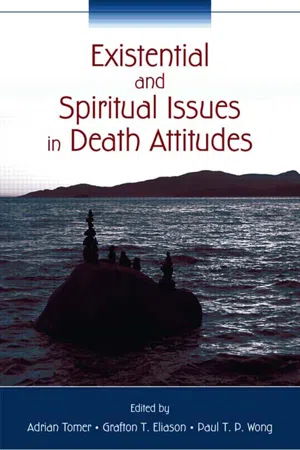
Existential and Spiritual Issues in Death Attitudes
- 496 pages
- English
- ePUB (mobile friendly)
- Available on iOS & Android
eBook - ePub
Existential and Spiritual Issues in Death Attitudes
About this book
Existential and Spiritual Issues in Death Attitudes provides: an in-depth examination of death attitudes, existentialism, and spirituality and their relationships; a review of the major theoretical models; clinical applications of these models to issues such as infertility, bereavement, anxiety, and suicide; and an introduction to meaning managemen
Information
I
Theoretical and Methodological Positions
1

Existentialism and Death Attitudes
Let each one examine his thoughts, and he will find them all occupied with the past and the future. We scarcely ever think of the present; and if we think of it, it is only to take light from it to arrange the future. The present is never our end. The past and the present are our means; the future alone is our end. So we never live, but we hope to live; and, as we are always preparing to be happy, it is inevitable we should never be so.—Pascal (1670/1978), pp. 64–65
Let us imagine a number of men in chains, and all condemned to death, where some are killed each day in the sight of others, and those who remain see their own fate in that of their fellows, and wait their turn, looking at each other sorrowfully and without hope. It is an image of the condition of men.—Pascal (1670/1978), p. 76
Between us and heaven or hell there is only life, which is the frailest thing in the world.—Pascal (1670/1978) p. 78
INTRODUCTION: EXISTENTIALISM AND DEATH
The connection between existentialism and “the problem of death” seems natural. Jacques Choron (1963), for example, in his Death and Western Thought (p. 222), mentions that one of the roots of existential thinking is the “philosophy of life.” Reflection on life is impossible without reflection on the end of life. In existentialism, reflection on life frequently takes the form of reflection on human existence, in particular on human existence as limited and contingent, ungrounded, thrown in the world without justification. The interest in death is double-fold. Death illuminates the concrete existence of the individual, helps us understand what is limited, unique, problematic, or precious in this existence. On the other hand, our concepts of the nature of the individual, of concrete life, can illuminate the event of dying. Thus, meditations on life and death complement one another and may point both to strengths and to weaknesses in one another. In addition to being connected to an examination of human life and its meaning, or lack of meaning, philosophical reflection on death has engaged in an examination of Being, and the meaning of it. The concept of nothingness, as an important element of what “man” is, is central in the philosophical thinking that, starting with Hegel and Heidegger, and through the considerable impact of Kojeve, influenced a whole generation (including Sartre) in France (see Safranski, 1998, for a vivid description of this influence). In Heidegger’s Being and Time (1927/1996), the presence of things and the presence of the individual to oneself are made possible by this nothingness. Death, in this sense, is always present at the core of human existence, is what makes this existence the clearing in which things appear (but see also Zimmerman, 1993).
We start by first examining the concept of spirituality and the connections between spirituality, meaning, and death. The concept of death in several existential philosophers is next examined in the section titled Existential Philosophers, followed by a brief discussion of several psychological or anthropological views influenced by existential thought. The goal in these sections, as throughout the whole chapter is not to be exhaustive, but rather to touch on important views and concepts. In the fourth section, we discuss connections between time, spirituality, and death attitudes. A final fifth section is dedicated to a presentation and discussion of several specific models of death attitudes that, again, were influenced by existential approaches.
SPIRITUALITY, MEANING, AND DEATH
Spirituality and Death
What is spirituality? Wong (1998) offers in his chapter on Spirituality, Meaning, and Successful Aging, an enlightening review of different meanings of the term spirituality and how spirituality relates to personal meaning. Similarly, Wilber (2000) describes five definitions or meanings of spirituality. The differences between the variety of approaches are related to the range of emphases placed on dimensions such as: asking questions versus providing answers, reliance on faith, developmental aspects, consideration of the relationship with God or the universe, and emphasis on feelings including, well-being, life satisfaction, self-transcendence, awe, wonder, or hope.
Our tentative approach here is to see spirituality as a type of attitude reflected in questions, feelings, and concerns, while not necessarily in answers, beliefs, faith, and so forth. From this perspective, the latter belongs more to religion or religiosity. The type of questions, feelings, and concerns that are at the core of spirituality are those dealing with the meaning of life, the human existence, and the meaning of Being. Frequently, philosophers and scientists express a sense of beauty and wonder generated by both the successes and the failures of modern science. There is a sense of mystery and awe, surprise that nature can be grasped by human reason, as well as a sense that ultimate questions, including our own success in understanding nature, might be incomprehensible. Such a feeling is common among great scientists and thinkers (see for, example, Margenau and Varghese, 1992, for the opinions expressed by over twenty Nobel Prize winners and distinguished scientists on issues such as the origins of the universe, life, science and religion, and the existence of God). An example of spirituality in the sense described here can be found in Norman Malcolm’s memoir about Ludwig Wittgenstein (Malcolm, 1984, p. 59). Wittgenstein, not a person of faith, described an experience typically associated with “I wonder at the existence of the world” or “How extraordinary that anything should exist.” This is, of course, a classical question that was already posed almost precisely in these terms by Leibnitz, about 300 years ago. The point here is that a pondering of these questions and the associated feelings of wonder, surprise, awe, and so on, constitutes spirituality, no matter what the answer is, indeed even in the absence of any answer. Thus, spirituality is closely connected with existential experiences that “pose the questions” or that suggest formulations such as the ones mentioned previously. Indeed, Wittgenstein would deny not only the possibility of formulating non-nonsensical answers but even the possibility of formulating non-nonsensical questions. In the Tractatus he writes: “When the answer cannot be put into words, neither can the question be put in the words” (Wittgenstein, 1921/1969, proposition 6.5, p. 149). He would also acknowledge, however, referring to the “things” that cannot be put into words: “They make themselves manifest. They are what is mystical” (6.5222, p. 151).
This approach to spirituality is consistent with Tillich’s definition of spirituality as “ultimate concerns” (1952, p. 47) and with the reference to some “peak experiences” as spiritual (see, e.g., Wilber, 2000, p. 134).These peak experiences should not be conceptualized, however, as including only “mystical states of consciousness,” either of Eastern or Western tradition (see, e.g., James, 1902/2004, lectures 16 & 17). An important contribution of the existential tradition coming from Martin Buber, Gabriel Marcel and, more recently, Emmanuel Levinas, emphasized, for example, the I–Thou relation (Buber, 1923/1970) and the “proximity of persons,” or the fact that others do not appear to me as objects (Levinas, 1987). According to this view, spirituality is expressed not only in our thoughts but is manifested daily in our numerous encounters with others.
Spirituality, Meaning, and Death
The connection of spirituality to meaning is clear. For example, to ask why there is anything is to look for a meaning behind existence, a reason. Moreover, in this broad sense, spirituality does not assume a positive experience of finding meaning. The spiritual experience may come together, in fact, with an experience of lack of meaning. For example, William James (1902/2004, p. 113) describes the loss of meaning in Tolstoy’s life that preceded his recovery and the finding of God. Similarly, both Sartre and Levinas describe the feeling of nausea at the discovery of “pure being” (Levinas, 1982, p. 90), of a world for which there is no reason to exist, that is superfluous (“de trop,” Sartre, La Nausée, 1938, p. 182) but for which it was impossible not to exist (p. 190). Such an existence is pure contingency and absolute absurdity.
If spirituality implies a quest or a question about overall meanings or, at the very least, involves feelings that imply or deny overall meanings, then one can see how death is related to spirituality. Viewed either from the perspective of the abhorrence of emptiness, or from the perspective of an insatiable “hunger for immortality” (de Unamuno, 1913/1954, p. 36), the end of life is an event that puts in question our very ability to ask questions, our spirituality. The challenge of death to the meaning of life is analyzed by Baumeister (1991) in terms of his four needs for meaning: purpose (or purposiveness), value, efficacy (control), and self-worth. Death is the event that makes future (and, in fact, present as well) unavailable, thus disallowing any possibility of undertaking a project. The meaning of our past deeds is not under our control but rather is at the mercy of others and is potentially affected by a vicissitude of unforeseeable events. Moreover, those deeds, even if they include considerable achievements, will eventually be forgotten and ignored (loss of value). Meditating on our death we realize that we’ll be easily replaced. After a while, it will be like we have never lived. Baumeister’s fourth need for meaning, the meaning for self-worth, is severely compromised when the upcoming death brings for us the end of time and plunges our life into utter futility. What is important to realize is that death does not only make the satisfaction of our basic needs impossible. In a sense this might not matter because we are not around any more. But death tends to dispel our “myths of higher meaning” (Baumeister, 1991, p. 58), essentially the myth that our life, considered as a totality, has special, or deep, meaning and value, is composed of elements that fit perfectly together forming an exceedingly harmonious, everlasting whole. Our awareness of mortality helps to bring home a much humbler message, that eventually, perhaps, it will not matter if we lived or not.
This bleak portrayal of death as a meaning annihilator can be mitigated to some extent by “imposing meanings on death” (Baumeister, p. 286), for example by dying while engaging in a significant project. This is the case of the soldiers who believe that they die while defending their home. Essentially, it is only by moving beyond oneself toward a broader context that one can perhaps escape the threat to life’s meaning.
There is another way in which death and death awareness can have a positive effect on life. Indeed, nothing can make us stop our absorption in everydayness (Heidegger) and encourage us to ponder the meaning of our fleeting existence more than the anticipation of our own death. Thus, death and awareness of finitude may create a sense of urgency that act as an incentive to deepen our spirituality. Generally speaking, death is potentially (as awareness and meditation) an incentive to dedicate oneself to what matters, to ignore the trivial and to start living an authentic life. The transformative power of death was emphasized by novelists, philosophers, psychologists, and psychiatrists. Yalom (1980), for example, in his Existential Psychotherapy, documents some of the positive effects of the “close encounter with death” (p. 33). Similarly, beneficial effects following the death of a loved one were reported in the literature dealing with grief and bereavement (i.e. Schaeffer & Moos, 2001). The basis for an existential psychotherapy can be seen in the premise that death anxiety is both fundamental to human beings and hidden (Yalom, 1980; see also Spinelli, 2005, p. 154). In addition, making the individual aware of it might have salutatory effects (i.e., Yalom, 1980, p. 165).
If death, or the threat of death, has the potential of deepening spirituality, then it is also true that contact with meaning can transform the way we see ourselves and, by doing this, the way we see death. For example, according to Buber, the individual can get a glimpse of the relation with the Eternal Thou—with God, on the basis of the relation with the human Thou (see also Levinas, 1987, in Martin Buber, Gabriel Marcel and Philosophy). In this process, the relation to our own death is being transformed (see also the section on Buber discussed later). Another example is Heidegger’s view of death articulated on the basis of his view of the Dasein. This view is discussed later.
EXISTENTIAL PHILOSOPHERS
Early Existentialists: Pascal and Kierkegaard
Although existentialism, strictly speaking, belongs to the 20th century, the idea that human beings have a special type of existence goes back at least as far as Kierkegaard. Similarly, the idea that rational philosophical systems cannot “catch” the uniqueness of human existence goes back centuries, at least to Pascal. We include here a short discussion of their views on death.
Section II in Pascal’s famous Thoughts (1670/1978) is entitled “The misery of man without God.” This section is followed by “of the necessity of the wager,” in which Pascal tries to convince the skeptic of the rationality of opting to believe in the truth of Christianity and in God. The description of human condition by Pascal in these and other sections is both powerful and gloomy and his similes have become almost modern clichés. Humans are similar to prisoners, waiting in chains to be executed while in the meantime watching the executions of others. Unhappiness is the common lot of humans. Occupied to use their past as a means, unsatisfied with their present, they run toward a future and substitute the hope of living for the real thing. Unable to deal with their mortality and insignificance in face of the infinite, they try to convince themselves that they can reach real understanding in science. Moreover, humans are constantly busy in using a variety of diversions designed to prevent them from seeing the precipice into which they are headed. Pascal, anticipating Kierkegaard, talks about the lack of happiness of the “diverted” individual that flees into idle amusement, into vanity, and into busyness.
Behind all the thoughts of Pascal’s description there is a clear sense of the horror of death. If there is greatness in man, this is “in that he knows himself to be miserable” (p. 130). The only way to deal with the absolute need to achieve immortality is the Christian faith in God.
Many years later, Kierkegaard (1844/1957) had reached a conclusion that is not very different. Dread or angst is described in The Concept of Dread as a feeling of dizziness that alarms us (p. 55). Distinct from fear, which is a defined emotion, dread has nothingness as its object. Kierkegaard describes it as being “freedom’s reality as possibility for possibility” (p. 38) and the “alarming possibility of being able” (p. 40). The individual should allow himself to be educated by dread that will open him toward infinity. Kierkegaard agrees with Hegel in relating to faith as an inward certainty anticipating infinity (p. 140). This certainty is achievable through the good services of dread. Eventually, when the dread comes, the individual is ready “…he does not recoil, still less does he attempt to hold it off with clamor and noise, but he bids it welcome, he hails it solemnly, as Socrates solemnly flourished the poisoned goblet” (p. 142). The alternative to faith is despair. Despair is described by Kierkegaard in The Sickness Unto Death (1849/1954) as a condition (perhaps uncon...
Table of contents
- Front Cover
- Half Title
- Title Page
- Copyright
- Dedication
- Contents
- About the Contributors
- Foreword
- Preface
- Introduction
- PART I: THEORETICAL AND METHODOLOGICAL POSITIONS
- PART II: RESEARCH
- PART III: APPLICATIONS
- Author Index
- Subject Index
Trusted by 375,005 students
Access to over 1.5 million titles for a fair monthly price.
Study more efficiently using our study tools.
Frequently asked questions
Yes, you can cancel anytime from the Subscription tab in your account settings on the Perlego website. Your subscription will stay active until the end of your current billing period. Learn how to cancel your subscription
No, books cannot be downloaded as external files, such as PDFs, for use outside of Perlego. However, you can download books within the Perlego app for offline reading on mobile or tablet. Learn how to download books offline
Perlego offers two plans: Essential and Complete
- Essential is ideal for learners and professionals who enjoy exploring a wide range of subjects. Access the Essential Library with 800,000+ trusted titles and best-sellers across business, personal growth, and the humanities. Includes unlimited reading time and Standard Read Aloud voice.
- Complete: Perfect for advanced learners and researchers needing full, unrestricted access. Unlock 1.5M+ books across hundreds of subjects, including academic and specialized titles. The Complete Plan also includes advanced features like Premium Read Aloud and Research Assistant.
We are an online textbook subscription service, where you can get access to an entire online library for less than the price of a single book per month. With over 1.5 million books across 990+ topics, we’ve got you covered! Learn about our mission
Look out for the read-aloud symbol on your next book to see if you can listen to it. The read-aloud tool reads text aloud for you, highlighting the text as it is being read. You can pause it, speed it up and slow it down. Learn more about Read Aloud
Yes! You can use the Perlego app on both iOS and Android devices to read anytime, anywhere — even offline. Perfect for commutes or when you’re on the go.
Please note we cannot support devices running on iOS 13 and Android 7 or earlier. Learn more about using the app
Please note we cannot support devices running on iOS 13 and Android 7 or earlier. Learn more about using the app
Yes, you can access Existential and Spiritual Issues in Death Attitudes by Adrian Tomer, Grafton T. Eliason, Paul T. P. Wong, Adrian Tomer,Grafton T. Eliason,Paul T. P. Wong in PDF and/or ePUB format, as well as other popular books in Philosophy & Mind & Body in Philosophy. We have over 1.5 million books available in our catalogue for you to explore.