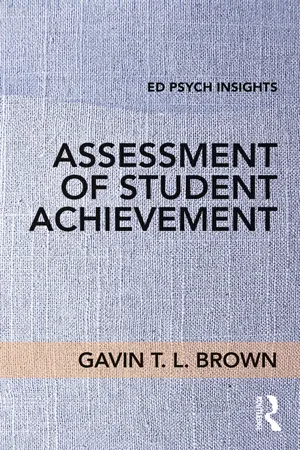
Assessment is a concept familiar across the field of education and is inherent to the work of professors, administrators, teachers, researchers, journalists, and scholars. A multifaceted and politically charged topic, assessment ranges from informal interactions with learners in classrooms to systematic high-stakes testing and examination. Written by a leading expert on assessment, this book situates the topic within the broader context of educational psychology research and theory and brings it to a wider audience. With chapters on the fundamentals of assessment, explanations of its uses, and advice for best application, this concise volume is designed for any education course that includes assessment in the curriculum. It will be indispensable for student researchers and both pre- and in-service teachers alike.
- 154 pages
- English
- ePUB (mobile friendly)
- Available on iOS & Android
eBook - ePub
Assessment of Student Achievement
About this book
Information
Index
Note: Italicized page numbers indicate a figure on the corresponding page. Page numbers in bold indicate a table on the corresponding page.
academic performance and feedback 83
accuracy of scoring 34
adaptive conceptions of assessment 9
age equivalent scores 122
American AP Studio Art evaluation 49
analytic rubric 31–3
‘approximate’ basis in scoring 103
assessment-like interactions 26
assessments: assumptions of 20–6; authentic assessment 50–6; challenges of 48–50; computer assessments of essays 37; conceptions of 2, 4, 5–10; ego-protective approach to 85; essay question assessment/test 18, 42–4; formative assessment 7, 26, 27–8, 32–3; fundamental goals of 4; introduction to 1–3; as learning 16; for learning 57; overview of 3–5; standardised tests 116, 119; student involvement in assessments 57–66; summary of 10–12; summative assessment 7–8, 26–8, 32; see also classroom assessment; evaluations; objectively scored assessments; scores/scoring assessments; self-assessment; tests/testing
assessment theory 3
authentic assessment 50–6
Authentic Assessment Toolbox 54
autonomy of students 61
‘best’ answer 95
biased scoring 26
binary-choice questions 99, 99–102, 100, 101
chance-adjusted correlation 34
check-marking 40
child-centred concerns 84
class-generated criteria 64–5
classical test theory 113
classroom assessment: authentic assessment 50–6; error in human judgements 36–41; essays and 42–4; exemplar and 35–6; introduction to 9, 12, 29; portfolio assessment 44–50; rubrics and 29–35; small-scale marking in classrooms 39
cognitive skills and teaching 90
complex processing 15
computer assessments of essays 37
computer-based testing 101
conceptions: adaptive conceptions of assessment 9; of assessments 2, 4, 5–10
Confucian approaches to learning 7
consistency of scoring 34
constructed response item formats 102–6
content knowledge of teachers 16
correlation: of agreement 43; chance-adjusted correlation 34; degrees of 113; inter-item correlations 114; inter-rater correlations 35; between markers 34; self-evaluations vs. test score ratings 60; split-half inter-item correlations 114
correlations: total score correlations 114
criterion referenced int...
Table of contents
- Cover
- Title
- Copyright
- Contents
- One: Purposes and Functions of Assessment
- Two: Embedding Assessment Within Curriculum, Teaching, and Learning
- Three: Classroom Assessment—Teacher Judgement
- Four: Involving Students in Assessment
- Five: Feedback, Grading, and Reporting
- Six: Objectively Scored Assessments
- Seven: Scores and Statistics
- Glossary
- References
- Index
Trusted by 375,005 students
Access to over 1.5 million titles for a fair monthly price.
Study more efficiently using our study tools.
Frequently asked questions
Yes, you can cancel anytime from the Subscription tab in your account settings on the Perlego website. Your subscription will stay active until the end of your current billing period. Learn how to cancel your subscription
No, books cannot be downloaded as external files, such as PDFs, for use outside of Perlego. However, you can download books within the Perlego app for offline reading on mobile or tablet. Learn how to download books offline
Perlego offers two plans: Essential and Complete
- Essential is ideal for learners and professionals who enjoy exploring a wide range of subjects. Access the Essential Library with 800,000+ trusted titles and best-sellers across business, personal growth, and the humanities. Includes unlimited reading time and Standard Read Aloud voice.
- Complete: Perfect for advanced learners and researchers needing full, unrestricted access. Unlock 1.5M+ books across hundreds of subjects, including academic and specialized titles. The Complete Plan also includes advanced features like Premium Read Aloud and Research Assistant.
We are an online textbook subscription service, where you can get access to an entire online library for less than the price of a single book per month. With over 1.5 million books across 990+ topics, we’ve got you covered! Learn about our mission
Look out for the read-aloud symbol on your next book to see if you can listen to it. The read-aloud tool reads text aloud for you, highlighting the text as it is being read. You can pause it, speed it up and slow it down. Learn more about Read Aloud
Yes! You can use the Perlego app on both iOS and Android devices to read anytime, anywhere — even offline. Perfect for commutes or when you’re on the go.
Please note we cannot support devices running on iOS 13 and Android 7 or earlier. Learn more about using the app
Please note we cannot support devices running on iOS 13 and Android 7 or earlier. Learn more about using the app
Yes, you can access Assessment of Student Achievement by Gavin T. L. Brown in PDF and/or ePUB format, as well as other popular books in Education & Education General. We have over 1.5 million books available in our catalogue for you to explore.