Spelling Rules, Riddles and Remedies
eBook - ePub

Spelling Rules, Riddles and Remedies

Advice and Activities to Enhance Spelling Achievement for All

  1. 174 pages
  2. English
  3. ePUB (mobile friendly)
  4. Available on iOS & Android
eBook - ePub

Spelling Rules, Riddles and Remedies

Advice and Activities to Enhance Spelling Achievement for All

About this book

Spelling Rules, Riddles and Remedies is for anyone supporting learners who are struggling to understand the world of English spellings.

This book engages learners and enhances their learning by using practical and dynamic resources to reveal the cause and effect of spelling confusions. By posing opportunities for understanding memory-related applications, learners and their spelling tutors are empowered with the knowledge and resources required to amend, improve and proliferate spelling success.

In this revised edition, bestselling author Sally Raymond offers further unique and accessible 'Spelling Detective' and 'Learning Application' activities and explores ways of empowering individual learners. Offering a wealth of effective approaches to improving spelling, chapters:

  • demonstrate how spelling errors can be examined to develop solutions for individual learners;
  • show how to engage pupils through use of meta-cognition;
  • highlight the reasons why spelling abilities might fail;
  • explore and resolve the impact of English spelling irregularities and deviations through informed discovery;
  • illustrate how to use mnemonics and story-lines to link tangible prompts to confident spelling ability;
  • provide structured game-play and challenging practice lessons.
  • boost pupils' achievement through the strategic use of multiple processing skills.

Clearly presented and highly illustrated, this book encourages creativity and shows teachers how to adopt and adapt a variety of learning strategies to suit different needs. Targeting learners in Key Stage 2 upwards, Spelling Rules, Riddles and Remedies brings a wealth of ideas to stimulate spelling success.

Frequently asked questions

Yes, you can cancel anytime from the Subscription tab in your account settings on the Perlego website. Your subscription will stay active until the end of your current billing period. Learn how to cancel your subscription.
No, books cannot be downloaded as external files, such as PDFs, for use outside of Perlego. However, you can download books within the Perlego app for offline reading on mobile or tablet. Learn more here.
Perlego offers two plans: Essential and Complete
  • Essential is ideal for learners and professionals who enjoy exploring a wide range of subjects. Access the Essential Library with 800,000+ trusted titles and best-sellers across business, personal growth, and the humanities. Includes unlimited reading time and Standard Read Aloud voice.
  • Complete: Perfect for advanced learners and researchers needing full, unrestricted access. Unlock 1.4M+ books across hundreds of subjects, including academic and specialized titles. The Complete Plan also includes advanced features like Premium Read Aloud and Research Assistant.
Both plans are available with monthly, semester, or annual billing cycles.
We are an online textbook subscription service, where you can get access to an entire online library for less than the price of a single book per month. With over 1 million books across 1000+ topics, we’ve got you covered! Learn more here.
Look out for the read-aloud symbol on your next book to see if you can listen to it. The read-aloud tool reads text aloud for you, highlighting the text as it is being read. You can pause it, speed it up and slow it down. Learn more here.
Yes! You can use the Perlego app on both iOS or Android devices to read anytime, anywhere — even offline. Perfect for commutes or when you’re on the go.
Please note we cannot support devices running on iOS 13 and Android 7 or earlier. Learn more about using the app.
Yes, you can access Spelling Rules, Riddles and Remedies by Sally Raymond in PDF and/or ePUB format, as well as other popular books in Education & Early Childhood Education. We have over one million books available in our catalogue for you to explore.

Information

Publisher
Routledge
Year
2018
eBook ISBN
9780429780622

Chapter One:
Varied and Innovative Learning Opportunities

For spellers who have established errors (such as ‘sed’ in place of ‘said’), a strong memory trigger is needed to overcome their inaccurate habits.

Creating a spelling prompt for ‘SAID’

snow and ice day
This spelling prompt is not effective because it is too bland.It does not relate to the word ‘said’ so it is unlikely to be triggered when the word ‘said’ is needed in mainstream writing.
Sally Anne is dancing
This spelling prompt is more interesting, particularly if the learner likes dancing.HOWEVER, it lacks drama, and also lacks any relation to the meaning of the word ‘said’ reducing its ability to be triggered when using the word in mainstream writing.
Sally Anne is dead, said the vet.
Turn to page 31 to see how to practise this spelling prompt
This spelling prompt attracts attention due to the drama of something being dead (toned down by the report being made by a vet).The two capital letters (S and A) have the potential to impact on the spelling, of ‘said’, but don’t appear to do so. The learner is involved with their learning and aware that the prompt is there to help trigger their spelling memory. The engagement of their thinking skills probably accounts for the brain’s ability to use lower-case letters when writing ‘said’.
Learners should draw their own picture to increase the strength of neurological pathways to and from long-term memory.

Creating a spelling prompt for ‘THEIR’

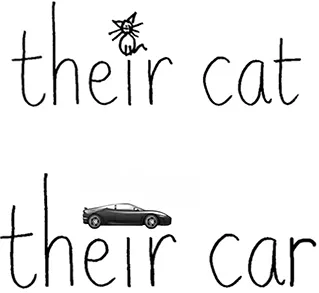
Their hamster eats iced rings
This spelling prompt contains the key word, helping to trigger its recall at the point of writing ‘their’ in mainstream text.It also uses the word in a sentence that helps identify the use of ‘their’ (rather than ‘there’ or ‘they’re’), reducing confusion between these homophones.
HOWEVER, it is relying on a lengthy mnemonic where every letter of the spelling is contained in the phrase. For some, this may be necessary, but for many, all they need is a reminder of which ‘their/there/they’re’ to use when referring to ownership.
This spelling prompt achieves the same effect as the one above, but in a more concise fashion.It also demonstrates how helpful it can be to (a) avoid the necessity to create mnemonics for every spelling, and (b) identify where the spelling mistake is commonly made, and focus the memory prompt just at that point.
Learners should copy this prompt to add visual and muscular activities to their memory pathways, adapting it to suit their individual interests. (For example, choosing a drawing that depicts ‘their bike’, or ‘their dog’ instead.)
Identifying the spelling of ‘there’ by asking “Is it here, there or everywhere?” helps provide a memory prompt for other spellings too.
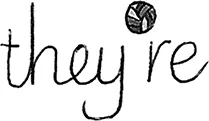
They are playing volley ball, and they’re losing!
Often, learners do not realise that ‘they’re’ is a contraction of ‘they are’ as the latter is not used in speech as often as it used to be. Shifting the focus of spelling to meaning (rather than sound) can be very helpful to a novice speller, especially when faced with multiple spelling choices.
Turn to page 31 to see how to practise these spelling prompts

Creating a spelling prompt for ‘WHAT’

What help are toes?
This spelling prompt contains the key word, helping to trigger its recall at the point of writing ‘what’ in mainstream text.
HOWEVER, it is an example of how the challenge of creating a mnemonic out of the letters available has resulted in a prompt that lacks interest and is easy to forget.
What an amazing hat!
For this prompt, FIRST ask the learner(s) to draw a hat of their own invention which you will be able to look at and say “What an amazing hat!”
Once this is done, write the word ‘what’ and ask them what the connection is between the picture they have drawn, your expression of “What an amazing hat!” and the spelling of the word ‘what’.
This spelling prompt is created by guiding the learner through a process which reveals purpose and discovery. For the learner to identify for themselves the appearance of ‘hat’ within the word ‘what’ is far more effective than for them to be told this by someone else.
When the hen …
Having introduced ‘what’, then encourage the learner(s) to decide how to apply the same idea to the spelling of ‘when’.
Remember that the prompt must link to the meaning of the word so you would expect their memory prompt to begin:
Whe...

Table of contents

  1. Cover
  2. Half Title
  3. Title Page
  4. Copyright Page
  5. Dedication
  6. Table of Contents
  7. Introduction: The Impact of Spelling Difficulties
  8. 1. Varied and Innovative Learning Opportunities
  9. 2. The Storage and Recall of Spelling Memories
  10. 3. Exploring the Rules of English Spelling
  11. 4. Promoting Creativity and Ownership
  12. 5. A Brief History of English Spellings
  13. 6. Spelling Riddles
  14. 7. Structure and Monitor Opportunities for Learning
  15. 8. Empowering Individual Learners
  16. 9. Answers to Literacy Challenges
  17. Index of Words and Spelling Patterns
  18. Index of Spelling Activities and Games
  19. Index of Topics