- 584 pages
- English
- ePUB (mobile friendly)
- Available on iOS & Android
eBook - ePub
About this book
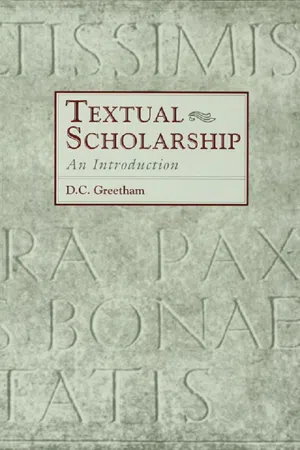
First published in 1994. This fully revised and updated edition of the bestselling Textual Scholarship covers all aspects of textual theory and scholarly editing for students and scholars. As the definitive introduction to the skills of textual scholarship, the new edition addresses the revolutionary shift from print to digital textuality and subsequent dramatic changes in the emphasis and direction of textual enquiry.
Information
1
Finding the Text:
Enumerative and Systematic Bibliography
Enumerative and Systematic Bibliography
As noted in the introduction, the term “bibliography” has become a rather slippery one of late, and its scope is by no means yet fixed. But most bibliographers agree that its central meaning must involve a study of the physical form of books, both manuscript and printed. Some bibliographers, particularly those practicing the “hard” bibliographies (analytical or descriptive, and so called because they deal with the material aspects of books, not necessarily because their technical vocabulary is inscrutable), would regard textual criticism and textual editing as merely an offshoot of bibliography so conceived. Others would exclude the study of mere enumerative bibliography from bibliography proper, since it seems to lack sufficient technical rigor. However, since there are several points (particularly in the study of early printed texts and manuscripts) at which the listing, the description, and the analysis of books have overlapped, and when a technical training in the enumerative bibliographer is not only desirable but necessary, it seems unwise to ignore enumerative bibliography entirely. Therefore, although this book will not in general be concerned with enumerative bibliography as a special field or with the work of such modern enumerative bibliographers as Theodore Besterman (even though his Early Printed Books: A Bibliography of Bibliographies does deal with the central subject matter of this chapter), this section of the coverage of textual scholarship will touch on enumeration as it relates to the history of the book as artifact or as tool for textual criticism and editing broadly construed. By the currently common extension of the term “enumerative bibliography,” the raw materials for enumerative bibliographies of the book and manuscript will include publishers’ catalogues, sales catalogues, the accession lists of certain libraries, and private book collections, but enumerative bibliography will not usually involve library science or cataloguing, except where the history of such disciplines bears on the growth of “bibliography” in the more technical sense.
Scholarly Libraries
The first Western library which was important to the growth of enumerative bibliography as a discipline was that founded by the Ptolemies in the fourth century B.C. at Alexandria, and the first bibliographer of note was Callimachus of Cyrene (ca. 310–240 B.C.), who may have succeeded Zenodotus of Ephesus in the position of chief librarian. As bibliographer, Callimachus compiled 120 volumes of a catalogue describing the contents of the library in eight divisions: drama; epic and lyric; law; philosophy; history; oratory; rhetoric; and “miscellaneous.” His methods of cataloguing were, however, inconsistent. Drama was ordered by date, Pindar and Demosthenes by the subjects of their works, Theophrastus and the “miscellaneous” entries alphabetically. Each book was quoted by its incipit (or opening words), by author, and by title. The importance of this pioneer work is not only that it tells us a good deal about the contents of the most famous library of the ancient world (even though the actual catalogue is lost and its contents survive only in later references), but also that it shows an early attempt—in fact, several attempts—to arrive at the “system” which must underlie all enumerative bibliography.
A later head librarian at Alexandria, Aristophanes of Byzantium (ca. 257–180 B.C.), began the fixing of the canon of Greek writers. This “selective” bibliography was to be extremely influential, for—along with the similar efforts of other Alexandrian and Byzantine scholars—it largely determined which authors were to be copied and passed down to the medieval scribal tradition. Many of those who did not make Aristophanes’ lists have perished. In poetry, for example, there were five recognized epic poets (Homer, Hesiod, Peisander, Panyasis, and Antimochus), five tragic poets (Æschylus, Sophocles, Euripides, Ion, and Achæus), three iambic poets, four elegiac poets, and so on. As the canon was handed down through the centuries, the number of authors selected grew smaller and smaller, until it was gradually reduced to the most “popular” Greek writers—the only ones still read, studied, and performed today.
The reason the efforts of the Alexandrian bibliographers were so significant (a significance recently recognized by plans announced by the Egyptian government to rebuild a version of the library) is that one of the major purposes of the library was to gather several manuscripts of the same work to be used as the basis for “collation” (the comparing of different copies of the same work) and textual criticism. Those authors included in the “selective” bibliographies became those studied by the textual scholars and linguists, and therefore those whose texts were preserved. But even the inclusion of the “great” authors in these bibliographies could not prevent the destruction or deterioration of their works through carelessness and time: of the 330 plays reportedly written by Æschylus, Sophocles, Euripides, and Aristophanes, only 43 survive today. Nearly all of the Alexandrians’ lyric poetry has vanished, and of the authors mentioned by the fifth-century anthologist Stobæus, 75 percent have disappeared without a trace.
The Roman libraries, both public and private, inherited the bibliographical system of Alexandria (and, to a lesser extent, that of its rival, Pergamum): there was a similar “fixing” of the canon, especially once the “classical” age of Virgil, Ovid, and Horace had driven out an interest in earlier, more “primitive” authors like Ennius. This fixing of the canon was transmitted to the medieval textual tradition during the various periods of enthusiastic copying of Roman classics, such as the Carolingian. In regard to the growth of enumerative bibliography, which depends so much upon the accumulation of works in large public depositories, Roman library stewardship was not as fruitful as Alexandrian. Unlike the Ptolemies of Egypt, each Roman emperor founded his own private library (the Ulpian by Trajan being probably the most famous), and wealthy Roman families emulated the practice. While this no doubt fostered literary culture, it did not encourage the growth of the universal “system” which enumerative bibliography requires. The situation was not dissimilar to that of Europe in the sixteenth to eighteenth centuries, where the great private collectors (Sloane, Harley, Cotton) built up very fine individual collections, which were only later to arrive at public depositories. Fortunately, the private collections of this later period were well documented (by, such bibliographers as Humfrey Wanley), but the contents of their Roman antecedents are generally undescribed.
During the medieval period, private libraries were very rare. The most famous—and no doubt very uncharacteristic—was that of Richard of Bury, Bishop of Durham, whose Philobiblon gives a detailed analysis of the fifteen hundred books in the collection. Alcuin of York listed some of the contents of the library at York in his poem in praise of the city, although the inclusion of certain authors (Aristotle, Cicero, Pliny, Virgil, Statius, and Lucan) may have been at least partly determined by metrical and cultural desiderata rather than bibliographical accuracy. Modern scholars such as Neil Ker have been able to reconstruct the contents of many important medieval libraries by tracing bequests, wills, and other evidence of present and former provenance.
In addition to York, Jarrow, and Westminster in England, the best libraries of the early medieval period were at those monasteries founded by Irish or Anglo-Saxon monks (e.g., Fulda, St. Gall, Reichenau, Bobbio). The first stimulus to book collecting, however, had occurred quite independently, in the sixth-century Benedictine foundation of Monte Cassino and the “Vivarium” of Cassiodorus. But the term “library,” with its associations of order and system, is probably misleading. It was not until the fifteenth century that special rooms began to be regularly allotted for the preservation and reading of all the institution’s books. Until then, while some religious fraternities observed more bibliographical coherence than others (the Cistercians, for example, seem to have used a small book-cupboard located between the church and the chapter-house), the books would often be distributed among several different monastic buildings, with service books in the chapel, school books in the school, books to be read during meals in the refectory. This was a perfectly practical organization, of course, but it was hardly a system. It was dictated by convenience, not by a coherent taxonomy.
It is doubtful, therefore, that even the largest of medieval monastic libraries (e.g., the two thousand volumes of Bury St. Edmunds and Canterbury, or the fourteen hundred volumes of Syon) followed any strict pattern of bibliographical arrangement. If the horrified stories of Renaissance humanist book collectors are to be believed, conditions toward the end of the Middle Ages were even worse. Boccaccio and Petrarch claim to have found the books in the monasteries they visited strewn about in haphazard fashion, piled in corners or buried under refuse, with leaves missing (stolen as love-tokens by the monks), contents incorrectly described, and generally with little evidence of any bibliography as an ordering discipline. But the humanists had a particular axe to grind, and while some monasteries in their decline were probably less careful of their textual riches than they should have been, the evidence of others, for example, the Catalogus librorum angliæ in the thirteenth century (a location list of various books) and the bibliographical guide of John Boston of Bury in the fifteenth century (prepared for the reorganization of the library of Bury St. Edmunds) shows that there was some emerging sense of a need for systematic classification and description. The late-medieval university libraries must inevitably have reflected this sense, for with the division into “faculties” (medicine, theology, etc.) and with certain universities being primarily known for the study of a particular discipline (e.g., Bologna for law), there was a built-in taxonomy by subject.
The founding of the Sorbonne library in the thirteenth century; Duke Humphrey’s library at Oxford (later refounded by Bodley in 1610 with two thousand books after the depredations of Edward VI’s commissioners had robbed it of much of its original “heretical,” i.e., Roman Catholic, contents); Charles IV’s academic library at Prague, founded in 1348; the Lambeth library of Archbishop Bancroft; Francis I’s library at Fontainebleau (organized by the distinguished scholar Guillaume Budé and later the basis for the Bibliothèque Nationale); Cardinal Borromeo’s founding of the Ambrosian library at Milan in 1609; the re-founding of the Vatican library by Pope Nicholas V after virtually nothing had survived of the medieval library of the popes at the Lateran; the Laurentian library of the Medici: all these semi-public, or at least incipiently public, institutions were augmented by the private libraries of the new humanist scholars, and in the following centuries by the collections of Arundel, Harley, Sloane, Cotton, and Rawlinson in England, and by Lenox, Arents, Folger, Carter Brown, Huntington, and Pierpont Morgan in America. Some of the public collections were to become the core of the great national libraries of a later period. Some of the private libraries were donated to, or purchased by, the public depositories (Sloane, Cotton, Arundel, and Harley to the British Library; Rawlinson to Bodley; Lenox and Arents to the New York Public Library; Spencer to the John Rylands; Lilly to Indiana). Others, while built up as the private collection of one person, and therefore reflecting a personal taste in bibliography, were to become in all other senses “public” collections (Folger’s Shakespeare library in Washington; Huntington’s library in San Marino, California; Pierpont Morgan’s library in New York).
Systematic Bibliography
But was there any bibliographic organizing principle, any system of enumerative bibliography, in all this explosion of book collecting, this accumulation of documentary riches?
Certain collections (e.g., Folger’s Shakespeare) had a built-in organizing principle of inclusion and exclusion: anything generally connected to Shakespeare or Elizabethan England was in; almost everything else was out. Others (e.g., Pierpont Morgan’s great collection of incunabula and other early printed editions), while of a more general nature, at least betrayed some central concerns, as, for example, in the concentration on English and American literature of the nineteenth and twentieth centuries in the Berg Collection of the New York Public Library. Some were extremely specialized (e.g., Arents on tobacco); others, such as the so-called cabinet collections of Grolier and H. Y. Thompson, applied an external principle (the selection of the one hundred best books in a particular field), and by judicious evaluation and rejection brought their collections into line with this principle by removing one “inferior” book each time a “superior” one was added. Even those collections with a well-defined basic interest (e.g., Cotton’s library of medieval manuscripts) could be internally organized by the most fanciful methods: the reference numbers of certain Cotton manuscripts (Cotton Vitellius A. xv for Beowulf, Nero A.x for Sir Gawain and the Green Knight, Pearl etc.) derive from the name of the Roman emperor whose bust was placed in the alcove where the manuscript happened to be situated.
It was with Gabriel Naudé’s theoretical treatise Avis pour dresser une bibliothèque (1627) that a true systematic enumerative bibliography as related to the organization of book collections got under way. Put in charge of the Mazarine library in Paris in 1642, Naudé began the subject-cataloguing of a large general collection according to principles of practical enumerative bibliography which were to be highly influential in both the cataloguing and the very raison d’être of private and public libraries alike in the next two centuries. John Evelyn translated Naudé’s treatise into English, and its principles of subject organization were put into effect in, for example, the Pepys library later in the seventeenth century, and now at Magdalene College, Cambridge. In Germany, G. W. Leibniz, after absorbing Naudé’s system in Paris, together with the new philological and paleographical research of the Maurists and Jesuits, undertook to emphasize the function of the enumerative bibliographer and library cataloguer as a facilitator of that easy and open access to research materials which is the basis for all scholarship. Refined by such later works as J. C. Brunet’s Manuel de librairie (1814), Naudé’s subject system led to its most familiar modern equivalents, the Dewey decimal system (1876), the Library of Congress (LC) classification by letter rather than number (1904), and the Universal Decimal Classification (UDC, 1899).
But while systematic library cataloguing as one aspect of enumerative bibliography may grow out of such treatises as Naudé’s, enumerative bibliography as an independent discipline—that is, concerned with more than the description of actual collections—needed a theoretical base of its own. While it is true that Dewey and Library of Congress can be (and are) used to designate the identity of a particular book before it is placed in a specific depository, and therefore can be said to have a theoretical ground as well as practical implications, as classification systems these descendants of Naudé are still primarily associated with the internal organization of actual libraries, whose librarians may decide to use one of these general systems, or may invent their own idiosyncratic methods (as, for example, in the British Library, where books are organized according to size).
Fredson Bowers (“Bibliography”) recognizes four alternative “systems” for enumerative organization: general, formal, subject, and author. The first class will rarely be truly “general” in these days of mass distribution of printed or electronic materials, for there will usually be some limitation: by time (e.g., the famous Pollard and Redgrave Short-Title Catalogue … 1475–1640, and its revision), by place (e.g., the various national bibliographies), or by language. “Formal” bibliographies will list only certain types or classes of document, for example, pamphlets, manuscripts, newspapers, dissertations; “subject” bibliographies may devote themselves to materials in literature, history, science, philosophy, or to any subdivision within each large class (in this sense, they are rather like the LC or Dewey “library” sy...
Table of contents
- Cover
- Half Title
- Title Page
- Copyright
- Dedication
- Contents
- Preface
- Acknowledgments
- Illustrations
- Introduction
- 1. Finding the Text: Enumerative and Systematic Bibliography
- 2. Making the Text: Bibliography of Manuscript Books
- 3. Making the Text: Bibliography of Printed Books
- 4. Describing the Text: Descriptive Bibliography
- 5. Reading the Text: Paleography
- 6. Reading the Text: Typography
- 7. Evaluating the Text: Textual Bibliography
- 8. Criticizing the Text: Textual Criticism
- 9. Editing the Text: Scholarly Editing
- Appendix I: Pages from the Shakespeare First Folio
- Appendix II: Some Types of Scholarly Edition
- Selected Bibliography
- Index
Trusted by 375,005 students
Access to over 1.5 million titles for a fair monthly price.
Study more efficiently using our study tools.
Frequently asked questions
Yes, you can cancel anytime from the Subscription tab in your account settings on the Perlego website. Your subscription will stay active until the end of your current billing period. Learn how to cancel your subscription
No, books cannot be downloaded as external files, such as PDFs, for use outside of Perlego. However, you can download books within the Perlego app for offline reading on mobile or tablet. Learn how to download books offline
Perlego offers two plans: Essential and Complete
- Essential is ideal for learners and professionals who enjoy exploring a wide range of subjects. Access the Essential Library with 800,000+ trusted titles and best-sellers across business, personal growth, and the humanities. Includes unlimited reading time and Standard Read Aloud voice.
- Complete: Perfect for advanced learners and researchers needing full, unrestricted access. Unlock 1.5M+ books across hundreds of subjects, including academic and specialized titles. The Complete Plan also includes advanced features like Premium Read Aloud and Research Assistant.
We are an online textbook subscription service, where you can get access to an entire online library for less than the price of a single book per month. With over 1.5 million books across 990+ topics, we’ve got you covered! Learn about our mission
Look out for the read-aloud symbol on your next book to see if you can listen to it. The read-aloud tool reads text aloud for you, highlighting the text as it is being read. You can pause it, speed it up and slow it down. Learn more about Read Aloud
Yes! You can use the Perlego app on both iOS and Android devices to read anytime, anywhere — even offline. Perfect for commutes or when you’re on the go.
Please note we cannot support devices running on iOS 13 and Android 7 or earlier. Learn more about using the app
Please note we cannot support devices running on iOS 13 and Android 7 or earlier. Learn more about using the app
Yes, you can access Textual Scholarship by David C. Greetham in PDF and/or ePUB format, as well as other popular books in Literature & Library & Information Science. We have over 1.5 million books available in our catalogue for you to explore.