Agile Sales
eBook - ePub

Agile Sales

Delivering Customer Journeys of Value and Delight

  1. 170 pages
  2. English
  3. ePUB (mobile friendly)
  4. Available on iOS & Android
eBook - ePub

Agile Sales

Delivering Customer Journeys of Value and Delight

About this book

If you ever wondered if Agile methodology can be applied to a sales environment, then this is the book for you. A step-by-step process explained from the point of view of someone who has walked the walk, not just talked the talk. A compelling read for anyone who wants to elevate their sales approach above the crowd.

–Ken Aitken

Managing Director, SmartFreight

The sales function, once believed to be exempt from the requirement to practice continuous improvement, is struggling. Now shaken by the age of e-commerce, sales teams are looking for answers. Agile Sales provides a path forward.

–Robert Hafey

Author, Lean Safety and Lean Safety Gemba Walks

The Agile philosophy has grown and achieved success initially through the technology design and development teams of some of the world's largest, most successful organizations. Recently, it has been adopted by the marketing departments of these organizations and others, and new techniques are evolving for defining, engaging, and providing customers with amazing and unique experiences.

Sales teams are becoming disrupted by technology and the differentiated experiences marketing teams are providing for their customers online using Agile techniques. Sales organizations have been looking for a way to avoid disruption and get back into the game with value. Sales teams are now beginning to adopt Agile, which is enabling these teams to revolutionize the way they engage customers with value and delightful experiences that result in greater value for the customers and themselves.

This book outlines how Agile can help sales teams develop a culture of innovation focused on their customers. This book takes the reader through the customer's buying journey (Agile technique), outlining tips and tricks that have come from Agile deployments within sales functions to help them get started.

The key benefit for the reader is the introduction of a proven philosophy and techniques that will help them avoid disruption, elevate themselves from the commodity trap, and achieve success again. This book provides the reader with insights into how to achieve sustainable change using real-life case examples. The reader will also experience enjoyment and delight from the stories told and case examples provided.
Frequently asked questions

Yes, you can cancel anytime from the Subscription tab in your account settings on the Perlego website. Your subscription will stay active until the end of your current billing period. Learn how to cancel your subscription.
No, books cannot be downloaded as external files, such as PDFs, for use outside of Perlego. However, you can download books within the Perlego app for offline reading on mobile or tablet. Learn more here.
Perlego offers two plans: Essential and Complete
  • Essential is ideal for learners and professionals who enjoy exploring a wide range of subjects. Access the Essential Library with 800,000+ trusted titles and best-sellers across business, personal growth, and the humanities. Includes unlimited reading time and Standard Read Aloud voice.
  • Complete: Perfect for advanced learners and researchers needing full, unrestricted access. Unlock 1.4M+ books across hundreds of subjects, including academic and specialized titles. The Complete Plan also includes advanced features like Premium Read Aloud and Research Assistant.
Both plans are available with monthly, semester, or annual billing cycles.
We are an online textbook subscription service, where you can get access to an entire online library for less than the price of a single book per month. With over 1 million books across 1000+ topics, we’ve got you covered! Learn more here.
Look out for the read-aloud symbol on your next book to see if you can listen to it. The read-aloud tool reads text aloud for you, highlighting the text as it is being read. You can pause it, speed it up and slow it down. Learn more here.
Yes! You can use the Perlego app on both iOS or Android devices to read anytime, anywhere — even offline. Perfect for commutes or when you’re on the go.
Please note we cannot support devices running on iOS 13 and Android 7 or earlier. Learn more about using the app.
Yes, you can access Agile Sales by Brad Jeavons in PDF and/or ePUB format, as well as other popular books in Business & Industrial Management. We have over one million books available in our catalogue for you to explore.

Information

Chapter 1

Agile Sales Concept 1: Customer Understanding

Many organizational excellence approaches such as Lean, Six Sigma, and Agile all concentrate on understanding what customers value. Agile goes one step further, as it also considers what brings customers delight. Agile recognizes that emotional experience is equally as important as the perceived value that the customer experiences when engaging with your brand. Emotional experience interacts with the limbic brain, which is directly involved in decision-making.
Agile focuses on knowing who your customers are and then putting yourself in their shoes to truly, empathically understand them. It becomes simple to learn how to deliver higher value and delight through this empathic understanding.
In this chapter, we will cover the following tools that you can use to analyze who your customers indeed are:
  1. The Pareto Principle – understanding who your top customers are
  2. The Persona Map – deeply understanding key decision-makers
  3. Contextual Interview – gaining direct insights
  4. Empathy Map – living in their shoes.
Utilizing these tools will offer you insights into how you can deliver a higher level of value and delight to your ideal customers.

The Pareto Principle

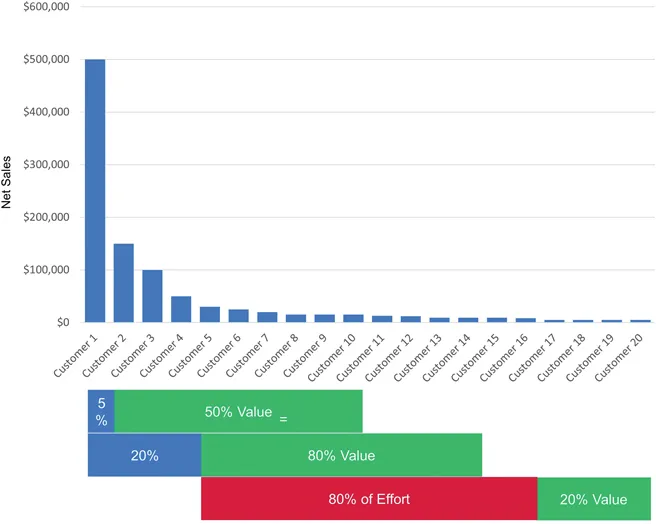
The Pareto Principle was developed by Vilfredo Pareto (Pareto, 1896) in 1896. Pareto was a sociologist and economist and developed the Pareto theory while studying land distribution in his home country, Italy. He found that most of the land in Italy was owned by a few, and this dropped rapidly down to a small amount of property owned by the masses.
Pareto developed the rapidly declining bar graph of the distribution shown in Figure 1.1.
Image
Figure 1.1 Pareto Principle and 80/20 Rule.
The Pareto Principle has been found to accurately describe many situations, such as the significant contributors to quality defects and safety incidents in a workplace, to hospital emergency department cases at a particular time of the week, to sales and profit revenue from customers, to items produced and sold by an organization.
The Pareto Principle can help an organization understand where they have been and could be most successful with the least amount of resource. It highlights why an organization and its people get distracted with the (often large) tail of smaller customers rather than focusing upon where they can be most successful. This tail can bring a great deal of noise and distraction if not effectively managed.
To conduct a Pareto analysis, simply generate a database of your sales by your customers over a recent period, say a few months or a year. Sort the database from largest to smallest, and then chart it using a bar graph, and hey presto, you have a Pareto analysis! With this data, it is crucial to analyze the top customers that you have had so much success with, and why you have had this success. The trick is to focus on your top 1%–5% of customers, which I predict will be bringing you between 30% and 50% of your sales. Get things right with these top-end customers first.
There are some great Agile tools and techniques that can help an organization gain a better understanding of customers. They can create an understanding of why customers purchase from your organization and what would keep them buying from you long into the future.

Living in Their Shoes

I have engaged with so many people throughout my career who talk about customers as if they are brands, buildings, or even mystical non-living entities! The reality is that customers are people like you and me. The problem of viewing customers as being objects rather than people creates a “one approach suits all” mentality of dealing with customers. We know that we are all different; we all want to be treated as individuals rather than one of the masses. When we are treated as an individual by someone tailoring to our needs, we experience delight and perceive high value from the interaction.
How does a business strategically plan and improve toward their customers? There are techniques for achieving this, and we will cover these throughout the rest of this book.
At a high level in Agile, we look to group people into typical personas that engage with our brand. When you analyze a group of people, you will find differences within everyone. You will also find a lot of commonalities that allow you to group and develop knowledge based on these groupings. In Agile, we call these groupings of related people who engage with our products and services “personas.”

Tools for Understanding Your Customer More Deeply

The Persona Map

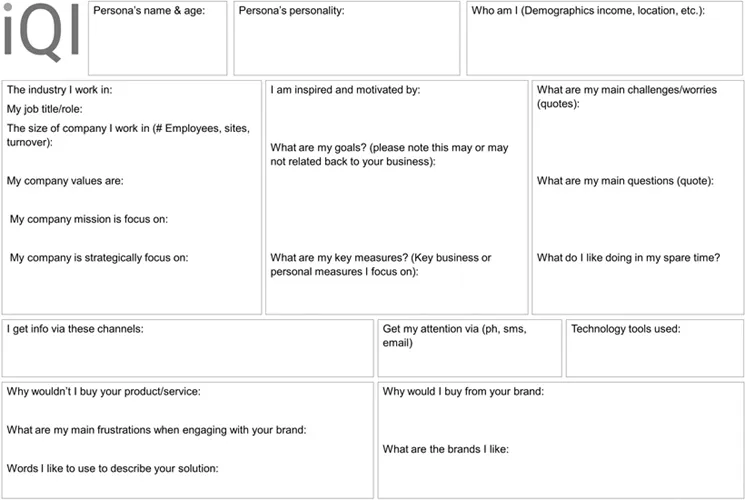
Typically, an organization will find that five to ten key customer personas engage with their brand and provide the most significant value (sales/profit) in return. The Agile tool that is used to help a team define their key personas is called a Persona Map.
In Figure 1.2, you will see some of the standard groupings of information that a team looks for to understand the different individuals they engage. Standard data captured includes age, demographics, personality, industry, company characteristics, motivations and goals, challenges and questions, communication channels and tools, as well as information about what they typically do and don’t like about your brand.
Image
Figure 1.2 Persona Map.
You can download this Persona Map for your immediate use at www.iqi.com.au.
The way to capture this data is to take the top grouping of Pareto customers from your database. Analyze the key decision-makers through existing data and input from team members within your organization. You can use social media tools and general Google searches to start to build an understanding of these decision-makers and begin to identify common traits.
Example – Driven Bob Persona Map
An excellent example of the use of the Pareto analysis technique followed by a Persona Map was conducted by a long-time colleague of mine, Boyd Rose. Boyd was brave enough in the early days of my discovery of this approach to conduct these analyses with me to discover his ideal customers.
Boyd was selling industrial equipment into Australian manufacturers and warehouses. Boyd brought together several experienced teammates (who dealt directly with customers) to review the Pareto chart information for his customers. These colleagues helped define common characteristics and groupings for both the companies and decision-makers within them. The team focused on the top 5% of Boyd’s customers, which equated for over 60% of his annual sales.
They drew on several resources to help them research and develop a profile:
  • ■ Their knowledge and experience with the companies and decision-makers;
  • ■ The company web sites for background information;
  • ■ Google searches for articles and additional data;
  • ■ Annual Reports for directional information such as purpose/mission, vision, and critical strategies and measures; and
  • ■ LinkedIn, Facebook, and general Google searches for decision-maker persona information.
Throughout this process, Boyd and his team were able to find a clear grouping of two ideal customer organizations where he has had most success:
  1. Food and beverage manufacturers with
    • – Over $500 million turnover,
    • – At least 10 production lines nationally (could be multi-site),
    • – A culture focused on innovation and continuous improvement,
    • – Strategic direction concentrated on quality and productivity gains, and
    • – A focus on production line performance.
  2. Building product manufacturers with
    • – Over $200 million turnover,
    • – At least three production lines nationally,
    • – A culture focused on innovat...

Table of contents

  1. Cover
  2. Commendation
  3. Half Title
  4. Title Page
  5. Copyright Page
  6. Dedication
  7. Table of Contents
  8. List of Figures
  9. Foreword
  10. Preface
  11. Acknowledgments
  12. About the Author
  13. Introduction
  14. 1 Agile Sales Concept 1: Customer Understanding
  15. 2 Agile Sales Concept 2: Hoshin Kanri
  16. 3 Agile Sales Concept 3: Scrum
  17. 4 Agile Sales Concept 4: Kanban
  18. 5 Agile Sales Concept 5: Sprints
  19. 6 Agile Sales Concept 6: Leader Standard Work
  20. 7 Agile Sales Concept 7: Sales Process Aligned to Your Customer’s Buying Journey
  21. 8 Discovery
  22. 9 Research
  23. 10 Purchase
  24. 11 Delivery
  25. 12 Devotion
  26. 13 Leveraging
  27. Conclusion
  28. Bibliography
  29. Index