eBook - ePub
The Piper Model
Personalised Interventions Promoting Emotional Resilience in children with Social, Emotional and Mental Health Needs
- 282 pages
- English
- ePUB (mobile friendly)
- Available on iOS & Android
eBook - ePub
The Piper Model
Personalised Interventions Promoting Emotional Resilience in children with Social, Emotional and Mental Health Needs
About this book
This book is intended to be both a practical evidence-based tool and an awareness-raising resource for teachers, teaching assistants, mentors and all adults who work with children and young people who present as 'extremely challenging' in the school context.
In every school there are a small number of pupils, less than five percent, who take up more than fifty percent of the staff's time. This book provides school staff with an approach to personalised interventions that enable those children or young people to build life-long resilience skills.
Frequently asked questions
Yes, you can cancel anytime from the Subscription tab in your account settings on the Perlego website. Your subscription will stay active until the end of your current billing period. Learn how to cancel your subscription.
No, books cannot be downloaded as external files, such as PDFs, for use outside of Perlego. However, you can download books within the Perlego app for offline reading on mobile or tablet. Learn more here.
Perlego offers two plans: Essential and Complete
- Essential is ideal for learners and professionals who enjoy exploring a wide range of subjects. Access the Essential Library with 800,000+ trusted titles and best-sellers across business, personal growth, and the humanities. Includes unlimited reading time and Standard Read Aloud voice.
- Complete: Perfect for advanced learners and researchers needing full, unrestricted access. Unlock 1.4M+ books across hundreds of subjects, including academic and specialized titles. The Complete Plan also includes advanced features like Premium Read Aloud and Research Assistant.
We are an online textbook subscription service, where you can get access to an entire online library for less than the price of a single book per month. With over 1 million books across 1000+ topics, weâve got you covered! Learn more here.
Look out for the read-aloud symbol on your next book to see if you can listen to it. The read-aloud tool reads text aloud for you, highlighting the text as it is being read. You can pause it, speed it up and slow it down. Learn more here.
Yes! You can use the Perlego app on both iOS or Android devices to read anytime, anywhere â even offline. Perfect for commutes or when youâre on the go.
Please note we cannot support devices running on iOS 13 and Android 7 or earlier. Learn more about using the app.
Yes, you can access The Piper Model by Dennis Piper in PDF and/or ePUB format, as well as other popular books in Education & Education General. We have over one million books available in our catalogue for you to explore.
Information
CHAPTER 1
PREPARING FOR THE JOURNEY
This chapter is divided into six sections. It involves looking at the backdrop to the development of this practical and evidence-based mental health resource for teacher-practitioners or adults involved in supporting children with social, emotional and mental health needs. It outlines the legislative policy shift incorporating a new special educational needs and disabilities framework for working with children and families as the central focus. It outlines the impact of the teacher on the emotional well-being of both children and themselves. It introduces us to the concept of understanding behaviour as communication and how this can be better understood through a child-centred model that reflects âwhat the child is telling usâ.
Each section is as follows:
Section 1: Introduction and overview
Section 2: The PIPER model and the assess, plan, do, review process
Section 3: The impact of the teacher
Section 4: The conversation
Section 5: The emotional well-being journey â from practice to three-step intervention
Section 6: An overview of the three-step PIPER model â an emotional well-being Intervention
- Step 1 â Risk and resilience (R&R) profiling
- Step 2 â Creating a reducing anxiety management plan (RAMP)
- Step 3 â Creating a personalised three-wave provision map (PM)
SECTION 1
1. Introduction and overview
Personalised interventions promoting emotional resilience is known as the âPIPER modelâ. The PIPER model is both a practical evidence-based tool and awareness-raising resource for teachers, SENCos, teaching assistants, mentors and all adults who work with children and young people who present as worrying and challenging in the school context.
This resource will assist school staff in making a transition in their thinking following recent policy and governmental changes. The new SEN/D code of practice (DfE, DoH, January, 2015) changed the previous special educational needs (SEN) descriptor of behaviour, emotional and social difficulties (BESD), which historically embodied the concept that âthe child needs fixingâ, to social, emotional and mental health (SEMH) needs: âwe need to look at the child holisticallyâ. This embodies the new concept of the child and the family at the centre of everything we do.
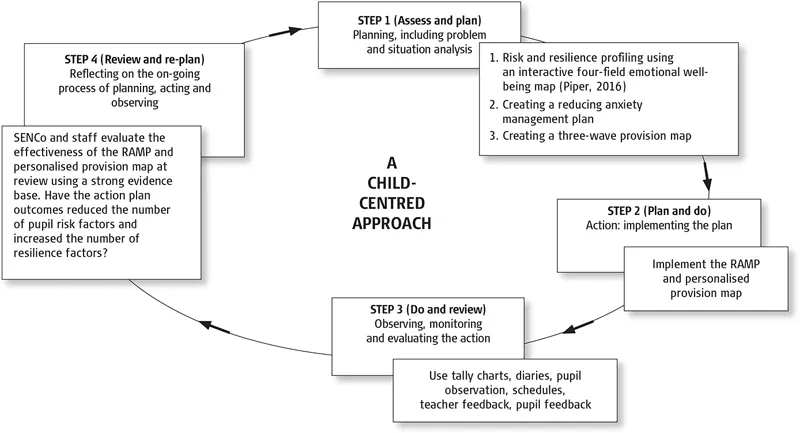
This resource provides the reader with both the rationale for the shift in government legislation and policy from BESD to SEMH and an effective and evidence-based process of putting that policy into practice. This process is illustrated on page 28. Also, this resource provides the reader with a practical, tried and tested way of working, as schools continue to struggle with children and young people whose behaviours cause them on-going concerns.
The established modus operandi that created a polarised system of dealing with behaviour under the pastoral system or the SEN system has resulted in an exclusionary mindset: the pastoral system too frequently leading to permanent exclusion and the SEN system too often placement outside the mainstream system, thus reinforcing the child or young personâs sense of rejection or non-belongingness including no incentive to change, understand or manage their behaviours and to learn how to self-soothe and self-regulate.
SECTION 2

Figure 1. The PIPER model and the assess, plan, do, review process
Planning, implementing, monitoring, reviewing and evaluating for a pupil with mental health/emotional well-being needs (Piper, 2016)
This resource will support school staff to work in an alternative and truly child-centred way in assisting the child or young person to increase their resilience factors and counteract their risk factors and in the process to be supported in learning how to self-soothe and self-regulate.
It is unique in its approach as, rather than focus on âretrainingâ the child through a pre-packaged programme of social and emotional learning (SEL), it provides the reader with a rationale for understanding what drives the individual child or young personâs behaviour. For children and young people with emotional well-being or mental health needs, due to high-risk factors and minimal resilience (or protective) factors in their lives, display correspondingly significant high levels of âanxiety-drivenâ behaviours.
SECTION 3
1. The impact of the teacher
This resource enables the reader to understand and draw on their own inner resources when challenged through a process of emotional introspection and reflection; it provides a clear, coherent and collaborative system of planned and personalised responses within interventions to support the child or young person in a communication dialogue with their teachers and support staff, which in turn provides the space for them to change their behaviour and build their levels of resilience.
Anyone in contact with a child has an impact on that childâs mental health and psychological wellbeing. The challenge for all of us is to remember that and to be able to respond if things start to go wrong.
âChildren and young people in mind: final report of the CAMHS reviewâ
(2008)
This resource will, first, assist school staff to understand behaviour as a form of communication. Second, it will provide them with the necessary tools to be truly child-centred; in other words, to constantly ask: âwhat is the child telling me that he or she needs?â and to support children in building the resilience they need not only to be a successful pupil but also to grow into an adult with robust mental health. In short,
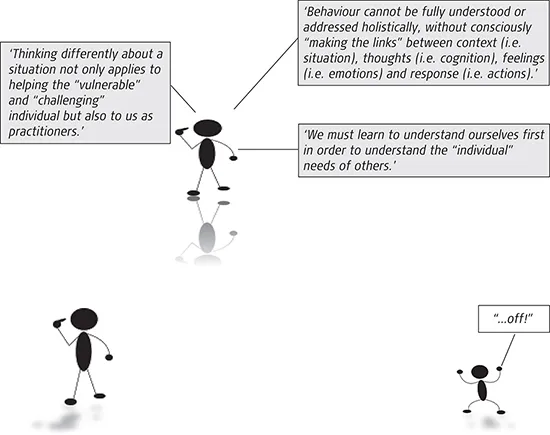
It challenges us to understand behaviour as communication and to remain curious about what is being communicated rather than leaping to conclusions.
Sarah Brennan (Young Minds)
SECTION 4
1. The conversation
So, how am I going to guide you through this emotional well-being journey? Well, in my work with teachers, we normally have a conversation irrespective of numbers; it is so much easier than being told what to do! These conversations are usually peppered with our own âtherapeuticâ, humourous, even personal manic anecdotes, not uncommon to those of us working in the world of âdifficultyâ versus âneedâ. However, they are always linked with sensitive and frequently uncomfortable behaviours that are too often the manifestations of underpinning interactive influences, regularly driving childrenâs emotions and anxieties to, in some cases, toxic levels, culminating in distress for all concerned. These are known as high risk and low resilience factors and, will have disproportionately âshapedâ all our lives to some degree from an early age, some with an indelible effect on our thinking and behaviours, both positively and negatively! But, I believe that where there is resilience there is hope and that is both the beginning and end of our journey â via a conversation on paper!

I hear what youâre saying ⌠but what are you telling me?
SECTION 5
1. The emotional well-being (EWB) journey â from practice to three-step intervention
For over 30 years as a behaviour support teacher and consultant, too often my Monday morning began in a school with a teacher âat the end of their tetherâ. The frequency of occurrence increased around the October half term and usually concerned th...
Table of contents
- Cover
- Half Title
- Title Page
- Copyright Page
- Dedication
- Table of Contents
- List of figures
- Forewords
- Preface
- Acknowledgements
- Chapter 1: Preparing for the Journey
- Chapter 2: What is behaviour? â behaviour as communication
- Chapter 3: Moving from BESD to SEMH
- Chapter 4: Factors to consider in preparation for the three-step PIPER model emotional well-being intervention
- Chapter 5: PIPER model step 1 â completing a risk and resilience profile
- Chapter 6: PIPER model step 2 â completing a reducing anxiety management plan
- Chapter 7: PIPER model step 3 â completing a personalised three-wave provision map
- Chapter 8: The PIPER model in practice: two case studies
- Chapter 9: Epilogue: Where do we go from here?
- References
- Useful addresses and contacts
- Useful websites
- Glossary of terms
- Index