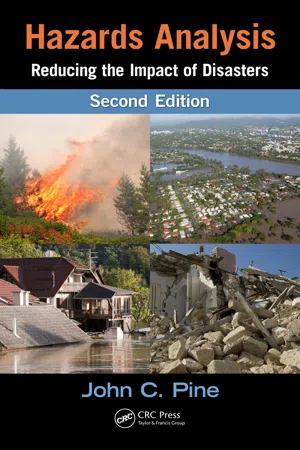
The impacts of natural and man-made disasters have increased exponentially over the past few decades. Moreover, with our global interconnectedness and the growing scale of disasters, today's catastrophic disasters can have regional, national, and even global economic consequences.Following in the tradition of the successful first edition, Hazards Analysis: Reducing the Impact of Disasters, Second Edition provides a structure and process for understanding the nature of natural and human-caused disasters. Stressing the role of hazard risk management for public, private, and nonprofit organizations, the author and expert contributors cover problem solving, risk analysis, and risk communications to ensure readers are in a position to identify key problems associated with hazards and the risks that they present.The book details a systematic process of hazards identification, vulnerability determination, and consequence assessment for the natural, built, and human environment. Using a cross-disciplinary approach, this book effectively demonstrates how to use the results of vulnerability assessment, spatial analysis, and community planning to reduce adverse disaster outcomes and foster social, economic, and environmental sustainability. Throughout, the book stresses that hazards analysis is not an isolated process but one that must engage the local community.Complete with clearly set objectives, key terms, discussion questions, satellite images and maps, and ancillary websites for further study, this authoritative guide covers every element of the hazard analysis process in a step-by-step format. Hazards Analysis presents time-proven strategies for building sustainable communities, identifying and prioritizing risks, and establishing successful disaster prevention and relief strategies prior to a disaster.
- 332 pages
- English
- PDF
- Available on iOS & Android
eBook - PDF
About this book
Table of contents
- Front Cover
- Contents
- Preface
- Acknowledgements
- Editor
- Contributors
- 1. Introduction to Hazards Analysis
- 2. Hazards Identification
- 3. Modeling Naturaland Human-Caused Hazards
- 4. Spatial Analysis
- 5. Risk Analysis: Assessing the Risks of Hazards
- 6. Social, Economic, and Ecological Vulnerability
- 7. Risk Communication
- 8. Hazards Risk Management Process
- 9. Planning for Sustainable and Disaster-Resilient Communities
- 10. Creating Disaster-Resilient Communities: A New Natural Hazards Risk Management Framework
Trusted by 375,005 students
Access to over 1.5 million titles for a fair monthly price.
Study more efficiently using our study tools.
Frequently asked questions
Yes, you can cancel anytime from the Subscription tab in your account settings on the Perlego website. Your subscription will stay active until the end of your current billing period. Learn how to cancel your subscription
No, books cannot be downloaded as external files, such as PDFs, for use outside of Perlego. However, you can download books within the Perlego app for offline reading on mobile or tablet. Learn how to download books offline
Perlego offers two plans: Essential and Complete
- Essential is ideal for learners and professionals who enjoy exploring a wide range of subjects. Access the Essential Library with 800,000+ trusted titles and best-sellers across business, personal growth, and the humanities. Includes unlimited reading time and Standard Read Aloud voice.
- Complete: Perfect for advanced learners and researchers needing full, unrestricted access. Unlock 1.5M+ books across hundreds of subjects, including academic and specialized titles. The Complete Plan also includes advanced features like Premium Read Aloud and Research Assistant.
We are an online textbook subscription service, where you can get access to an entire online library for less than the price of a single book per month. With over 1.5 million books across 990+ topics, we’ve got you covered! Learn about our mission
Look out for the read-aloud symbol on your next book to see if you can listen to it. The read-aloud tool reads text aloud for you, highlighting the text as it is being read. You can pause it, speed it up and slow it down. Learn more about Read Aloud
Yes! You can use the Perlego app on both iOS and Android devices to read anytime, anywhere — even offline. Perfect for commutes or when you’re on the go.
Please note we cannot support devices running on iOS 13 and Android 7 or earlier. Learn more about using the app
Please note we cannot support devices running on iOS 13 and Android 7 or earlier. Learn more about using the app
Yes, you can access Hazards Analysis by John C. Pine in PDF and/or ePUB format, as well as other popular books in Law & Forensic Science. We have over 1.5 million books available in our catalogue for you to explore.