- 296 pages
- English
- ePUB (mobile friendly)
- Available on iOS & Android
eBook - ePub
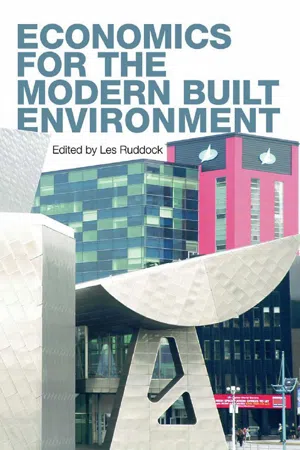
Economics for the Modern Built Environment
About this book
Recent decades have seen a major social and economic changes across the developed world and consequent changes in the construction and property industries. The discipline of construction economics needs to respond to this. For instance, the importance of sustainable development has become recognised, as has the need to increasingly master the mediu
Chapter 1
The changing nature of the built environment
An economic perspective
Introduction
The built environment is the accumulated residual history of mostly man-made environmental change. It receives additions from new construction, it is reinvested in, adapted, refurbished and maintained, or the structures are disused, dilapidated and disappear in time, despite their generally extreme durability compared to other goods in the economy. For our purposes, the dynamics of how the modern built environment relates to the economy as a whole constitutes its changing nature. In this chapter, we shall explore the links between the economy and the built environment, relying on varieties of microeconomics: spatial economics and the economics of asymmetrical information, in particular that of signalling in markets; sometimes, it is useful to draw on contributions from other disciplines, notably economic geography, for broader approaches.
Buildings and the physical infrastructure in general are durable and immobile, more so than other resources in the economy. The relative permanence of most built structures explains their role as vehicles for long-term transfer of resources, through changes in ownership or mortgaging. It is no accident that the euro banknotes carry architectural motifs, both as symbols of stability and as elements of a generally recognized cultural language. But the very durability also threatens with increasing physical misfit between inherited facilities and present patterns of consumption and production in a given location. The signals emitted by the built environment are reinterpreted over time and may accelerate decay and demolition; however, in other cases, they may lead to greater efforts for maintenance and renovation.
Simulation models for the forecasting of material flows into the buildings stock, or at least the housing stock, have been developed for Germany (Kohler and Yang, 2007), the Netherlands (Müller, 2006) and Norway (Bergsdal et al., 2007). All these models are based on observed patterns for new construction and demolition, but there are no explicit links to economic mechanisms.
An author coming from the field of cultural studies may see the spread of glass architecture as linked to the home as an interactive media centre and driven by a new culture of transparency (McQuire, 2003). However, a simple economic explanation can be sufficient as an alternative. Changes in the use of building materials can be interpreted as reactions to changes in relative prices over the years. During the 25-year period from 1982, sheet, plate and float glass fell slightly in current dollar prices in the US, while prices of cement, ready-mixed concrete and gypsum boards increased to more than twice their 1982 level, according to US Bureau of Labor statistics. It is thus not only architectural fashion and computational technologies for structural analysis (Addis, 2007) that explain why modern office buildings look the way they do.
Since most changes in the built environment give rise to effects that are external to the market, be they negative or positive, the institutional context within which any market forces operate is important. Central and local government devise legal systems for property ownership and use, such as for tenure security and titling in slum areas (UN-Habitat, 2003: p. 107 seqq.; Field, 2005; Méndez, 2006), they engage in planning (Glaeser et al., 2006; Glaeser and Tobio, 2007; Yin and Sun, 2007), issue building regulations, offer subsidies or tax incentives (Pickerill and Pickard, 2007) and sometimes they impose price or rent controls (Gilderbloom and Ye, 2007). Why many structures in US cities have been abandoned, boarded up and demolished has been explained as owner optimal behaviour under uncertainty and in the presence of the legal forfeiture mechanism (O’Flaherty, 1993).
Refurbishment and changes in use of buildings are often particularly subject to a number of institutional effects. The emergence of vacant and obsolete office space in the UK and many other countries with the recession in the early 1990s soon led to a number of conversions for residential purposes (Heath, 2001). In Toronto, the alternative for owners was often seen as demolition in order to create parking lots, whereas the tax consequences made politicians take the initiative to promote residential conversion. This has fitted in with a growing taste for central city amenities and with congestion problems in urban transport systems. For a British provincial city such as Nottingham, office refurbishment and development in the 1980s was clearly influenced by the availability of central and local government subsidies, as well as by a range of institutional factors in the regulatory process and in the traditional lease contracts (Bryson, 1997).
Rapid changes in economic systems, such as the transition to market economies in Eastern Europe and the reforms successively introduced in China, are associated with transformations of the built environment. This allows an identification of current ties between consumption, production and the built infrastructure: more decentralized choice of goods, services and means of transportation shift the distribution between building types according to purposes and also housing densities. The post-socialist city experiences with quick commercialization of city centres in Eastern Europe are typified by Leipzig: there was an initial rise in shopping malls (Kok, 2007) and enterprise zones, which was followed by residential suburbanization and then by a shift to a higher level of investments in the inner city (Nuissl and Rink, 2005). However, there are differences in trajectories; the former German Democratic Republic, which was incorporated into the Federal Republic, experienced more of a rapid suburban sprawl than Hungary and Poland did (Kotus, 2006). These highly visible effects occurred in spite of overall population decline in many cities (Hall, 2006; Turok and Mykhnenko, 2007). There have been major changes in Chinese cities in recent decades, much as in the transition economies in Eastern Europe, but on a larger scale and clearly affected by stronger economic growth (He et al., 2006).
Spatial economics and the built environment
Any urban area can be interpreted as a particular balance between positive and negative externalities of both consumption and production activities, given that there are transport costs. When analysing the dynamics of the built environment and its relations to a local economy, there are two issues in spatial economics or urban theories that come into focus: agglomeration forces in cities and sprawl. While earlier theories (Anas et al., 1998) assumed monocentric cities and were unable to predict or analyse the move towards polycentricity and phenomena like reverse commuting (people who choose to live in the centre and who work in the periphery), there are recent developments, notably the shift in theory towards a consumption perspective on city centres (Glaeser et al., 2001), which will be discussed here. Neglected questions such as the effects of durability of housing and of housing supply conditions have been approached only lately.
In Marshall’s Principles of Economics (1920), there are three types of agglomeration effects in cities: knowledge spillovers between firms, thickness of markets for specialized inputs and linkages, both backward (generating greater demand for goods) and forward (variety of goods produced). It is difficult to observe directly how knowledge spills over in the built environment and how spillover is influenced by the geometry of the environment, but location patterns for activities reveal something. Localized knowledge spillover effects as measured by agency location attenuate quickly: counts of neighbours matter strongly up to 500 m and then drop sharply, judging by a survey of advertising agencies in New York City (Henderson, 2007). This distance can be compared to the 150 feet limit (approximately 46 m) for spillovers, as measured by property prices, due to new and rehabilitation residential investment in Cleveland, Ohio (Ding et al., 2000). If the effects are so local, it should be possible to assess the effects of the physical form of the local environment.
More recently it has been argued by Duranton and Puga (2004) that there are three basic mechanisms for generating local increasing returns: sharing, matching and learning. Sharing means that small fixed costs paid by producers can be spread across larger quantities as markets grow; matching mechanisms refer to how larger markets improve the quality and probability of matching; learning is exploiting local size for creation and diffusion of knowledge. It should be possible to interpret these three mechanisms in relation to the built environment, but, as shall be seen at the end of this chapter, despite efforts to understand science parks and so-called innovation environments, little is still known about the links between physical form and innovative activities.
Amenities is a concept that is used to explain why different household income groups locate differently in cities; consumer utility depends on non-housing and housing consumption and also on the amenity level a(x) at distance x to the central business district (Brueckner et al., 1999). Households are faced with commuting cost per mile and housing price p per unit q of housing. If the marginal valuation of amenities rises sharply with income, dynamic effects can be generated. Amenities are divided into natural (such as water access), historical (both largely exogenous) and modern amenities (restaurants, swimming pools, etc.) which are endogenous depending as they do on current income level in the neighbourhood etc. Renovation of a central city’s historical amenities can link historical to modern amenities. Maintenance of historical amenities may, with time, explain why historical amenities are partly endogenous in this model. More recently, the idea of starting from the endogeneity of historical amenities has been developed in a dynamic perspective by Yonemoto (2007), again with differences between poor and rich people driving the mechanism. Yonemoto thus assumes that a city’s historical amenities, which are considered exogenous today, may have been formed endogenously ov...
Table of contents
- Contents
- Figures
- Tables
- Preface
- Contributors
- Introduction and overview
- Chapter 1 The changing nature of the built environment
- Chapter 2 Quantifying the GDP–construction relationship
- Chapter 3 Input–output techniques applied to construction
- Chapter 4 The scope of the construction sector
- Chapter 5 Investment in construction and economic growth
- Chapter 6 The impact of fiscal, monetary and regulatory policy on the construction industry
- Chapter 7 From the short to the long term
- Chapter 8 Construction markets in a changing world economy
- Chapter 9 Global construction markets and contractors
- Chapter 10 The new construction industry
- Chapter 11 The impact of reverse knowledge transfer on competitiveness
- Chapter 12 Market interdependencies between real estate, investment, development and construction
- Chapter 13 Theories of investment in property
- Index
Trusted by 375,005 students
Access to over 1.5 million titles for a fair monthly price.
Study more efficiently using our study tools.
Frequently asked questions
Yes, you can cancel anytime from the Subscription tab in your account settings on the Perlego website. Your subscription will stay active until the end of your current billing period. Learn how to cancel your subscription
No, books cannot be downloaded as external files, such as PDFs, for use outside of Perlego. However, you can download books within the Perlego app for offline reading on mobile or tablet. Learn how to download books offline
We are an online textbook subscription service, where you can get access to an entire online library for less than the price of a single book per month. With over 1.5 million books across 990+ topics, we’ve got you covered! Learn about our mission
Look out for the read-aloud symbol on your next book to see if you can listen to it. The read-aloud tool reads text aloud for you, highlighting the text as it is being read. You can pause it, speed it up and slow it down. Learn more about Read Aloud
Yes! You can use the Perlego app on both iOS and Android devices to read anytime, anywhere — even offline. Perfect for commutes or when you’re on the go.
Please note we cannot support devices running on iOS 13 and Android 7 or earlier. Learn more about using the app
Please note we cannot support devices running on iOS 13 and Android 7 or earlier. Learn more about using the app
Yes, you can access Economics for the Modern Built Environment by Les Ruddock in PDF and/or ePUB format, as well as other popular books in Economics & Business General. We have over 1.5 million books available in our catalogue for you to explore.