Environmental and social impact assessment (ESIA) is an important and often obligatory part of proposing or launching any development project. Delivering a successful ESIA needs not only an understanding of the theory but also a detailed knowledge of the methods for carrying out the processes required. Riki Therivel and Graham Wood bring together the latest advice on best practice
from experienced practitioners to ensure an ESIA is carried out effectively and efficiently. This new edition:
• explains how an ESIA works and how it should be carried out
• demonstrates the links between socio-economic, cultural, environmental
and ecological systems and assessments
• incorporates the World Bank's IFC performance standards, and best practice examples from developing as well as developed countries
• includes new chapters on emerging ESIA topics such as climate change, ecosystem services, cultural impacts, resource efficiency, land acquisition and involuntary resettlement.
Invaluable to undergraduate and MSc students of ESIA on planning, ecology, geography and environment courses, this internationally oriented fourth edition of Methods of Environmental and Social Impact Assessment is also of great use to planners, ESIA practitioners and professionals seeking to update their skills.
1.1 Environmental and Social Impact Assessment (ESIA) and the aims of the book
This book aims to improve the practice of ESIA by providing information about how ESIAs are, and should be, carried out. This introductory chapter (a) summarises the process and current status of ESIA, (b) explains the book’s structure, and (c) considers some trends in ESIA methods.
ESIA is an extension of what has traditionally been the process of Environmental Impact Assessment (EIA), which was concisely defined by the United Nations Economic Commission for Europe (UNECE 1991) as ‘an assessment of the impacts of a planned activity on the environment’. The definition adopted by the International Association for Impact Assessment (2009) is ‘the process of identifying, predicting, evaluating and mitigating the biophysical, social and other relevant effects of proposed development proposals prior to major decisions being taken and commitments made’. The World Bank, a key international driver of both EIA and subsequently ESIA, explains that
The key process elements of an ESIA generally consist of
(i) initial screening of the project and scoping of the assessment process;
(ii) examination of alternatives;
(iii) stakeholder identification (focusing on those directly affected) and gathering of environmental and social baseline data;
(iv) impact identification, prediction, and analysis;
(v) generation of mitigation or management measures and actions;
(vi) significance of impacts and evaluation of residual impacts; and
(vii) documentation of the assessment process (i.e., ESIA report).
(IFC 2012)
ESIAs involve assessments of aspects of the environment and society (e.g. landscape, heritage, air, soil, biodiversity, Indigenous people) that are likely to be significantly affected by a proposed project. This book focuses on practical assessment methods and techniques used in the part of the ESIA process concerned with analysing a development’s impacts on these environmental and social components.
The overall ESIA process is explained and discussed in this book’s ‘sister volume’, Introduction to Environmental Impact Assessment (Glasson et al. 2012). This fourth edition of Methods of Environmental and Social Impact Assessment is a departure from the first three editions (previously entitled Methods of Environmental Impact Assessment) in that it aims to be of wider international relevance, rather than focused on the UK and Europe. It also, for the first time, uses the International Finance Corporation’s (2012) performance standards on environmental and social sustainability as its ‘backbone’. This has involved major revisions to the content, including the addition of several new chapters. We have used the terms ‘ESIA’ and ‘ESIA report’ where possible, but in cases where the literature or practice relates explicitly to EIA, we have kept the terms EIA and EIS (Environmental Impact Statement).
1.2 The ESIA process
1.2.1 Introduction
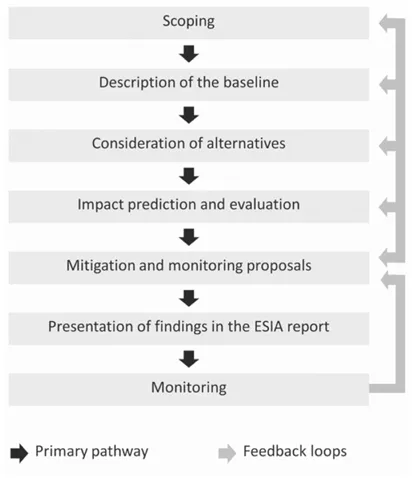
Figure 1.1 summarises the main ESIA procedures followed in the assessment of any environmental or social component. The figure assumes that the developer has conducted feasibility studies, and that screening to determine the need for ESIA (see Glasson et al. 2012) has already been carried out – and these assumptions are made in the chapters. The model illustrates the stepwise nature of ESIA, but also the requirement for continuous reappraisal and adjustment (as indicated by the feedback loops). The model, and the ESIA steps discussed below, form the broad structure for the book’s subsequent chapters.
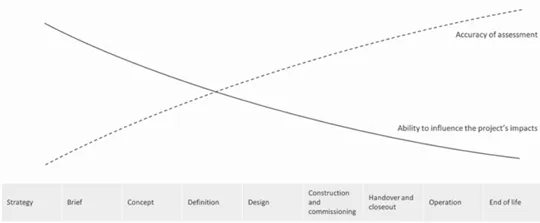
Figure 1.2 shows how ESIA’s ability to influence a project is highest in the early stages of project development, decreasing over time. The accuracy of assessment, instead, increases as more is known about the project, but may be very limited early in project development.
1.2.2 Scoping and baseline studies
Scoping is an essential first step in the assessment of a component. The main aims of scoping are:
• to consider and agree at an early stage (when the project type, location and/or design are still relatively amenable to modification): key receptors, impacts and project alternatives; the scope of the ESIA in time and space; the methodologies to use; and whom to consult;
• to ensure that resources and time are focused on important impacts and receptors;
Figure 1.1 Procedures in the assessment of an environmental or social component for an ESIA
Figure 1.2 Stages of project development and dimensions of ESIA (based on BSI 2016)
• to establish early communication between the developer, consultants, consenting authority, statutory consultees and other interest groups who can provide advice and information;
• to warn the developer of any constraints which may pose problems if not discovered until later in the ESIA process.
Scoping is carried out in consultation between the developer, the consenting authority, regulators and possibly other stakeholders (e.g. the public, NGOs). The scoping process should conclude with preliminary agreement on:
• the project’s potential impacts on component receptors, estimated from the project description (including its size, construction requirements, operational features and secondary developments such as access roads) and the nature of the components and receptors;
• the impact area/zone and time within which impacts are likely to occur, estimated from the impact types and the nature of the surrounding area and environmental/social components, e.g. impacts on air or water may occur at considerable distances from the project site;
• the project alternatives that should be assessed in the ESIA;
• the methods and levels of study needed to obtain reliable information that can be used to evaluate the baseline conditions, make accurate impact predictions, and formulate adequate mitigation measures and monitoring procedures. The selection of methods should involve consideration of:
• the impact and component receptors on which the studies will focus, and the accuracy and precision required;
• the most appropriate methods for collecting, analysing and presenting information;
• the resource requirements and timing considerations, especially for field surveys;
• constraints such as the time and resources available;
• possible mitigation measures;
• the need and potential for monitoring.
Depending on the jurisdiction, developers may request a scoping opinion from the consenting authority. The findings of the scoping process are typically documented in a scoping report that is made available to the developer, consultants, consenting authority and possibly the other stakeholders.
Table 1.1 shows some commonly used aids in ESIA. Two of these, checklists and matrices, are useful scoping tools, particularly for tasks such as identifying key impacts and receptors, and selecting appropriate consultees and interest groups. Lack of detailed information at the scoping stage means that scoping estimates and decisions should be reassessed in the light of baseline information gained as the ESIA progresses.
Baseline studies form the backbone of component assessments. It is only when they provide sound information on the socio-economic or environmental systems in the impact area that valid impact predictions can be made, and effective mitigation and monitoring programmes formulated.
Table 1.1 Commonly used ESIA methods
Method
Attributes
Checklists
Useful, especially during scoping, for identifying key impacts and ensuring that they are not overlooked. Can include information such as data requirements, study options, questions to be answered, and statutory thresholds – but are not generally suitable for detailed technical analysis.
Matrices
Can have various uses, e.g. (a) to identify impacts and cause–effect links between impac...
Table of contents
Cover
Half Title
Title Page
Copyright Page
Dedication
Table of Contents
Contributors
1 Introduction
2 Water
3 Soils, land and geology
4 Air
5 Climate and climate change
6 Ecology
7 Coastal ecology and geomorphology
8 Ecosystem services
9 Noise
10 Transport
11 Landscape and visual
12 Cultural heritage
13 Socio-economic impacts 1: Overview and economic impacts
14 Socio-economic impacts 2: Social impacts
15 Land acquisition, resettlement and livelihoods
16 Health
17 Resource efficiency
18 Risk and risk assessment
19 Cumulative effects
20 Environmental and social management plans
Glossary
Index
Trusted by 375,005 students
Access to over 1.5 million titles for a fair monthly price.
Study more efficiently using our study tools.
Frequently asked questions
Yes, you can cancel anytime from the Subscription tab in your account settings on the Perlego website. Your subscription will stay active until the end of your current billing period. Learn how to cancel your subscription
No, books cannot be downloaded as external files, such as PDFs, for use outside of Perlego. However, you can download books within the Perlego app for offline reading on mobile or tablet. Learn how to download books offline
Perlego offers two plans: Essential and Complete
Essential is ideal for learners and professionals who enjoy exploring a wide range of subjects. Access the Essential Library with 800,000+ trusted titles and best-sellers across business, personal growth, and the humanities. Includes unlimited reading time and Standard Read Aloud voice.
Complete: Perfect for advanced learners and researchers needing full, unrestricted access. Unlock 1.5M+ books across hundreds of subjects, including academic and specialized titles. The Complete Plan also includes advanced features like Premium Read Aloud and Research Assistant.
Both plans are available with monthly, semester, or annual billing cycles.
We are an online textbook subscription service, where you can get access to an entire online library for less than the price of a single book per month. With over 1.5 million books across 990+ topics, we’ve got you covered! Learn about our mission
Look out for the read-aloud symbol on your next book to see if you can listen to it. The read-aloud tool reads text aloud for you, highlighting the text as it is being read. You can pause it, speed it up and slow it down. Learn more about Read Aloud
Yes! You can use the Perlego app on both iOS and Android devices to read anytime, anywhere — even offline. Perfect for commutes or when you’re on the go. Please note we cannot support devices running on iOS 13 and Android 7 or earlier. Learn more about using the app
Yes, you can access Methods of Environmental and Social Impact Assessment by Peter Morris, Riki Therivel, Graham Wood, Peter Morris,Riki Therivel,Graham Wood, Riki Therivel, Graham Wood in PDF and/or ePUB format, as well as other popular books in Biological Sciences & Urban Planning & Landscaping. We have over 1.5 million books available in our catalogue for you to explore.