Understanding Batch Chemical Processes
eBook - ePub

Understanding Batch Chemical Processes

Modelling and Case Studies

  1. 312 pages
  2. English
  3. ePUB (mobile friendly)
  4. Available on iOS & Android
eBook - ePub

Understanding Batch Chemical Processes

Modelling and Case Studies

About this book

Batch chemical processes, so often employed in the pharmaceutical and agrochemical fields, differ significantly from standard continuous operations in the emphasis upon time as a critical factor in their synthesis and design.

With this inclusive guide to batch chemical processes, the author introduces the reader to key aspects in mathematical modeling of batch processes and presents techniques to overcome the computational complexity in order to yield models that are solvable in near real-time. This book demonstrates how batch processes can be analyzed, synthesized, and designed optimally using proven mathematical formulations. The text effectively demonstrates how water and energy aspects can be incorporated within the scheduling framework that seeks to capture the essence of time. It presents real-life case studies where mathematical modeling of batch plants has been successfully applied.
Frequently asked questions

Yes, you can cancel anytime from the Subscription tab in your account settings on the Perlego website. Your subscription will stay active until the end of your current billing period. Learn how to cancel your subscription.
No, books cannot be downloaded as external files, such as PDFs, for use outside of Perlego. However, you can download books within the Perlego app for offline reading on mobile or tablet. Learn more here.
Perlego offers two plans: Essential and Complete
  • Essential is ideal for learners and professionals who enjoy exploring a wide range of subjects. Access the Essential Library with 800,000+ trusted titles and best-sellers across business, personal growth, and the humanities. Includes unlimited reading time and Standard Read Aloud voice.
  • Complete: Perfect for advanced learners and researchers needing full, unrestricted access. Unlock 1.4M+ books across hundreds of subjects, including academic and specialized titles. The Complete Plan also includes advanced features like Premium Read Aloud and Research Assistant.
Both plans are available with monthly, semester, or annual billing cycles.
We are an online textbook subscription service, where you can get access to an entire online library for less than the price of a single book per month. With over 1 million books across 1000+ topics, we’ve got you covered! Learn more here.
Look out for the read-aloud symbol on your next book to see if you can listen to it. The read-aloud tool reads text aloud for you, highlighting the text as it is being read. You can pause it, speed it up and slow it down. Learn more here.
Yes! You can use the Perlego app on both iOS or Android devices to read anytime, anywhere — even offline. Perfect for commutes or when you’re on the go.
Please note we cannot support devices running on iOS 13 and Android 7 or earlier. Learn more about using the app.
Yes, you can access Understanding Batch Chemical Processes by Thokozani Majozi,Esmael R. Seid,Jui-Yuan Lee in PDF and/or ePUB format, as well as other popular books in Biological Sciences & Biotechnology. We have over one million books available in our catalogue for you to explore.

Information

1
Introduction to Batch Processes

1.1INTRODUCTION

Batch processes differ from continuous processes in several ways. The main difference is that time is inherent in batch processes. In batch processes, every task has a definite duration with starting and finishing times, whereas in continuous processes, time is important during non-steady-state operation. As a result, scheduling of batch processes is vital to the operation of any batch facility. Furthermore, in batch plants, detailed requirements for the various products may be specified on a day-to-day basis. A production schedule must indicate the sequence and manner in which the products are to be produced and specify the times at which the process operations are to be carried out. It is clear that the overall productivity and economic effectiveness of batch plants depend critically on the production schedule as it harmonizes the entire plant operation to attain production goals. While flexibility of batch plants improves productivity, it also makes plant scheduling a challenging task. Much research has focused on developing optimization techniques for scheduling batch plants with the aim of reducing the CPU time required to attain the optimal objective value.
This chapter provides a detailed literature review on various scheduling techniques. The review covers work which has been done in the field of mathematical models used for scheduling of batch plants. Papers presented in the last two decades are considered in the review, with focus on models based on unit-specific event-point continuous-time representation. The chapter is systematically divided into six major sections. Section 1.1 discusses recipe, State Task Network (STN) and State Sequence Network (SSN) representations for batch plants. One of the major characteristics that differentiates batch plants from continuous plants is the existence of intermediate storage in batch plants in order to separate operations in multipurpose equipment and to free the equipment for subsequent processes. The different intermediate storage operational philosophies that exist in batch plants are discussed in Section 1.2. Section 1.3 discusses the different types of batch plants under the main division of multiproduct and multipurpose batch plants.
Section 1.4 discusses the different types of models developed for scheduling of multiproduct batch plants. In this section, the models are categorized under the main division of graphical technique and mathematical technique. In the mathematical section, the different models are grouped into models based on sequence precedence and slot time representations. A brief of scheduling techniques for continuous and semi-continuous plants is given in Section 1.5. Section 1.6 details scheduling techniques developed for multipurpose batch plants. Finally, conclusions and limitations of the current scheduling techniques are briefly discussed in Section 1.7.

1.2BATCH PROCESS REPRESENTATION

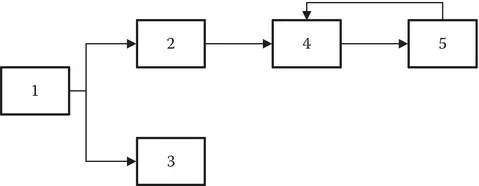
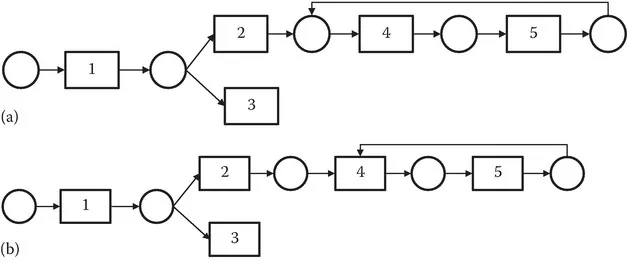
Batch plant processes were first represented in terms of ‘recipe networks’, as used by Reklaitis (1991). This is analogous to the flow sheet representation of continuous plants, but proposed to describe the process itself rather than a specific plant. Each node on a recipe network corresponds to a task, with directed arcs between nodes representing task precedence. Although recipe networks are certainly adequate for several processing structures, they often involve ambiguities when applied to more complex ones. Kondili et al. (1993) showed that a recipe network was not enough to represent batch processes without vagueness, as illustrated in Figure 1.1. It is not clear from this representation whether task 1 produces two different products later used as inputs of tasks 2 and 3, respectively, or whether it produces one type of product which is then shared between unit operations 2 and 3. Similarly, it is also impossible to determine from Figure 1.2 whether task 4 requires two different types of feedstock, respectively produced by tasks 2 and 5, or whether it only needs one type of feedstock which can be produced by either 2 or 5. Both interpretations are equally plausible. The former could be the case if, say, task 4 is a catalytic reaction requiring a main feedstock produced by task 2 and a catalyst which is then recovered from the reaction products by the separation task 5. The latter case could arise if task 4 were an ordinary reaction task with a single feedstock produced by 2, with task 5 separating the product from the unreacted material which is then recycled to 4.
fig1_1
FIGURE 1.1 Recipe representation of chemical processes.
fig1_2
FIGURE 1.2 STN representations for recipe representation.
In order to remove these ambiguities in a systematic fashion, Kondili et al. (1993) proposed a new representation for chemical processes called State Task Network representation. The distinctive characteristic of the STN was that it had two types of nodes: namely, the state nodes, representing the feeds, intermediate and final products; and the task nodes, representing the processing operations which transform materials from one or more input states to one or more output states. State and task nodes were denoted by circles and rectangles, respectively. State Task Networks are free from the ambiguities associated with recipe networks. Figure 1.2 shows two different STN representations, both of which correspond to the recipe network of Figure 1.1. The STN representation is equally suitable for networks of all types of processing tasks, such as continuous, semi-continuous and batch.
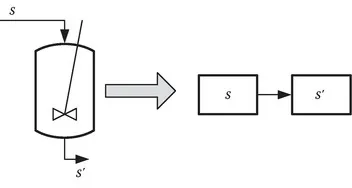
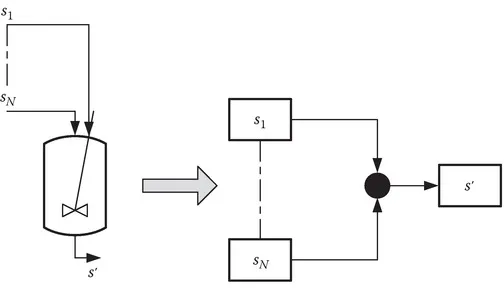
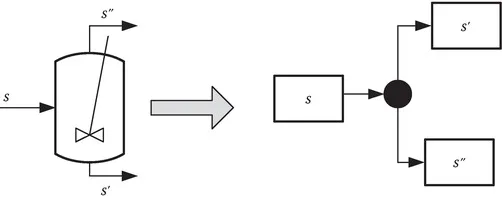
Majozi and Zhu (2001) introduced a new concept called the State Sequence Network representation for scheduling of batch plants. The SSN was a graphical network representation of all the states that exist in batch plants, and the network was formulated based on the production recipe. A state changes from one state to another state when it undergoes a unit operation such as mixing, separation or reaction. The building blocks of the SSN are shown in Figure 1.3, Figure 1.4 and Figure 1.5. From these building blocks, it is easy to construct a SSN for any process recipe. The SSN representation was developed by realizing that (1) the capacity of a unit in which a particular state is used sets an upper limit on the amount of state used or produced by the corresponding task, (2) the presence of a particular state in an operation corresponds to the existence of a corresponding task and (3) the usage of state s corresponds to the production of another state s′.
fig1_3
FIGURE 1.3 Simple unit operation.
fig1_4
FIGURE 1.4 Unit operation with mixing/reaction.
fig1_5
FIGURE 1.5 Unit operation with splitting.

1.3DIFFERENT STORAGE OPERATIONAL POLICIES IN BATCH PLANT

According to Reklaitis (1982), the multistage nature of a batch processing network allows several different storage and waiting options:
  • Unlimited intermediate storage (UIS)
  • Finite intermediate storage (FIS)
  • No intermediate storage (NIS)
  • Central intermediate storage (CIS)
  • Unlimited wait (UW)
  • Finite wait (FW)
  • Zero wait (ZW)
The ZW or FW policy is used where unstable intermediate material must be processed immediately or within a short time after the previous step has been completed. In the NIS policy, there is no intermediate storage between process units, but a product can be stored in a process unit before moving to the next available processing unit. A more practical operational storage policy is that of FIS, where there is limited storage capacity between process units. The UIS policy is more of a theoretical one. If the intermediate products are compatible, the CIS policy is recommended. After materials are processed in a unit...

Table of contents

  1. Cover
  2. HalfTitle Page
  3. Title Page
  4. Copyright Page
  5. Foreword
  6. Acknowledgements
  7. Authors
  8. Chapter 1 Introduction to Batch Processes
  9. Chapter 2 Modelling for Effective Solutions: Reduction of Binary Variables
  10. Chapter 3 Methods to Reduce Computational Time: Prediction of Time Points
  11. Chapter 4 Integration of Scheduling and Heat Integration: Minimization of Energy Requirements
  12. Chapter 5 Heat Integration in Multipurpose Batch Plants
  13. Chapter 6 Design and Synthesis of Heat-Integrated Batch Plants Using an Effective Technique
  14. Chapter 7 Simultaneous Scheduling and Water Optimization: Reduction of Effluent in Batch Facilities
  15. Chapter 8 Optimization of Energy and Water Use in Multipurpose Batch Plants Using an Improved Mathematical Formulation
  16. Chapter 9 Targeting for Long-Term Time Horizons: Water Optimization
  17. Chapter 10 Long-Term Heat Integration in Multipurpose Batch Plants Using Heat Storage
  18. Index