This book is available to read until 25th January, 2026
- 266 pages
- English
- ePUB (mobile friendly)
- Available on iOS & Android
eBook - ePub
Available until 25 Jan |Learn more
About this book
The American legal profession and judicial system bear a unique responsibility to set and maintain the balance between defending homeland security and protecting the civil liberties outlined in the Bill of Rights. These competing interests will continue to collide as the threats to our safety grow. Exploring the most significant terrorist cases of
Frequently asked questions
Yes, you can cancel anytime from the Subscription tab in your account settings on the Perlego website. Your subscription will stay active until the end of your current billing period. Learn how to cancel your subscription.
No, books cannot be downloaded as external files, such as PDFs, for use outside of Perlego. However, you can download books within the Perlego app for offline reading on mobile or tablet. Learn more here.
Perlego offers two plans: Essential and Complete
- Essential is ideal for learners and professionals who enjoy exploring a wide range of subjects. Access the Essential Library with 800,000+ trusted titles and best-sellers across business, personal growth, and the humanities. Includes unlimited reading time and Standard Read Aloud voice.
- Complete: Perfect for advanced learners and researchers needing full, unrestricted access. Unlock 1.4M+ books across hundreds of subjects, including academic and specialized titles. The Complete Plan also includes advanced features like Premium Read Aloud and Research Assistant.
We are an online textbook subscription service, where you can get access to an entire online library for less than the price of a single book per month. With over 1 million books across 1000+ topics, we’ve got you covered! Learn more here.
Look out for the read-aloud symbol on your next book to see if you can listen to it. The read-aloud tool reads text aloud for you, highlighting the text as it is being read. You can pause it, speed it up and slow it down. Learn more here.
Yes! You can use the Perlego app on both iOS or Android devices to read anytime, anywhere — even offline. Perfect for commutes or when you’re on the go.
Please note we cannot support devices running on iOS 13 and Android 7 or earlier. Learn more about using the app.
Please note we cannot support devices running on iOS 13 and Android 7 or earlier. Learn more about using the app.
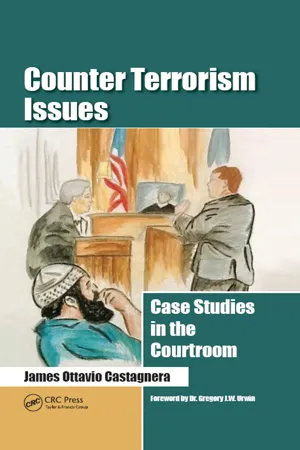
Yes, you can access Counter Terrorism Issues by James Ottavio Castagnera in PDF and/or ePUB format, as well as other popular books in Law & Cyber Security. We have over one million books available in our catalogue for you to explore.
Information
The Fire Bell in the Night1The 1993 World Trade Center Bombing | 1 |
On a snowy day, Friday, February 26, 1993, a massive car bomb nearly toppled the World Trade Center. The unthinkable had happened, an instantly recognizable American landmark had become the target of a terrorist attack…. There had been terrorist acts before 1993,2 but the Trade Center attack was unique. These were not Americans killed on an airplane or in a foreign land. These were Americans killed on their own soil. And the scariest element may have been not the explosion, the scale of the destruction, nor even the number of dead but the sense of vulnerability ushered in by the arrival of guerilla tactics in America.3
The writer of these words is Robert E. Precht, who in 1993 was a public defender appointed to represent one of the Muslim men accused of the bombing. In the first sentence of his book he asks, “Is a fair trial possible in the war on terrorism?”4 This is a question I will be asking—and, I hope, answering—throughout this book. In 1993, before the “War on Terrorism” was a cliché, but radical Muslim terrorism was already commonplace in the world at large (if not yet in the United States), the answer was a clear “yes.”
On November 5, 1990, Rabbi Meir Kahane was shot dead in a Marriott Hotel in Manhattan, following a speech he had just given there. Kahane headed the Jewish Defense League, a radical Zionist organization linked to numerous terrorist activities. Accused of the assassination was El Sayyid Nosair, who was shot by an officer of the U.S. Postal Inspection Service as he fled the scene.5
Born on November 5, 1955, in Egypt, Nosair was a naturalized U.S. citizen. He had emigrated from Port Said in 1981, arriving to the United States with an engineering degree. He worked at various jobs in New York and New Jersey, notably as an HVAC repairman in the Big Apple’s criminal court buildings. He was granted U.S. citizenship in 1989. However,
Nosair expressed dislike for American culture and what he perceived to be rampant moral corruption. Nosair became involved with the al-Farouq Mosque in Brooklyn, which was supported by the Maktabal-Khadamat (Services Office), which was established in 1984 by Osama bin Laden and Abdullah Azzam in Peshawar, Pakistan. The purpose of the Services Office was raising funds for the Arab mujahadeen during the Soviet war in Afghanistan, as well as recruitment. Ali Mohamed, a sergeant at Fort Bragg, provided United States Army manuals and other assistance to individuals at the al-Farouq Mosque, and some members including Mahmoud Abouhalima and Nosair practiced at the Calverton Shooting Range on Long Island, many of the group wearing t-shirts reading “Help Each Other in Goodness and Piety … A Muslim to a Muslim is a Brick Wall” with a map of Afghanistan emblazoned in the middle.6
Nosair’s defense was undertaken by the flamboyant “radical lawyer” William M. Kunstler.7 Kunstler wrote in 1994—shortly after the trial and only a year before his death—“When I first took on Nosair, I believed he was guilty, so I suggested an insanity defense.”8 However, Kunstler explained, from the time he first met Nosair in a hospital, shortly after the shootings, his client consistently professed his innocence. Kunstler and his trial team eventually decided to withdraw the insanity plea and force the prosecution to prove beyond a reasonable doubt that Nosair had killed Kahane. Recalled Kunstler,
During the trial, the prosecutors from the Manhattan district attorney’s office presented a case with serious weaknesses. For example, although several people testified that they had seen Nosair near Kahane when the rabbi was killed, the videotape made by a Kahane supporter moments before the assassination showed that not a single one of the “eyewitnesses” was standing where they said they were when the shooting occurred. During the deliberations, the jury several times requested that the videotape be played back for them frame by frame.9
The jury’s verdict has been called “bizarre.”10 Nosair was acquitted of Kahane’s murder but convicted of assault and possession of an illegal firearm. The presiding judge, Alvin Schlesinger, opined that the jury’s acquittal of Nosair on the murder charge “was against the overwhelming weight of evidence and was devoid of common sense and logic.”11
Kunstler, of course, held a different view. Noting inconsistencies in the prosecutors’ case, as well as some bizarre events in the aftermath of the killing,12 he called the acquittal “a thrilling victory.”13 Judge Schlesinger called it “a rape of this country, of our Constitution and of our laws, and of people seeking to exist peacefully together.” But he also conceded on the record, “The one thing that persists is the fairness and vitality of our system of law.”14
Indeed, the outcome of the Nosair trial suggests that—at least in the early 1990s—a fair trial was possible for a Muslim terrorist in America.
The 1993 World Trade Center Bombing
In a 1997 Home Box Office docu-drama entitled Path to Paradise, Nosair is depicted plotting from prison with the convicted perpetrators of the 1993 bombing.15 And, in fact, he was convicted in 1994 of seditious conspiracy for his role in planning the attack. The actual attackers—presuming the right guys were arrested and convicted—included Ramzi Yousef, Mahmud Abouhalima, Mohammad Salameh, Nidal Ayyad, Ahmad Ajaj, and Eyad Ismoil. All were said to be impassioned followers of an imam, the so-called blind Sheik, Omar Abdul-Rahman.
At seventeen minutes past noon on February 26, 1993, a Friday, the thunderous explosion—like the Black Tom Island blast nearly seventy-five years earlier—rocked Manhattan. This time the epicenter was the parking garage beneath the World Trade Center. The explosion, officially attributed to a 1,500-pound urea nitrate and hydrogen gas truck bomb, dug a 100-foot crater. It killed six. More than a thousand more were injured, mostly in the chaos of the subsequent evacuation.16
Background17
On April 24, 1992, Ahmad Mohammad Ajaj departed from his home in Houston, Texas, and traveled to the Middle East to attend a terrorist training camp, known as Camp Khaldan, on the Afghanistan-Pakistan border. There he learned how to construct homemade explosive devices. During his time in Pakistan, Ajaj met Ramzi Ahmed Yousef. Together the two plotted to use their newly acquired skills to bomb targets in the United States.
In the fall of 1992, after formulating a plan, Ajaj and Yousef traveled to New York City under assumed names. Ajaj carried with him a so-called terrorist kit that he and Yousef had assembled in Pakistan. The kit included, among other things, handwritten notes Ajaj had taken while attending explosives courses, manuals containing formulae and instructions for manufacturing bombs, materials describing how to carry off a successful terrorist operation, videotapes advocating terrorist action against the United States, and fraudulent identification documents.
On September 1, 1992, Ajaj and Yousef, using false names and passports, arrived at John F. Kennedy International Airport in New York. As they attempted to clear customs, Immigration and Naturalization Service (INS) inspectors discovered that Ajaj’s passport had been altered. They searched his belongings. When the agents discovered his terrorist kit, Ajaj became belligerent. The INS seized the kit and placed him under arrest. Ajaj was later indicted in the U.S. District Court for the Eastern District of New York for passport fraud. He pled guilty and was sentenced to six months’ imprisonment.
During Ajaj’s encounter with the INS inspectors, he denied that he was traveling with Yousef, who proceeded unmolested to the secondary inspection area, where he presented an Iraqi passport and claimed political asylum. Yousef was arrested for entering the United States without a visa. In this still innocent age, he subsequently was released by the INS on his own recognizance, promising to appear for a hearing some months hence.
Once in New York, Yousef assembled his team, which allegedly included Mohammed Salameh, Nidal Ayyad, Mahmoud Abouhalima, and Abdul Rahman Yasin. Together, the conspirators implemented the bombing plot that Ajaj and Yousef had hatched overseas. Ayyad and Salameh opened a joint bank account into which they deposited funds to finance the bombing plot. Some of that money was later used by Salameh to rent a storage shed in Jersey City, New Jersey, where the conspirators stored chemicals for making explosives. Yousef also drew on that account to pay for materials described in Ajaj’s manuals as ingredients for bomb making.
The first target of the conspirators’ plot was the World Trade Center. Ayyad used his position as an engineer at Allied Signal, a large New Jersey chemical company, to order the necessary chemical ingredients for bomb making, and to order hydrogen tanks from ALG Welding Company that would enhance the bomb’s destructive force. Abouhalima obtained “smokeless powder,” which the conspirators used to make explosives. Smokeless powder, and all the other chemicals procured by the conspirators for the bomb, was stored in the shed rented by Salameh.
Abouhalima helped Salameh and Yousef find a ground-floor apartment at 40 Pamrapo Avenue in Jersey City. The apartment fit the specifications in Ajaj’s manuals for an ideal base of operations. In the 40 Pamrapo apartment, Abouhalima, Salameh, Yousef, and Yasin mixed the chemicals for the World Trade Center bomb, following Ajaj’s formulae. Abouhalima also obtained a telephone calling card, which the conspirators used to contact each other and to call various chemical companies for bomb ingredients.
During this entire period, although Ajaj remained incarcerated, he kept in telephone contact with Yousef. By doing so, Ajaj stayed abreast of the conspirators’ progress in carrying out the terrorist plot and attempted to get his terrorist kit into Yousef’s hands. Because Ajaj was in jail and his telephone calls were monitored, Ajaj and Yousef spoke in code when discussing the bomb plot.
On February 23, 1993, Salameh rented a yellow van at DIB Leasing, a Ryder dealership in Jersey City. The conspirators loaded their homemade bomb into that van. On February 26, 1993, the conspirators drove the bombladen van into a belowground parking lot on the B-2 level of the World Trade Center Complex and, using a timer, set the bomb to detonate. At 12:18 p.m., the bomb exploded, killing six people, injuring over a thousand others, and causing hundreds of millions of dollars in damage.
The explosion opened a hole seven stories high; one FBI agent called the small number of deaths “a miracle.”17a
After the explosion, Ayyad took credit for the bombing on behalf of the conspirators by, among other things, writing an anonymous letter to the New York Times explaining that the attack was undertaken in retaliation for American support of Israel. The letter threatened future terrorist “missions.”
Immediately after the bombing, Yousef, Abouhalima, and Yasin fled the country. Abouhalima was apprehended in Egypt prior to the trial and turned over to federal agents by Egyptian authorities, but Yousef and Yasin remained fugitives. Salameh arranged to flee as well, but was arrested the day before he planned to depart when he made the ludicrous mistake of going back to the Ryder truck rental office to get his rental deposit back. On March 1, 1993, Ajaj completed his term of impr...
Table of contents
- Cover
- Half Title
- Title Page
- Copyright Page
- Dedication
- Table of Contents
- Foreword
- Preface
- Acknowledgments
- Introduction
- About the Author
- 1 The Fire Bell in the Night: The 1993 World Trade Center Bombing
- 2 Homegrown Terrorists: Tim McVeigh and Terry Nichols (1995)
- 3 Should Zacarias Moussaoui Die for Usama Bin Laden’s Sins? (2006)
- 4 It Shouldn’t Happen to a Dog?: The Trial of the SHAC 7 (2006)
- 5 All My Trials Soon Be Over?: Sami Al-Arian (2005–2010)
- 6 Victims Fight Back: The Persian Antiquities Cases (2001–2012)
- 7 At the Tipping Point on the Scales of Justice: National Security vs. Civil Liberties (When a U.S. Citizen Is Declared an Unlawful Enemy Combatant)
- 8 Of Wannabes and Bumblers: The Fort Dix Conspirators and the Underwear Bomber
- 9 Lone Madman or Freelance Jihadist?: Nidal Malik Hasan and the Fort Hood Shootings (2009)
- 10 The Yemeni Connection (Redux): What the Times Square Bomber Case Portends
- 11 Conclusion
- Index