Light in Architecture explores the role and use of light in and around buildings from the time that Stonehenge was built through to the present day, illustrating how a greater understanding of this intangible and free material will lead us to better architecture and, ultimately, improve our quality of life. Translated and carefully updated from the best-selling Spanish book, La Materia Intangible, this full colour edition explains why light is so fundamental to human perception, how its nature and use are influenced by time and place, and how it has come to be used as a tool for abstract architectural design. Drawing on centuries of thinking and over 40 real-life, international exemplars, the book explores the different ways that light can be harnessed and manipulated to achieve particular objectives, emotions or experiences, as well as how the technologies and techniques for doing so have developed over time.
- 192 pages
- English
- ePUB (mobile friendly)
- Available on iOS & Android
eBook - ePub
About this book
Information
Topic
ArquitecturaSubtopic
Arquitectura generalpart one
the role of light in architecture
In the beginning,
God created the heavens and the earth.
The earth was without form and void,
and darkness was over the face of the deep.
And the Spirit of God was hovering
over the face of the waters.
And God said, “Let there be light”,
and there was light.
And God saw that the light was good.
God created the heavens and the earth.
The earth was without form and void,
and darkness was over the face of the deep.
And the Spirit of God was hovering
over the face of the waters.
And God said, “Let there be light”,
and there was light.
And God saw that the light was good.
– Genesis 1:1–4 (ESV)
Illuminating a space makes life possible within it. The way in which a space is lit determines, to a large extent, its characteristics and quality.
If we consider that architecture encompasses all of the conditions of a given space, including what makes it habitable, then that space must be considered in relation to light. To create spaces in which people can live comfortably, we must first recognise that human beings are naturally drawn to light. Almost all forms of life on Earth depend on sunlight; we are “driven” by it. If a designed space is to be comfortable and to function well, then it must engage with this one vital component, which is both intangible and invisible yet enables us to see. Light is free, yet also the most enriching of all the “materials” available to the architect.
Natural light is an indispensable material and one that architects have to handle well if they are to create the best possible humane and life-affirming spaces.
one
light and perception
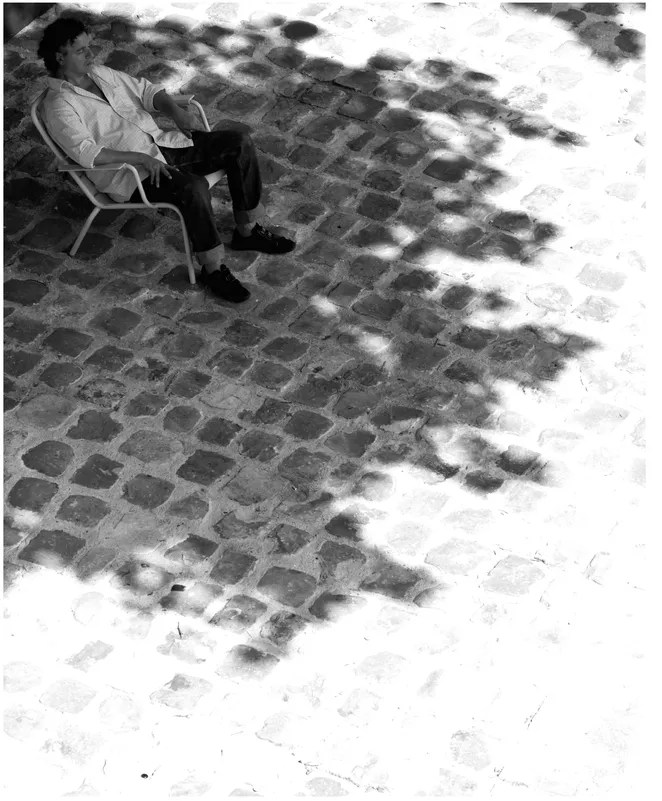
Opposite page Dappled sunlight illustrates the natural contrast between light and shadow.
What is space?
It is nothing other than very subtle light.1
– Proclus
Light and Space
Space holds the key to the meaning of architecture. Talking about architecture means talking about space – space delimited by tangible material. We perceive this space through the interplay of light and shadows, to such an extent that Proclus, the fifth-century AD Neoplatonist thinker, declared that space and light were one and the same thing.
From ancient times, space had been seen as an abstract idea, discussed in philosophy and metaphysics, or else the subject of the experimental and natural sciences. Exploration of concepts of space developed in parallel with humans’ knowledge of the natural world. However, until the 19th century, space itself was not thought of in fine-art terms, and so it was not discussed in architectural books and treatises.
Light, too, has been studied and theorised upon from the earliest times. By the time of the Greek mathematician Euclid in the third century BC, knowledge of its properties included the laws of reflection and refraction and the fact that light travels in straight lines. However, ancient scholars committed the basic error of thinking that light was
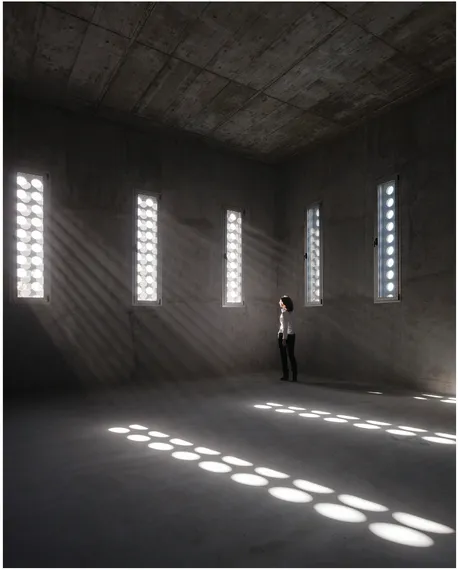
Figure 1.1 New multi-purpose space in Cerrillo de Maracena School, Granada, 2014, by Elisa Valero Ramos.
an “effluence” issuing forth from a person’s eyes, like tentacles touching and feeling objects, and that it was this that enabled the person to see those objects.
Subsequently, Plato’s belief was, by contrast, that rays of light came from the viewed object and informed us of its qualities, mainly its surface and foreshortening. These visible aspects were what his contemporary Democritus called, respectively, an object’s “shell” and its “profile”. The Renaissance architect Leon Battista Alberti took up these ideas almost 17 centuries later, speaking of “Lineaments”, the underlying geometry that, together with matter, he held responsible for constituting an architectural form:
The plane is measured by rays that serve the sight – known as visual rays – which carry the form of the thing seen to the sense ... These behave, in a manner of speaking, like the chameleon, an animal which takes to itself the colours of things near it ... This is the reception of light.2
Towards the year AD1000, in Baghdad, the Arab philosopher Alhazen theorised that light originates in luminous sources such as the sun or fire, and invented the “camera obscura”, a darkened projection chamber. Leonardo da Vinci and other artists would later use this as a tool in their drawing exercises. Da Vinci developed the concept of the “radiant pyramid”: he thought that an object radiates material images or semblances of itself in straight lines in all directions, and that the further these images are from the original object, the smaller they become. He also devoted a significant amount of study to shadow – or “darkness”, as he termed it – as an absence of light. This was, in a sense, light’s opposite:
Light is always accompanied by shadow. Just as there are luminous bodies emitting light rays, there are also “umbrous” bodies emitting shadow rays. Light and denseness are opposed to one another; being dense is the opponent of being luminous.3
At the beginning of the 18th century, Isaac Newton published Opticks, the first scientific work on light. He demonstrated that white light contains all the colours of the rainbow, or rather, has the capacity to produce the sensation of these different colours in us. Seventeenth-century mathematician and physicist Francesco Grimaldi had discovered the phenomenon of diffraction, the deviation observed when light encounters an obstacle, and, in the early 19th century, English polymath Thomas Young proved that
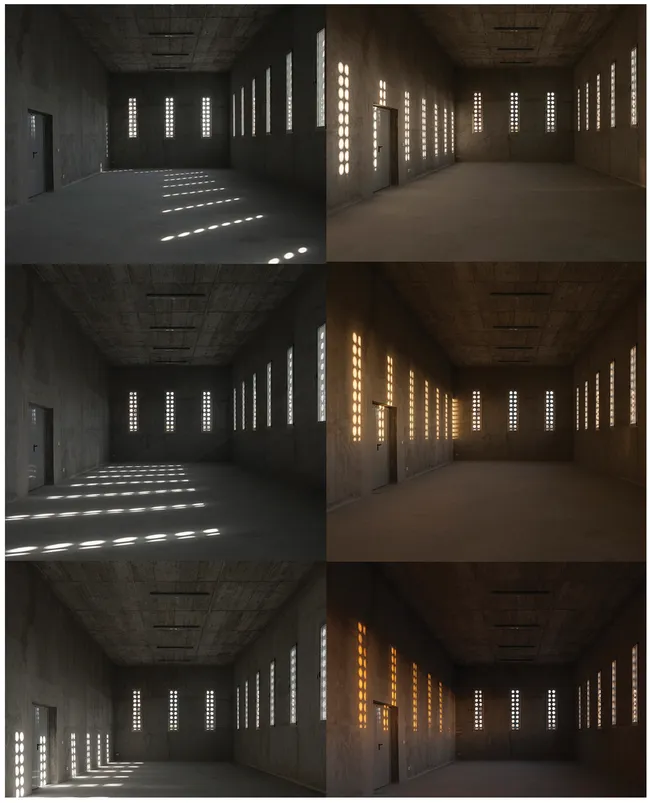
Figure 1.2 Light variations in Cerrillo de Maracena School, Granada (opposite).
light moves in waves. Science continued to progress, and eventually arrived at the current definition of light as energy in the form of electromagnetic waves travelling in a vacuum at a speed of almost 300 kilometres per second – the iconic “186,000 miles a second”. Despite the fact that until the 19th century there had been no explicit nonscientific theorising about light, it continued to be used as a means of describing space in architecture and the arts. According to visionary US architect Louis Kahn:
Architecture is the thoughtful making of spaces. It is the creating of spaces that evoke a feeling of appropriate use ... To the musician a sheet of music is seeing from what he hears. A plan of a building should be read like a harmony of spaces in light.4
What gives a room its particular character is the interplay between its structure and its light. “To make a square room is to give it the light which reveals the square in its infinite moods”, declared Kahn.
The Measure of Time
It is also through the medium of light that we perceive time. In fact, time might be described as the measure of changes in light; the alternation of day and night constitutes a change in light, as do the seasons of the year. The measure of time has, of course, played a fundamental role in the history of humanity. Daylight is interrupted, and so measured and structured, by night. We associate blue light with morning, and golden light with evening; we distinguish spring from winter by changes in the light. This instinctive knowledge of what sort of light is coming next provides us with a sense of stability amid the movement of the world.
For millennia, the sundial has been the quintessential means of measuring these changes. It is the primordial “clock” – so much so that some ancient buildings act almost as sundials. Marguerite Yourcenar describes this beautifully in her book Memoirs of Hadrian, in which she refers to the Pantheon in Rome:
This temple, both open and mysteriously enclosed, was conceived as a solar quadrant. The hours would make their round on that caissoned ceiling, so carefully polished by Greek slave artisans; the disk of daylight would rest suspended there like a shield of gold.5
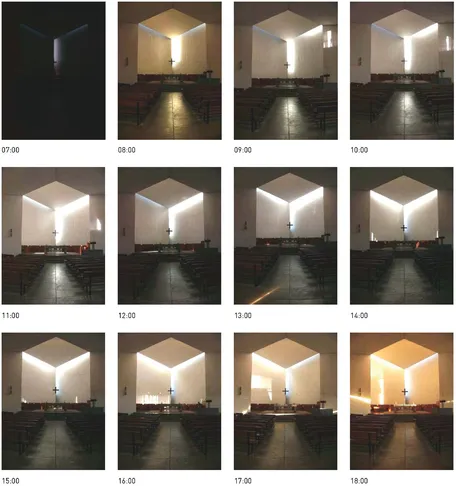
Figure 1.3 Variations in light and colour over the course of one day (27 August 2007), in the church of the Benedictine monastery of the Santísima Trinidad de las Condes, Santiago de Chile, 1960–5, by M Correa and G Guarda.
To some extent, therefore, the human body is regulated by light. Our bodies respond to the level of light and the amount of time that we are exposed to it. In summer and winter alike, the human body is subject to the cycles of day and night. Light and temperature levels repeat similar cycles every day, rising as the day progresses and falling to a minimum at night, and this produces changes in the body and regulates the secretion of melatonin, a hormone that aids sleep. So, biologically speaking, light informs the organism when to be active and when to rest. This is so important that designers are now experimenting with lighting systems that can mimic natural variations in temperature and the intensity of light and colours, in order to produce lighting that not only looks “natural” but actually varies in the same ways as natural light does. Technology can thus produce its own version of the day-and-night cycle, and this necessarily affects architecture.
Perceiving Space
We know from experience that we can tell the difference between a dark place and a well-lit one even without comparing them directly. But we can also get so used to a dimly lit room that after a while we no longer notice the low level of lighting. This is partly due to the adaptation mechanism of our nervous system: the pupils of our eyes enlarge automatically as the level of lighting falls, so as to enable a greater amount of light to enter.6
What is more, we do not see the world directly. What we see is a two-dimensional pattern of light that falls on the retina of our eyes. In order to arrive at the three-dimensional world – with its trees, people, cars, etc – we have to interpret that pattern, making sense of the discontinuities and variations in the light. To take a simple example: what falls on the retina might be the image of a flat circle, with light and shading combined in a particular way; our complex prior experience enables us to recognise this particular combination of light and shadow as a ball. In other circumstances, we might recognise it as a two-dimensional photograph of a three-dimensional ball. We do not apprehend the essence of an object directly but we abstract it from the information that reaches us, and we interpret that information differently depending on the precise situation in which we find ourselves. What this means is that seeing is not a purely physical operation but a psychophysical one. And the mind deals not only with the levels of intensity of the light received by the eyes, but
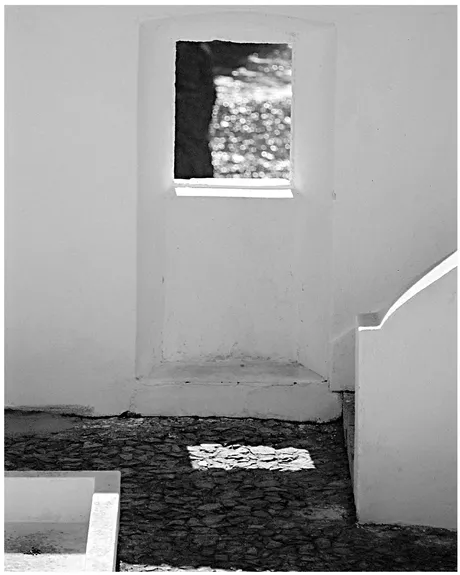
Figure 1.4 Austere forms and pure geometric shapes are defined by the sun that delineates their sharp edges
also with its colour or colours. At different times, the same object might be seen under different levels of light and also in differently coloured light. The mind has therefore to compose and store a pattern of a given object that will enable it to identify and recognise that object under different stimuli.
Shade, or shading, enables us to perceive things in three dimensions because we can interpret variations of shading in the flat image that falls on our retina. When we draw a two-dimensional picture of a three-dimensional object, we do the same thing in reverse – denoting relief and form through means of shading. The shading on a dome will gradually become deeper, whereas the edges of a pyramid will show a sharp line between light and shade. Notions of light and shade are closely linked to art; Roman philosopher Pliny the Elder, in his Natural History, asserts that art was invented when a woman traced the outline of her lover’s shadow on the wall.7
Architecture necessarily brings time and space together. Just as time – or timing – underpins music, architecture also needs to be perceived in relation to time: second by second, as we progress through a building or sequence of spaces. We join successive spaces together in our perception, and so arrive at an appreciation of an entire work of architecture, because we have the capacity to comprehend the essential “oneness” of the work through an infinite series of varied images and different forms.
This is, in fact, what perception is: the way in which we relate to the world outside ourselves. Spanish philosopher José Antonio Marina, in his book Teoría de la inteligencia creadora (A Theory of Creative Intelligence), explains this as follows:
Light reaches our eyes like rain. A storm of stimuli overwhelms the retina, and we have to organise them. Possibly the first act of organising consists of distinguishing a shape against a background. The mark on the wall. We cannot avoid making this selection.8
The "Right" Light
People very often think that “good light” means the same as “a lot of light”, and that increasing the amount of light will necessarily help us to see a space better. However, this is not always the case. The quality of the light is just as important as its quantity – and this attribute may include the position of the light source, the colour and even the dazzling effect of light shining directly in the eyes (glare).
To appreciate the complexities of this situation, we must understand that if an object is lit by symmetrical sources of light which eliminate shadows, it can be difficult to perceive it in three dimensions. Side illumination produces relief so that we can see the volume of an object, since we need ...
Table of contents
- Cover
- Half Title
- Copyright
- preface and acknowledgements
- about the author
- foreword
- Contents
- part one: the role of light in architecture
- part two: working with light in architecture
- part three: light in architecture from past to future
- image credits
- endnotes
Trusted by 375,005 students
Access to over 1.5 million titles for a fair monthly price.
Study more efficiently using our study tools.
Frequently asked questions
Yes, you can cancel anytime from the Subscription tab in your account settings on the Perlego website. Your subscription will stay active until the end of your current billing period. Learn how to cancel your subscription
No, books cannot be downloaded as external files, such as PDFs, for use outside of Perlego. However, you can download books within the Perlego app for offline reading on mobile or tablet. Learn how to download books offline
Perlego offers two plans: Essential and Complete
- Essential is ideal for learners and professionals who enjoy exploring a wide range of subjects. Access the Essential Library with 800,000+ trusted titles and best-sellers across business, personal growth, and the humanities. Includes unlimited reading time and Standard Read Aloud voice.
- Complete: Perfect for advanced learners and researchers needing full, unrestricted access. Unlock 1.5M+ books across hundreds of subjects, including academic and specialized titles. The Complete Plan also includes advanced features like Premium Read Aloud and Research Assistant.
We are an online textbook subscription service, where you can get access to an entire online library for less than the price of a single book per month. With over 1.5 million books across 990+ topics, we’ve got you covered! Learn about our mission
Look out for the read-aloud symbol on your next book to see if you can listen to it. The read-aloud tool reads text aloud for you, highlighting the text as it is being read. You can pause it, speed it up and slow it down. Learn more about Read Aloud
Yes! You can use the Perlego app on both iOS and Android devices to read anytime, anywhere — even offline. Perfect for commutes or when you’re on the go.
Please note we cannot support devices running on iOS 13 and Android 7 or earlier. Learn more about using the app
Please note we cannot support devices running on iOS 13 and Android 7 or earlier. Learn more about using the app
Yes, you can access Light in Architecture by Elisa Valero Ramos in PDF and/or ePUB format, as well as other popular books in Arquitectura & Arquitectura general. We have over 1.5 million books available in our catalogue for you to explore.