The perception of the immigrant as criminal or deviant has a long history in the United States, with many groups (e.g., Irish, Italians, Latinos) having been associated with perceived increases in crime and other social problems, although data suggest this is not necessarily the case. This Handbook examines the relationship between immigration and crime by presenting chapters reflecting key issues from both historical and current perspectives. The volume includes a range of topics related to immigration and crime, such as the links between immigration rates and crime rates, nativity and crime, and the social construction of the criminal immigrant, as well as historical and current immigration policy vis-à-vis perceptions of the criminal immigrant. Other topics covered in this volume include theoretical perspectives on immigration and assimilation, sanctuary cities, and immigration in the context of the "war on terror."
The Routledge Handbook on Immigration and Crime fills the gap in the literature by offering a volume that includes original empirical work as well as review essays that deliver a complete overview of immigration and crime relying on both historical and contemporary perspectives. It is a key collection for students in immigration courses; scholars and researchers in diverse disciplines including criminal justice, criminology, sociology, demography, law, psychology, and urban studies; and policy makers dealing with immigration and border security concerns.
PART I Historical Perspectives on Immigration and Crime
1 ON THE HISTORY OF IMMIGRATION AND CRIME
Holly Ventura Miller
Introduction
Despite its designation as a “nation of immigrants” or a “melting pot,” rarely has the U.S. been a welcoming place to newcomers. A considerable misconception in today’s immigration debate is the belief that anti-immigrant sentiment is new, a product of the times, due to a particular political candidate or set of circumstances, or associated with only certain types of immigrants. Rather, hostility toward immigrants and governmental responses to control immigration are longstanding traditions in American sociopolitical life. From the Alien and Sedition Acts of the late 18th century to today’s calls for restrictions on immigrants and refugees, there are numerous instances of legislation conceived to control immigration or immigrants. This chapter attempts to provide a broad overview of several interrelated topics by way of a general introduction to the socio-cultural-legal history of immigration and crime. Specifically, this chapter is designed to provide: 1) a brief history of immigration to the U.S.; 2) an introduction to American nativism vis-à-vis immigration and crime; 3) an overview of early studies on immigration and crime; and 4) a review of American immigration policy throughout history with a particular focus on how perceptions of the criminal immigrant shaped these laws.
The perceived criminality of the newly arrived foreign-born was the impetus for early state and local action in controlling immigration and was critical in getting the federal government involved in immigration in the 19th century (Bernard, 1980). Each of the major waves of immigration to the U.S. sparked nativist movements and policies as the native-born sought to distance themselves from newcomers and firmly establish the dominance of the preceding immigrant groups. Generally speaking, nativism was sparked by several major concerns including: 1) the foreign-born undercut the wages of native-born American workers; 2) these new immigrants would not be able to effectively assimilate into American society; and 3) immigrants would increase various social ills, including crime (Feagin, 1997). Notably, these concerns remain at the forefront of the contemporary immigration debate.
Historically, immigration to the U.S. was driven by many of the same reasons that remain relevant today. Immigrants often were motivated by religious persecution or economic oppression; some came as indentured servants and others were transported as part of a criminal sentence (Davie, 1936). The vast majority of settlers in early Colonial America were English or of English parentage such that 90% of those in the colonies in 1699 shared this Anglican background. The remaining white settlers at this time included Swedes in Delaware, Germans in Pennsylvania, Dutch in New York, and Huguenots in New Rochelle (Zelinsky, 1973). The first U.S. Census taken in 1790 showed a population of 2.8 million, 1.3 million of whom were of English descent. The 1790 Census also recorded 560,000 Africans, 180,000 Scots, 156,000 Germans, 54,000 Dutch, 44,000 Irish, and 13,000 French.
The first half of the 18th century brought with it mass immigration to the U.S. when nearly 750,000 immigrants arrived in the two decades spanning 1821 and 1840 alone (Hansen & Schlesinger, 1940). Another 1.7 million entered in the next decade, spurred by famine, industrialization, and political unrest on the European Continent. The Treaty of Guadalup-Hidalgo ended the Mexican-American War in 1848, extending citizenship to 80,000 Mexicans living in the newly acquired territories in the Southwest (e.g., Texas, California, Arizona). The California Gold Rush led to a significant increase in Chinese immigration as well during this decade.
The second half of the 19th century saw a steady increase in immigration with 2.6 million arriving between 1851 and 1860, followed by another 2.3 million the succeeding decade (Thompson & Whelpton, 1933/1969). Between 1881 and 1890, 5.2 million immigrants arrived, 1 million of whom were German. This second wave of mass immigration saw a corresponding rise in immigration policy and law, as well as nativist backlash that included the emergence of anti-immigrant political parties (e.g., Know Nothings party) and anti-Catholic riots in Philadelphia that burned churches and schools. And while nativists’ hostility was high toward immigration from mainly Catholic nations such as Germany and Ireland, their ire was provoked even more so by the third wave of mass immigration (1880–1930) (Billington, 1964; Higham, 1963).
Between 1881 and 1920, 2 million Eastern European Jews immigrated to the U.S. and in the five decades preceding World War II, 25 million immigrants arrived in the U.S., mainly from Southern and Eastern Europe (Taeuber & Taeuber, 1958). These new arrivals substantially altered the complexion and cultural context of many large American cities and gave rise to the first empirical assessments of the immigration-crime relationship. Immigration legislation increased dramatically during this period, as Congress restricted the immigration of various groups including the Chinese, Japanese, convicts, prostitutes, the mentally ill, indigents, polygamists, and persons with contagious diseases (Garis & Schibsby, 1928). This period also saw the rise of nativist and related movements, the most significant of which was the prohibition of alcohol and drugs (see Chapter 2 in this volume).
The Hart-Cuellar Act of 1965 altered immigration significantly as the quota system1 was abolished and source nations shifted from Europe to Latin America and Asia. European immigration constituted the majority of arrivals between 1920 and 1960 (i.e., 60%), by 1975 these numbers shifted, with Europe sending only 19%, South and Central America 43%, and Asia 34% (Waldinger, 1989). Referred to as the post-1965 cohort, this group is demarcated from older, mainly European immigrant groups. This trend continued throughout the end of the 20th century altering demographics and substantially increasing the non-white population in the U.S. Today’s immigrant population includes 40 million foreign-born, less than half of whom are naturalized American citizens (U.S. Census, 2012). This number consists of 21.2 million immigrants from Latin America, 11.3 million from Asia, and 4.8 million from Europe. While the foreign-born resided in every state in 2010, the population is disproportionately concentrated in California, New York, Texas, and Florida (i.e., more than half live in these four states). Immigrants today are, on average, younger than native-born citizens, more likely to be married, less likely to be divorced, and more likely to have children. They are also more likely to live in poverty.
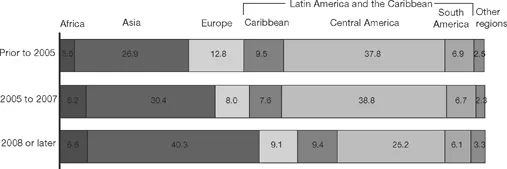
Figure 1.1 Foreign-Born Population by Period of Entry and World Region of Birth: 2010 (percent distribution. Data based on sample. For information on confidentiality protection, sampling error, nonsampling error, and definitions, see www.census.gov/acs/www/)
Note: “Other regions” includes Northern America and Oceania.
Source: U.S. Census Bureau, 2010 American Community Survey.
Figure 1.1 is from the U.S. Census’ American Community Survey in 2010 and shows immigration trends before and after 2005. Data indicated that the nine largest countries of birth constituted nearly 60% of the total foreign-born population in 2010 (U.S. Census, 2011). The largest number by far hailed from Mexico (29.3%), followed by China (5.4%), India (4.5%), and the Philippines (4.4%). The remaining countries in the top nine included Vietnam (3.1%), El Salvador (3.0%), Korea (2.8%), Cuba (2.8%), and the Dominican Republic (2.2%).
American Nativism and the Criminal Immigrant
The history of immigration and crime is situated within the larger context of immigration and related policy in the U.S. Perceptions regarding immigration and crime fall under the broader umbrella of perceptions regarding newcomers more generally such that perceptions of the criminal immigrant are merely one manifestation of a larger sociohistorical reality of nativism in the U.S. Nativism is both general and specific; it can be defined as “intense opposition to an internal minority on the ground of its foreign (i.e., ‘un-American’) connections” (Higham, 1988, p. 5). Nativism in the U.S. has typically resulted in discriminatory legislation and immigration restrictions aimed at controlling the movement and liberties of a foreign “other” (Bennett, 1988; Jaret, 1999). Various immigrant groups during different time periods have been viewed as deviant, criminal, immoral, atavistic, and otherwise unappealing. Generally, nativism can be viewed through the lens of four major themes: 1) certain races are intellectually and culturally inferior; 2) those from racially and culturally inferior groups face difficulties in assimilating to the larger Anglo-dominated culture; 3) immigrants represent an economical threat to native-born Americans; and 4) immigration triggers governmental crises (Feagin, 1997, pp. 13–14). The immigrant as criminal threat is situated within each of these larger themes.
The first groups to draw the ire of nativist philosophies and policies were the Germans in the mid-18th century and the French in the late 18th/early 19th centuries (Higham, 1988). Though the latter was largely a function of internal political strife between John Adams’ Federalists and Thomas Jefferson’s Democrats, these immigrants were painted as socially problematic, prompting a series of legislative acts known collectively as the Alien and Sedition Acts (discussed further in the following section). Nativism took on more significant proportions in response to Irish and Catholic immigration in the mid-19th century and led to the development of the first specifically anti-immigrant political party, the Know Nothings. At the heart of this party was rabid anti-Catholicism that in turn disproportionally affected immigrants from places like Ireland and Germany. Famine and political strife led to the immigration of millions between 1820 and 1850, mainly Irish and German Catholics. These Catholic immigrants were disliked for being foreign-born, non-Anglos and because of Protestant disdain for “popery” (Jaret, 1999).
Nativism in the mid-19th century, while firmly rooted in anti-Catholic bias, also adopted philosophies of racial superiority (Handlin, 1959). Race in this context was largely used to distinguish between the white race comprised of those with Northern European backgrounds (i.e., Nordic races) and those from undesirable groups such as Southern and Eastern Europeans (i.e., Mediterranean and Alpine races). Those outside of the Nordic race were viewed as racially inferior, prone to socially problematic behavior, more likely to engage in crime, and unlikely to successfully assimilate into American society. Though much of the racism was devoted to typologizing various European ethnicities, this new form of nativism was also directed toward people of color, most notably Mexicans in California and Texas whose land had been recently subsumed as new American territories. Consistent with larger beliefs regarding American Manifest Destiny, nativism saw these groups as socially and culturally inferior to Anglo-dominated culture that characterized the U.S.
Among immigrant groups, Italian Catholics were particularly vilified vis-à-vis criminality (see, for example, Bingham, 1908). Nativists viewed Italians as “inferior and degraded,” unable to effectively assimilate, and responsible for the destruction of the nation’s moral fiber. Media accounts described Southern Europeans as inferiors that lived immoral lives centered on alcohol consumption while similar derogatory depictions were leveled at Jews in the early 20th century, describing them as immoral and unscrupulous in business (Jaret, 1999). Even agents of the criminal justice system weighed in on the criminality of Italians and Jews in public forums. Tiedore A. Bingham, the then-Chief of the NYPD, wrote in 1908: “The crimes committed by the Russian Hebrews are generally those against property. They are burglars, firebugs, pickpockets, and highway robbers … but … pickpocketing is the one to which they seem to take most naturally” (p. 384). Bingham described the manner in which Jews work in concert with Italians to commit crimes in tandem and noted “the Italian malefactor is by far the greater menace to law and order,” while also alleging that both groups were “engaged in the slave trade in New York” (p. 390). Bingham’s treatise, published in the North American Review, also described concerns with Chinese, Eastern European, and Armenian immigrants.
Ultimately, nativism carried with it significant implications for American political, social, and economic life (Higham, 1988; Jaret, 1999; Perea, 1997). Political elites turned their attention to the immigration “problem” and established organizations such as the Immigration Restriction League, working doggedly to curtail immigration. Both the American Protective Association and the Ku Klux Klan worked aggressively against immigration from Southern and Eastern Europe as well as from Asia. Anti-immigrant hysteria reached a peak in the 1920s when many aliens were prohibited from certain jobs or professions such as medicine, law, and engineering (Jaret, 1999). Decades of anti-immigrant sentiment resulted in a number of restrictive pieces of legislation between 1870 and 1920, culminating in the Immigration Act of 1924, which established quota systems specifically designed to reduce and restrict the number of immigrants hailing from “inferior” races. Most notably, Asians and Southern and Eastern Europeans were targeted to ensure fewer immigrants arrived from these nations by setting quota numbers consistent with numbers in the U.S. Census from three decades prior (Bernard, 1980).
Early Studies of Immigration and Crime
Early empirical assessments of the immigration-crime link tended to differ based upon data availability, quality, and analysis. In an early 20th-century analysis using state-level data from New York, Hourwich (1912) reported that the state’s recent crime rate increase “coincided with the lowest ebb of immigration, while the high tide of immigration was contemporaneous with a decrease in crime” (p. 479). The study concluded that an increase in the foreign-born population was accompanied by a corresponding decrease in the crime rate. Sutherland (1927) was an early critic of data reliability with respect to the immigration and crime question but found that immigrants had a considerably higher commitment (i.e., incarceration) rate compared to native-born whites. However, he also reported lower commitment rates for New York City and New York State after allowing for the adult male population, an early reminder of the importance of confounding variables in the immigration-crime relationship. The Wickersham Commission (1936) examined the immigration and crime question and concluded that the foreign-born were significantly less likely to commit crime overall compared to the native-born, but that the rates were closer for crimes of violence and personal gain. The Commission also reported that arrest, conviction, and incarceration rates were similarly lower for the foreign-born. Glueck and Glueck (1930) found that the native-born were significantly over-represented in their study of 500 parolees such that 79% of ex-prisoners were native-bo...
Table of contents
Cover
Half Title
Title Page
Copyright Page
Table of Contents
Contributors
Immigration and Crime: An Introduction to the Handbook
PART I Historical Perspectives on Immigration and Crime
PART II Theoretical Perspectives on Immigration and Crime
PART III Empirical Research on Immigration and Crime
PART IV Current Issues in Immigration and Crime
Acknowledgments
Index
Trusted by 375,005 students
Access to over 1.5 million titles for a fair monthly price.
Study more efficiently using our study tools.
Frequently asked questions
Yes, you can cancel anytime from the Subscription tab in your account settings on the Perlego website. Your subscription will stay active until the end of your current billing period. Learn how to cancel your subscription
No, books cannot be downloaded as external files, such as PDFs, for use outside of Perlego. However, you can download books within the Perlego app for offline reading on mobile or tablet. Learn how to download books offline
Perlego offers two plans: Essential and Complete
Essential is ideal for learners and professionals who enjoy exploring a wide range of subjects. Access the Essential Library with 800,000+ trusted titles and best-sellers across business, personal growth, and the humanities. Includes unlimited reading time and Standard Read Aloud voice.
Complete: Perfect for advanced learners and researchers needing full, unrestricted access. Unlock 1.5M+ books across hundreds of subjects, including academic and specialized titles. The Complete Plan also includes advanced features like Premium Read Aloud and Research Assistant.
Both plans are available with monthly, semester, or annual billing cycles.
We are an online textbook subscription service, where you can get access to an entire online library for less than the price of a single book per month. With over 1.5 million books across 990+ topics, we’ve got you covered! Learn about our mission
Look out for the read-aloud symbol on your next book to see if you can listen to it. The read-aloud tool reads text aloud for you, highlighting the text as it is being read. You can pause it, speed it up and slow it down. Learn more about Read Aloud
Yes! You can use the Perlego app on both iOS and Android devices to read anytime, anywhere — even offline. Perfect for commutes or when you’re on the go. Please note we cannot support devices running on iOS 13 and Android 7 or earlier. Learn more about using the app
Yes, you can access Routledge Handbook on Immigration and Crime by Holly Ventura Miller, Anthony Peguero, Holly Ventura Miller,Anthony Peguero in PDF and/or ePUB format, as well as other popular books in Social Sciences & Immigration Policy. We have over 1.5 million books available in our catalogue for you to explore.