This volume is a key text for understanding the major regional international organizations of the Middle East. Analysing the Arab League, the Gulf Cooperation Council, and the Arab-Maghreb Union in a concise and accessible format, it explores their successes and failures across their full range of activities (economic, social, and political), while contextualising the reasons why many consider that these organizations have stalled.
The book:
- assesses the reasons why IOs in the Middle East are under-developed relative to neighbouring regional organizations;
- explores their history, evolution, and structure, while considering the successes and failures of each IO;
- analyses the reasons for the specific difficulties faced by each organization through the context of intra-regional relations;
- develops a new framework for analysing the forces that have shaped these bodies and challenges the existing narrative that largely ignores the achievements and prospects of the organizations;
- considers the likely impact of the Arab Spring upon the future development of these frequently overlooked regional international organizations.
This book will be of great interest to students and scholars of Middle East studies, international organizations, and global governance, as well as diplomats and policymakers
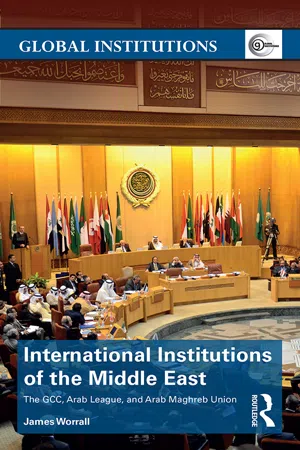
eBook - ePub
International Institutions of the Middle East
The GCC, Arab League, and Arab Maghreb Union
- 192 pages
- English
- ePUB (mobile friendly)
- Available on iOS & Android
eBook - ePub
International Institutions of the Middle East
The GCC, Arab League, and Arab Maghreb Union
About this book
Information
1 Context and framework
• Context
• Themes
• Concepts
• Framework
• Conclusion
Understanding the state system, politics, and international relations of the region is critical in appreciating the difficulties faced by the regional institutions of the Middle East. There have been a number of attempts to explain the perceived “failure” of the region’s institutional mechanisms in enabling meaningful cooperation across a broad range of issue areas from trade and industry to war and peace, with these explanations often drawing upon the wider international relations literature, especially theories of international cooperation and conflict. In addition, there have been attempts to examine the obstacles facing these institutional mechanisms, which focus much more on the specific dynamics of Arab regional politics, drawing on the importance of ideological differences, clashes of personality, and the specific dynamics of the types of authoritarian regimes in question.
Perhaps the greatest issue here is the difficulty of effectively bringing together regional politics and area studies approaches to the region, with their nuanced historical understanding, and broader international relations approaches which attempt to explain how international organizations (IOs) generally form and how they subsequently develop over time. These theories by their very nature have to omit detailed and specific dynamics and were frequently designed to explore the specific nature of organizations that have followed a particular path driven by liberal democratic Western states.
This chapter begins by outlining the broad context within which the region’s IOs were created and developed. This takes the form of a brief chronological survey of key periods in the shaping of a Middle Eastern order over the course of the twentieth century, which highlights key events and themes and provides the reader with the relevant background material against which the specific IOs were operating. The second part of the chapter consists of an exploration of the various tools that have been applied to the region’s IOs to explain the difficulties the region has faced in creating genuinely cooperative and empowered shared institutions. It assesses the utility of these various concepts before going on to outline, in the final part of this chapter, its own hybrid framework for analysis, which subsequently guides discussion in later chapters.
Thus we begin by providing the necessary context and background for what follows with a brief examination of the emergence of the state system in the modern Middle East, alongside an exploration of key tensions and dynamics that have had an impact upon the process of institutionalization across the Arab world and its two key sub-regions. Subsequent chapters draw upon this context in their analysis to explore the specific ways in which regional events and dynamics accelerate or derail processes of institutionalization.
Context
Any understanding of the development of the international institutions of the Middle East must be grounded in an awareness of the nature of the Arab States system and the authoritarian structures of rule, which have predominated across the region since independence. These more structural factors must also be tempered by an understanding of the normative, popular, and intellectual discourses amongst the populations of Middle Eastern states for some kind of Arab unity. Here, using Michael Barnett’s division of the region’s recent history as a rough chronological structuring tool,1 key events and themes are highlighted within each time period before some more general observations are made, both about changes to the regional order in general, and to the structure, ideology, and preoccupations of individual states and peoples, and what this means for IOs in the region.
The embryonic years, 1917–46
Beginning in the late nineteenth century as the ideas of nationalism and socialism spread to the Middle East, Arab consciousness began to grow as the Ottoman Empire gradually ceded control and European colonialism began to penetrate the region in a more comprehensive manner.2 The combination of changing power dynamics in the region, and increasing exposure to Western ideas and technologies gradually brought about a revolution in Arab thought which spread rapidly from the intellectual classes into the wider popular consciousness often through cultural channels.3 With the final dissolution of the Ottoman Empire upon the foundation of the Republic of Turkey in 1923 and with the promises made to the Arabs during the war in order to secure their support in the campaign against the Turks only being partially fulfilled, space was created for discussion around the future forms of Arab unity that might be achieved.4 During this crucial period key themes emerged, which were to shape regional politics over the coming decades. The first of these, of course, was the Balfour Declaration of 1917 promising a “national homeland for the Jewish people in Palestine.”5 While the declaration was deliberately not promising a “Jewish state” the growing numbers of Jewish immigrants into the British-mandated territory of Palestine was to become a major issue during the 1930s, which gave the Arabs a common cause.6 British and French control of League of Nations mandated territories, while clearly not the kind of colonialism practiced elsewhere, also contributed to the creation of a common enemy, which has traditionally been a necessary requirement of nationalism and forms the second major theme.7 Even during the height of this colonial époque mandated territories were receiving their independence, albeit with strong residual colonial influence and often a continuing military presence.8 Thus over this period Arab States, many of which were created from scratch through the mandate system, began to form links and to promote various schemes for greater Arab unity.9 It is during this period that the map of the Middle East as it is today was formed, with the Al-Saud finally coalescing their territorial gains and formally establishing Saudi Arabia in 1932,10 Iraq receiving its independence from Britain in the same year,11 followed by the French retreat from Lebanon in 1943, Syria in 1946,12 and Britain’s formal handover of power in Jordan in the same year. These states, plus Egypt, which had received its nominal independence in 1922,13 were to form the core of the Arab world and consistently tried to lead the growing Arab Nationalist movement and promote schemes for Arab unity.14
Consolidation, 1946–55
During the previous period the Middle East had been defined by the independence of many of its core states. This new period saw further decolonization with Libya gaining full independence in 1953 from French and British oversight, after having been an Italian colony before the war. More significant changes emerged as Arab Nationalism grew further in popularity and began to dominate domestic politics in the newly independent states of the region. One must also bear in mind that most of the countries in the region were monarchies during this period, the only exceptions being Syria and Lebanon, and these monarchies had close relationships with Britain and relied upon London for political, economic, and military assistance. This of course often brought the regimes into conflict with their Arab Nationalist populations who, as a core tenet of Arab Nationalism, were stridently anti-colonial and frequently explicitly anti-Western.15 As the various different creeds of Arab Nationalism consolidated their influence they increasingly aligned themselves with stridently socialist rhetoric to go alongside their anti-Western ideology.16
During this period, and despite the clear similarities between the various strains of Arab Nationalism, dividing lines began to emerge between the expressly communist groupings and those that advocated other forms of Arab Nationalism, including Ba’athism.17 These differences were later to entwine with other regional tensions and undermine moves towards Arab Unity. Arab Nationalism had by now gained deep roots in societies across the region with cells of the various strands of Arab Nationalism operating even at village level. These roots soon enabled the various movements to penetrate the structures of the state, including the security forces.18 This would lead to a series of coups d’état across the region during the course of the 1950s and 1960s.19 The most important of these coups came in 1952 with the colonels’ plot in Egypt, which removed King Farouk, eventually replacing him with Col. Gamal Abdul Nasser.20 As the region’s largest state by population, and the most important in terms of its cultural influence, being the major Arab center for publishing and cinema, this meant that core soft power tools were now controlled by Arab Nationalists. Nasser set about spreading his beliefs and fomenting unrest elsewhere. Before that, though, he had to consolidate his rule and find a way of removing the British from their base in the Suez Canal Zone. This he achieved in 1954 after a subversive campaign and a skillful treaty renegotiation.21
The other crucial development during this period was of course Britain’s withdrawal from its Palestine mandate, and the declaration in 1948 of the State of Israel after a UN partition plan for Palestine was rejected by the Arab States. The Arab–Israeli War which ensued led to the surprising defeat of the combined might of the Egyptian, Syrian, Jordanian, Iraqi, and Lebanese Armies, and was a humiliation for the Arabs who were faced with the exodus of hundreds of thousands of Palestinian refugees.22 The episode became known as an-nakhba, or the catastrophe, and was to drive regional politics, Arab Nationalism, and the search for unity over the coming decades.
The peak of Arab Nationalism, 1956–66
With Arab Nationalism now consolidated amongst the populations of the core states of the Middle East, even the Saudi monarchy was aware of the power of the movement, and the idea of Arab unity, amongst large elements of its population. The Algerian war of independence against the French, which had been running since 1946, became especially violent during this period, attracting widespread Arab support that would eventually lead to Algeria’s independence in 1962.23 This was preceded by Tunisian, Moroccan, and Sudanese independence in 1956, and British protection over Kuwait ending in 1961. These years were pivotal for Arab Nationalism’s power in the region and in terms of the political attempts at Arab unity, which were prosecuted through a number of different schemes. The period also saw the deposition of more of the region’s monarchies in North Yemen in 1962 and Iraq in 1958, along with Arab Nationalists taking over in Syria.
Perhaps the most obvious development in this era was the Suez Crisis of 1956 in which Nasser nationalized the Suez Canal, which was swiftly followed by Britain and France intervening militarily in Egypt to protect the canal, in collusion with the Israelis who offered a pretext when they invaded the Sinai Peninsula.24 The subsequent global condemnation, and withholding of US monetary and diplomatic support, led to the intervention failing politically rather than militarily. This handed a colossal propaganda victory to Nasser whose popularity across the region soared to unprecedented levels. The collusion between the colonial powers and the Israelis only confirmed Arab Nationalist conspiracy theories and was in hindsight the movement’s apogee.25
What the series of coups, wars, and rhetoric concealed, though, were two other important themes that came to the fore during these years. The first of these was that Nasser’s prominence drew a backlash from other Arab leaders as he attempted to meddle in their affairs. Other states and leaders wanted to lead the Arabs and other forms of Arab Nationalism other than Nasserism were further promoted, thus widening divisions in the movement, and the meddling came to be seen as a security threat, leading to Arab politics becoming increasingly securitized at elite level. The second major change was economic. The region saw a rapidly emerging split develop between those states that produced oil in large quantities and those that did not have the same oil resources.26
The other economic change was principally led by the new Arab Nationalist regimes whose socialist tendencies led them into large-scale nationalizations, of which the Suez Canal is the prime example. These nationalizations in Egypt led to Greek, Italian, and Armenian business owners fleeing the country and many businesses floundering under their new state owners. The implementation of large-scale industrialization (including the Aswan High Dam and Helwan City), often chaotic land reform, and import substitution programs caused significant economic and environmental damage without providing the benefits so loudly trumpeted by the regimes.27 Despite these failures, these new regimes were often quite successful in providing minimum safety nets and basic health care, and the period also saw rapid declines in illiteracy and infant mortality levels; however, these programs were expens...
Table of contents
- Cover
- Half Title
- Title Page
- Copyright Page
- Table of Contents
- List of illustrations
- Abbreviations
- Maps
- Acknowledgements
- Prologue
- Introduction
- 1. Context and framework
- 2. The Arab League: Structure and evolution
- 3. The Arab League: Peace and security
- 4. The Arab League: Economic, social, and cultural cooperation
- 5. The Arab League: Problems and prospects
- 6. The Gulf Cooperation Council: Structure and evolution
- 7. The Gulf Cooperation Council: Security, peace, and defense
- 8. The Gulf Cooperation Council: Economic, social, and cultural cooperation
- 9. The Gulf Cooperation Council: Problems and prospects
- 10. The Arab Maghreb Union
- 11. The Arab League, Gulf Cooperation Council, and the Arab Spring
- Conclusion
- Select bibliography
- Index
Trusted by 375,005 students
Access to over 1.5 million titles for a fair monthly price.
Study more efficiently using our study tools.
Frequently asked questions
Yes, you can cancel anytime from the Subscription tab in your account settings on the Perlego website. Your subscription will stay active until the end of your current billing period. Learn how to cancel your subscription
No, books cannot be downloaded as external files, such as PDFs, for use outside of Perlego. However, you can download books within the Perlego app for offline reading on mobile or tablet. Learn how to download books offline
Perlego offers two plans: Essential and Complete
- Essential is ideal for learners and professionals who enjoy exploring a wide range of subjects. Access the Essential Library with 800,000+ trusted titles and best-sellers across business, personal growth, and the humanities. Includes unlimited reading time and Standard Read Aloud voice.
- Complete: Perfect for advanced learners and researchers needing full, unrestricted access. Unlock 1.5M+ books across hundreds of subjects, including academic and specialized titles. The Complete Plan also includes advanced features like Premium Read Aloud and Research Assistant.
We are an online textbook subscription service, where you can get access to an entire online library for less than the price of a single book per month. With over 1.5 million books across 990+ topics, we’ve got you covered! Learn about our mission
Look out for the read-aloud symbol on your next book to see if you can listen to it. The read-aloud tool reads text aloud for you, highlighting the text as it is being read. You can pause it, speed it up and slow it down. Learn more about Read Aloud
Yes! You can use the Perlego app on both iOS and Android devices to read anytime, anywhere — even offline. Perfect for commutes or when you’re on the go.
Please note we cannot support devices running on iOS 13 and Android 7 or earlier. Learn more about using the app
Please note we cannot support devices running on iOS 13 and Android 7 or earlier. Learn more about using the app
Yes, you can access International Institutions of the Middle East by James Worrall in PDF and/or ePUB format, as well as other popular books in Politics & International Relations & Intergovernmental Organizations. We have over 1.5 million books available in our catalogue for you to explore.