eBook - ePub
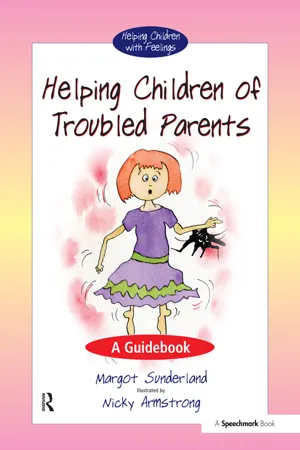
Helping Children with Troubled Parents
A Guidebook
- 238 pages
- English
- ePUB (mobile friendly)
- Available on iOS & Android
eBook - ePub
About this book
This book is designed to enable practitioners to help children whose emotional wellbeing is being adversely affected by troubled parents. These are children who live with the burden of having to navigate their parent's troubled emotional states, often leaving them with a mass of painful feelings about a chaotic and disturbing world. They can feel alarmed by their parent rather than experiencing them as 'home', and a place of safety and solace. The author explores the fact that when parents are preoccupied with their own troubles, they are often unable to effectively address their child's core relational needs, e.g. soothing, validating, attunement, co-adventure, interactive play. As a result, children are left self-helping, which all too often means drugs, drink, self-harm, depression, anxiety, eating disorders or problems with anger in the teenage years. This guidebook offers readers a wealth of vital theory and effective interventions for working with these children and, specifically, the key feelings such children need help with. Particular focus is given to the effects on children of: family breakdown; separation and divorce; witnessing parents fighting; and parents who suffer from depression or anxiety, mental or physical ill-health, alcohol or drug addiction. Readers will learn: the complexity of children's feelings about their troubled parents; how to enable children to address their unspoken hurt, fear, grief, rage, and resentment about their troubled parent in order to move forward in their lives; how to empower children to find their voice when they have been left in the role of impotent bystander; effective parent-child intervention when parental troubles are adversely affecting the child; and how to help a parent and child 'find' each other again.
Information
Part One
Helping Children of Troubled Parents
How Parents’ Troubles can Affect their Parenting
Troubled parents often find it difficult to be an emotional regulator for their child
All children need their parents to be ‘emotional regulators’. This means that they need their parents to help them with big feelings such as rage, frustration, separation distress. They need their parents to soothe their distress, to provide empathic listening when needed, to help the child make sense of what is happening and has happened to them in their lives for better or worse and to enable them to manage conflict with siblings and peers well. In other words, a key parental role is to help the child in states of intense emotional dysregulation to move back to emotional regulation and so a feeling of well-being.
Freud knew that all children need emotional regulation. ‘The child is really not equipped to master psychically the large sums of excitation that reach him whether from without or from within’ (Freud, 1926).
Their self-confidence as they carried us when we were babies, their security when they allowed us to merge our anxious selves with their tranquility – via calm voices or closeness with their relaxed bodies as they held us. [All this] will be retained by us as the calmness we experience as we live our lives. (Kohut and Wolf, 1978)
When the child is being infuriating, irritating, relentlessly demanding, parents who are effective emotional regulators will stay stable under stress, calm and reflective rather than shouty, angry, controlling or critical, or becoming like a toddler themselves.
Emotional regulation not only develops the child’s mind but also their brain. It sets up stress regulatory systems in the brain, enabling good handling of life’s inevitable stressors and knocks (Cozolino, 2006; Schore, 1999, 2003a, 2003b). In other words, when we are consistently and repeatedly emotionally responsive to children then top-down brain pathways naturally inhibit primitive impulses to lash out or run away. When this doesn’t happen, life becomes very difficult and minor stressors can be experienced as major emergencies. This leaves the parent vulnerable to developing mental health problems with anxiety, aggression or depression.
To be an emotional regulator for a child you need the space in your mind to be able to think into and feel into your child’s pain. Troubled parents don’t have this space due to their own mind being full of their own distress, which they are finding it difficult to deal with. It takes up all their time to try to emotionally regulate themselves.
Troubled parents often don’t have the patience to respond to the infant’s incessant (but entirely developmentally appropriate) needs
Behavioural psychologists have observed that preschoolers typically demand that their parents deal with some kind of desire or need every 20 seconds. So if you have more than one preschooler it’s a need every 10 seconds (Gottman and DeClaire, 1998). Under ideal circumstances, a parent can respond cheerfully, with interest and attunement, but when a parent is troubled, a child’s incessant, and sometimes irrational, demands can drive parents wild.
Example
Amelie’s (aged two) needs, which come every 20 seconds:
- to show you her plastic dinosaur for the fifth time
- to separate the sweetcorn from the ham on her dinner plate
- to help lift her up to see what is on the top shelf
- to pick her up and give her a cuddle when she hurts her knee on the toy car
- to be the one who switches off the cold tap when you brush your teeth
- to get your help in trying to turn a key in the front door lock
- to get you to comment for the sixth time on the spider crawling up the bathroom wall
- to listen to her story for the umpteenth time about how the naughty puddle made her slip that morning.
Troubled parents affect the child’s behaviour
Troubled parents, distracted by their own problems, have less quality time and quality attention for their children, so children can move into more disturbed or troubled behaviour. The parent’s emotional dysregulation is very dysregulating for the child. In other words, the parent’s tensions become the child’s tensions. The child can end up discharging, or ‘acting out’ through bad behaviour, the tension from their parent’s painful feelings or painful feelings in the parental relationship.
Also, children learn through modelling. If a parent is impulsive, reactive and having angry outbursts, they teach their children to be reactive and impulsive and to have angry outbursts. If a parent is anxious, the child will be anxious. If a parent is warm, kind and gentle, the child will be warm, kind and gentle, and so on.
Troubled parenting affects the child’s quality of life
There is no doubt that gross events – such as births, deaths, illnesses and the deaths of siblings, the illnesses and deaths of parents, the breakups of families, the child’s prolonged separations from the significant adults, his severe and prolonged illness, and so on – can play an important role in the genetic factors that lead to later psychological illness. But … experience tells us that in the great majority of cases it is the specific [mental unwellness] of the parent(s) and specific [negative] features of the atmosphere in which the child grows up that account for the mal-developments, fixations and unsolvable inner conflicts characterizing the adult personality. (Kohut, 1977)
The child of troubled parents often has poor quality of life. This is because they are so often deprived of a carefree childhood and live in a family culture where the very atmosphere of relational exchanges is troubled in the way described above. Instead, they are dealing with major existential issues at a very young age, such as:
- how to respond to the emotional needs of an adult
- how to manage adult mental health problems
- how to live with a parent who is clinically depressed or addicted to substances
- how to manage the fallout from parents arguing and family breakdown.
This is so much the case that the troubled parent can become the child’s world:
- If Mummy is wobbly, the world is wobbly
- If Mum ain’t happy, no one is happy
- If Daddy is frightening the world is frightening
- If Mum is chaotic – the world feels mad
(Brian Post)
Some children of troubled parents don’t realise that there is anything wrong. They don’t know any other reality. They had not had another childhood or another set of parents – so unhappiness is just a way of being. Some may never have been close enough to a fortunate child’s home life to know there is another very different reality for some children. So they may think, this is what you do as a child: look after your parent, put her in bed when she is drunk, mop up the sick, get the younger children ready for school.
Troubled parenting affects the child’s ability to learn
The troubled parent is so much of a worry for so many children that it can be difficult to think of other things, or focus on anything else. Many children are constantly monitoring their parent. For some children all the space in their minds is taken up thinking about their troubled parent and how to get him or her to be happy or well again.
Troubled parenting affects the child’s ability to feel
A child with a troubled parent may survive by emotional numbing. Seeing their parent in so much emotional or physical pain is just too much. It’s a way of surviving, but surviving is not living. If you cut off pain you can cut off life, in other words, living without the capacity to feel passionate or excited or loving. The lines in Ted Hughes’ poem called ‘Sheep’ offer a poignant portrayal of this numbing process.
Only slowly their hurt dies, cry by cry
As they fit themselves to what has happened.
(Ted Hughes, from ‘Sheep’ (part III), 1995)
I have known many children and adults for whom these two lines are particularly resonant, who have indeed had to ‘fit themselves to what has happened’, by closing their hearts. The lines describe the gradual building of defences to protect against pain, accompanied by certain loss of aspects of one’s very humanity. Some children have learned not to have feelings, so that they don’t burden their parents with them. As a six-year-old said to me, ‘I keep my feelings in a tunnel’.
Troubled parenting affects the child’s mental health now and in the future
A large number of studies link troubled parents to conduct disorders, learning difficulties, mental ill-health in infants, children, and teenagers. The statistics clearly show that chronic distress or stress states in parents appears to be one of the biggest contributory factors to children developing or sustaining emotional problems (Department of Health, 2005).
Some anxious children develop obsessive-compulsive ordering or checking rituals. Sometimes this is due to them trying to ‘tidy up’ their parent’s too messy feelings. Research has shown that having angry or depressed parents is predictive of later aggression in children (Lyons-Ruth, 1996). This is due to the persistent activation of the stress system in the child’s brain called the hypothalamus-pituitary-adrenal axis (HPA axis). This ‘axis’ can become wired for oversensitivity if the child has an alarming parent.
Some children get a double whammy of two emotionally dysregulated parents, such as a depressed mother and a father who experiences angry explosions. This can be a damaging situation for a child to grow up in.
Parental mental health in the first years of life has a significant influence on early brain activity and long-term behavioural outcome (Dawson et al, 2000). Biochemical systems activating maternal feelings of protective, warm, tender, compassionate feelings towards her baby can become blocked by high levels of stress hormones. The stress in the parent’s own body and brain will result in too high levels of stress chemicals in her child’s brain (Schore 2003a, 2003b).
Troubled parenting affects the child’s body
With the calm untroubled parent, ‘The infant merges with the strength and calm of the mother’s body’ (Mahler, 1968). Over time, her calmness becomes the child’s calmness. When a parent is troubled, there is no merging with anything lovely, only with a body with the tensions and agitations from being anxious, angry or depressed. So a troubled parent’s body can become a place of alarm not of calm. Over time, this can then lead to disgust for the mother’s body, particularly as the child gets older.
Research shows that children will be reacting to the parent’s stress or distress states physiologically as well as psychologically, so children of troubled parents often have sleep, eating or elimination problems. They are far more highly aroused and, during rest periods, far slower to relax, particularly when both parents expressed intense emotions (Hibbs et al, 1992).
Children of troubled parents may experience the following physiological problems:
- heart rate (racing – sometimes 140 beats per minute)
- sleep
- eating
- toileting
- immune system.
(Field, 1994; Dawson et al, 2000; Hibbs et al, 1992)
When emotionally well parents become troubled
When a previously well parent becomes mentally ill or troubled, the child suffers ...
Table of contents
- Cover
- Half Title
- Title
- Copyright
- Contents
- ABOUT THE BOOK
- HOW TO USE THE BOOK
- INTRODUCTION
- PART ONE
- PART TWO
- REFERENCES
Trusted by 375,005 students
Access to over 1.5 million titles for a fair monthly price.
Study more efficiently using our study tools.
Frequently asked questions
Yes, you can cancel anytime from the Subscription tab in your account settings on the Perlego website. Your subscription will stay active until the end of your current billing period. Learn how to cancel your subscription
No, books cannot be downloaded as external files, such as PDFs, for use outside of Perlego. However, you can download books within the Perlego app for offline reading on mobile or tablet. Learn how to download books offline
Perlego offers two plans: Essential and Complete
- Essential is ideal for learners and professionals who enjoy exploring a wide range of subjects. Access the Essential Library with 800,000+ trusted titles and best-sellers across business, personal growth, and the humanities. Includes unlimited reading time and Standard Read Aloud voice.
- Complete: Perfect for advanced learners and researchers needing full, unrestricted access. Unlock 1.5M+ books across hundreds of subjects, including academic and specialized titles. The Complete Plan also includes advanced features like Premium Read Aloud and Research Assistant.
We are an online textbook subscription service, where you can get access to an entire online library for less than the price of a single book per month. With over 1.5 million books across 990+ topics, we’ve got you covered! Learn about our mission
Look out for the read-aloud symbol on your next book to see if you can listen to it. The read-aloud tool reads text aloud for you, highlighting the text as it is being read. You can pause it, speed it up and slow it down. Learn more about Read Aloud
Yes! You can use the Perlego app on both iOS and Android devices to read anytime, anywhere — even offline. Perfect for commutes or when you’re on the go.
Please note we cannot support devices running on iOS 13 and Android 7 or earlier. Learn more about using the app
Please note we cannot support devices running on iOS 13 and Android 7 or earlier. Learn more about using the app
Yes, you can access Helping Children with Troubled Parents by Margot Sunderland,Nicky Armstrong,Nicky Armstrong in PDF and/or ePUB format, as well as other popular books in Psychology & Education General. We have over 1.5 million books available in our catalogue for you to explore.