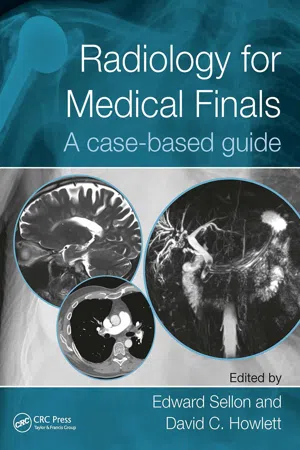
This book is an informed, educational and abundantly illustrated guide to the imaging knowledge that medical students in the clinical years of their undergraduate studies will be required to get to know, understand and recall in order to negotiate successfully their finals exams. Via the popular and instructive case-based format, readers are guided through 100 cases chosen specifically to reflect what the authors consider is necessary knowledge for finals, and imaging modalities that students can reasonably expect to encounter with a resulting emphasis on plain film with some CT and MR.
eBook - ePub
Radiology for Medical Finals
A case-based guide
- 562 pages
- English
- ePUB (mobile friendly)
- Available on iOS & Android
eBook - ePub
Radiology for Medical Finals
A case-based guide
About this book
Information
1 Overview of imaging modalities
It is helpful for finals to have an understanding of the core imaging modalities you are likely to encounter and to have an idea of the relative strengths/weaknesses and indications/ contraindications for each.
Plain Films: Chest X-Ray, Abdominal X-Ray, And Orthopaedic Bone/Joint X-Rays
Conventional X-ray remains an important diagnostic tool in medicine and remains the most commonly used imaging modality. Plain films are commonly the chest X-ray (CXR), abdominal X-ray (AXR), and orthopaedic bone/joint X-rays (XRs). An XR is relatively inexpensive, time effective, and does not require any special preparation of the patient. There is a degree of ionising radiation associated with X-ray exposure and this radiation dose varies with body part; a lumbar spine XR entails a far higher radiation dose than a wrist XR for example owing to radiation of pelvic organs. However, generally X-ray doses are far lower than those associated with computed tomography (CT). Dose information is included in Chapters 3 and 4. As always ‘justify’ the exposure: does the benefit to the patient outweigh the potential risk of irradiation?
When a radiograph is taken, the X-ray beam passes through the body part onto an X-ray sensitive screen. Bones, owing to their high calcium content, absorb most of the X-rays whereas soft tissues absorb a smaller amount, depending on composition and density. As a result, X-rays from the bones do not reach the screen and appear white on the radiograph, with the soft tissue appearing darker. X-rays pass through the air without being absorbed at all, which is then detected by the screen and appears black on the radiograph.
ADVANTAGES
- Inexpensive.
- Usually quick to perform.
- Painless, noninvasive.
- Good diagnostic tool for many pathologies.
DISADVANTAGES
- Soft tissue, lung, bone resolution much reduced compared with CT/magnetic resonance imaging (MRI).
- Provides a two-dimensional (2D), single image only.
- Radiation exposure.
INDICATIONS – ARE BROAD
CXR
- Respiratory – infection, septic screen, pneumothorax, chest trauma, inhaled foreign body, pleural effusion, suspected malignancy.
- Cardiac – clinical heart failure, clinical cardiomegaly, heart murmurs.
AXR
- Abdomen – bowel obstruction, perforated viscus (erect CXR more sensitive), ingested foreign body, abdominal pain in the emergency setting.
- Pelvic – pelvic fracture, neck of femur fracture.
Soft tissue XR neck
- Inhaled foreign body.
- Retropharyngeal abscess.
Bone XR
- Limbs – trauma, fractures, skeletal survey, acutely swollen joint, osteomyelitis, septic arthritis, bone pain, tumour/metastasis.
- Skulls – skeletal survey, myeloma, dental imaging.
- Spine – trauma, scoliosis.
Ultrasound
Ultrasound (US) uses sound waves of high frequencies, which are emitted towards the studied tissues and are reflected/echoed back to the probe depending on the tissue density and composition. This signal is then translated into an US image. US is a ‘live’ imaging modality and requires interpretation while the investigation is being carried out. US colour Doppler techniques are used to assess moving blood and are used in vascular assessment, e.g. carotid stenosis.
ADVANTAGES
- No radiation, noninvasive (some US is performed using endocavity probes, e.g. transrectal, transvaginal, transoesophageal).
- Real-time assessment and interpretation of results.
- Relatively inexpensive.
- Useful for imaging of soft tissue and muscles, extremities, testes, breast, and eye, plus abdomen, pelvis, chest, and vascular colour Doppler applications.
DISADVANTAGES
- Requires a skilled practitioner with US interpretation skills, operator dependent.
- No use for bone imaging as sound is attenuated/absorbed by bone.
- Images are degraded by gas and fat, and this restricts US use in the abdomen/pelvis in some patients.
INDICATIONS
- Abdomen – trauma, malignancy, abdominal aortic aneurysm (AAA) surveillance, gallstones, suspected hydronephrosis.
- Chest – assessment of pleural spaces.
- Musculoskeletal – assessment of muscles, ligaments, and tendons.
- Scrotal – assessment of testicles, epididymis, and scrotum.
- Obstetrics – growth scans, placental sighting, anomaly scans.
- Gynaecology – transabdominal and transvaginal imaging of ovaries, uterus, and Fallopian tubes.
- Baby hips.
- Breast, eye assessment.
- Vascular applications – suspected upper/lower limb deep vein thrombosis (DV T), carotid/ peripheral vascular assessment.
Computed Tomography
CT uses X-rays, which are emitted from a rotating X-ray source around the patient with multiple detectors to produce a series of 2D axial images of the studied body part. This can then be computer-reconstructed to obtain axial, coronal, sagittal 2D, and three-dimensional (3D) images of the studied body parts. There are other imaging modalities that make use of CT imaging such as positron emission tomography (PET scan).
ADVANTAGES
- Provides 2D cross-sectional images of the body, which are rapidly acquired with the potential to reformat in multiple planes; 3D reformatting is also possible.
- Provides a detailed image of the studied body part and the surrounding tissue.
- High sensitivity and specificity in particular for assessment of the lungs, mediastinum, bones, abdomen/pelvis structures, the brain – especially acute blood.
DISADVANTAGES
- CT scanners are expensive.
- Moderate to high dose of radiation, depending on areas scanned.
- May require intravenous (IV) iodinated contrast use – risk of contrast reaction (allergy, anaphylaxis) and nephrotoxicity in those at risk.
INDICATIONS
- Head – trauma, brain imaging (ischaemic/haemorrhagic strokes, calcifications, haemorrhage, malignancy).
- Chest – detailed imaging of the lungs to detect abnormalities not seen on CXR, used in diagnosis and surveillance of malignancy, pulmonar y embolism (CT pulmonary angiogram: CTPA), emphysema, fibrosis. Cardiac – CT to image coronary arteries.
- Abdomen and pelvis – diagnosis, staging, and surveillance of malignancies, bowel obstruction, A AA, pancreatitis, renal calculi (CT kidneys ureters and bladder [CT KUB] and CT IV urogram [CT IVU]).
- CT angiography and venography – for example, suspected limb or mesenteric vascular occlusion, sagittal sinus thrombosis.
- Orthopaedic – complex fractures.
- CT-guided biopsy, surgery, and radiosurgery.
Magnetic Resonance Imaging
MRI does not use any X-rays, thus does not expose the patient to ionising radiation. It is superior to CT in obtaining detailed images of the soft tissues and also the brain. MRI uses strong magnetic fields, radio waves, and field gradients to generate the image.
In structural MRI, the images are obtained by proton alignment by an external magnet and a subsequent radiofrequency pulse disrupts the equilibrium, which gives an MRI signal. Details of MRI protocols and sequences are not needed for finals – T1- and T2-weighted are common sequences (in the brain cerebrospinal fluid [CSF] appears bright/white on T2), and IV contrast can also be used (gadolinium).
ADVANTAGES
- No ionising radiation exposure.
- Provides 2D and 3D cross-sectional images of the body.
- Superior to other imaging modalities in obtaining high-resolution images of the brain and musculoskeletal system.
- Ideal for soft tissue structures, cartilage, and ligament imaging.
- Vascular and cardiac applications.
DISADVANTAGES
- Expensive equipment – the most expensive imaging modality.
- Time consuming, requiring patient cooperation, ability to lie still, often for 30 – 60 minutes.
- Contraindicated in patients with ferrous metal implants – pacemakers, cochlear implants, metallic foreign bodies in the eyes.
- MRI is undertaken in a relatively enclosed space – unsuitable for patients with claustrophobia and young children (may need general anaesthesia).
- Relatively contraindicated in pregnancy, particularly first trimester.
INDICATIONS
- Head and neck – neuroimaging – clear differentiation between the grey and white matter, diagnosis of demyelinating disease, cerebrovascular disease, detailed imaging of malignancies and infectious diseases, epilepsy imaging, functional MRI brain studies.
- CT is more accurate in the detection of acute blood; new MRI techniques, e.g. diffusion weighting, can detect cerebral ischaemia very early (minutes) when compared with CT.
- Spine imaging – nerve compression (cord and cauda equina), malignancies, disc disease.
- Hepatobiliary – liver, pancreas, and biliary lesions, MR cholangiopancreatography (MRCP) for structural imaging of the biliary tree.
- Small bowel – Crohn’s disease diagnosis.
- Knee and other joints – used in cartilage and ligament imaging.
- Angiographic, vascular protocols, cardiac MRI.
- Prostate imaging, diagnosis, and staging of prostate cancer.
- Rectal, gynaecological cancer staging.
Nuclear Medicine
Nuclear medicine uses injected (or inhaled) radioactive isotopes to diagnose or treat many conditions: endocrine, heart, and gastrointestinal (GI) diseases. It images the emission of isotope radiation from within the body and can construct a 2D/3D image of the areas of the radioactive substance uptake. It is used for functional imaging, rather than structural imaging, as contrast/ spatial resolution is poor. Some nuclear medicine is combined with CT/MRI to improve anatomical detail.
IMAGING MODALITIES
- Myocardial perfusion scan – assessment of the function of myocardium for diagnosis of hypertrophic cardiomyopathy and coronary artery disease, in combination with MRI +/– CT.
- Genitourinary scan – assessment of renal blood flow and function, evaluate renovascular hypertension, and assess vesicoureteral reflux.
- Bone imaging – assessment of bone metastases, infection.
- PET – imaging of metastases, neuroimaging – imaging of brain activity in dementias, combining injection of metabolically active substances, e.g. fluorodeoxyglucose (FDG) and tomography/CT detection.
ADVANTAGES
- Provides functional information of organs and disease processes.
- Advancement of treatment options for cancer patients.
- Allows early or improved detection of metastases (PET).
- Provides detailed and accurate information in hard to reach areas.
- Radioisotopes are used to treat some cancers, e.g. radioiodine and papillary thyroid cancer.
DISADVANTAGES
- High cost.
- Exposure...
Table of contents
- Cover
- Halftitle
- Title
- Copyright
- Contents
- Foreword by Professor Malcom Reed
- Foreword by Dr Giles Maskell
- Preface
- Acknowledgments
- Abbrevations
- 1 Overview of imaging modalities
- 2 Hints and tips for finals Objective Structured Clinical Examination
- 3 The normal chest X-ray
- 4 The normal abdominal X-ray
- 5 Thoracic cases
- 6 Cardiovascular cases
- 7 Abdomen and pelvis cases
- 8 Musculoskeletal cases
- 9 Neurology cases
- 10 Paediatric cases
- Bibliography
- List of cases
- Index
Trusted by 375,005 students
Access to over 1.5 million titles for a fair monthly price.
Study more efficiently using our study tools.
Frequently asked questions
Yes, you can cancel anytime from the Subscription tab in your account settings on the Perlego website. Your subscription will stay active until the end of your current billing period. Learn how to cancel your subscription
No, books cannot be downloaded as external files, such as PDFs, for use outside of Perlego. However, you can download books within the Perlego app for offline reading on mobile or tablet. Learn how to download books offline
Perlego offers two plans: Essential and Complete
- Essential is ideal for learners and professionals who enjoy exploring a wide range of subjects. Access the Essential Library with 800,000+ trusted titles and best-sellers across business, personal growth, and the humanities. Includes unlimited reading time and Standard Read Aloud voice.
- Complete: Perfect for advanced learners and researchers needing full, unrestricted access. Unlock 1.5M+ books across hundreds of subjects, including academic and specialized titles. The Complete Plan also includes advanced features like Premium Read Aloud and Research Assistant.
We are an online textbook subscription service, where you can get access to an entire online library for less than the price of a single book per month. With over 1.5 million books across 990+ topics, we’ve got you covered! Learn about our mission
Look out for the read-aloud symbol on your next book to see if you can listen to it. The read-aloud tool reads text aloud for you, highlighting the text as it is being read. You can pause it, speed it up and slow it down. Learn more about Read Aloud
Yes! You can use the Perlego app on both iOS and Android devices to read anytime, anywhere — even offline. Perfect for commutes or when you’re on the go.
Please note we cannot support devices running on iOS 13 and Android 7 or earlier. Learn more about using the app
Please note we cannot support devices running on iOS 13 and Android 7 or earlier. Learn more about using the app
Yes, you can access Radiology for Medical Finals by Edward Sellon, David Howlett, Edward Sellon,David Howlett in PDF and/or ePUB format, as well as other popular books in Medicine & Medical Theory, Practice & Reference. We have over 1.5 million books available in our catalogue for you to explore.