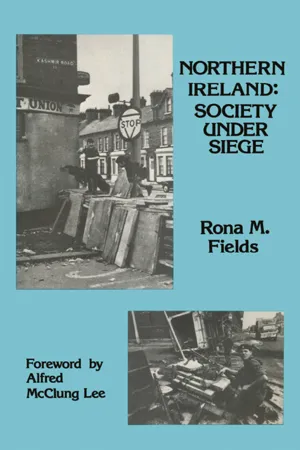
The troubles in Ireland are not new. They have taken a heavy toll in lives and, perhaps more importantly, in psychological health. This book is not concerned with events in themselves, although it includes historical analysis of the conflict in Northern Ireland. It does attempt to discover the human effects of long-term conflicts such as those occurring in Ireland. From testing and interviews with the children, women, and men of Northern Ireland beginning in 1969, the author has developed a case study of the long-term effects of stress on a population. She identifies certain social control mechanisms that produce a mixture of chaos and docility in the troubled North and argues that England has established these in order to destroy the identity of the people—a process she calls "psychological genocide.", Northern Ireland: Society Under Siege applies social-psychological theory to a concrete and ongoing situation in a way that is illuminating for the general reader and for the specialist. Dr. Fields has done what might appear obvious: find out the effects of stress on a population by going to that population and observing what their lives are like. The remarkable fact is, however, that until now no one has done so., ...a wide-ranging and perceptive book.... A significant thrust and contribution of this book is Fields' discussion of psychological and social control procedures and practices....(Fields') report is a challenge to humanity and an indictment of English patricianism, racism, and imperialism. Alfred McClung Lee, Dr. Rona Field is a brave and deeply compassionate human being, a committed researcher who cannot be intimidated by gunmen, English soldiers, bigots, ferocious politicians, or the horrors of confronting human suffering in dreadful forms. This valiant woman deserves international praise and recognition for the unflinching study of a tragic society. Dennis Clark, National Catholic Reporter
- 268 pages
- English
- ePUB (mobile friendly)
- Available on iOS & Android
eBook - ePub
About this book
Information
IntroductionIreland—The Victim | 1 |
There is a saying in Ireland—“fighting like a couple of Kilkenny cats”—which implies a kind of mortal combat undertaken by desperate individuals. The saying arose from an incident that, like most incidents of several hundred years ago, was either historical, apocryphal, or mythical. It was the seventeenth-century siege of Kilkenny, an old and small city near the center of Ireland that held fast against the invading English armies half a dozen times or more between the fifteenth and seventeenth centuries. This time it was Cromwell’s army, it is said, which, when they had finally broken through the defenses of the besieged town, set out to slaughter every living thing. Not a person nor a cow was to be left alive, for they were all Irish, and by order everything Irish was to be “extirpated.” They slaughtered the priests, every one they could find, in terrible ways. Then they set about with sword and with their bare hands and with fire to massacre the men, women, and babies. When they’d finished with the human inhabitants, the soldiers, despite their weariness, went to work slaughtering the cattle and then the dogs and the sheep. When they came to the cats, they were tired and a little bored, so they invented something new: they strung a line between two trees and, having gathered up all the cats, tied them by their tails, two by two, and flung them over the line. Well, cats being cats, they clawed and chewed each other to death.
The story is historically uncertain, but the slaughters and scorched-earth policies of successive English invasions are not only historical facts, but also a feature of contemporary social psychology of Ireland. The Irish people have a psychohistory predicated on siege, manipulation, victimization, wanton destruction and self-destruction like that of the Kilkenny cats.
It is currently out of vogue to relate the history of Ireland in terms of colonial oppression, bloody revolutions, foiled struggles for liberation, economic devastation, and martyrdom. The current Irish Minister for Posts and Communication, Conor Cruise O’Brien, a noted literary critic and historian, has eloquently argued that this kind of history has been self-defeating and worse—self-deluding. The current “troubles” in the north, as they are called, are but another evidence, he says, of the reality of two Irelands.1 If this is so, then writing about the Irish past must acknowledge a discontinuity predicated on the geopolitical border fixed in 1922 as a compromise to terminate years of bloodshed on that island. But in spite of that separation, the death toll by political violence has persisted north and south of the border to this date. The political imprisonment of thousands of men and women, north and south, during the past decade would also suggest that the history of Ireland before 1922 is not merely an archaic myth.
There can be room for argument on the issue of premeditated, organized, schematic destruction of the Irish people versus happenstance.2 But the evidence of destruction stands clearly by itself. The partitioning of the island is more a symbol of the social dynamics unleashed by centuries of oppression and colonial rule than it is a measure of the level of destruction. The solution for the “troubles” remains as ephemeral and unreachable as the mists and rainbows hovering over the Irish countryside.
Woodrow Wilson labeled the “Irish question” “the great metaphysical issue of all time …” and then proceeded to ignore it in setting forth the tasks of the League of Nations for assuring self-determination by all other European peoples.3 But precisely because the Irish problem has persisted for so long, and because the various solutions attempted have so often presaged application to other parts of the world (with equivalent failure), it becomes imperative to examine the case of the Irish people.
In terms of twentieth-century history, Ireland was the first colony granted independence; it was the first nation partitioned into two separate political units; urban guerrilla warfare, which has marked the independence campaigns of later liberation movements, started in Ireland. Whether directly or indirectly, twentieth-century liberation movements have emulated the tactics and often the black beret uniform of the Irish Republican Army.
Earlier, many other strategies and tactics for social movements originated in Ireland, too. The boycott, a tactic frequently utilized by labor and nationalist groups during the twentieth century, has Irish origins in the Land League movement for agrarian reform during the latter half of the nineteenth century.4 The hunger strike, a tactic adopted by groups as diverse as the Suffragists and the Gandhians, originated in early Celtic practice and twentieth-century Irish prisoners’ protest.5 Such tactics and programs emanated from the earlier applications of colonialism, racism, and cultural genocide to the Irish people by their British conquerors from at least the fourteenth century. The Irish were the first to experience British colonial policy as racism and genocide. These policies were later incorporated in the practices against the American Indian populations of North America (who were frequently likened to “wild Irishmen” by their colonial persecutors).6
The most recent period of conflagration on the island has taken more than sixteen hundred lives within half a decade. It has featured an apparently fratricidal campaign that is variously interpreted by those unfamiliar with the history of colonialism in Ireland as an archaic residue of Reformation religious rivalries, as a sectarian feud, or even as a revolt of the working class.7 Outside Ireland, the struggles in its northern six counties are seldom correlated with the national liberation struggles of former African colonies; nor are they compared with the insurgency campaigns of Basques and Catalonians against the fascist Franco government of Spain. Even less often are the historical experiences of the Irish people compared with the genocidal enactments against European Jews and against Armenians under the Ottoman Empire, or with the decimation of the American Indian population.
Yet the Irish were among the first to experience victimization from fascism, genocide, national liberation struggles, and colonial exploitation. Ethnically, the population called “Irish” is a mixture of Celts, Picts, Angles, Saxons, Normans, Norsemen, Spaniards, Portuguese, and Dutch. There is not even an appropriate definition of the Irish as an ethnic group. Despite cartoon depictions of the Irish Savage Buffoon in Punch cartoons of the nineteenth and early twentieth century, and romanticized descriptions of the dark-haired, fair-skinned, blue-eyed beauty of Kathleen Ni Houlihan, there is no anthropologically accurate format for measuring Irish ethnicity. For the Irish are an ethnic blend of nearly all European peoples. Their far island was early inhabited by a people referred to by the Romans as Scotti (fierce fighters) and then invaded by the Gaelic Celts who had migrated from the mountains and shores of northern Portugal and Spain, while other Celtic tribes found their home in Britain and Brittany. Latins and Phoenicians found the island of Ireland not long after the Celts, but did not stay there in any great numbers during the early centuries. The Vikings raided and then settled mostly on the south coasts of Ireland; their names and genes were assimilated with the mainstream and some of the Viking habits and culture were carried by that mainstream.8 The next invasion and settlement was Norman—an ethnic combination not unlike that which already inhabited the place, since the Normans themselves were descendants of Celts, Vikings, and other west European strains. The invasion of the Normans marked a different kind of turning point. Although they too became Irishized in later years, they brought a feudal system, which was superimposed on a pastoral communal economic system in which not even property rights issued by automatic inheritance, but rather through a combination of individual choices and group consensus, defined through a complex legal system, propounded by oral tradition until the sixth century.9
But that was not the last ethnic invasion. Scots, themselves for long so close as to be almost indistinguishable, persisted in crossing back and forth over the island chain separating Ireland from Scotland, continually adding their genetic and cultural stock into the pool. And it was not long before small groups of Spaniards, Portuguese, and a smaller proportion of Italian and French sailors and soldiers, either through shipwreck or battle alliances with the Irish against the British, also settled in Ireland. The English themselves—a mixture of Anglo-Saxon and Celt, Norman and Dutch, settled in Ireland or adventured in Ireland, leaving their mark with considerable genetic intermingling. A few Spanish and Portuguese Jews, fleeing the Inquisition, found safe refuge in the south of Ireland and joined the earlier settlement of English Jews who had formed a community in Dublin.10
The late President of the Irish Republic, Erskine Childers, was himself a descendant of the combination of Gaelic Celt, Anglo-Saxon, and Sephardic Jewish, which epitomized the ethnic mixture of the island. Ireland had indeed achieved a genuine melting pot long before the colonization of the Americas. Over and over again, new immigrants—whether they came as invaders, as settlers, or as slaves, like St. Patrick himself—became Irish and welcome.
Perhaps the cultural abyss between the Irish and their captors was a product of the persistence of the Gaelic Celtic ways into the sixteenth and seventeenth centuries, standing in sharp contrast with the English (and other Europeans’) feudal systems and mercantilism. The Irish, like the American Indians and the Siberian natives later subdued by the Russians, existed for the most part in a pastoral communal economy and tribal society that contradicted the entire concept of civilization and order then prevalent in Europe. Most important, their persistence in this pattern defied the English determination to “develop the resources” of Ireland, to the advantage of the English economy, by providing from it taxes to support their government.
In the historical experience of the Irish people are some of the earliest recorded successful guerrilla warfare operations against the regular forces of Elizabethan England and against which some of the most prominent English military scholars and leaders, such as Humphrey Gilbert and Thomas Gainsford, devised “pacification” actions, which consisted of burning down people, homes, pastureland, and crops.11
The earlier Irish liberation movements, climaxing with the one led by the Great O’Neill, were terminated in the seventeenth century through the complete destruction of the Irish countryside and most of its population. Whereas in 1366 to be Irish was to be outside the law,* by the second half of the seventeenth century, everything Irish was outlawed—the language, the legal system, the clerics, and religion—even the relationship of the person to the land of his or her birth.
This constitutes one of the earliest examples of the relationship between ascription of “race” and prejudicial treatment by law. It is also an early example of the definition of ascription of difference of human capacities by virtue of inherited superiorities. The statutes also incorporated one of the earliest European formulations prohibiting miscegenation. As we shall see in later chapters, the social distancing prescribed by such statutes would ultimately provide the framework for the destruction of masses of people by virtue of their race as much as of their religion.
During the fifth through the thirteenth centuries, the Irish wandered the face of the earth as scholarly missionaries and as mercenary soldiers.12 From the time of Cromwell’s invasion to the present, the Irish have wandered as refugees and emigrants—and even as slaves. For Cromwell’s executives shipped off thousands of Irish children, aged eight through twelve, to become slaves in Barbados and other British Caribbean holdings.13
Until the reign of Henry VIII, in the latter part of the sixteenth century, the Anglo-Normans, established in Ireland as the ascendancy but assimilated with the native Gaels, focused their political attentions on the monarchy, and on their battles with one another and against the Gaelic chiefs for lands and titles. Henry’s disestablishment of the Church, the papal reaction to his schism, and the resulting rift between adherents of the two communions set the stage for the pseudo-religious wars that turned Ireland into a battlefield during the seventeenth century. Ironically, the Anglo-Irish aristocracy that rebelled against Elizabeth I found common cause with the Stuart kings against the parliamentarians.
Queen Elizabeth proved more determined than her father to excise Catholicism from her kingdom.14 Her military commanders, some of whom had served at the Spanish court, extended her colonial aspirations to the western hemisphere and saw the political instability of the Irish territories as a serious threat to the continuity of the new empire. Ireland’s disloyalty to Elizabeth posed a threat from two directions. First, it threatened to prevent access to the New World colonies and trade. Second, the Spaniards, who had supported the claim of Mary to the throne, were in league with the dissident Catholic aristocracy of Ireland, and indeed, in the final battle of the last native Irish king, Hugh O’Neill, the Spanish sent their forces to Kinsale to aid the Irish attempt to oust the English.15 The flight of the earls of Tyrone (the Great O’Neill) and Tyrconnell (Red Hugh O’Donnell) and their loyal chiefs marked the end of Gaelic Ulster and the foundation of the first Ulster plantation in 1608. But this was only the beginning of the seventeenth-century wars between the Anglo-Irish lords and the crown. Between 1641 and the Battle of the Boyne in 1690, which marked the victory of William of Orange, there were repeated uprisings. Cromwell’s invasion of Ireland in August of 1649 took on the character of a religious war as Cromwell’s forces sought to establish the primacy of Parliament and puritanism while the Irish nobles gave their support to the Stuart monarchy and Catholicism. A series of settlement acts followed, which encouraged the plantation of English and Scottish settlers on lands taken from the native Irish, who were excluded from more than half the island. The geographic redistribution of the Irish population played a major role in establishing the east–west division of Ireland into Gaelic and Anglo-Saxon culture zones, respectively.16 The real division of Ireland has continued on these East/West lines to the present day. Language, culture, and even economic status are thus segregated.
Ironically, King William had the covert support of the Vatican for his claim to the British crown. The Stuart dynasty had, through their alliances with France, presented a threat to the primacy of Rome as the center of the faith. While Irish Protestants commemorate the lifting of the Siege of Derry by the forces of King William (1689) and the victory of the battle of the Boyne (1690), the Battle of Aughrim on July 12, 1691, and the Treaty of Limerick (1692) marked the end of Stuart claims. From 1692 until 1829 Catholics were excluded from Parliament and public office. The Penal Laws, established in 1693, excluded Catholics from owning land, livestock, weapons, or even a horse worth over £5. In 1704, Protestant Dissenters (Presbyterians, Congregationalists, Methodists) were excluded from office by the Test Act. The eighteenth-century Irish populace was demoralized, enslaved, and progressively separated from its native Gaelic culture.17
Roman Catholicism became a major influence (in contrast to Irish Catholicism) when, in the eighteenth and early nineteenth centuries, the Penal Laws prevented the training of any priests in Ireland (in fact, attempted to prevent the practice of Catholicism entirely). Irish Catholicism, which had somehow managed to bypass much of that influence in its earlier phases, came increasingly under the influence of Rome and Augustinian Catholicism, which had a major impact.18 When the State authorized funds for Maynooth College as a seminary for the training of priests in 1792, it was less an act of concession to the religious needs of the majority Catholic population than an attempt to ensure a loyal clergy not “contaminated” by the ideas of republicanism so popular then on the continent. The loyalty of clerics was further assured by making them take an oath to the crown.
Meanwhile, the native Irish population had been denied access to education for over a hundred years, and their only learning was achieved through “hedge” schools taught by poets, priests, and laymen in hiding.19 The population as a whole was thoroughly pauperized and demoralized by forced moves, emigration, evictions, cyclical famines, and religious persecutions. The obliteration of Irish law and custom was thus completed within a couple of generations in the seventeenth century. The Act of Union in 1800, which tied Ireland into the United Kingdom and eliminated any semblance of home rule, marked a final turning point in the imposition of English Common Law and the obliteration of the Gaelic culture. When Catholic Emancipation was enacted in 1829 and the National Education system founded in 1831, even the Gaelic language became a handicap for the Irish in participating in their own society, and it, too, throughout the century became extinct over most of the country.20
Under the new laws the education of Catholics and their access to professions and government were severely restricted. Until the late nineteenth century, socioeconomic mobility (ordinarily predicated on education and ownership) was nonexistent. The minor advances during the latter half of the nineteenth century and the early twentieth century only served to reinforce the existing social framework of political and economic power as equivalent with membership and family origins in Church of Ireland.
The rigidity has been further reinforced and mad...
Table of contents
- Cover
- Half Title
- Title Page
- Copyright Page
- Table of Contents
- Dedication
- Foreword
- Preface
- 1 Introduction: Ireland—The Victim
- 2 Psychological Genocide: Patriot Games Children Play
- 3 Psychotechnology: Its Effects
- 4 Social Control Mechanisms: Putting a Society on the Run
- 5 Women of Ireland: Slaves of Slaves
- 6 The British Army: In Command or on the Run?
- 7 The Blood of Martyrs
- 8 Social Control: Irish Ideology and the Mass Unconscious
- Appendix
- Notes
- Index
Trusted by 375,005 students
Access to over 1.5 million titles for a fair monthly price.
Study more efficiently using our study tools.
Frequently asked questions
Yes, you can cancel anytime from the Subscription tab in your account settings on the Perlego website. Your subscription will stay active until the end of your current billing period. Learn how to cancel your subscription
No, books cannot be downloaded as external files, such as PDFs, for use outside of Perlego. However, you can download books within the Perlego app for offline reading on mobile or tablet. Learn how to download books offline
Perlego offers two plans: Essential and Complete
- Essential is ideal for learners and professionals who enjoy exploring a wide range of subjects. Access the Essential Library with 800,000+ trusted titles and best-sellers across business, personal growth, and the humanities. Includes unlimited reading time and Standard Read Aloud voice.
- Complete: Perfect for advanced learners and researchers needing full, unrestricted access. Unlock 1.5M+ books across hundreds of subjects, including academic and specialized titles. The Complete Plan also includes advanced features like Premium Read Aloud and Research Assistant.
We are an online textbook subscription service, where you can get access to an entire online library for less than the price of a single book per month. With over 1.5 million books across 990+ topics, we’ve got you covered! Learn about our mission
Look out for the read-aloud symbol on your next book to see if you can listen to it. The read-aloud tool reads text aloud for you, highlighting the text as it is being read. You can pause it, speed it up and slow it down. Learn more about Read Aloud
Yes! You can use the Perlego app on both iOS and Android devices to read anytime, anywhere — even offline. Perfect for commutes or when you’re on the go.
Please note we cannot support devices running on iOS 13 and Android 7 or earlier. Learn more about using the app
Please note we cannot support devices running on iOS 13 and Android 7 or earlier. Learn more about using the app
Yes, you can access Northern Ireland by Rona M. Fields in PDF and/or ePUB format, as well as other popular books in Psychology & Social Psychology. We have over 1.5 million books available in our catalogue for you to explore.