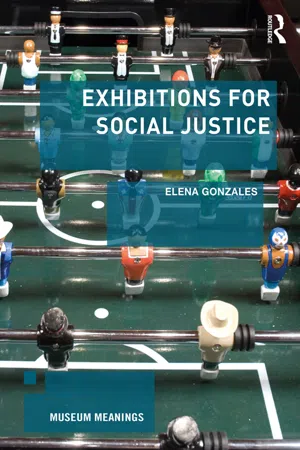
Exhibitions for Social Justice assesses the state of curatorial work for social justice in the Americas and Europe today. Analyzing best practices and new curatorial work to support all those working on exhibitions, Gonzales expounds curatorial practices that lie at the nexus of contemporary museology and neurology. From sharing authority, to inspiring action and building solidarity, the book demonstrates how curators can make the most of visitors' physical and mental experience of exhibitions.
Drawing on ethnographic and archival work at over twenty institutions with nearly eighty museum professionals, as well as scholarship in the public humanities, visual culture, cultural studies, memory studies, and brain science, this project steps back from the detailed institutional histories of how exhibitions come to be. Instead, it builds a set of curatorial practices by examining the work behind the finished product in the gallery.
Demonstrating that museums have the power to help our society become more hospitable, equitable, and sustainable, Exhibitions for Social Justice will be of interest to scholars and students of museum and heritage studies, gallery studies, arts and heritage management, and politics. It will also be valuable reading for museum professionals and anyone else working with exhibitions who is looking for guidance on how to ensure their work attains maximum impact.
Without empathy, social justice ceases to exist. In this chapter, I will explore ways of building empathy in the museum and of translating empathy into solidarity. I move through examples that deal with interpersonal human bonding to the creation of community across generations to the relationships among institutions, and finally to the histories that connect our personal identities and grapple us to our communities. First, however, I will introduce the concepts of empathy and groupness.
Empathy and groupness
Empathy is a common part of our human experience. Most of us empathize with family, friends, and colleagues daily. We also likely feel empathy for people we learn about in the news and on social media and for fictional characters in books, movies, and TV shows. As babies, we learn to knit ourselves into the group – our lifeline – by understanding the feelings of others and responding accordingly. Empathizing is part of how humans bond to one another and is a crucial element of our survival.
Some react negatively to the term “empathy” as a catalyst for museum work. Empathy is not as significant a framing tool outside the US. Linda Norris and Julieta Cuéllar, the Global Networks Team at the International Coalition of Sites of Conscience (SoC), helped me to understand why.1 The reaction comes from the sense that this is an elitist framework, that only White, majoritarian institutions need to foster empathy because marginalized populations or those dealing with violence are already in the trenches. In regional networks of SoC, such as the African network and the Latin American and Caribbean network, the primary concern for sites and their local communities is achieving retributive justice – the redress of wrongs. In these contexts, the word “empathy” can connote a lack of experience with hardship. So, the term isn’t as popular among sites where the majority of stakeholders have direct experience with violence. They do use it, however, in discussions of making connections to young people. The next generation may not have had these personal experiences with violence, and all regional networks are focused on reaching them. I approach empathy as a necessary element of all human experience and a connector that can bring us together, whether our differences in experience are significant or small. In addition, empathy is just the starting point, not the only or final goal for the curatorial work I examine and imagine.
In 1970, the psychologist Henri Tajfel coined the term “groupness” to describe the propensity of humans and other animals to form groups.2 This is the social equivalent of something that happens in the body as well. The body distinguishes between self and other – internal and external – in several important ways. This is how it protects itself against dangers including illness and infection. But this is also how the body manages its necessary and constant interactions with the external world, including eating, moving around, socializing, and mating. The body’s strategies for delineating the self include the skin, the immune system, the gut (where 80 percent of the immune system resides), and the emotional system.3 The emotional system determines how best to relate an individual to the external world. Just as a healthy immune system fights off infection, a healthy emotional response produces choices that strengthen our bonds with close family and friends: helping a friend move, bringing soup to someone with a cold, shoveling the neighbor’s sidewalk. Unlike reptiles, which do not rely on groups, our drive to help and protect our group is more powerful than even our drive for self-preservation. Determining the best interactions with other individual selves is a crucial job of the emotional system. What’s best for my organism? What’s best for the group? For mammals in general and primates in particular, our emotionally determined social strategies are extremely important.
Humans form social groups based on the slightest pretext. In college, housemates or teammates speak a special in-group language. In-jokes evolve into a vocabulary that is opaque to outsiders. Each of us belongs to many groups, some with stronger alliances than others. You might feel some kinship with other people who collect fountain pens, but a much stronger bond with other parents, for example. The strongest bond of all is usually with one’s own nuclear family. The formation of groups is necessarily also about exclusion. There is no group without outsiders. We rightly rail against this with interdisciplinary academic programs, cross-listings of books, and academic positions, perhaps by refusing to accept a single sexual, racial, or ethnic identity. But our tendency to create the groups of “us” and “them” is innate.
Groupness is neither good nor bad. It is simply a fact of life. It can be useful, consolidating and strengthening a population against a common enemy. What if this enemy were not another human group, but were a particular problem to be solved? Museums can call new publics – new groups – into being through forms of address. When museums use groupness as a tool, they can and do consolidate publics around issues such as supporting the rights of immigrants, reforming the justice system, or mitigating prejudice against marginalized populations. Although it is difficult for people to empathize with those they feel are outside their group – whatever type of group that may be – museums have a special ability to demonstrate to visitors that they actually do share a group with supposed others.
Clearly, groupness can have harmful effects depending on what groups it reinforces. Philip Zimbardo’s Stanford Prison Experiment in 1971 dramatically demonstrated how situational groupness can create behavior that has no correlation to individuals’ personalities. In his experiment, normal, healthy, male college students were to participate for two weeks in a mock prison scenario, wherein the students were randomly assigned to play guards or prisoners. Almost immediately, the play-acting went out of control. Guards’ abuses of prisoners became intolerable, and Zimbardo’s own moral compass faltered. It took a visit from an outsider to convince Zimbardo that the experiment needed to be cut short.4 Groupness can strengthen prejudices and marginalization and can result in ideologies that guide and empower large and powerful groups to decimate other groups. The lesson from Zimbardo’s work, and Stanley Milgram’s before him, is that “there but for the grace of God go I.” We all have human instincts to make sense out of nonsensical circumstances, to solve problems, and to form groups. We are also trained from birth to obey authority. In the wrong situation, our instincts and training combine to enable good people to act cruelly and evilly.
Dismantling negative forms of groupness will help our civilization survive. It will not rid the world of dangerous situations, “bad barrels,” as Zimbardo put it, that create the proverbial “bad apples,” but it’s a start. Damasio describes groupness (though he doesn’t use that term). Then, he substantiates my idea that we can (and need to) think our way out of groupness:
The best of human behavior is not necessarily wired under the control of the genome. The history of our civilization is, to some extent, the history of a persuasive effort to extend the best of “moral sentiments” to wider and wider circles of humanity, beyond the restrictions of the inner groups, eventually encompassing the whole of humanity.5
One can imagine a hunter-gatherer society in which the evolutionary benefit accrued to those who narrowed their groups to bands or tribes that could care for themselves. Caring too much about others can become expensive. To early humans, expensive and life-threatening were the same thing. Even within this setting, however, cooperation was something that survival demanded. We evolved to work with and help others.6
Groupness exists and is a human tendency. It can have good or bad effects. But now, in our globalized, transnational world, it is becoming important for us to sometimes work against groupness. Our world requires more cooperation among groups and less exclusivity. Museums working for social justice combat negative forms of groupness by teaching us to think our way out of it. For Robert Janes, museums are founded on imagining ourselves in the shoes of others. At bottom, this is not only thinking, but also feeling. Museums must be smart guardians against groupness and teach visitors to be on their guard as well. This means setting the stage for intellectual and emotional experiences to intertwine in the gallery.
The universe of obligation
The concentric circles of caring, or ripples, that emanate from each of us form what Facing History and Ourselves, a non-profit that develops curricula and also supports teachers, called the “universe of obligation.” Museums can help visitors bring people from the outside circles closer into their universe of obligation. Two organizational forces are at work in structuring our universes of obligation: our social commitments and emotional ties and are one, and geography is the other. Though it doesn’t seem as if our physical proximity to others should necessarily play a role in how well we empathize with them, it does.7
In his studies of obedience and authority after World War II, Stanley Milgram found that people are more willing to harm others the further they are from them physically.8 Milgram’s finding provides more support for the special place museums have in bringing people together. The ways of structuring public space and third spaces discussed in Chapter 4 may help to combat visitors’ willingness to do wrong when they know better.
Museums’ ability to turn “them” into “us” is part of what makes these institutions special. Letting us “walk a mile in another’s shoes” isn’t just a saying. When museums excel at helping visitors imagine the experience of another, visitors’ own bodies ensure their empathetic responses. Empathy is a naturally arising outcome of the way the human brain functions.9 There are systems in the brain that enable us not only to imagine what someone else’s experience was like, but also to actually feel the foreign experience physically and emotionally simply by watching that person.10 The phrase “monkey see, monkey do” represents a deep neurological truth: each thing we do activates its own pattern in the brain. When we watch someone else taking action, that activates the same pattern, as if we were taking the action ourselves. Everyday experience tells us that, to our brains, seeing is very like doing. If you cut your finger, you cringe. If you see someone cut his finger, you also cringe. Moreover, if you look at Caravaggio’s painting Incredulità di San Tommaso (Figure 1.1), wherein Thomas plunges his hand deep into a wound on Christ’s side, you cringe.
Figure 1.1Incredulità di San Tommaso by Michelangelo Merisi da Caravaggio, 1601–1602, oil on canvas, 42″ x 57″. Courtesy of Stiftung Preußische Schlösser und Gärten Berlin-Branden...
Table of contents
Cover
Half Title
Series Information
Title Page
Copyright Page
Dedication
Contents
Figures
Tables
Abbreviations
Acknowledgments
Introduction
1 From empathy to solidarity
2 Physical experiences: Building memories and empathy
3 Inspiring action
4 Welcome, inclusion, and sharing authority
Conclusion
Index
Trusted by 375,005 students
Access to over 1.5 million titles for a fair monthly price.
Study more efficiently using our study tools.
Frequently asked questions
Yes, you can cancel anytime from the Subscription tab in your account settings on the Perlego website. Your subscription will stay active until the end of your current billing period. Learn how to cancel your subscription
No, books cannot be downloaded as external files, such as PDFs, for use outside of Perlego. However, you can download books within the Perlego app for offline reading on mobile or tablet. Learn how to download books offline
Perlego offers two plans: Essential and Complete
Essential is ideal for learners and professionals who enjoy exploring a wide range of subjects. Access the Essential Library with 800,000+ trusted titles and best-sellers across business, personal growth, and the humanities. Includes unlimited reading time and Standard Read Aloud voice.
Complete: Perfect for advanced learners and researchers needing full, unrestricted access. Unlock 1.5M+ books across hundreds of subjects, including academic and specialized titles. The Complete Plan also includes advanced features like Premium Read Aloud and Research Assistant.
Both plans are available with monthly, semester, or annual billing cycles.
We are an online textbook subscription service, where you can get access to an entire online library for less than the price of a single book per month. With over 1.5 million books across 990+ topics, we’ve got you covered! Learn about our mission
Look out for the read-aloud symbol on your next book to see if you can listen to it. The read-aloud tool reads text aloud for you, highlighting the text as it is being read. You can pause it, speed it up and slow it down. Learn more about Read Aloud
Yes! You can use the Perlego app on both iOS and Android devices to read anytime, anywhere — even offline. Perfect for commutes or when you’re on the go. Please note we cannot support devices running on iOS 13 and Android 7 or earlier. Learn more about using the app
Yes, you can access Exhibitions for Social Justice by Elena Gonzales in PDF and/or ePUB format, as well as other popular books in Kunst & Kunst & Politik. We have over 1.5 million books available in our catalogue for you to explore.