A customer-centric culture provides focus and direction for the organization, ensuring that exceptional value will be offered to customers ? this, in turn, results in enhanced market performance. Unfortunately, caught up in the daily economic and competitive pressures of running complex and fast-changing businesses, managers may lose sight of custo
Building a Winning Business Model and Value Proposition
It ain’t that hard to be different.
Tom Peters
We believe that we know where the world should go. But unless we’re in touch with our customers, our model of the world can diverge from reality. There’s no substitute for innovation, of course, but innovation is no substitute, for being in touch, either.
Steve Ballmer
One of the most critical challenges for service firms is to differentiate themselves from competitors. It is relatively easy to be like everyone else; great companies have their own unique identities and carefully conceived value propositions. Realize that different isn’t always better, but better is always different! In this chapter, we explore how a business model provides the basis for a customer-centric marketing strategy, how to design and refine successful value propositions (VP), and creative ways to add value for customers.
Business Models
A business model describes the rationale of how an organization, creates, delivers, and captures value.1 The business model provides all stakeholders (owners, shareholders/investors, employees, suppliers, partners, customers, communities, and media) with a shared understanding of how the business operates. A strong business model provides a competitive edge in the marketplace/marketspace by demonstrating that a company’s goods, services, or ideas are different, more innovative, and better than its rivals.
Howard Schultz, founder and CEO of Starbucks, commented on his company’s phenomenal success:
Customers don’t always know what they want. The decline in coffee-drinking was due to the fact that most of the coffee people bought was stale and they weren’t enjoying it. Once they tasted ours and experienced what we call the “third place”—a gathering place between home and work where they were treated with respect—they found we were filling a need they didn’t know they had.
Herbert Kelleher and Rollin King sketched out the Southwest Airlines business model on a cocktail napkin at breakfast in 1967. Recognizing a need for a service-oriented low-cost airline, the “Texas triangle” meant that Southwest would fly dozens of daily flights between Dallas, Houston, and San Antonio. When the company faced a cash crunch during its challenging first year, the company sold one of its four airplanes but kept the existing flight schedule, launching the start of the company’s renowned 15-minute turnaround.
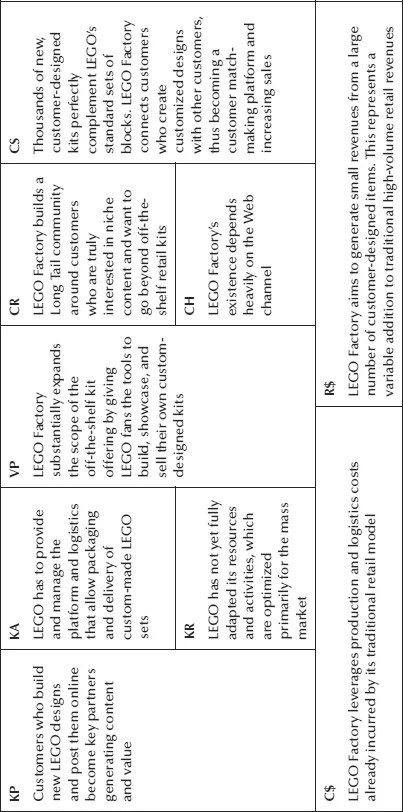
Osterwalder and Pignon explain that, to design winning business models, entrepreneurs or managers should explicate nine building blocks: customer segments, value proposition, channels, customer relationships, revenue streams, key resources, key activities, key partners, and cost structure. They recommend preparing a business model canvas to get participation and buy-in from all key decision makers. (See LEGO Factory example in Figure 4.1; this is a customized LEGO toy set created online by customers.) In fact, these authors employed this research process in writing their book Business Model Generation (www.businessmodelgeneration.com). This project represented a true cocreation of value, as 470 participants from 45 countries provided input to their guidebook.2
Internet commerce is well suited to many new types of business models. Rappa reported nine major types (categories) and more than 40 subcategories of online models. These basic categories include brokerage (Orbitz), advertising (Yahoo), infomediary (DoubleClick), merchant (Lands’ End), direct manufacturer (Dell), affiliate (Commission Junction), community (Flickr), subscription (NetFlix), and utility (Slashdot).3 An alternative view by Wirtz and colleagues looked at a 4C Internet business model consisting of content (Wall Street Journal), commerce (Amazon), context (Google), and connection (Earthlink).4
Figure 4.1 LEGO Factory: customer-designed kits. KP = Key Partners, KA = Key Activities, KR = Key Resources, VP = Value Proposition, CR = Customer Relationships, CH = Channels, CS = Customer Segments, C$ = Cost Structure, R$ = Revenue Streams. (Reprinted from A. Osterwalder and Y. Pigneur, Business Model Generation [New York: John Wiley and Sons, 2010], 73. With permission.)
The digital era has been the primary driver of many recent business transformations. Apple’s iTunes (www.Apple.com/iTunes) is a great example of the changing music industry. Record companies, distributors, and music retailers once controlled the marketing channels and profits; today, artists and the platform (iTunes) have the market power. While in the past it was not uncommon for a band to earn only $1 from a $16 CD sale, today they often generate $7 from a $10 downloaded album on iTunes.
Newspaper publishers have struggled to stay relevant; they are attempting to morph into information providers as their readership base ages and defects to other media. The Wall Street Journal, New York Times, and USA Today have stellar reputations, translating into large and loyal customer bases, and they can charge fees for their online content. In contrast, most major metropolitan newspapers are a less viable option, as free alternatives (Web sites, smartphones, community magazines, television) abound.
Business models can be viewed from the perspective of shapers versus participants (types include influencers, hedgers, and disciples). Google, Microsoft, Facebook, Apple, and Salesforce.com are examples of shapers, since they open up platforms for third parties. These proactive organizations are market drivers and open up new market space. Companies that adopt, embrace, and enhance shapers’ platforms are participants and may include applications (apps) developers, service firms, or online e-tailers. These companies include influencers (Bank of America for Visa), hedgers (advertisers that support Google and Microsoft platforms), or disciples (Dell’s exclusive commitment to the Wintel platform).5
Zynga, a Silicon Valley social-gaming company, has generated hundreds of millions of dollars in revenues, largely through Farmville, its hugely popular game. Millions of Internet users manage virtual plots of land, grow crops, raise animals, and use online tools such as tractors. It has been estimated that there are 20 times more people today playing Farmville than there are actual farms in the United States.6 Some other examples of commonly used business models are listed in Table 4.1.
Value Proposition
A value proposition (VP) is a “statement that matches up the firm’s distinctive competencies with the needs and preferences of a carefully designed set of potential customers.”7 It helps firms as a communications device and is a basis for creating a shared understanding. A well-designed VP is a strategic business tool that includes, but goes beyond, the product mix, pricing, and promotion (marketing communications) to define the organization’s competitive advantage through offerings, people, processes, and technology.
For example, the “Passionate Pursuit of Perfection” is the Lexus value proposition. This value statement encapsulates the essence of this upscale Japanese automobile manufacturer’s worldwide marketing commitment to customer delight and retention with respect to product-line quality, sales philosophy, dealership atmospherics, customer service, image, distribution, and logistics. A positioning strategy that supports the VP is how the organization delivers and differentiates value to its customers (this is discussed later in the chapter).
Table 4.1 Business Models
Type of Business Model
Description
Corporate Examples
Bricks and mortar
Traditional retail stores
Blockbuster Video, Whole Foods
Bricks and clicks
Retail and e-tail
Best Buy, Target
Internet pure-play
Online presence only
Blue Nile, Overstock.com
Software as a Service (SaaS)
Delivering applications over the Internet as a service
ADP, Salesforce.com
Community of users
Users generate knowledge, solve problems, and offer place for exchange
eBay, Wikipedia
Shaper
Open up new market space/platforms
Apple, Facebook
Platform participant
Enhance platforms by creating user applications
Zynga, Foursquare
Multisided markets
Company serves multiple customer segments, e.g., readers and advertisers
USA Today, Visa
Bundling
Sell two or more products for a discount
Comcast, Microsoft Office
Unbundling
Sell a single product even though company offers related products
AT&T DSL service, Windows Live Essentials
Long ...
Table of contents
Cover
Title Page
Copyright
Dedication
Contents
Preface
Acknowledgments
About the Author
SECTION I CUSTOMER VALUE—THE BUILDING BLOCKS
SECTION II DESIGNING A SUCCESSFUL CUSTOMER STRATEGY
SECTION III EXCELLING IN THE MARKETSPACE
SECTION IV RETAINING CUSTOMERS—ANALYSIS AND STRATEGY
Notes
SECTION V CUSTOMER VALUE CASE STUDIES
Index
Trusted by 375,005 students
Access to over 1.5 million titles for a fair monthly price.
Study more efficiently using our study tools.
Frequently asked questions
Yes, you can cancel anytime from the Subscription tab in your account settings on the Perlego website. Your subscription will stay active until the end of your current billing period. Learn how to cancel your subscription
No, books cannot be downloaded as external files, such as PDFs, for use outside of Perlego. However, you can download books within the Perlego app for offline reading on mobile or tablet. Learn how to download books offline
Perlego offers two plans: Essential and Complete
Essential is ideal for learners and professionals who enjoy exploring a wide range of subjects. Access the Essential Library with 800,000+ trusted titles and best-sellers across business, personal growth, and the humanities. Includes unlimited reading time and Standard Read Aloud voice.
Complete: Perfect for advanced learners and researchers needing full, unrestricted access. Unlock 1.5M+ books across hundreds of subjects, including academic and specialized titles. The Complete Plan also includes advanced features like Premium Read Aloud and Research Assistant.
Both plans are available with monthly, semester, or annual billing cycles.
We are an online textbook subscription service, where you can get access to an entire online library for less than the price of a single book per month. With over 1.5 million books across 990+ topics, we’ve got you covered! Learn about our mission
Look out for the read-aloud symbol on your next book to see if you can listen to it. The read-aloud tool reads text aloud for you, highlighting the text as it is being read. You can pause it, speed it up and slow it down. Learn more about Read Aloud
Yes! You can use the Perlego app on both iOS and Android devices to read anytime, anywhere — even offline. Perfect for commutes or when you’re on the go. Please note we cannot support devices running on iOS 13 and Android 7 or earlier. Learn more about using the app
Yes, you can access Superior Customer Value by Art Weinstein,D. Hank Ellison in PDF and/or ePUB format, as well as other popular books in Business & Customer Relations. We have over 1.5 million books available in our catalogue for you to explore.