![]()
Part I
Introduction to Fingerprints
![]()
Chapter 1
Introduction
Class and Individual Characteristics
Objectives
1.1 Background
Any effort to organize and categorize a large group of items begins with observation. Large groups of things are often organized based on visible characteristics such as color, size, type, or material. Observable features used to organize a large group of things into smaller categories are known as class characteristics. Forensic evidence such as trace evidence utilizes class characteristics to determine whether a fiber, hair, or soil sample is consistent with similar material from a crime scene. While a fiber does not contain individualizing characteristics such as DNA, it does contain class characteristics such as length, color, material (natural or synthetic), and cross-sectional shape. A comparison of class characteristics from evidentiary fibers and fibers from a suspect’s home, car, or clothing can elucidate an association between the suspect and the crime scene but cannot conclusively determine the origin of the fibers.
For example, vehicles can exhibit both class and individualizing characteristics. They can be organized by make, model, color, or type. Individualizing characteristics organize items into a category of one. For example, individual characteristics of a vehicle may include specific body damage (dents, scratches), a VIN number, or a license plate number. While many vehicles may share class attributes of color, make, and model, only one vehicle will have these individualizing characteristics.
Forensic scientists distinguish between class and individual characteristics of forensic evidence in order to organize large amounts of data or determine the potential source of evidentiary materials. If a single hair with a root attached is found at a crime scene, the potential source of that hair may be determined with an analysis of class and individualizing characteristics. People may have black, brown, blonde, or red hair. While the source of that hair cannot be identified based on class characteristics alone—such as hair color, eye color, or ethnic origin—it can narrow the potential source or eliminate a subject. In order to further narrow down the source of the hair, one would need to conduct a DNA analysis. Similarly, friction ridge impressions provide individualizing characteristics that can narrow down the potential source of forensic evidence to a category of one.
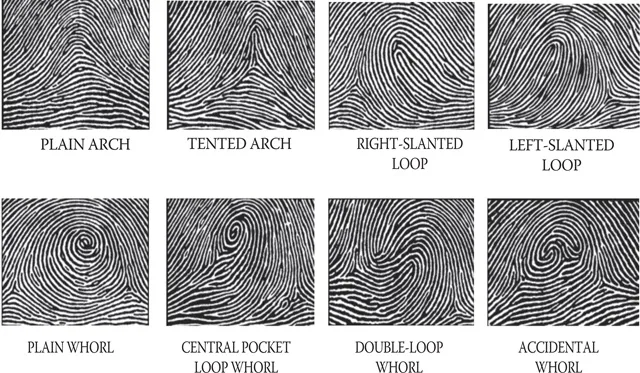
Friction ridge impressions contain both class and individual characteristics. Pattern types are class characteristics, because they are not unique to an individual. There are three main pattern types: arches, loops, and whorls. Within those categories are eight subcategories: plain arches, tented arches, ulnar loops, radial loops, plain whorls, double-loop whorls, central pocket loop whorls, and accidentals (Figure 1.1). Most fingerprints in the population are loop patterns, while whorls are much less common, and arches are rare. Finding a latent print with an arch pattern at a crime scene is valuable for elimination purposes, because they are so rare in the population. Conversely, finding a latent print with a loop pattern at a crime scene is not as discriminating, because loops are very common in the population.
Figure 1.1
The eight fingerprint sub-pattern types: plain arch, tented arch, right-slanted loop, left-slanted loop, plain whorl, central pocket loop whorl, double-loop whorl, and accidental whorl.
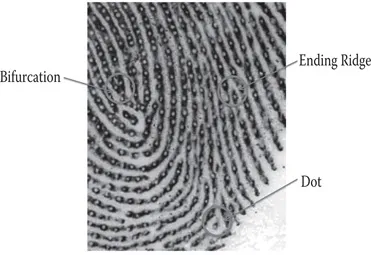
Figure 1.2
A bifurcation, dot, and ending ridge in a magnified portion of a fingerprint.
While pattern types can be used to narrow down the population of fingerprints or eliminate a subject as the possible contributor of a latent print, they do not have individualizing power. Minutiae are individualizing characteristics. They can be used to narrow down the potential source of a latent print. There are three types of fingerprint minutiae: bifurcations, ending ridges, and dots (Figure 1.2). While all individuals have ending ridges and bifurcations present along friction ridges, an analysis of the relative locations of those minutiae in the impression makes it possible to identify the potential source of a latent print. An analysis of both the class characteristics (pattern types, ridge flow, level 3 detail) and individual characteristics (minutiae types and relative locations) contribute to fingerprint identification. In the following laboratory exercises, you will explore the class and individual characteristics of various types of forensic evidence as well as the three types of fingerprint minutiae.
1.2 Materials
Pen or pencil
Figure 1.3
Figure 1.4
1.3 Exercises
Part I: Class and Individual Characteristics
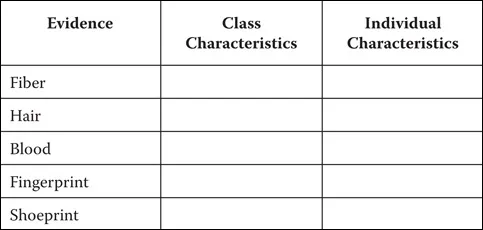
Identify the class and individual characteristics for each type of forensic evidence listed in Figure 1.3.
Part II: Class Characteristics
Identify all observable class characteristics of a classmate, friend, colleague, or spouse
What are the individualizing characteristics associated with that individual?
Figure 1.3
Part I: Class and Individual Characteristics—Identify the class and individual characteristics for each type of forensic evidence listed.
Figure 1.4
Part III: Individualizing Characteristics—minutiae: draw a bifurcation, ending ridge, and dot.
Part III: Individualizing Characteristics—Minutiae
Draw the following minutiae in Figure 1.4:
Bifurcation
Ending ridge
Dot
1.4 Post-Lab Questions
Are fingerprint pattern types individual characteristics? Why or why not?
What are the eight fingerprint sub-pattern types?
What are the three types of minutiae found in fingerprints?
Are minutiae class or individual characteristics? Why or why not?
Besides narrowing the possible source...