A unique chance to explore different aspects of place, heritage, and tourism
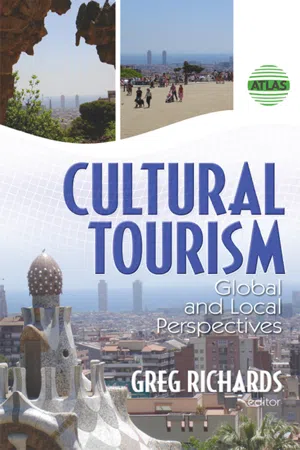
For many nations around the world, cultural tourism is not only a major industry but also a support for national identity and a means for preserving heritage. Cultural Tourism: Global and Local Perspectives brings together in one volume interdisciplinary explora
- 378 pages
- English
- ePUB (mobile friendly)
- Available on iOS & Android
eBook - ePub
About this book
Chapter 1
Introduction: Global Trends in Cultural Tourism
Greg Richards
Today, cultural tourism seems to be omnipresent, and in the eyes of many it also seems to have become omnipotent. It is the holy grail of quality tourism that cares for the culture it consumes while culturing the consumer. Cultural tourism has therefore been embraced globally by local, national, and transnational bodies. UNESCO promotes cultural tourism as a means of preserving world heritage, the European Commission supports cultural tourism as a major industry, and the newly emerging nation-states of Africa and Central Europe see it as a support for national identity. In many parts of the world it has become a vital means of economic support for traditional activities and local creativity.
The globalization of cultural tourism arguably coincides with a number of fundamental cultural and social changes, as well as changes in the structure of tourism itself. The culturization of society has led to more and more areas of consumption being viewed as “cultural.” This has shifted the focus of cultural tourism away from the “shining prizes” of the European Grand Tour toward a broader range of heritage, popular culture, and living cultural attractions (Richards, 2001). The extension of education has democratized travel and cultural consumption, turning cultural tourism from an elite pursuit into a mass market. At the same time, growing competition in traditional tourism markets has caused a search for alternatives on the part of destinations worldwide.
The tendency to alight on cultural tourism as the primary alternative for such a large number of different places in different regions of the world is mainly driven by supply-side logic. Cultural tourism is arguably a “good” form of tourism for the destination, which avoids many of the pitfalls of conventional tourism while offering additional benefits in the form of high-spending tourists who are keen to support culture (Richards, 2001). Cultural tourism is also available as a development option to all destinations, because all places have culture. As the demand for culture grows in society, there is also growing pressure on the public sector to support more and more cultural facilities. Tourism becomes one means of finding external sources of income to achieve this.
Growth in cultural tourism has also been stimulated by rising demand, although research indicates that cultural tourism is growing no faster than global tourism as a whole (de Haan, 1998). Rising education levels enable more people to access culture, while the effects of globalization create more interest in distant cultures as well as local heritage. Surveys in the United States, for example, indicate that 46 percent of domestic tourists visit cultural attractions (TIA, 2003).
Cultural tourism has therefore become a global common currency. In fact, as Richards (2001) has argued, it may have become such a common form of tourism that it is beginning to lose all meaning as a distinct category. Many argue, as the World Tourism Organization (1985:2) does in its “wide” definition of cultural tourism, that all tourism trips can be considered as cultural tourism, because they “satisfy the human need for diversity, tending to raise the cultural level of the individual and giving rise to new knowledge, experience, and encounters.”
The problem is that as cultural tourism has expanded, so have the meanings attached to it. In the past, cultural tourism was largely associated with high culture and with “cultured” people. Today, cultural tourism includes many popular cultural attractions (McKercher et al., 2004), sport, living heritage, recent nostalgia, and the “everyday life” of “local” communities (Howie, 2000). The resources associated with cultural tourism have expanded from the largely fixed, tangible heritage of the past toward the mobile, intangible products of contemporary culture (Richards, 2000).
Many of these changes are linked to issues of globalization. If globalization is viewed in terms of an increasing integration of economic, social, and cultural systems, then tourism can be seen both as a cause and an effect of globalization processes. Tourism becomes one of the flows through which economic, social, and cultural exchange takes place, and the increasing scale of such exchanges in turn becomes a stimulus to tourism. Although studies of globalization have tended to concentrate on its economic aspects, there is increasing attention for “cultural globalization,” which Nijman (1999:148) defines as “acceleration in the exchange of cultural symbols among people around the world, to such an extent that it leads to changes in local popular cultures and identities.” This definition implies that changes in the global flows of culture will also impact on localities everywhere. At a global level, for example, cultural forms have become globalized and therefore accessible to tourists worldwide through the growth of personal mobility, the travel industry, the Internet, and the media. Not only do tourists travel to consume cultural resources in every corner of the globe, but those resources are themselves becoming more mobile, as art exhibitions embark on global tours, musicals are replicated on different continents, and the process of “McGuggenheimization” develops globally branded museums. Nijman further argues that this process is dependent on the global extension of a culture of consumption, and that economic globalization is therefore in many ways dependent on cultural globalization.
The fact that globalization has deep cultural consequences is also evident in the countervailing process of localization. Arguably, the processes of homogenization and disembedding that accompany globalization have stimulated localization, as local communities work to establish new identities and reclaim their heritage. In the tourist industry there has also been a growing realization that local identities and distinctiveness can also provide the basis for tourist products. For example, the Sense of Place Toolkit produced by the Wales Tourist Board (2002:2) advises on the creation of tourism products based on the “sense of place” or “authentic essence of place.” This practical guide also contains a strong recognition of the role of quotidian culture in cultural tourism, reminding users that “our everyday life is someone else's adventure” (p. 2).
The idea that “local” identities are somehow more “authentic” is deeply rooted in the analysis of tourism as well as in the practice of tourism product development.
Authenticity is seen as being important for all tourism, as Taylor (2001:7) has argued:
Authenticity has become the philosopher's stone for an industry that generally seeks to procure other peoples' “realities.” In tourism, authenticity poses as objectivism. It holds the special powers both of distance and of “truth.”
But authenticity has been particularly important in the study of cultural tourism, as Schouten argues in Chapter 2 of this volume. A number of studies of cultural tourism have argued that cultural tourists are seeking more “authentic” or “deeper” experiences than other types of tourists (McKercher and du Cros, 2002). These authentic experiences were also usually seen as encompassing high culture, or traditional local culture, while specifically avoiding popular and contemporary culture. MacCannell (1976) was one of the first analysts to problematize this relationship, by showing how “authentic” cultural attractions were created as contemporary cultural productions. By marking something as “authentic” and therefore worthy of the tourist gaze, destinations could assure themselves a steady flow of tourists engaged in sightseeing or “the ritual performed to the differentiations of society” (p. 13).
Cultural tourism, because of its supposed connections with a search for authenticity and meaning, is also usually seen as a more serious form of tourism. For example, Meethan (2001:128) argues:
Rather than the simple aimless pleasures of mass tourism, the cultural tourists are those who go about their leisure in a more serious frame of mind. To be a cultural tourist is to attempt, I would suggest, to go beyond idle leisure and to return enriched with knowledge of other places and other people even if this involves gazing at, or collecting in some way, the commodified essences of otherness.
However, such dichotomies between idle and active, or authentic and inauthentic, do not generally stand up to empirical scrutiny, as May (1996) has indicated. Package tourists in beach destinations often see themselves as seekers of authenticity as well. The concept of authenticity may well differ between tourists, but it is a widely sought-after experience (Lengkeek, 1996).
The problem seems to have become the growing realization among many tourists that authenticity is in the eye of the beholder. Why bother queuing to view “authentic” historic monuments when there are equally authentic bits of local culture to be found everywhere? Where McCannell (1976) identified the process of “marking” attractions as something special and worthy of attention, current trends in society and in tourism in particular seem to have shifted toward a logic of “reverse marking.” As Brekhus explains in the context of social science:
reverse marking is an explicit strategy whereby one consciously ignores what is typically marked as though it were mundane and focuses on the unmarked as though it were ”exotic” and ”unusual.“ Rather than gravitating to what already stands out as exceptional, reverse marking tries to find the exceptional in what is ordinarily taken-for-granted as unexceptional. (Brekhus, 1998)
This also seems to be a strategy that is gaining ground with tourists. For example, Ramchander examines the growth of “township tourism” in South Africa in Chapter 3 of this volume. The townships, the cruel physical manifestations of the policy of apartheid, have now become tourist attractions as tourists visiting the new South Africa seek a glimpse of what everyday life is like for people marginalized by the system. The attraction of the everyday is also to be found outlined in travel guides, as the Lonely Planet for Singapore shows:
In the crowded streets of Chinatown, fortune tellers, calligra-phers, and temple worshippers are still a part of everyday life. In Little India, you can buy the best sari material, freshly ground spices, or a picture of your favourite Hindu god. In the small shops of Arab St, the cry of the imam can be heard from the nearby Sultan Mosque. (Lonely Planet, 2004)
There is a growing awareness that the exotic, the surprising, and the challenging are to be found in the everyday lives of others: “India jolts your senses awake like no other country. And it happens through its people and everyday life” (Lonely Planet, 2004). Places increasingly situate themselves as windows onto everyday life, from Norway to New Zealand:
Lillesand (pop. 3,000) presents an opportunity to experience what daily life is like in a traditional Norwegian coastal village. (iexplore, 2004)Dunedin offers all the facilities you would expect within a modern, thriving city, without the traffic jams and parking problems! Daily life is vibrant, and bars compete for space with a fabulous mix of shops and entertainment venues. (Tourism.net.nz, 2004)
Experiencing everyday life is also positioned as a sign that you have arrived, because the other tourists are still only scratching the surface:
Joy's House is not for backpackers or for standard tourists, rather for people who want to allow the daily life and the people in Thailand into their lives, who have possibly been in other countries without really arriving there. (Joy's House, 2004)
The emergence of the everyday or the mundane as a source of authentic experience in tourism has much to do with the development of consumption in modern societies. In his study of the “Joyless Economy,” Scitovsky (1976) focused attention on the way in which people learn. The processing of information during the learning process is essentially a process of creating redundancy in information. As we develop skills, certain actions become automatic, and we cease to process large amounts of information that are taken for granted. Such redundancy is also necessary if we are not to be overwhelmed with the rising tide of data generated by the information society. Redundancy is what enables us to move on and learn new things, which is arguably the basis of cultural consumption in general, and cultural tourism in particular (Richards, 2001).
The learning process, therefore, consists in making new things visible, while at the same time making invisible what we have already learned and can take for granted. Because everyday life is so full of already-learned facts, our own everyday lives essentially become invisible, which is one reason why travel to other places is so pleasurable. It is not just a discovery of the new, but a rediscovery of the quotidian, which is revealed by our newfound perspective. It is this aspect of travel that has come to be used as a new attraction and a new form of exoticism in tourism.
This perspective also problematizes the concept of “placeless-ness,” which is discussed at length by Melanie Smith in Chapter 5. The tendency for globalization to produce similar landscapes and spaces in different parts of the world has been a concern for a long time. Some authors have also posed the question of whether it will make sense to travel in the future, if everywhere begins to look the same. However, as Robert Maitland suggests in Chapter 6, it is possible to develop “placefulness” in “new tourism areas” which have previously been overlooked by tourists. This line of argument is essentially one that Alain de Botton (2002) makes much more prosaically in The Art of Travel. He examines the way in which we tend to ignore everyday details that can make our home environments just as exciting, engaging, and exotic as distant destinations.
The idea that we can find just as much cultural diversion at home as by going on holiday is not as far removed from the current practice of cultural tourism as it may seem. For example, Thrane (2000) found that the cultural consumption of cultural tourists is actually very like their consumption at home. Cultural tourism, he concludes, is not so much a process of reversal, but is in fact an extension of everyday life. This argument also finds echoes in the ATLAS research, which has uncovered a strong relationship between people's work and their cultural tourism experiences. Those who work in museums, for example, are also particularly likely to visit museums on holiday. People...
Table of contents
- Cover
- Half Title
- Full Title
- Copyright
- Dedication
- Contents
- About the Editor
- Contributors
- Preface
- Chapter 1. Introduction: Global Trends in Cultural Tourism
- PART I: TOURISM, GLOBALIZATION, AND AUTHENTICITY
- PART II: CULTURAL TOURISM DEVELOPMENT IN A GLOBALIZING WORLD
- PART III: SENSITIZING TOURISTS AND COMMUNITIES
- PART IV: CULTURAL EVENTS AND FESTIVALIZATION
- Index
Trusted by 375,005 students
Access to over 1.5 million titles for a fair monthly price.
Study more efficiently using our study tools.
Frequently asked questions
Yes, you can cancel anytime from the Subscription tab in your account settings on the Perlego website. Your subscription will stay active until the end of your current billing period. Learn how to cancel your subscription
No, books cannot be downloaded as external files, such as PDFs, for use outside of Perlego. However, you can download books within the Perlego app for offline reading on mobile or tablet. Learn how to download books offline
Perlego offers two plans: Essential and Complete
- Essential is ideal for learners and professionals who enjoy exploring a wide range of subjects. Access the Essential Library with 800,000+ trusted titles and best-sellers across business, personal growth, and the humanities. Includes unlimited reading time and Standard Read Aloud voice.
- Complete: Perfect for advanced learners and researchers needing full, unrestricted access. Unlock 1.5M+ books across hundreds of subjects, including academic and specialized titles. The Complete Plan also includes advanced features like Premium Read Aloud and Research Assistant.
We are an online textbook subscription service, where you can get access to an entire online library for less than the price of a single book per month. With over 1.5 million books across 990+ topics, we’ve got you covered! Learn about our mission
Look out for the read-aloud symbol on your next book to see if you can listen to it. The read-aloud tool reads text aloud for you, highlighting the text as it is being read. You can pause it, speed it up and slow it down. Learn more about Read Aloud
Yes! You can use the Perlego app on both iOS and Android devices to read anytime, anywhere — even offline. Perfect for commutes or when you’re on the go.
Please note we cannot support devices running on iOS 13 and Android 7 or earlier. Learn more about using the app
Please note we cannot support devices running on iOS 13 and Android 7 or earlier. Learn more about using the app
Yes, you can access Cultural Tourism by Greg Richards in PDF and/or ePUB format, as well as other popular books in Business & Hospitality, Travel & Tourism Industry. We have over 1.5 million books available in our catalogue for you to explore.