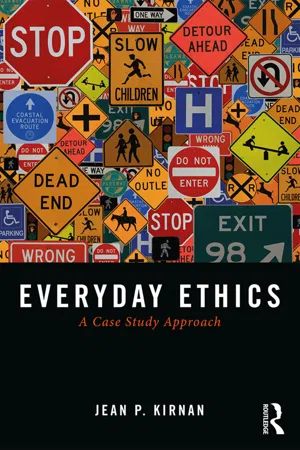
This book expands the current discussion on ethics, addressing the gap between "headline" ethics cases, which are often extreme and taken from a business context, and the everyday ethical challenges that we all face in school, work, relationships, and communities. Case studies throughout demonstrate concepts and provide opportunities for readers to apply theory as they consider everyday issues such as the temptation to lie about an arrest on a job application, peer pressure to steal or drink, and the implications of "ratting out" a classmate who is cheating or a co-worker who is stealing. By including a broad array of ethical challenges, this book makes ethics more accessible to the reader. Drawing from several academic disciplines, including social psychology and organizational behavior, this book explores the personal and environmental factors that influence our ethical decision-making. The book is appropriate for ethics courses in an array of disciplines as well as anyone interested in ethical challenges.
- 224 pages
- English
- ePUB (mobile friendly)
- Available on iOS & Android
eBook - ePub
About this book
Information
p.1
Part I
Foundation for a Conversation on Ethics
p.3
1 Introduction
Opposing Cases
CASE STUDY 1.1
Case 1.1 My fiancé and I were at the grocery store this past Sunday and during checkout he asked for $20 cash back. When we got outside, he told me that the cashier gave him $30 cash back instead of the $20 that he requested. He asked me if he should go back in and give her the extra $10, since he was only supposed to get $20. I told him it was his choice, but he didn’t have to, and that most people in that situation probably wouldn’t give it back. When we left, I did feel bad and dishonest. I thought about the cashier and the fact that her drawer would be $10 short at the end of the day and that she may get in trouble for it. I also felt bad, because I thought she may lose her job because they would maybe think she was stealing money from the register.
CASE STUDY 1.2
Case 1.2 I went to the bank to cash a check. As the teller was counting out the money, I noticed she gave me $20 extra. My first feeling was excitement at getting $20 extra. I decided not to say anything. When I got home, I started reconsidering my decision to keep the money. What if the teller got in trouble for being $20 short in her drawer? What if she got fired? I decided I would call the bank and tell them. I thought that there was no excuse not to tell them because I did not have to say that I noticed it at first. For all they knew, I noticed it when I got home. I called and told them what happened and agreed to return the $20 to the bank. After I returned the money, the teller said that most people would not have returned the money. That made me feel good about returning the money. She was so grateful that the money was returned.
p.4
The preceding cases present a common ethical situation that many of us have faced: Through someone else’s error, we are the recipient of money that is not ours. In Case 1.1, the situation occurred at a retail establishment when someone asked for “cash back” and received extra money. In Case 1.2, the narrator received extra money during a banking transaction. The individuals in these two cases chose to act quite differently from each other. Why, in such similar situations, do some people act ethically and some act unethically? Why does any one person sometimes act ethically and at other times the same person acts unethically? These are the types of questions that we will explore together in this book.
Purpose
The purpose of this book is to engage you, the reader, in a conversation about everyday ethical challenges that we all face in school, work, relationships, and our communities. A scan of recent headlines reveals the scope of ethical issues facing society today, such as child abuse scandals at Penn State and in the Catholic Church, Bernie Madoff’s pyramid scheme, emissions fraud at Volkswagen, student cheating at Harvard, the financial crisis of 2008, and accounting irregularities at Enron. There is reason to expect the incidence of ethical challenges to continue, or even increase, as uncertainty in society and organizations creates conditions where conflict occurs between stakeholders, interests, and values (Treviño, 1986). With the advent of the internet, social media, international business, and the sheer speed of communication and technological innovation, we can be assured of continuing change, uncertainty, and potential discord.
There are several reasons why we should care about ethics. First, the immediate financial cost of unethical acts poses a problem. Considering monetary costs in U.S. businesses alone, the estimated loss from employees (theft of goods, theft of time, and fraudulent expense and injury claims) is $50 billion annually (Gino & Margolis, 2011). On a global level, the cost of fraud is estimated to exceed $2.9 trillion (Moore, Detert, Treviño, Baker, & Mayer, 2012). But damages are not only financial. We must consider the human cost to victims and the ripple effect on observers. Victims experience additional suffering related to health, safety, and psychological well-being. While we are all susceptible, those who are most vulnerable present easier targets as they are often unable to understand when they are taken advantage of, are further uneducated about their rights, and have fewer resources for recovery. A more long-term cost of unethical conduct appears at a societal level. Repeated exposure to unethical conduct changes our perception of what is and is not acceptable. Thus, bullying becomes commonplace, consumers assume poor workmanship, we expect to be victimized, and we come to believe that victimizing others is just a way of life.
The rise in ethical scandals has brought about an increased focus on teaching ethics, as can be seen in the recent proliferation of ethics courses in institutions of higher education (Wecker, 2011); workplace initiatives evidenced in employee training, the development of ethics statements, and appointment of ethics officers (Bazerman & Tenbrunsel, 2011; Weaver, Treviño, & Cochran, 1999; Weber & Wasieleski, 2013); and increased regulations (Bazerman & Tenbrunsel, 2011). A surge in published articles on business ethics has also been noted, reflecting both research and theoretical advances on the topic (Tenbrunsel & Smith-Crowe, 2009). Many articles note that ethical practices are good for a company’s bottom line, given that an ethical climate and leadership lead to greater job satisfaction, commitment to the company, and greater employee retention (Promislo, Giacalone, & Jurkiewicz, 2013).
p.5
This book is motivated by two concerns with these initiatives aimed at educating the populace on ethics. First, much of the coursework in colleges and universities is offered in business schools,1 when in fact all students have and will continue to face ethical challenges in their personal and professional lives. Second, there is a tendency to use “headline” cases in teaching and training programs. However, when presented with these headlines, many people dismiss such extreme unethical cases because they cannot relate to the possibility of committing such egregious acts. We often hear: “I would never do that” or “I would never be in a position to do that”; in other words, “These cases don’t apply to me.” There is consequently a need to develop materials focused on a discussion of everyday ethical challenges that is not exclusively limited to workplace concerns. Addressing this need is important because the ethical challenges we all face begin early in our lives and continue to occur throughout adolescence and into adulthood. Thus, while an issue of academic integrity or cheating on a sports team may repeat itself, more critically, this initial compromise of moral values leads to a pattern of behavior, a slow erosion of what is and is not acceptable to ourselves (Welsh, Ordóñez, Snyder, & Christian, 2015). Even dissimilar situations will be influenced by our earlier behaviors, which exert an influence on future decisions. The willingness to use “fairness” as an excuse for academic cheating can lead to other justice rationalizations when we contemplate tax evasion or embezzlement as adults (Nonis & Swift, 2001).
Few books address ethics from an everyday perspective, Treviño and Nelson’s Managing Business Ethics: Straight Talk about How To Do It Right (2011) being one of the exceptions. Their text focuses on ethical challenges in the workplace, from product safety concerns to wrongful termination of employment. I have used this book in my courses and, while the focus on everyday ethical challenges does make the material more accessible, all of the examples are still from the workplace. This book is written to address that gap, expanding the conversation to include everyday issues outside of the business realm. For example, we will consider the temptation to lie about an arrest on a job application, the peer pressure a teen employee faces to provide discounts or free merchandise for friends, and the implications of “ratting out” a classmate who is cheating or a co-worker who is stealing. By extending the scope of ethical challenges, I hope to introduce greater variety and breadth to the topics under discussion, making “ethics” more accessible to you, the reader.
A second major focus of this book is geared toward expanding your lens regarding ethical decision-making. This will be accomplished in several ways: 1) introducing personal and situational factors that influence our interpretation and reaction to ethical challenges; 2) reviewing strategies we all employ to rationalize unethical acts; 3) viewing the ripple effects of our actions by expanding our consideration of stakeholders; and 4) identifying our role in ethical situations and accepting agency for our actions and inactions.
p.6
It is hoped that an increased understanding of ethical decision-making will help you identify ethical challenges in the future and provide you with resources for a more thoughtful response. Throughout the book, numerous case studies are used to demonstrate concepts or as vehicles for you to apply what you have learned. These examples are taken from over 800 cases that I have collected during the course of several years and represent a wide array of situations by which the narrator felt challenged. The case studies include a variety of settings, such as educational institutions, workplaces, community organizations, and families. Developmentally, they range from elementary school to end-of-life issues and cover actions such as cheating, theft, lying, bullying, rules violations, as well as whistleblowing and proactive ethical behaviors.
It is important to note that an increased understanding of both the factors that influence our decision-making and the strategies often used to rationalize unethical behavior should NOT be regarded as providing excuses to engage in unethical acts. Rather, such insights create a greater ethical burden on you, the reader, as you are now aware of these forces and should make future ethical decisions in light of them. Therefore, understanding diffusion of responsibility (a phenomenon whereby we are less likely to act when in the company of others who are inactive) does not excuse you from action, but rather increases your agency or responsibility to act because of this newfound understanding. Weir echoes this perspective in her comments on the value and purpose of psychological research on morality, stating that such research “can also help us consider our own moral judgment process with a more critical eye. If we understand the unconscious biases and thought processes that influence our moral decision-making, we’re better equipped to decide if we’re reaching our decisions in a valid way” (2016, p. 46).
Finally, in the course of using various case studies in my teaching, students often ask me “What would you do?” or “What is the right decision to make?” I do not answer those questions as my goal is to have my students take responsibility for their actions, not to mirror mine. Another driving theme of this book is that we all have agency and are accountable for our own actio...
Table of contents
- Cover Page
- Praise
- Everyday Ethics
- Title Page
- Copyright
- Dedication
- Advertisment
- Brief Contents
- Contents
- List of Figures
- List of Tables
- Preface
- Acknowledgments
- Part I Foundation for a Conversation on Ethics
- Part II Understanding Why and How We Do What We Do
- Part III Recalibrating Your Moral Compass
- Part IV Applying What You’ve Learned
- Index
Trusted by 375,005 students
Access to over 1.5 million titles for a fair monthly price.
Study more efficiently using our study tools.
Frequently asked questions
Yes, you can cancel anytime from the Subscription tab in your account settings on the Perlego website. Your subscription will stay active until the end of your current billing period. Learn how to cancel your subscription
No, books cannot be downloaded as external files, such as PDFs, for use outside of Perlego. However, you can download books within the Perlego app for offline reading on mobile or tablet. Learn how to download books offline
Perlego offers two plans: Essential and Complete
- Essential is ideal for learners and professionals who enjoy exploring a wide range of subjects. Access the Essential Library with 800,000+ trusted titles and best-sellers across business, personal growth, and the humanities. Includes unlimited reading time and Standard Read Aloud voice.
- Complete: Perfect for advanced learners and researchers needing full, unrestricted access. Unlock 1.5M+ books across hundreds of subjects, including academic and specialized titles. The Complete Plan also includes advanced features like Premium Read Aloud and Research Assistant.
We are an online textbook subscription service, where you can get access to an entire online library for less than the price of a single book per month. With over 1.5 million books across 990+ topics, we’ve got you covered! Learn about our mission
Look out for the read-aloud symbol on your next book to see if you can listen to it. The read-aloud tool reads text aloud for you, highlighting the text as it is being read. You can pause it, speed it up and slow it down. Learn more about Read Aloud
Yes! You can use the Perlego app on both iOS and Android devices to read anytime, anywhere — even offline. Perfect for commutes or when you’re on the go.
Please note we cannot support devices running on iOS 13 and Android 7 or earlier. Learn more about using the app
Please note we cannot support devices running on iOS 13 and Android 7 or earlier. Learn more about using the app
Yes, you can access Everyday Ethics by Jean P. Kirnan in PDF and/or ePUB format, as well as other popular books in Psychology & Business Ethics. We have over 1.5 million books available in our catalogue for you to explore.