eBook - ePub
Rock Mechanics and Rock Engineering
Volume 2: Applications of Rock Mechanics - Rock Engineering
- 384 pages
- English
- ePUB (mobile friendly)
- Available on iOS & Android
eBook - ePub
Rock Mechanics and Rock Engineering
Volume 2: Applications of Rock Mechanics - Rock Engineering
About this book
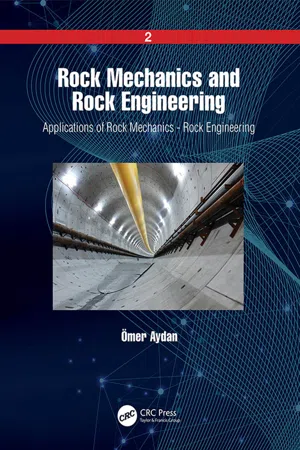
The two-volume set Rock Mechanics and Rock Engineering is concerned with the application of the principles of mechanics to physical, chemical and electro-magnetic processes in the upper-most layers of the earth and the design and construction of the rock structures associated with civil engineering and exploitation or extraction of natural resources in mining and petroleum engineering.
Volume 2, Applications of Rock Mechanics – Rock Engineering, discusses the applications of rock mechanics to engineering structures in/on rock, rock excavation techniques and in-situ monitoring techniques, giving some specific examples. The dynamic aspects associated with the science of earthquakes and their effect on rock structures, and the characteristics of vibrations induced by machinery, blasting and impacts as well as measuring techniques are described. Furthermore, the degradation and maintenance processes in rock engineering are explained. Rock Mechanics and Rock Engineering is intended to be a fundamental resource for younger generations and newcomers and a reference book for experts specialized in Rock Mechanics and Rock Engineering and associated with the fields of mining, civil and petroleum engineering, engineering geology, and/or specialized in Geophysics and concerned with earthquake science and engineering.
Information
Chapter 1
Introduction
Rock engineering is concerned with the applications of the principles of rock mechanics in practice. These applications involve the construction of transportation facilities such as tunnels, high-cut rock slopes, foundations of large bridges, nuclear power plants, dams, storage of oil and natural gases in caverns in civil engineering, exploitation of natural sources such as metallic minerals, coals in the form of open-pits or underground mines in mining engineering, extraction of oil and gas in petroleum engineering and utilization of geothermal energy.
Some of the practical applications of empirical, analytical and numerical methods involve the evaluation of deformation and stress state of surface, semi-underground and underground rock engineering structures in the short and long term, as well as under static and dynamic loading conditions. Some fundamental examples of applications to surface and underground structures are explained with the consideration of practical conditions.
The model testing technique in rock mechanics and rock engineering has been an important tool for engineers for understanding the response of rock engineering structures as well as obtaining design parameters if the similitude law is properly established for a given structure. With the development of numerical methods, response and stability of rock engineering structures could be evaluated under very complicated initial and boundary conditions as well as rock mass behavior. Nevertheless, model testing is still a useful yet powerful technique to have an insightful view of what is taking place with regard to a given structure under the given conditions. They may also provide a clear visual yet quantitative picture of the phenomenon, which may be quite difficult to evaluate by numerical methods.
From earlier times, many rock classifications have been proposed, and some of them provide quantitative characterization of rock masses with or without their applications to certain rock engineering structures. These classifications and their utilization for estimating the mechanical properties of rock masses are presented.
Model tests have been used in engineering for thousands of years, and it is still widely used in many engineering applications. The similitude law used in model testing is described, and some specific examples are given. Principles of various model testing techniques under static and dynamic conditions are explained, and various specific examples of model tests are described in order to illustrate their use in rock mechanics and rock engineering.
Humankind has devised many excavation techniques to create underground openings, construct foundations of rock engineering structures and pass through steep valleys. Blasting is still the most commonly used excavation technique, and its principles are explained. Besides the excavation, the positive and negative characteristics of the blasting technique are presented. Furthermore, the principles of machine-based excavation techniques and expansive chemical agents are described.
Vibrations in rock mechanics and rock engineering result from different processes such as blasting, machinery, impact hammers, earthquakes, rockburst, bombs (including missiles), traffic, winds, lightning, weight drop and meteorites. Vibrations may also be induced by impact hammers, blasting with small explosives, Tunnel Boring Machine (TBM), and they may be used to evaluate wave velocity characteristics of rocks and rock masses for assessing the rock mass properties for design purposes. The related chapter describes the devices for measuring vibrations and their utilization for characterization of rock mass conditions such as existence of weak/fracture zones, cavities and their properties. Furthermore, they are used to infer some yielding or loosening around rock structures. Various field examples of its utilization in rock mechanics and rock engineering are presented.
Degradation of rock masses subjected to atmospheric conditions and/or gas/fluids percolating through rocks and rock discontinuities is quite well-known. This issue is explained, and the causes of degradation such as the alteration of minerals, weakening of particle bonds and/or solution of particles are explained. Furthermore, the effects of degradation processes on the properties of rocks and rock engineering structures are described.
The monitoring of rock mass movements, as well as of their responses to various environmental conditions, has become quite common in the construction of various rock engineering structures. This chapter is devoted how to measure deformation responses utilizing direct and space-borne optical and laser techniques as well as variations of various parameters using the multiparameter monitoring technique, which may include temperature, water level, acoustic emissions, electric potential, infrared imaging technique. Various laboratory and field examples are described.
Earthquakes are often encountered in many long-term rock engineering projects. Therefore, understanding the behavior of rock mass during shaking as well as various rock engineering structures during earthquakes is of great importance. Chapter 10 is devoted to the science and engineering aspects of earthquakes and their effect on rock engineering structures. In addition, some specific examples are given for evaluating ground motions caused by earthquakes on the basis of principles of rock mechanics and how to design rock engineering structures against the motions caused by earthquakes. Furthermore, the possibility of earthquake prediction on the basis of principles of rock mechanics is studied and discussed.
Chapter 2
Applications to surface rock engineering structures
2.1 Cliffs with toe erosion
2.1.1 Analytical approach
As pointed out in the previous section, the toe erosion of rock cliffs results in overhanging rock blocks. If the overhanging part of the cliff is continuously connected to the rest of rock mass, these rock blocks may be modeled as cantilever beams. However, depending upon the erosion type, their configuration may change from a rectangular prism to triangular prism. If the bending theory is employed, one can easily derive the following set of equations by assuming that cliffs are subjected to gravitational and seismic loads as illustrated in Figure 2.1 for a unit thickness.
Equivalent beam thickness
| (2.1) |
Shear force
| (2.2) |
Bending moment
| (2.3) |
Bending stress at the outer fiber
| (2.4) |
where
| (2.5a) |
| (2.5b) |
hb, hs, γ and L are beam height at the base and at the far end, unit weight of rock mass and erosion depth, respectively. kh, and kv are horizontal and vertical seismic coefficients.

Figure 2.1 Modeling of overhanging cliffs

Figure 2.2 Comparison of distribution of bending stress at the outermost fiber of beam with different configurations
Figure 2.2 shows the bending stress distributions along the outermost fiber of the beam for different geometrical configurations. The severest condition occurs when the beam has a rectangular shape and the value of the bending stress is much higher for the rectangular configuration. Tensile stress is also the largest at the base of the cantilever beam. As discussed by Ayda...
Table of contents
- Cover
- Half Title
- Title
- Copyright
- Contents
- Preface
- 1 Introduction
- 2 Applications to surface rock engineering structures
- 3 Applications to underground structures
- 4 Rock mass classifications and their engineering utilization
- 5 Model testing and photo-elasticity in rock mechanics
- 6 Rock excavation techniques
- 7 Vibrations and vibration measurement techniques
- 8 Degradation of rocks and its effect on rock structures
- 9 Monitoring of rock engineering structures
- 10 Earthquake science and earthquake engineering
- Index
Trusted by 375,005 students
Access to over 1.5 million titles for a fair monthly price.
Study more efficiently using our study tools.
Frequently asked questions
Yes, you can cancel anytime from the Subscription tab in your account settings on the Perlego website. Your subscription will stay active until the end of your current billing period. Learn how to cancel your subscription
No, books cannot be downloaded as external files, such as PDFs, for use outside of Perlego. However, you can download books within the Perlego app for offline reading on mobile or tablet. Learn how to download books offline
Perlego offers two plans: Essential and Complete
- Essential is ideal for learners and professionals who enjoy exploring a wide range of subjects. Access the Essential Library with 800,000+ trusted titles and best-sellers across business, personal growth, and the humanities. Includes unlimited reading time and Standard Read Aloud voice.
- Complete: Perfect for advanced learners and researchers needing full, unrestricted access. Unlock 1.5M+ books across hundreds of subjects, including academic and specialized titles. The Complete Plan also includes advanced features like Premium Read Aloud and Research Assistant.
We are an online textbook subscription service, where you can get access to an entire online library for less than the price of a single book per month. With over 1.5 million books across 990+ topics, we’ve got you covered! Learn about our mission
Look out for the read-aloud symbol on your next book to see if you can listen to it. The read-aloud tool reads text aloud for you, highlighting the text as it is being read. You can pause it, speed it up and slow it down. Learn more about Read Aloud
Yes! You can use the Perlego app on both iOS and Android devices to read anytime, anywhere — even offline. Perfect for commutes or when you’re on the go.
Please note we cannot support devices running on iOS 13 and Android 7 or earlier. Learn more about using the app
Please note we cannot support devices running on iOS 13 and Android 7 or earlier. Learn more about using the app
Yes, you can access Rock Mechanics and Rock Engineering by Ömer Aydan in PDF and/or ePUB format, as well as other popular books in Technology & Engineering & Geology & Earth Sciences. We have over 1.5 million books available in our catalogue for you to explore.