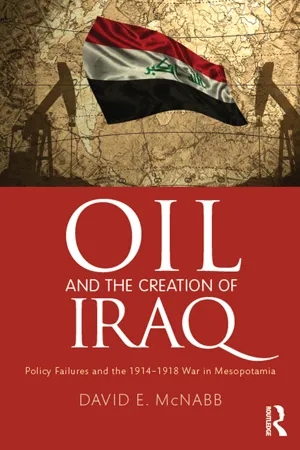
Off to the sidelines of the brutal western front of World War I was a nasty little campaign by British and India troops sent to secure Persian oil fields. Explaining what and how this happened in the early decades of the twentieth century goes beyond being just another history of a distant campaign in the 1914 to 1918 war. The highs and lows of what many British military planners in London considered to be a minor campaign in a distant theatre of operations proved to be a long, costly conflict the results of which still influence events today.
Oil and the Creation of Iraq describes how the policies of allied military leaders of the time resulted in pushing the Ottoman government into partnership with Germany and Austria during World War I, resulting in its disintegration and loss of its Middle Eastern territories. The book then describes how the political and economic aims of the nations involved in the Mesopotamian campaign influenced the fighting and subsequent creation of Iraq, a new nation with few defensible boundaries, but one sitting atop an almost inexhaustible supply of oil and gas.
The events and policy decisions that influenced the last years of the Ottoman Empire resulted in a long search among the political leaders of Europe for a resolution to what was an often bitterly contested Eastern Question. Defining the question was more difficult since it depended upon the point of view and prejudices of those doing the defining. For more than 200 years, hardly any diplomats of the time agreed on the same definition of what the question entailed. There has, however, been significant agreement that the unrest and conflict in the Middle East has only grown since the demise of the Empire. The ethnic, cultural, and religious conflicts that have characterized the region for hundreds of years have been exacerbated by great-power competition for dominant influence in the area, including access to the region's vast energy resources. Together, these internal and external forces have long played a major role in the formation of foreign policy around the globe. The shape and scope of the conflicts that have been in the news for the past three decades were formed in the policy-forming parlors of Europe more than 100 years ago. In the pages that follow I have tried to identify the thinking that underlay the nineteenth- and early twentieth-century policy decisions that led to engagement of the Ottoman Empire in World War I on the side of Germany and how that decision resulted in the final end of the Empire after the war.
For many in Europe, the events that led up to and continued after World War I in the Middle East had their roots in the eighteenth century as one of the disastrous consequences that the Russo-Turkish War of 1764–1774 had for the Ottomans. The harsh terms of the Kutchuk-Kainardji Treaty at the end of that war are considered to be the prelude to the end for the Ottoman Empire. Historians also agree that the Eastern Question was put to rest with the 1923 Lausanne Treaty that officially ended the Ottoman state and replaced it with the Republic of Turkey.
The Evolving Eastern Question
In using the Eastern Question as a model for analyzing the twentieth-century problems faced by Muslims in the Balkans, Fikret Karcic (2002) traced the evolution of the Eastern Question from its first use in the sixteenth century. He referred to an anonymous source writing in 1849, which was one of the first to associate the term with what Western nations should do with the declining Ottoman Empire, also noting that there is disagreement as to whether this was the earliest statement of the problem. Another of the earliest chroniclers of the Eastern Question, J.S.R. Marriott, avoided being pinned down to a date, and instead asserted that Europeans had been confronted with the Eastern Problem “from time immemorial.” However, he also stated that it had not become a common item in the diplomatic lexicon of Great Britain by the time of the 1821 Greek War of Independence. Marriott apparently did not have any qualms about what the Question involved when he summarized its import in the early pages of his detailed history of the Eastern Question:
The primary and most essential factor in the problem is, then, the presence, embedded in the living flesh of Europe, of an alien substance. That substance is the Ottoman Turk. Akin to the European family neither in creed, in race, in language, in social customs, nor in political aptitudes and traditions, the Ottomans have for more than five hundred years presented to the other European Powers a problem, now tragic, now comic, now bordering almost on burlesque, but always baffling and paradoxical.
(Marriott 1917, 3)
By 1899, other European historians considered the question to refer to the Russian moves into Ottoman territories on the Black Sea, and what the great powers of Europe should do to halt the Russian incursions. For others, the question focused on how to remove what they termed the “foreign religion” of Islam—and its protector, the “Turk”—from the Balkan Christian states and eventually from Europe entirely (Anderson 1966).
As the nineteenth century ended and the twentieth century began, the Eastern Question changed to refer to what the great powers of Europe were to do with the Empire's European and African territories after what they saw as the irreversible collapse of the Ottoman Empire. Great Britain, France, Germany, Austria-Hungary, Italy, and Russia all feared that one or more of the others were going to take unfair advantage over the others by grabbing a larger share of the Balkan spoils; more to the point, they were adamant that any other's disproportionate gain was not going to happen (Sowards 1997). Their foreign policies were developed to ensure that loss of opportunity did not happen. One way to be certain they received their share of the Ottoman spoils was to negotiate mutual assistance treaties and build alliances with other participants. Those alliances would eventually make the disintegration of the Ottoman Empire a certainty.
To understand the Ottoman decision to seek association with a powerful European power in 1914, it is necessary to follow the external crises the Ottomans suffered through during the several centuries leading to August 1914. Those crises seemed to always end badly for the Ottomans, and more often than not resulted in a steady stream of losses in prestige, property, and territory. A map of the Ottoman Empire at the peak of its seventeenth-century expansion and the dates and territories acquired during that expansion is shown in Map 1.1.
Map1.1 The Ottoman Empire at its Seventeenth-Century Peak
(source: André Koehne. February 2008. Wikimedia commons. https://commons.wikimedia.org/wiki/File:Ottoman_empire.svg).
The Scope of the Eastern Question
By 1914, the Eastern Question had taken on a new dimension. J.A.R. Marriott's 1917 (reprinted in 2012) study of the history of European diplomacy concluded that the Eastern Question prior to the war referred to what was basically a clash between two very different cultures, or as suggested by Samuel Huntington in 1993, it was more a clash between civilizations. Huntington identified three conclusions that should be considered when analyzing the impact of the Eastern Question on eastern and western nations’ policies toward the Middle East in the eighteenth, nineteenth and twentieth centuries, and continue to do so in the twenty-first century: first, it is civilizations, not nations or people, that make history; second, there are sharp and irreconcilable differences between Eastern (especially Islamic) and Western civilizations; and third, those differences will always lead to conflict. Marriott identified six issues that brought the question to the fore in European capitals in the nineteenth and early twentieth centuries:
The actions of the Ottoman Turks since invading Europe in the fourteenth century that resonated as barbaric and reminiscent of the Huns.
The balkanization of Central Europe and the nationalistic uprisings against their Ottoman overlords, such as with the new states of Greece, Serbia, Bulgaria, and Romania, together with the would-be states of Bosnia, Herzegovina, and Transylvania that had been annexed by Austria, and Montenegro that had escaped being “under the Turkish yoke.”
The reoccurring problem of entry and exit from the Black Sea and who would ultimately control Constantinople.
Russian aggression and annexation of Ottoman lands in the Caucuses and Black and Caspian Sea regions, along with their growing presence in the Eastern Balkans.
The role of the Habsburgs (Austria-Hungary) in Eastern Europe, their goal of gaining an outlet in the Adriatic and, through there, naval access to the Mediterranean, along with their relations with the South Slavs in the annexed Balkan territories of Dalmatia, Bosnia, Herzegovina, and the Kingdom of Serbia and Montenegro.
The aggressive attitudes of the European great powers in general and how Britain's relations with them were shaped by one or more of these and related issues.
The Ottoman Empire
Europe's concerns with the Ottoman Empire may have begun earlier than the collapse of the Ottoman Empire, even as early as a result of the fear generated by the fall of Constantinople to the seemingly unstoppable Muslim Turks in 1453 and their entry onto the soil of Southeastern European. Writing in 1904, the American scholar Arthur Gray called this the onset of what was to be four phases of the Eastern Question in the foreign policies of European nations. Underlying all of these phases was their fundamental political, religious, and economic quest to drive the Turks from Europe. The first phase lasted until the 1606 Treaty of Sitvatorok released Austria from having to pay annual tribute for control of what became a part of Hungary.
The second phase of Ottoman expansion into Europe was halted in 1683 when the Ottomans failed to capture Vienna. Austrian forces pushed the Ottoman Army out of Austria and back into Ottoman territory. In 1699, Austrian forces soundly defeated the Ottomans at the Battle of Zenta in what is now Serbia. The Ottomans ended these forays deeper into Europe by having to give up nearly half of the territory they had conquered in the Balkans. The Treaty of Karlowitz, which ended the 1683–1699 Austria–Ottoman war, allowed Austria to annex most of Hungary and Croatia, essentially ending Ottoman control over large portions of Central Europe. From then on, the Porte had to suffer the loss of more and more territory to European powers.
In the third period, Russia supplanted Austria as the Ottoman's greatest enemy. It began with the loss of Azov and Crimea, given semi-autonomous status as the Crimean Khanate under Ottoman guidance. This was followed less than a year later by Russia's outright annexation of the Khanate in an unprovoked act of territorial accretion that would be repeated by Russia in the twenty-first century. Mesopotamia, which lay between the regions of Persia that the Russians were interested in and the Anatolian heartland of the Empire, was about to take on an important place in the foreign-policy planning of the Ottomans.
Mesopotamia Awakening
In 1914, the eastern portions of the Ottoman Empire that included the provinces (vilayets) of Mosul, Baghdad, and Basra had been an integral part of the Ottoman Empire for more than 400 years. The vilayets were unofficially known collectively as Mesopotamia. The farthest southwest provinces of Baghdad and Basra had been acquired and lost several times during that long period until finally in the middle of the sixteenth century it was taken for the last time from Persia. Over its thousands of years of existence, these three provinces had been slowly declining from having once been one of the richest centers of farming and trade in the then known world to becoming a forgotten and ignored field of crumbling ruins, destroyed irrigation canals, and desert. By the early twentieth century under Ottoman rule, Mesopotamia had become little more than essentially a forgotten, distant corner of land inhabited by a small number of desert nomads, herders of goats or sheep, primitive tillers of small farm plots of grain or dates, or dwellers of vast and mysterious, nearly impenetrable, reed-choked, malaria-infested swamps. By the eighteenth century, the Ottoman Empire itself was suffering through revolutions among subject populations that were affecting continual territorial losses. These problems were exacerbated by a variety of external and internal crises.
External Crises
A series of external crises occurred from the eighteenth to the early twentieth century in which the Eastern Question became increasingly an issue among the great powers of Europe. They began with the loss of lands on the Black Sea in the 1768–1774 war with Russia. This was followed by the Greek War of Independence that began in 1821 and lasted until 1829, the Crimean War from 1853 to 1856, the three-year Balkan Crisis that began in 1875, and the two Balkan Wars of 1912 and 1913. In addition to these wars, throughout the several years leading up to the outbreak of the First World War, Turkey's Balkan territories—Romania, Bulgaria, Albania, Serbia, and Greece—were clamoring for independence. More important, they were ready to go to war to achieve it.
The July 1774 treaty signed by Russia and the Ottomans ended what had been probably the most disastrous of wars for the Ottoman Empire until her defeat in World War I. The Ottomans ceded much of their lands on the Black Sea and granted Russia freedom of naval and merchant ship navigation on the Black Sea itself where, prior to 1774, only Ottoman ships could sail. Russian merchant vessels were to be allowed access through the Bosporus, the narrow strait between the Black Sea and the Sea of Marmara, and the Dardanelles, the 38-mile strait at the western end of the Straits that separates Europe from Asia. The Crimea, which had been an Ottoman vassal state, became an independent state under the protection of Russia. Russian merchants were allowed to trade in Constantinople, and Russia was also allowed to construct an Orthodox church in Constantinople to serve as protector of all Orthodox Christians in Turkey (Anderson 1966; Sowards 1997).
Internal Crises
Internal crises included the Young Turk revolution of 1908 and counterrevolution of 1909. By 1908 the Sultan no longer controlled the Empire's economic policy and administration; a condition for receiving another loan from foreign bankers gave foreigners the right to control all income and disbursements as collateral for the ...
Table of contents
Cover
Half Title Page
Title Page
Copyright Page
Table of Contents
List of Maps
List of Boxes
List of Tables
Foreword
PART I Prelude to War
PART II Forces Shaping Prewar Foreign Policy
PART III The War in Mesopotamia
PART IV Creating Iraq
Afterword: Britain’s Long Struggle for an Iraq Policy
Appendix A: Timeline of Selected Events in Ottoman History
Appendix B: The Mandate Covenant
Appendix C: The Treaty of Lausanne
Bibliographic Notes and Author Information
Bibliography
Index
Trusted by 375,005 students
Access to over 1.5 million titles for a fair monthly price.
Study more efficiently using our study tools.
Frequently asked questions
Yes, you can cancel anytime from the Subscription tab in your account settings on the Perlego website. Your subscription will stay active until the end of your current billing period. Learn how to cancel your subscription
No, books cannot be downloaded as external files, such as PDFs, for use outside of Perlego. However, you can download books within the Perlego app for offline reading on mobile or tablet. Learn how to download books offline
Perlego offers two plans: Essential and Complete
Essential is ideal for learners and professionals who enjoy exploring a wide range of subjects. Access the Essential Library with 800,000+ trusted titles and best-sellers across business, personal growth, and the humanities. Includes unlimited reading time and Standard Read Aloud voice.
Complete: Perfect for advanced learners and researchers needing full, unrestricted access. Unlock 1.5M+ books across hundreds of subjects, including academic and specialized titles. The Complete Plan also includes advanced features like Premium Read Aloud and Research Assistant.
Both plans are available with monthly, semester, or annual billing cycles.
We are an online textbook subscription service, where you can get access to an entire online library for less than the price of a single book per month. With over 1.5 million books across 990+ topics, we’ve got you covered! Learn about our mission
Look out for the read-aloud symbol on your next book to see if you can listen to it. The read-aloud tool reads text aloud for you, highlighting the text as it is being read. You can pause it, speed it up and slow it down. Learn more about Read Aloud
Yes! You can use the Perlego app on both iOS and Android devices to read anytime, anywhere — even offline. Perfect for commutes or when you’re on the go. Please note we cannot support devices running on iOS 13 and Android 7 or earlier. Learn more about using the app
Yes, you can access Oil and the Creation of Iraq by David E. McNabb in PDF and/or ePUB format, as well as other popular books in Storia & Storia mediorientale. We have over 1.5 million books available in our catalogue for you to explore.