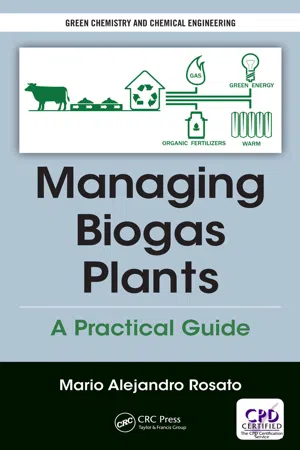
This practical manual provides basic theoretical knowledge about fermentative processes, biochemical laboratory techniques, and an arsenal of practical tricks, recipes, do's, and don'ts for the biogas plant manager. It explains why some popular tests and techniques are unreliable, how to optimize the feedstock's cost and the energy self-consumption of the digester, and how to analyze experimental error propagation and judge whether a marketing claim or a test result from the literature is correct. All examples are taken from the author's experience as consultant in managing biogas plants in Italy and Spain. It features a glossary of technical jargon and useful reference tables and formulae. By following the procedures described in this manual, anybody can learn in short time how to become a "bacteria farmer."
- 274 pages
- English
- ePUB (mobile friendly)
- Available on iOS & Android
eBook - ePub
About this book
Trusted by 375,005 students
Access to over 1.5 million titles for a fair monthly price.
Study more efficiently using our study tools.
Information
Contents
Foreword
Preface
About the Author
1. Relevant Aspects for Optimizing the AD Process
1.1 What Is Anaerobic Digestion?
1.1.1 Theoretical Notions
1.1.2 Practical Implications
1.1.2.1 Complexity of the System
1.1.2.2 Sequential Process
1.1.2.3 Multiparametric Process
1.1.2.4 Two Degradation Paths of the Organic Matter
1.1.2.5 Influence of Temperature
1.1.2.6 Need of a Balanced Diet for the Microorganisms
1.1.2.7 Criterion for the Selection of Feedstock for AD
1.2 Technical Nomenclature
1.2.1 Definitions
1.2.2 Practical Applications and Numerical Examples
1.2.2.1 Approximate Ratio between COD and VS
1.2.2.2 Methane Yield of a Substrate with a Known BMP
1.2.2.3 Coherent Use of the TS, VS, and BMP Values
1.2.2.4 Calculation of the HRT
1.2.2.5 Checking the OLR
1.2.2.6 Optimizing the ClN Ratio of a Substrates Mixture
1.3 Managing the Plant “by Tables”: Limitations and Risks
1.3.1 Conclusions on the Use of Tables
1.4 The Dynamic Management of the Biogas Plant
1.4.1 The pH
1.4.2 The Relationship between pH and Alkalinity
1.4.3 The Chemical Composition of the Substrate
1.4.4 The VFA Profile
1.4.5 Monitoring the Biogas’ Flow and Composition
1.4.6 Monitoring the ORP
1.4.7 Monitoring the Electric Conductivity
1.5 The Outsourced Biological Management Service: Limitations of the Traditional Techniques
1.5.1 Conclusions
1.6 The Automatic Titrator: Myths and Legends
Bibliography
2. Overview of the laboratory methods for the analysis of fermentative processes
2.1 Basic notions of metrology: Accurateness and precision or repeatability
2.1.1 Definitions of accurateness and of precision or repeatability
2.1.2 Error propagation
2.2 Measurement methods employed in the biogas industry
2.2.1 Classical volumetric and barometric methods
2.2.1.1 Volumetric methods
2.2.1.2 Barometric methods
2.2.2 Automatic measurement systems: AMPTS and BRS
2.2.3 Reactors for biological tests: which are better?—big or small ones?
2.2.4 The most frequent errors in the measure of small gas flows
2.2.4.1 Normalization
2.2.4.2 Correction of the moisture
2.2.4.3 Elimination of carbon dioxide
2.2.5 Auxiliary physicochemical tests
2.2.5.1 Measure of the pHAND the ORP
2.2.5.2 Determination of the DM and VS of biomass
2.2.5.3 Determination of the COD of sludge and liquid substrates
2.2.6 The in situ laboratory for the real‐time control of the biological process
Bibliography
3. How to perform tests under optimum conditions
3.1 Scope
3.2 Measuring the DM and VS
3.2.1 Measuring the DM with a moisture analyzer
3.2.1.1 Confusing the “Moisture” and the “DM” Scales
3.2.1.2 Wrong setting of the drying temperature
3.2.1.3 Wrong installation of the moisture analyzer
3.2.1.4 Measuring the DM of silage
3.2.1.5 Interpretation of the scale’s technical sheet
3.2.2 Measurement of the DM with an oven and a scale
3.2.3 Measuring the ash content and VS
3.3 Measuring the COD and Total N
3.4 How to Design a Biological Experiment
3.5 The Preparation of Both Inoculum and Sample
3.6 The inoculum/substrate ratio, I/S
3.7 Defining the mix ratio (Intensity of stirring)
3.8 The BMP Test: One General Procedure, Multiple Applications
3.8.1 General procedure for measuring the BMP
3.9 Processing the measured data
3.9.1 Step‐by‐step data processing
3.9.2 Frequent causes of problems during the BMP test
3.9.2.1 Problems caused by human errors
3.9.2.2 Problems caused by instrumental or method errors
3.10 The hydrolytic and methanogenic activity tests: checking the bacteria’s health
3.10.1 Degradation of polysaccharides (Glucose, starch, and cellulose)
3.10.2 Casein and gelatin in powder
3.10.3 Propionic and butyric acids
3.10.4 Fatty acids (Lipids)
3.10.5 Acetic acid and sodium acetate
3.10.5.1 Stoichiometry of acetic acid and sodium acetate
3.10.5.2 First step: checking the methanogenic capacity of acetate or acetic acid
3.10.5.3 Second step: The SMA calculation
3.11 Analysis of the error propagation in the BMP assay and its variants
3.12 A controversial technique: correcting the pH, the alkalinity, and adding nutrients before starting the batch tests
Bibliography
4. Application of Laboratory Experimental Results to the Management of the Biogas Plant
4.1 Practical Applications of the VS Test
4.1.1 Measuring the Organic Load (OL) and the Organic Load Rate (OLR)
4.1.1.1 PracticalApplication
4.1.2 Measuring the Efficiency of the Feedstock’s Conversion into Methane
4.1.3 Corrective Actions in the Case ηDA < 45\
4.2 Practical Applications of the BMP Test
4.2.1 The Right Price for the Feedstock
4.2.2 Optimizing the Biogas Plant’s Diet
4.2.3 Preventing the Inhibition Caused by “Difficult” Substrates
4.2.4 Checking the Digestion Efficiency of the Biogas Plant
4.2.5 Determination of the Optimum SRT/HRT
4.2.6 Determining the Efficacy of Additives and Pretreatments
4.2.7 Frequent Errors in Planning and Performing Biological Tests
4.3 Using Reference Substrates to Check the Hydrolytic Activity: How to Find Out if Something Is Going Wrong
4.3.1 Hydrolysis Test of Cellulose
4.3.2 Hydrolysis Test of Sugar and Starch
4.3.3 Hydrolysis of Proteins
4.3.4 Lipolytic Activity Test
4.3.5 General Substrate Inhibition Test
4.4 Applications of the SMA Test: Preventing the Biological Collapse and Selecting the Best Inoculum to Start a Biogas Plant
4.4.1 Practical Example on How to Test an Inoculum Suspected of Methanogenic Inhibition Using Wine Vinegar
4.4.2 Practical Example of the SMA Test for the Selection of the Inoculum Necessary for Starting a New Biogas Plant
4.4.3 How to Determine the Dosage of Trace Elements if SMA < 10
4.5 Conclusions
4.5.1 Usefulness of the Test with Vinegar, Acetic Acid, or Acetate as Reference Substrate
4.5.2 Reference Substrates
Bibliography
5. Some Simple Tricks To Improve The Laboratory’s Operativity
5.1 Foreword
5.2 Measuring the Percentage of Methane in the Biogas with the Double Reactor Set and with the Syringe Method
5.2.1 Necessary Materials for the Syringe Test
5.2.2 Performing the Test with the Syringe
5.2.3 Error Analysis of the Syringe Method
5.3 Solving the Problem of the Thermostatic Bath’s Evaporation
5.3.1 Seal the Cap between the Reactors and the PIexyglass Cover by Means of O-rings or Rubber Bands
5.3.2 Add Some Very SoIuble Sa|t to the Water
5.3.3 Replacing the Water in the Thermostatic Bath with Any Fluid Having Low Vapor Pressure
5.4 Improved Connection of the DC Stirrer Motors
5.4.1 Description and TheoreticaI Analysis of the Problem
5.4.2 Step-by-Step Procedure to Connect the Power Sup...
Table of contents
- Cover
- Halftitle
- Title
- Copyright
- Table of Contents
Frequently asked questions
Yes, you can cancel anytime from the Subscription tab in your account settings on the Perlego website. Your subscription will stay active until the end of your current billing period. Learn how to cancel your subscription
No, books cannot be downloaded as external files, such as PDFs, for use outside of Perlego. However, you can download books within the Perlego app for offline reading on mobile or tablet. Learn how to download books offline
Perlego offers two plans: Essential and Complete
- Essential is ideal for learners and professionals who enjoy exploring a wide range of subjects. Access the Essential Library with 800,000+ trusted titles and best-sellers across business, personal growth, and the humanities. Includes unlimited reading time and Standard Read Aloud voice.
- Complete: Perfect for advanced learners and researchers needing full, unrestricted access. Unlock 1.5M+ books across hundreds of subjects, including academic and specialized titles. The Complete Plan also includes advanced features like Premium Read Aloud and Research Assistant.
We are an online textbook subscription service, where you can get access to an entire online library for less than the price of a single book per month. With over 1.5 million books across 990+ topics, we’ve got you covered! Learn about our mission
Look out for the read-aloud symbol on your next book to see if you can listen to it. The read-aloud tool reads text aloud for you, highlighting the text as it is being read. You can pause it, speed it up and slow it down. Learn more about Read Aloud
Yes! You can use the Perlego app on both iOS and Android devices to read anytime, anywhere — even offline. Perfect for commutes or when you’re on the go.
Please note we cannot support devices running on iOS 13 and Android 7 or earlier. Learn more about using the app
Please note we cannot support devices running on iOS 13 and Android 7 or earlier. Learn more about using the app
Yes, you can access Managing Biogas Plants by Mario Alejandro Rosato in PDF and/or ePUB format, as well as other popular books in Biological Sciences & Biotechnology. We have over 1.5 million books available in our catalogue for you to explore.