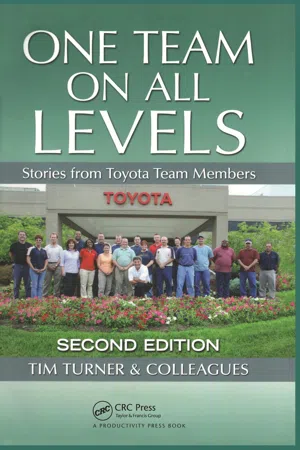
eBook - ePub
One Team on All Levels
Stories from Toyota Team Members, Second Edition
- 322 pages
- English
- ePUB (mobile friendly)
- Available on iOS & Android
eBook - ePub
One Team on All Levels
Stories from Toyota Team Members, Second Edition
About this book
Written by actual Toyota team members, One Team on All Levels: Stories from Toyota Team Members, Second Edition is not another technical explanation of the Toyota Production System (TPS). Rather, it illustrates the culture it creates. The stories, told by employees from various levels of the organization, illustrate how Toyota's presence in Kentuck
Information
Publisher
Productivity PressYear
2011Print ISBN
9781439860670
9781138434806
Edition
2eBook ISBN
9781439860687
Chapter 1
Our History
Kosai, Shizuoka, japan, 1867
This was the year that Sakichi Toyoda was born. He was an inventor who is actually referred to as the “king of Japanese inventors.” The Toyoda family is a very humble family probably due in large part to the family story. Sakichi’s father was a carpenter in Kosai, Shizouka, Japan. The creativity and ingenuity that he used while in the carpentry shop were followed and studied by his son. Sakichi’s most famous invention was the automatic power loom that would stop automatically when a problem occurred. This was known as jidoka (autonomous automation). The idea of jidoka is the combination of machines and people to ensure great quality, and it is built into every Toyota product.
Sakichi had two children: a son named Kichiro Toyoda and a daughter named Aiko Toyoda. With his father’s approval, Kichiro would eventually found Toyota Motor Corporation and would set the groundwork of the Toyota production system in the form of a four-inch-thick manual. He first began implementing these ideas in the loom works factory. He would resign from president of the auto division in 1948 and ask his cousin and close friend, Eiji Toyoda, to take over. Eiji had already proven himself to be a great leader in 1938, when he was charged with the task of overseeing the construction of the Toyota Motors facility near the town of Kiromo, which would later be called “Toyota City.” This factory would later be known as the mother plant to all other facilities throughout the world.
He would lead Toyota through hard times and successful times until it would eventually be known as a worldwide leader in automobiles. He would lead us through the creation of Lexus, which would be known as a worldwide luxury brand, the first from a major Japanese company.
Toyota Motor Corporation would twice attempt to get into the American auto market. The first time was in the 1950s, when it introduced the Toyota Toyopet. This car would have small success in California, but it could not get sold throughout the rest of the country.
Throughout the 1950s, members of Toyota would visit the United States to see how the Americans could mass-produce products. Eiji would visit a Ford plant at the invitation of Henry Ford II. He was amazed at how the Americans could build 8,000 cars a day when the Japanese (Toyota) could only produce 2,500 cars in their entire thirteen-year history. He went back to Japan with the challenge to catch up with the Americans’ productivity in three years. Toyota had to increase production and do it in a way to save space and money.
This challenge created a lot of excitement within the company. Many team members and managers would take on this challenge with great enthusiasm, and none greater than an employee named Taichii Ohno. Mr. Ohno was born in Dalian, China. He is now considered to be the father of the Toyota production system and lean manufacturing. He was a faithful Toyota employee, getting his start on the factory floor at the loom works and then moving to the motor company in 1943. He is a true success story and an example that any employee at Toyota can grow within the company to become an executive and leader. This is a huge key to the success of every Toyota facility. Each employee is empowered to create “kaizen” (continuous improvement) and then “yokaten” (share those ideas to all other Toyota facilities). We should never rest on our laurels and always look to improve.
Mr. Ohno liked to share stories in his teachings. The following story is an excerpt taken from his book, Toyota Production System: Beyond Large-Scale Production.
Years ago, I used to tell production workers one of my favorite stories about a boat rowed by eight men, four on the left side and four on the right side. If they do not row correctly, the boat will zigzag erratically. One rower might feel he is stronger than the next and row twice as hard. But this effort upsets the boat’s progress and moves it off course. The best way to propel the boat faster is for everyone to distribute force equally, rowing evenly and at the same depth. Teamwork is essential to our success.
In 1959, Toyota would build its first plant outside of Japan. The plant would be built in Brazil. At this point, Toyota would commit to someday build and design cars where they are sold.
As you read this book, you will see examples that the systems that he and others created, combined with the values and humble nature of the Toyoda family and the corporation itself, would create a company that would provide stable employment for nearly 68,000 direct employees across the globe.
These principles and values would help shape a new idea in the world that people from across the globe can work together for a common goal. In our company’s case, it is to build a work culture that provides safe cars to transport people from every region of the world to their destination.
Georgetown, Kentucky, 1985
It was known that Toyota wanted to expand to North America. One company principle that Toyota believes in is that they build the cars where they sell them. In January 1985, Toyota Motor Manufacturing, USA, would be established, and the search began to find a site for its first American auto assembly plant. It was narrowed to five states in November, and on December 11, 1985, it would be announced that Georgetown, Kentucky, would be the site of the new facility that would employ over 3,000 Kentuckians.
Ground was broken on May 5 for the building of the factory. Fifteen suppliers would also begin showing interest in locating to Kentucky. In 1988, the state announced that over 120,000 applications from every county had been turned in to the state for a job at Toyota. Most Kentuckians did not have a lot of choices as far as employment went. I suspect this was one reason why Toyota decided to locate in our state. They were able to pick the very best workers from a state in need of a strong employer. Many people would relocate their families from all over the state. A lot of people were able to leave a region of the state that provided only the opportunity to work in the coal mines for a good-paying job.
In May 1988, the first-generation Camry would roll off our line. This car can now be seen in the Toyota visitor center located at our plant. In August, the company would break ground on a new power train plant. The company now directly employs over 7,000 workers at the Georgetown facility and later established Toyota Motor Engineering & Manufacturing North America (hereafter, TEMA) in Erlanger, Kentucky. This would be the headquarters for all North American facilities.
Toyota had many concerns with locating in North America. It had to find a state with a culture very similar to the company’s beliefs and values. Georgetown had to be a success story. The corporation and the state could accept nothing less than a great partnership. Mr. Fujio Cho (former president of Toyota Motor Manufacturing, Kentucky; hereafter, TMMK) said it best at our twentieth-anniversary celebration: “Twenty years ago Toyota took a giant step in North America. In the beginning we were anxious. We were not sure if we would be accepted in the U.S., and especially in Kentucky. But as it turned out, the people of the community and the state welcomed us wholeheartedly and with open arms.”
Toyota now has seven assembly plants in North America. The Georgetown plant is considered to be the mother plant of a few of the North American facilities. This is something that we are proud of and take very seriously. It is our job to provide other states and our fellow team members across the United States with the support and leadership that were provided to us twenty-three years ago. The key to Toyota’s success is that we see everyone as our customer. This starts with management of our company seeing the team members as their customers and the team members on the factory floor having a customer-first attitude. We realize that if our cars are not built with quality in mind, then we go backward. We are always looking ahead.
Georgetown, Kentucky, January 2009: The Recession and Downturn of the Auto Industry
In January 2009, the world economy was the worst it had been since the Great Depression, and uncertainty surrounded everyone, including Georgetown for the first time since 1988. Our plant was idle. A rare, uneasy feeling was surrounding the team members. Our president, Steve St. Angelo, would walk around the plant raising morale. He referred to it this way. He felt as if he was the captain of a ship: he said he was steering the ship, trying to make sure everyone was having a good time but keeping the focus on avoiding that iceberg that he knows is out there. This positive attitude from our executives along with the understanding of the situation among our team members would keep us afloat. The year 2009 would be a challenge due to the economy, but nothing could prepare us for 2010.
Washington, D.C., February 2010
Two congressional hearings would take place in February 2010 to look at Toyota quality and claims of unintended acceleration. A Toyota customer testified that her Lexus sped up in Tennessee and she could not get it to stop. It was a heartfelt testimony of a call to her husband. After the incident, the Lexus was sold to another family who did not experience any issues. Our government used our tax dollars to buy that Lexus from that family and to tear it apart. As of November 19, 2010, they have found no issues to prove that it had unintended acceleration. Toyota Motor Sales President Jim Lentz was then questioned. It was a rough testimony full of politically charged allegations and claims. Keep in mind that I am not a spokesman for Toyota. I’m just an American who feels like our representatives in Congress mistreated my employer and that they are using my tax dollars to hurt my family by attempting to destroy my company’s good name and reputation. Enough is enough. Congressional priorities need to stay focused on our economy and quit looking for ways to take the attention off of the real problems in our country.
The second hearing would have Toyota Motor Corporation President Akio Toyoda and North American President Yoshi Inaba sharing testimony. I think a lot of Americans don’t realize it, but Akio Toyoda could have said NO to Congress. He did not have to testify. He chose to because our customers deserved to hear from him. It was a proud moment to see him “step up to the plate.” Congress was brutal. Some of them seemed to be having fun at the expense of someone in a tough situation, and they took full advantage of their power. When I watched the hearings, I couldn’t help but feel sorry for him. He had a language barrier and a cultural barrier to deal with along with the Congress members’ sharp questions and comments. It was a proud moment for me to see him in our nation’s capital. You see, he wasn’t just defending his company or his family’s name. He was defending the honor of the 37,000 Americans who work for his company. Under the circumstances, he did a great job.
The following are stories shared by Toyota team members from all levels of the company. Some discuss the importance of the fourteen Toyota Way principles, how they are an outline to create a culture of servant-style leaders, and how those principles with the idea of lean manufacturing are combined to create a culture of constant improvement.
The rest are stories from team members who wanted to share how the company provides them with benefits and demonstrates the values that the Toyoda family has created within the corporation to provide us with a stable secure future. It is these values that empower the team members to work hard for Toyota Motor Manufacturing and create a sense of loyalty to the company.
Chapter 2
Our Beginning: Team Members Who Began the Success Story
There is a story of two Japanese men who were driving through Georgetown, Kentucky, in 1985 and stopped to ask for directions to Cherry Blossom Way (the address of our plant). They were treated rudely and sent on their way. It would have been easy for Toyota to have gone back to Japan and said no to Kentucky. Thankfully, they did not do that. They realized that putting a plant in the United States was about breaking down racial boundaries. Diversity actually began in our plant and community before ground was even broken to build it. Georgetown would never be the same.
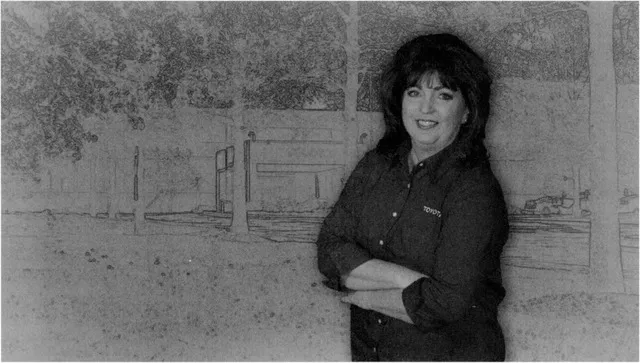
“It was an exciting time, working at the paper, waiting to see if Georgetown, Kentucky, would be the chosen one.”
Debbie Poe: Assistant Manager
“Oh, What a Feeling!” is what the headlines read after the finishing touches were made late that night at the newspaper back in 1985. It was an exciting time, working at the paper, waiting to see if Georgetown, Kentucky, would be the chosen one. What a feeling it really was, to get the wonderful news that TOYOTA was coming to Georgetown and be able to pass it along to our readers.
From then on, it seemed that every edition had new and exciting news about Toyota. But not all of it was positive. We were really surprised that there were so many in the community that did not want the plant to be built here. What would happen to our community? They wanted to keep our small, hometown atmosphere. But there were so many more that wanted the growth that Toyota would bring. Growth had already begun, with the years in planning for a new, larger airport, which had to look for another site to build after Toyota decided on their new site.
Yes, it was a very exciting time for me, also. My husband, a pilot and the owner and operator of Fixed Based Operation, Marshall Field Airport, had hosted several meetings at the old airport during the planning phase of the plant. All of this time, he kept telling me, “You really need to apply for a position at the Toyota plant when the time comes.” I would just say, “OK, I will think about it,” all the time thinking to myself, “I have no skills to build a car!” I could barely identify the major components, much less build one.
The day came when there it was, in black and white ... I was actually pasting it to a page in the newspaper. “Toyota: now accepting applications.” Everyone was talking about it. But what would I do there? Again, I don’t know anything about building a car. Finally, my husband talked me into it.
I will never forget the feeling I had when I returned home one afternoon and had a message on my answering machine. It was from a member in HR at Toyota. The message said exactly this: “This message is for Deborah. This is Todd from Toyota. Please call me Monday morning at this number. I have some good news.” YES ... Monday morning. This was Friday afternoon, after everyone had gone home for the day. I had to wait the entire weekend before I could speak to anyone. I was so excited. I remember screaming when I heard the message. My sons ran into the kitchen to see what I was acting so crazy about. I was so happy, I cried and screamed and explained to them that I thought I had been accepted at Toyota. The first thing they said was “But Mom, you don’t know anything about building cars, do you?” I laughed so hard, then, we all started to scream. It was one of the happiest times of our family.
I started out my career in conveyance. My first job was picking up kanbans (a sign board for reordering parts) on a tricycle, every hour, then sorting them for the d...
Table of contents
- Cover
- Half Title
- Title Page
- Copyright Page
- Table of Contents
- Dedication Page
- The Toyota Precepts
- Foreword
- 1 Our History
- 2 Our Beginning: Team Members Who Began the Success Story
- 3 Our Motivation: Stories of Appreciation and Dedication
- 4 Our Inspiration: Stories of Support and Triumph
- 5 Our Determination: Stories of Kaizen
- 6 Our Thinking Minds: Stories of Quality Circle Activity
- 7 Our Family: Making It Personal
- 8 Our Education and Training: Reach for the Stars Program
- 9 Our Teamwork
- 10 Our Understanding: What We Have Learned Along the “Toyota Way”
- 11 Our Development: Special Projects Stories
- 12 Toyota Way Principles
- 13 Our Leadership
- 14 Our Ambassadors
- 15 My Career and Thoughts
- Index
Trusted by 375,005 students
Access to over 1.5 million titles for a fair monthly price.
Study more efficiently using our study tools.
Frequently asked questions
Yes, you can cancel anytime from the Subscription tab in your account settings on the Perlego website. Your subscription will stay active until the end of your current billing period. Learn how to cancel your subscription
No, books cannot be downloaded as external files, such as PDFs, for use outside of Perlego. However, you can download books within the Perlego app for offline reading on mobile or tablet. Learn how to download books offline
Perlego offers two plans: Essential and Complete
- Essential is ideal for learners and professionals who enjoy exploring a wide range of subjects. Access the Essential Library with 800,000+ trusted titles and best-sellers across business, personal growth, and the humanities. Includes unlimited reading time and Standard Read Aloud voice.
- Complete: Perfect for advanced learners and researchers needing full, unrestricted access. Unlock 1.5M+ books across hundreds of subjects, including academic and specialized titles. The Complete Plan also includes advanced features like Premium Read Aloud and Research Assistant.
We are an online textbook subscription service, where you can get access to an entire online library for less than the price of a single book per month. With over 1.5 million books across 990+ topics, we’ve got you covered! Learn about our mission
Look out for the read-aloud symbol on your next book to see if you can listen to it. The read-aloud tool reads text aloud for you, highlighting the text as it is being read. You can pause it, speed it up and slow it down. Learn more about Read Aloud
Yes! You can use the Perlego app on both iOS and Android devices to read anytime, anywhere — even offline. Perfect for commutes or when you’re on the go.
Please note we cannot support devices running on iOS 13 and Android 7 or earlier. Learn more about using the app
Please note we cannot support devices running on iOS 13 and Android 7 or earlier. Learn more about using the app
Yes, you can access One Team on All Levels by Tim Turner,Constantine H. Sheldon,John J. D'Azzo,Constantine H. Houpis,Stuart N. Sheldon in PDF and/or ePUB format, as well as other popular books in Business & Leadership. We have over 1.5 million books available in our catalogue for you to explore.