Contemporary Climate Change Debates is an innovative new textbook which tackles some of the difficult questions raised by climate change.
For the complex policy challenges surrounding climate migration, adaptation and resilience, structured debates become effective learning devices for students. This book is organised around 15 important questions, and is split into four parts:
What do we need to know?
What should we do?
On what grounds should we base our actions?
Who should be the agents of change?
Each debate is addressed by pairs of one or two leading or emerging academics who present opposing viewpoints. Through this format the book is designed to introduce students of climate change to different arguments prompted by these questions, and also provides a unique opportunity for them to engage in critical thinking and debate amongst themselves. Each chapter concludes with suggestions for further reading and with discussion questions for use in student classes.
Drawing upon the sciences, social sciences and humanities to debate these ethical, cultural, legal, social, economic, technological and political roadblocks, Contemporary Debates on Climate Change is essential reading for all students of climate change, as well as those studying environmental policy and politics and sustainable development more broadly.
1 Is climate change the most important challenge of our times?
Sarah E. Cornell and Aarti Gupta
Summary of the debate
This debate tackles the overarching question that frames the whole book, namely what is the significance of climate change for today’s decision-making and political action in the world? Sarah Cornell argues that climate change is the most important challenge of our times because it now sets the global context for all the other social and ecological challenges the world faces. Unmitigated climate change puts at risk all other human development accomplishments and measures of wellbeing. Conversely, Aarti Gupta argues that only by addressing the more fundamental ‘inequality crisis’ of our times do we have even a hope of effectively addressing the climate crisis. In a context of persisting inequalities, characterising climate change as the most urgent challenge might even be potentially dangerous.
YES: Because climate change is changing everything (Sarah E. Cornell)
Introduction
In our times it has become clear that Earth’s climate is changing as a consequence of people’s activities. The state of scientific understanding of the climate system has been routinely deliberated and detailed in successive assessment reports of the Intergovernmental Panel on Climate Change (IPCC, 2014). These reports also assess the social and ecological impacts of a changing climate and the implications of climate adaptation and mitigation activities. The ‘bare facts’ are that anthropogenic (human-caused) greenhouse gases are currently accumulating in the atmosphere. The main greenhouse gas is carbon dioxide from fossil fuel use. Landscape changes such as deforestation, agriculture, wetland drainage and the large-scale restructuring of coastal zones are also important sources of carbon dioxide and of methane and nitrous oxide, the two other main greenhouse gases. Emissions of these gases are increasing year-by-year and their concentration in the atmosphere is rising (Hawkins, 2019, gives clear visualisations of the changes).
As the atmosphere’s chemical composition changes, so too do its physical properties: the higher the concentration of radiatively active gases in the atmosphere, the stronger the greenhouse effect and the warmer Earth’s surface, and ocean, becomes. These processes are well understood and can be predicted with high scientific confidence. At the heart of today’s climate modelling are calculations of fluid motion and exchanges of heat between atmosphere and ocean. The ice sheets, land surface and life itself are also involved in shaping Earth’s climate, so advances in climate research have progressively included representations of these dynamics too, resulting in the current generation of multi-component Earth system models (Simmons et al., 2016).
In short, climate change is a global and increasingly well understood phenomenon. But why should climate change be seen as more important than any other environmental, social or political issue of our times? I will present five arguments about the importance of climate change from the perspectives of different fields of knowledge, spanning different timeframes and scales.
The argument
Climate change changes the conditions for life on Earth
The importance of climate change can be seen when we set it in the context of our understanding of Earth as a living planet: climate changes are associated with fundamental shifts in how Earth functions. In the field of Earth system science, one of the most productive—and at times contentious—ideas of the last century is the Gaia hypothesis (discussed in Kleidon, 2004). This is the idea that life on Earth operates as an active and adaptive ‘control system’ for the whole planet, tending to maintain stability in the climatic and geochemical conditions that are conducive to life itself. Seen from a planetary perspective over the long time-scales of geological change and the large spatial scales of macroecology, life is part of a kind of co-evolutionary dance with the physical world. Whether or not the feedback interactions between life and its abiotic environment are ultimately self-regulating and generally stabilising, it is well accepted that life both shapes and is shaped by Earth’s climatic conditions.
The IPCC’s Fifth Assessment Report (2014) acknowledges that climate change amplifies the risk of fundamental shifts in all components of the climate system. The IPCC’s remit is to be policy relevant, so much of its discussion of climate impacts has a rather human-centred and near-term emphasis. Yet current climate change is also intensifying Earth’s largest scale and long-term processes, involving ice sheets, ocean circulation, the water cycle and the living biosphere. Climate change is altering the global cycles and complex biophysical and biogeochemical feedbacks of the elements of life—not just carbon, but also nitrogen, oxygen, sulphur and more (van de Waal et al., 2018).
Understanding these macro processes is still a major scientific challenge. It involves piecing together evidence found in observations of different components of the Earth system. This evidence includes long time-scale palaeo-records such as ice cores and sea-floor sediments, as well as near real-time observations. Thresholds of change are unlikely to be fully predictable (see Chapter 2), even though it is clear that the faster Earth warms and the hotter conditions get, the more abrupt some of the shifts are likely to be.
Climate change affects all living beings
Climate change is also a vitally important ecological challenge, if we take a perspective focused on the smaller scale of organisms and their interactions. Organisms differ in the ways they adapt and in their ability to adjust to different (and now often more changeable) conditions, so today’s diverse ecosystems will respond to climate change in a variety of ways. But put bluntly, living beings will either adapt to changing conditions, move to places where conditions are more favourable—or die if they can neither adapt nor move.
The observed effects of climate on ecosystems are increasingly well-documented scientifically (see a collation of recent research in PLOS & Atkins, 2016). Climate-driven ecosystem impacts are summarised in global assessment reports (e.g. IPBES, 2019; IPCC, 2014) and in studies supporting the UN Convention on Biological Diversity (www.cbd.int/climate). Climate change is already driving wholesale shifts in ecological regimes. Organisms are migrating to higher latitudes or higher altitudes, where temperatures are cooler. Range shifts change the assemblages of organisms that make up ecosystems and thus change the ways that ecosystems function. Range shifts of pests and diseases are a particular concern because they can drive very rapid disruptions. Effects of climate change on one species can also ripple through the food web.
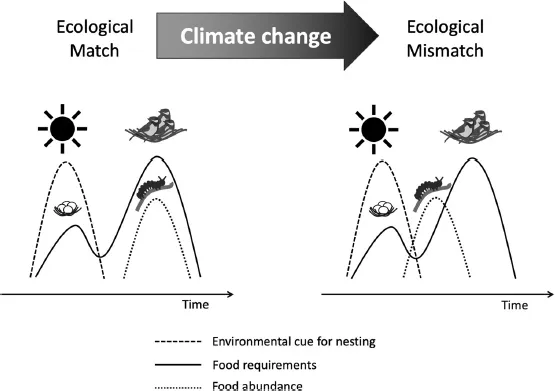
Figure 1.1 shows how phenological changes, or shifts in the timing of life cycle events, can differ for different species. For example, caterpillar populations peak earlier than they used to because insects tend to respond rapidly to warmer conditions. Chicks are not hatching earlier however, because for birds egg laying is prompted by springtime day length more than by temperature. This means that fledgling chicks now have their highest food demands when their preferred food source is no longer abundant. Will species be able to adapt—or evolve—fast enough to keep up with such complex changes in their environment?
Some species and ecosystems (coral reefs and polar ecosystems, for instance) are conspicuously climate sensitive and are often described as ‘highly vulnerable’. Coral bleaching and ice-melting at today’s rates are severe threats and they are largely irreversible. But so too are other changes that are less visible to our human eyes, yet are no less important from an ecological viewpoint. Even though much of science and policy places life into categories, typologies and classifications, climate change is driving interconnected shifts in ecosystems and altering the diversity of life at all scales. Also, ecosystems are not hermetically sealed units. Whenever one ecosystem is ‘lost’, the ecological connections that are unravelled then start their re-weaving of the whole web of life of which our own species, Homo sapiens, is part. We may not need to face a mass extinction event to discover that we are maladapted to newly emerging ecological conditions.
Climate change has impacts on people
We should also look at today’s climate change from the perspective of people’s needs and wellbeing. While some climatic changes might actually make life easier for some, coping with current changes is already a major challenge for many people. Many studies document how climate change is a significant contributor both to present-day impacts and, likely, to future risks to people’s survival and wellbeing all around the world. Changing temperatures, rainfall, storminess and other climate-related hazards have immediate effects on people’s health, safety, welfare and livelihoods. The IPCC (2014) frames the key climate risks in terms of reduced food and water security, adverse effects on health and livelihoods and systemic risks linked to the breakdown of critical infrastructures. It also recognises the losses of ecosystem goods, functions and services because of disruptions to ecosystems and biodiversity.
These changes span across world regions, so the economic costs of current climate impacts are enormous—and rising. The World Bank’s Shockwaves report (Hallegatte et al., 2016) focuses on climate change and poverty reduction, but its pervasive message is that issues of poverty, prosperity, productivity and equity cannot be isolated in today’s highly globalised and interdependent world. Vulnerability to climate change is one among many systemically linked vulnerabilities. Importantly, climate change is one issue where good, targeted action will be a cost-effective way to steer towards many other societal goals.
Climate change is tightly linked to societal change
History shows that when climate changes, options also change for what societies can do. That is not to say that climate controls or determines social conditions and development trajectories. But seen from a ‘longue durée’ perspective of history and archaeology, climate change has always and everywhere been an important factor in the existential challenges and opportunities faced by the world’s societies (Lane et al., 2018 provide a multidisciplinary reflection).
The traces of the profound importance of climate change can be uncovered in the emergence, sustainability and ‘collapse’ of societies. Climatic influences are evident in the location and layout of cities, in trade routes, arenas of war and other patterns of settlement and movement (see Chapter 4). Ancient ruins and many of today’s technologies alike can be read as the enduring marks of societies’ efforts to deal with sea-level rise and retreat, booms and busts of natural resource flows, the crises of climate-related plagues and weather extremes and the sometimes equally disruptive challenges of slower but cumulative environmental change.
We can expect the same of current and future global warming. Many physical processes of climate change are now locked in for centuries to come, even if strong action is taken to reduce greenhouse gas emissions. In coming years, societies worldwide will have to deal with altered ecosystems, food and hydrological systems, infrastructure, landscapes and livelihoods. The IPCC (2014) observes that social systems may be fundamentally transformed not just by climate impacts, but also by climate mitigation and adaptation actions. Mitigation pathways to stabilise climate (whether at 1.5ºC, 2ºC or higher) will require anthropogenic emissions of GHGs to be drawn down to zero or below; and achieving the lower temperature targets will require rapid and wide-ranging social, technological and economic changes. Whether today’s societies can pursue resilient and sustainable pathways as they navigate unprecedented environmental conditions is a wide open question.
Climate change is our challenge, in our times
Today’s technologically equipped societies have the scientific capacity to detect and attribute human-caused climate disruption and (crucially) to predict many aspects of the future climate with high confidence. Climate science—actually a field combining multiple areas of expertise—has provided a sophisticated understanding of the causes, effects, impacts and risks of climate change. It confirms that today’s climate change differs in some key ways from changes in the past. In particular, it shows that people’s collective activities are driving global heating and that there is scope for societies to take action to limit the rate and magnitude of climate change. New challenges for scientists and citizens alike come with this current power to anticipate and attribute climate change. Climatic changes of today’s magnitude are not just of scientific interest; it is also important for wider society to know about them. Initiatives like NASA’s Climate Apps (NASA, 2019) translate Earth observations and scientific insights into publicly available appealing and informative maps and charts of environmental conditions. Since 1990, the IPCC’s successive scientific assessment reports have intensified their messages to policymakers about the need to prioritise climate action. And the tone of concern remains, despite the attenuation of their messages that comes from the need to achieve international political consensus on the wording.
Industrialised technology-dependent societies have an especially important role to play in responding to climate change. Allocating historic responsibility may be fraught with ethical challenges (see Chapter 10), but regardless of past contributions to the climate problem the people in these societies today contribute by far the most to the drivers of climate change. And yet...
Table of contents
Cover
Half Title
Title Page
Copyright Page
Dedication
Table of Contents
List of figures
List of tables
Acknowledgements
List of contributors
List of abbreviations
Glossary
Introduction: Why and how to debate climate change
1. Is climate change the most important challenge of our times?
PART I: What do we need to know?
PART II: What should we do?
PART III: On what grounds should we base our actions?
PART IV: Who should be the agents of change?
Index
Trusted by 375,005 students
Access to over 1.5 million titles for a fair monthly price.
Study more efficiently using our study tools.
Frequently asked questions
Yes, you can cancel anytime from the Subscription tab in your account settings on the Perlego website. Your subscription will stay active until the end of your current billing period. Learn how to cancel your subscription
No, books cannot be downloaded as external files, such as PDFs, for use outside of Perlego. However, you can download books within the Perlego app for offline reading on mobile or tablet. Learn how to download books offline
Perlego offers two plans: Essential and Complete
Essential is ideal for learners and professionals who enjoy exploring a wide range of subjects. Access the Essential Library with 800,000+ trusted titles and best-sellers across business, personal growth, and the humanities. Includes unlimited reading time and Standard Read Aloud voice.
Complete: Perfect for advanced learners and researchers needing full, unrestricted access. Unlock 1.5M+ books across hundreds of subjects, including academic and specialized titles. The Complete Plan also includes advanced features like Premium Read Aloud and Research Assistant.
Both plans are available with monthly, semester, or annual billing cycles.
We are an online textbook subscription service, where you can get access to an entire online library for less than the price of a single book per month. With over 1.5 million books across 990+ topics, we’ve got you covered! Learn about our mission
Look out for the read-aloud symbol on your next book to see if you can listen to it. The read-aloud tool reads text aloud for you, highlighting the text as it is being read. You can pause it, speed it up and slow it down. Learn more about Read Aloud
Yes! You can use the Perlego app on both iOS and Android devices to read anytime, anywhere — even offline. Perfect for commutes or when you’re on the go. Please note we cannot support devices running on iOS 13 and Android 7 or earlier. Learn more about using the app
Yes, you can access Contemporary Climate Change Debates by Mike Hulme in PDF and/or ePUB format, as well as other popular books in Politics & International Relations & Ecology. We have over 1.5 million books available in our catalogue for you to explore.