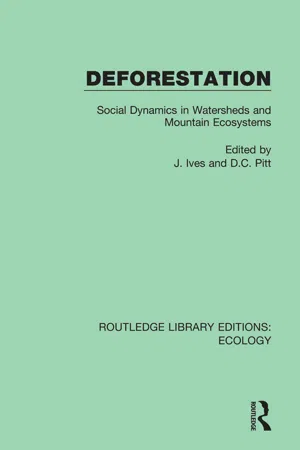
Originally published in 1988 Deforestation examines deforestation as a major environmental and development problem. It examines the issues of forests being cut in tropical and mountain areas, and how acid rain, pollution and disease wreak havoc in temperate zones. Some of the worst effects of deforestation have been changes in the world's climate system, erosion and flooding, desertification, wood short-ages and the disappearance of some floral and fauna species. This book challenges the belief that deforestation is due to entirely rapid population growth and agricultural expansion and emphasises the effects of commercial exploitation and poor planning and management. In concludes with a programme for reforestation using agro-forestry, appropriate cottage industries, improved international programmes, local land reforms and community participation.
- 258 pages
- English
- ePUB (mobile friendly)
- Available on iOS & Android
eBook - ePub
About this book
Information
1
Uncertainty on a Himalayan Scale
Welcome to Uncertainty
The spiral of tragedy has taken its own route. There is suffering in the hills now and there will be considerably more suffering in the future. The Himalayas might well change completely to a semi desert ecology. They might not. But things will get worse before they get better. (Cronin, 1979:222)
A complex series of interactions between man and nature in the Himalayan region has many experts from various disciplines speculating about the probable course of events in the area. The literature on the Himalayan ‘eco-crisis’ is replete with descriptions of rapidly expanding hill populations exploiting increasingly marginal land in an attempt to produce more food. As agriculture is extended so the forest cover is destroyed. Erosion and landslips decrease the productivity of soil, pasture and forest. There are all manner of self-reinforcing feedback loops in this system and traditional attempts by the farmer to better his lot or produce more food and fuel often lead to a worsening of the global situation in the hills and in the plains below (Eckholm, 1976; Lall, 1981). The lowlands are subjected to the silt and water runoff from the denuded land above, as well as all the attendant effects of migration by hill people. Because of growing populations in both the hills and plains, more and more people are displaced or otherwise affected by food and fuel shortages, changes in ground and surface water flows, and mass movements of land, water, and people in the area. Social unrest has also been increasingly intermixed with the effects of these processes. Regional and international attention has been focused on this situation, and many governments and organizations are already involved in trying to find a solution to a perceived crisis.
But describing the nature and the extent of the problem is fraught with complexity and uncertainty. There are many levels of interdependent cause-and-effect relationships to consider in the context of extremely fluid and complicated ecological and social systems. And uncertainty has become just as important a feature of the problem as any of its other attributes.
The problem, all agree, is that the Himalaya are caught in a downward spiral. Yet, when we look at the key variables in current models that attempt to define this spiral, we find that the uncertainties are so vast that we cannot even be sure that there is a spiral. For example, the expert estimates of two of these key variables - the per capita fuelwood consumption rate and the sustainable yield from forest production - vary by such enormous factors that it is but a slight exaggeration to say that, if the most pessimistic estimates are correct, the Himalaya will become as bald as a coot overnight and that, if the most optimistic estimates are correct, it will shortly sink beneath the greatest accumulation of biomass the world has ever seen. Despite our convictions as to the nature of the problem, the quantitative data can give us no guidance as to whether the spiral, if it indeed exists, is upward or downward. Far from the problem containing some uncertainty - a common enough situation in applied science - it is the uncertainty that contains the problem. The credible problem definitions, thanks to all this uncertainty, span such a wide range that it no longer makes any sense to use methods that attempt to tune to an already acceptable understanding of ‘the problem’. Such a tunable understanding is possible only when the problem contains some uncertainty; it simply does not exist in the Himalaya.
Another way of talking about this switch from tunable to untunable problem that accompanies such a marked increase in the scale of uncertainty is to say that as we go from the one situation to the other so we go from science to trans-science (Weinberg, 1972). Trans-science is the science of messes, and the most important thing for the scientist who ventures into this region is that he be aware that he is entering it. This is because the tried-and-true methods that have long served him so well in situations that involve some messiness simply cannot be relied on to support him when he finds himself in a situation where there is nothing but mess. It is our contention that the Himalaya currently constitutes such a region and that the scientists who have ventured into it have failed to switch across to the methods appropriate to trans-science. Furthermore, since these scientists have entered the region at the behest of policy makers, there has been a knock-on effect and the policy formulations generated by this inappropriate science have been similarly flawed. Our argument, therefore, proceeds in two stages. Firstly, a critical stage in which we show that the Himalaya are currently well inside the realm of trans-science and that both research and policy formulation, having failed to concede this, have been inappropriately conceived. Secondly, a constructive stage in which we try to develop the methods and the policy implications appropriate to the trans-scientific realm.
Cis-science and trans-science
Policy issues can be approached in two ways. You can ask ‘what are the facts?’ and you can ask ‘what would you like the facts to be?’. In a situation where there is already considerable certainty about the facts (and especially where there is a good prospect of increasing that certainty even further) the sensible approach is by way of the first question. As the noose of certainty is tightened so those who are advocating policies that, to be justified, would require the facts to be other than they are will be forced to abandon either their positions or their credibility. But in a situation where there is wide uncertainty about the facts (and especially where there is little prospect of decreasing that uncertainty) the sensible approach is by way of the second question. If those who are advocating the various rival policies can all justify their policies without losing their credibility, then they will simply stick to those positions. Here, in contrast to the first situation in which the problem contains some uncertainties, the noose is so loose that the relationship is the other way round and it is the uncertainty that contains the problems. This means that, try as you may, you cannot determine who is ‘right’. But you can still do something - you can gain some understanding of why the various advocates take up their various positions.
When the noose of certainty is loose we are in the realm of trans-science and, as it tightens, we move across into the realm of what we are accustomed to call science but which, if we are going to be following policy issues back and forth across this divide, we should get used to calling cis-science. That way we can give equal status to each - they are just two kinds of science - and we can concentrate on the different methods and modes of enquiry that are appropriate to each. Since cis-science is quite familiar to us, it is the methods and modes of enquiry that go with trans-science that will appear strange; and none stranger, perhaps, than the sociology of perception (by which is included the history, philosophy, and sociology of science and the sociology of everyday knowledge) and that has to do with the institutional forces that confer and withdraw credibility.
A science, it is often said, has reached maturity when it can afford to ignore its history but this comforting idea of an irreversible progression - for instance, from natural history to the various biological and earth sciences - is currently being undermined by the emergence of forest historians, risk historians, climate historians … carbon historians in response to such pressing and largely trans-scientific problems as ‘the greenhouse effect’, and the whole question of the sustainable development of the biosphere. This distinction between (and even-handed legitimation of) cis-science and trans-science does not do away with the notion of scientific progress but it does reject the idea that it is always in the same direction. Cis-science, one could say, progresses by ignoring its history; trans-science cannot get along without it. Each has its part to play in the advancement of science. We are not opposed to cis-science; we are opposed to its misuse.
Is there a spiral?
Analysis in terms of physical facts - the appropriate method of cis-science - has first to identify all the components of the Himalayan system and all the connections between those components. The result is a qualitative model made up of numerous labelled boxes that represent the components of the system, connected together by a web of labelled arrows representing the dynamical pocesses that, in toto, sustain or transform the system. Before you can tell whether this system is being sustained or transformed (and, if the latter, the direction of that transformation) you need to know the relative rates of all these processes. At the very least, you will need to know the rates of those that can clearly be seen to be the key variables of the system. Uncertainty can enter into this analysis at several points. You may not have identified all the components of your complex system, you may not have identified all the dynamic processes that link those components, you may not have identified the key variables correctly and, lastly, you may not have achieved a sufficiently accurate measurement of the rates of these key variables. The Himalaya notch up impressively high scores on all of these possible sources of uncertainty.
For example, in trying to understand how fast the forested area is changing - one of the most important characteristics of the ecological structure of the region - you must first understand the pressures on the forest resource. One of the most significant demands is the need for fuelwood by farmers. In Nepal, farmers make up about 95 per cent of the population, and it has been calculated (by the Energy Research and Development Group at Tribhuvan University, Kathmandu, Nepal) that about 95 per cent of all wood taken from the forest is destined for use as fuelwood. Not only this, but the same group has estimated that about 87 per cent of total energy consumption for the whole country is in the form of fuelwood. Most attempts to quantify the impact of this factor have depended upon measuring the per capita rate of fuelwood consumption. This, according to the prevalent models, is one of the most crucial variables for understanding the whole system and many authors have used estimates of this rate to demonstrate the environmental impact of a growing population that must (they assume) depend on the land for meeting its subsistence needs.
A survey of estimates of this nationwide rate in Nepal over the last 26 years (Donovan, 1981) has revealed a range from 0.1m3 (or 60 kg) to 6.67 m3 (or 4,000 kg) per capita per annum - quantities separated by a factor of 67. Even when the two upper outliers are deleted (one of which may be a misprint) (1) we are still left with a range that differs by a factor of 26. Though the estimates do seem to cluster around the 1 cubic-metre level, Donovan’s investigation of the range of expert opinion is very instructive for those trying to assemble previous research data on the Himalayan region. Uncertainty of this magnitude on a crucial system variable is quite rare in the systems with which we are familiar. Even the vast uncertainties associated with estimating oil and gas reserves (Schanz, 1978; Wildavsky and Tenenbaum, 1981) pale into insignificance when compared with this. And, in the case of fuelwood consumption, there is at least something that can be measured; in oil and gas reserves estimation there is nothing. (2)
Challenges to quantification
Such gross and persistent uncertainty, around something that is intrinsically measurable, demands some explanation. What obstacles, self-imposed and external, have got in the way of the fuelwood consumption estimators? The answers form a sad and familiar litany.
All too often visiting consultants have neglected to explain the methods used to arrive at their expert opinions … some estimates have been boldly quoted and requoted, often without citation, in ever more respectable documents, until a very casually contrived estimate has become the basis for policy formation and program planning. (Donovan, 1981: 5 and 14)
Donovan’s own investigation into fuelwood use in the commercial sector sheds some more light on the uncertainty of figures related to resource consumption in the Himalayan region. Much information is gathered by asking local people how much they use.
… sometimes we felt the reply given was more socially or politically desirable than correct. At times there appeared to be an effort to present a facade of modernity; a few individuals preferred to guess weight, volume, or distance in international units rather than to report what they probably knew with greater confidence in traditional units … Volume to weight ratios often vary from village to village, region to region and season to season. Time and distance are two additional variables presenting measurement problems, especially in a country where the average inhabitant does not own a timepiece and has little use for kilometers or miles. (Donovan, 1980:5)
On top of these difficulties in collecting data where bookkeeping is practically non-existent, and where (as anyone who has travelled in the Himalaya knows to his cost) people always try to give the answer they think you would like to hear, there are some other powerful forces at work shaping the data.
… a universal dread of the tax collector appeared to hinder our attempts to secure accurate production and revenue data … Although not as sensitive an issue as the more popular survey topics of family planning and farm management, the study focus on wood-fuel utilization did give rise to some degree of apprehension among those individuals questioned. Due to the rapid deterioration of Nepal’s national forests during the last decade, the consumption of firewood and charcoal recently has come under scrutiny by government officials. In some districts where forest preserves have been established, local villagers now must obtain special permits to cut wood in areas which once were their common fuelshed; in Surkhet valley townspeople who have access to government fuel depots are denied such permits. Government forest regulations subject to enforcement by an inadequate, ill-equipped staff of field officers have had only limited success, however, in halting forest destruction. To our questions regarding forest utilization, I often felt informants gave a politically appropriate response rather than actual fact. Many times individuals were hesitant to name their suppliers or geographical source. In several instances we were told to return at dawn if we wanted to talk with the charcoal producers. Fearful of government surveillance these people carry their loads into the cities and towns under the cover of early morning darkness. (Donovan, 1980:8)
It is indeed difficult to gather factually accurate information under these circumstances. We say ‘factually accurate information’ because, of course, the information that is gathered does quite accurately reflect the various social forces that are at work in the Himalaya. In this sense, it is institutionally accurate and, as we shall argue later, perhaps institutional accuracy is more valuable (and more accessible) than factual accuracy. Though ‘proper’ research methods are supposed to control sources of bias such as these, they have clearly met their match in the Himalaya. But, even assuming that the information that has been gathered can be controlled for bias, it still has to be assembled into a conceptual framework that is consistent with the context from which it was derived, and herein lies the next obstacle.
Challenges to conceptualization
When trying to fit a factor such as per capita fuelwood consumption into a quantitative causal model of impact on forest resources, the ‘consumption’ concept is often used as a proxy for ‘demand’ or ‘need’ in order to provide a gross measure of pressure on resources. This is probably a better proxy than many arbitrary guesses, but it has been noted that there are sometimes extreme variations in fuelwood use in relation to region (Donovan, 1981), availability (FAO, 1974), season (Kawikita, 1979), food-grain availability, and farm management styles (Bajracharya,...
Table of contents
- Cover
- Half Title
- Title
- Copyright
- Original Title
- Original Copyright
- CONTENTS
- Preface
- Acknowledgements
- Introduction
- 1. Uncertainty on a Himalayan Scale
- 2. Development in the Face of Uncertainty
- 3. Soil and Water Impacts of Deforestation
- 4. Forestry and Watershed Management
- 5. The Explanation of Land Degradation in Nepal
- 6. Alternative Social Forestry Development Strategies
- 7. Poverty, Women and Young People
- 8. The Chipko Movement
- Conclusion
- INDEX
Trusted by 375,005 students
Access to over 1.5 million titles for a fair monthly price.
Study more efficiently using our study tools.
Frequently asked questions
Yes, you can cancel anytime from the Subscription tab in your account settings on the Perlego website. Your subscription will stay active until the end of your current billing period. Learn how to cancel your subscription
No, books cannot be downloaded as external files, such as PDFs, for use outside of Perlego. However, you can download books within the Perlego app for offline reading on mobile or tablet. Learn how to download books offline
Perlego offers two plans: Essential and Complete
- Essential is ideal for learners and professionals who enjoy exploring a wide range of subjects. Access the Essential Library with 800,000+ trusted titles and best-sellers across business, personal growth, and the humanities. Includes unlimited reading time and Standard Read Aloud voice.
- Complete: Perfect for advanced learners and researchers needing full, unrestricted access. Unlock 1.5M+ books across hundreds of subjects, including academic and specialized titles. The Complete Plan also includes advanced features like Premium Read Aloud and Research Assistant.
We are an online textbook subscription service, where you can get access to an entire online library for less than the price of a single book per month. With over 1.5 million books across 990+ topics, we’ve got you covered! Learn about our mission
Look out for the read-aloud symbol on your next book to see if you can listen to it. The read-aloud tool reads text aloud for you, highlighting the text as it is being read. You can pause it, speed it up and slow it down. Learn more about Read Aloud
Yes! You can use the Perlego app on both iOS and Android devices to read anytime, anywhere — even offline. Perfect for commutes or when you’re on the go.
Please note we cannot support devices running on iOS 13 and Android 7 or earlier. Learn more about using the app
Please note we cannot support devices running on iOS 13 and Android 7 or earlier. Learn more about using the app
Yes, you can access Deforestation by J. Ives,D.C. Pitt in PDF and/or ePUB format, as well as other popular books in Biological Sciences & Ecology. We have over 1.5 million books available in our catalogue for you to explore.