Being a client on a construction project can be incredibly complex and demanding but ultimately rewarding once your ambitions are fulfilled. This comprehensive 'one stop shop' will help you to achieve that magic combination of quality and efficiency, guiding you through the entire project lifecycle, from briefing to taking delivery and beyond. It will help you to better understand the project process, the client's role within it and, critically, how to be successful and effective by advising you on;
eBook - ePub
Being an Effective Construction Client
Working on Commercial and Public Projects
- 192 pages
- English
- ePUB (mobile friendly)
- Available on iOS & Android
eBook - ePub
About this book
Information
Topic
ArchitectureSubtopic
Architecture GeneralChapter 1
Introduction
“Those who wish to build in the United Kingdom must be effective in a mainly negative environment where public opposition, local government inertia and comprehensive legislation must often be overcome or complied with in order to achieve projects.”
Clients and buildings
Buildings, buildings and yet more buildings. Distinct from the landscape, buildings are among the numinous structures that enable our civilisation. Clients seek to organise space so that we can live, work, repair, defend and enjoy ourselves. They are preeminent – having the basic initiative and constant drive to achieve buildings. They assemble resources and consents to create environments and are the apex of the construction pyramid and yet very little light has been cast on their activities, the skills and the techniques they need to use. Mainly, the clients are the quiet and understated magicians who achieve so much.
The target readership
This book will inform and guide clients in the commercial, public and institutional sectors. While there are countless books on architects, design, engineers and buildings, there are very few that focus on what could be called ‘clientship’ – in other words, all that it takes to be an effective client. This book provides essential information to clients who are new to, or have limited experience in, clientship, as well as the very many who serve and deal with clients, including students of the professions and those who have ambitions to be clients. A distinguished faculty of authors and commentators who are either clients, or who advise clients, have worked together on this book. Our authors provide essential insight, guidance and information for those taking responsibility for building projects in both the public and private sectors. Our Perspective authors provide thoughtful - and sometimes challenging opinions on the subject of clientship.
The process of producing buildings has become highly complex and exacting, and clients need a wide range of consultants, advisers and constructors to achieve success. For clients to be effective – and this key criterion is expressed in the title of this book – they need to be served by those who are experienced, creative and skilled, who are right for the particular assignment and who know what support their clients really need. There are no university courses in clientship and with temerity this book aims to start to fill that lacuna.
Attitudes for change
Those who wish to build in the United Kingdom must be effective in a mainly negative environment where public opposition, local government inertia and comprehensive legislation must often be overcome or complied with in order to achieve projects. The developer Qatari Diar felt the full force of majestic opposition when it attempted to gain consent to redevelop the Chelsea Barracks site, which is only now under way after years of design, redesign and negotiations. Major projects are notoriously difficult to progress in the UK as politicians are extremely wary of supporting these against even a whisper of public dissent, and prospective clients for projects large and small should be aware of the disproportionate influence of pressure groups. Clients will always meet resistance and it is reasonable to propose that they must have political skills as a basic requirement in order to move projects through the resistance of inevitable opposition. Three projects are evidence of this: HS2, an additional runway for a London airport and Crossrail 2, all infrastructure projects that we have needed for years and are mired. It is in this climate of opposition to development and change that clients must press their cases to achieve projects – to be effective.
Architects and clients
The RIBA Client Liaison group, led by Nigel Ostime, was established in 2014 by RIBA President Stephen Hodder to understand the clients’ perception of architects and the value they bring to the project team. This builds on the work completed some 20 years ago by the then President of the RIBA, Dr. Frank Duffy, who commissioned a landmark strategic study of the profession. So the profession is able to keep abreast of the real needs of clients in key sectors. RIBA Accredited Client Advisers are actively working with clients from the earliest stages of their projects (Stage 0 onwards) and provide additional and valuable feedback to the profession. The RIBA document ‘Leading architecture: The RIBA’s Strategy 2012–2016’ (downloadable from www.architecture.com) provides a list of strategies and goals for the RIBA and for architecture related to clients whose objectives are still midway on the waves.
Authors and topics
In this book, clients are given the vital message that they must define the outcomes they want in order to discover the best ways of achieving them. The first reactive response to a management problem may be to build. However, a more considered response might be to do something very different. Susie Gray explores topics of feasibility, business case and funding in detail. If a building project is the best response, then Joanna Eley describes the briefing process – the essential DNA of any project. Ben Hughes examines the art and science of procurement and describes the principal methods that clients can use to purchase their buildings. Clients will need to assemble a project team that is capable of responding to the challenges and opportunities of the project and Adrian Dobson describes what services are needed and how they can be chosen. Projects need to be organised efficiently and effectively and Dale Sinclair, as the author of the RIBA Plan of Work 2013, describes the reasons, structure and detail of this plan and how it provides a consistent and comprehensive methodology for achieving projects. From a position of authority, Rab Bennetts shines light on the mysteries of the design process. Drawings are the lingua franca of communication between professionals, the client and those who construct, and Richard Saxon explains that the construction of a common digital building model, with shared liability for the work, requires productive collaboration. He describes Building Information Modelling (BIM) and gives us a view of the future. Tom Taylor explores the world of project management. From his vantage point as Project and Construction Director for one of Europe’s largest companies, Gary Wingrove describes the process of accepting, commissioning and using projects.
The use of formal service and construction contracts practically invite disputes between the parties and expert Murray Armes writes about the laws and clauses that apply to clients, and offers them advice on what they should do if things begin to go wrong.
Janet Young describes the nature of the government client and explains the methods, criteria and processes by which government evaluates and manages projects. RIBA Past President Ruth Reed describes the intricacies of the town planning system.
Perspectives
Our faculty of writers includes a number of distinguished commentators, each providing their unique perspective on clientship. Among them Sir David Omand asks the wise and thoughtful question ‘Do you really want us as clients?’, while Tim Stone wishes clients would better understand the need for advice rather than process, and value more highly the proactive and creative advice given by independent professionals.
So what makes you a ‘client’?
How do you know if you are a client? The accepted definition is that clients are those who are protected by their professional advisers. The relationship between client and professional is usually long term and the degree of trust placed by the client in the work of the professional is significant. In the context of this book, clients have the money and the mission to achieve change by creating environments across a very wide spectrum of scales and types. To be effective, they have to be astute in business, as well as sustaining and promoting the project vision through all project stages and into occupation. They produce the building and may go on to manage it over time. The players may come and go, but the client remains. Of course, the client is not omnipotent and all-seeing. However, they see the overall picture and ensure that everyone else sees it too. Clients make strategic (and tactical) decisions before and during the gestation period of the project, hold the money and are responsible for the returns on capital employed – and these returns could be as diverse as a decent percentage or enhanced learning outcomes. They are accountable to stakeholders. To be a client is to occupy a position of trust.
Clients need to be aware that almost every building or environment is a prototype and the result of ‘purposeful creativity’. Dr Andrea Siodmok, writing in the RSA Journal (Issue 4, 2014) commented that prototyping generates imperfect truths and with the right approach also generates data about the future. Clients and their advisers need to be aware of what it takes to create a prototype that works perfectly first time at full speed without crashing. For those who mistakenly underestimate the importance of design in achieving the right outcomes, the OECD (Organisation for Economic Co-operation and Development) has said that 80% of the impact of any product or service is determined at the design phase. Decisions made in the first 10% of the process heavily influence outcomes. To be effective, clients must value their appointed professionals and constructors for their talents, skills, creativity and gifts.
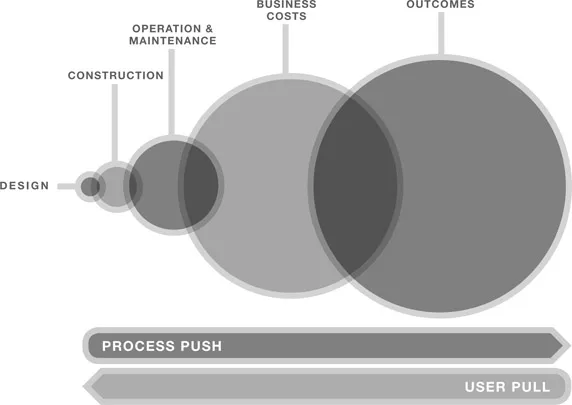
▯Figure 1.1: The value relationship within the build cycle
Basic leadership skills are needed for the client to be effective and the effective client will transfer leadership qualities to team members. Max De Pree at Herman Miller identified the concept of the roving leader who is there when needed, stepping in and out of the scene as required. Sometimes the client will recognise that some functions can be done better by others and will move aside to allow this to happen. They will recognise when things are going wrong (including team morale) and take swift action.
Clients may wish to transfer as much risk as possible to others. Tony Bingham, writing in the Estates Gazette (9 January 2015), criticised the concept of design and construct (D&C) which exposes the client to a system where design is relegated to a backroom function over which the client has little or no control, particularly when the initial designs have been approved and the scheme is taken in for construction drawings and specification to be devised and building done. As he put it, ‘designers design, builders build’. It is all too easy for an inexperienced client to be seduced by D&C. However, if the effective client employs competent advisers, the best arrangements can move forward successfully. Clients who choose architects and schemes though competitions must have the courage and capability to realise the winning scheme, unlike the Cardiff Bay Opera House Trust and the Japanese Government with their Olympic stadium. Clients must be aware of the many dangers to the success of their projects, of losing their client status and of becoming ‘customers’ of a project over which they have significantly reduced control.
Constructing Excellence
Constructing Excellence provides a vital forum for successful clientship, including achieving value through collaborative work and support for the government’s ‘Construction 2025’ strategy. For example, relationships between the client and supply sides will change significantly and added value will be the basis of payment. The reader is recommended to refer to CE’s website at www.constructingexcellence.org.uk for further details.
The above figure shows the fiscal relationship between design, build cost, operating costs, business costs and the financial benefit of the outcomes. Too many clients fall into the trap of minimising the importance of design, denying to them the vastly greater financial advantages arising from good design.
After the crash
Clients need to consider that the entire means of production of the built environment continues to emerge from the worst financial crash since 1929. The fall of Lehman Brothers in 2008 marked the irrevocable and fast-moving collapse of property values, leaving gigantic debt that only bottomed in mid-2009. Almost every type and size of client suffered, with the exception of London’s four great family estates (Cadogan, Grosvenor, Howard de Walden and Portman) that actually saw a healthy increase in their values. Major and successful developers suffered gigantic losses. Professionals and the construction industry were hit hard. Public sector work was curtailed.
Clients know that the surviving lending banks have recovered and are lending – now actively looking for investment opportunities. An air of optimism pervades the market. The degree of skill required by clients to raise money at the right price is significant, with developers conscious of changing economies in the Middle and Far East, as well as Russia. Oil revenues are falling, reducing the money supply in some countries. For the public sector, the private finance initiative (PFI) is only attractive when other sources of funding projects are unavailable, generally offering poor long-term value. The supply of public money is restricted at national and local levels. PF2 is a new Treasury model1 for achieving specific types of public sector projects, offering solutions to the serious shortcomings of the original PFI concept. Additionally, those bidding for public sector work pay a heavy cost in actual and risk terms, facing heavy competition for any opportunity. Over time this has meant that a significant debt remains in the industry begging to be resolved, which is unlikely with the current (arguably flawed) framework system.
As we distance ourselves from the crash, clients will find it increasingly easier to find senior debt for their projects. Encouragingly, Property Wire reported in January 2015 that there was a significant rise in new lending for commercial property in the UK, particularly in London in the first half of 2014. The construction industry is trying hard to accommodate this growth, which consists of delayed projects and new initiatives. Whilst the government’s now defunct BSF2 programme sustained many professionals and construction firms during the hard years, its replacement is but a shadow and the public estate has shrunk dramatically as Janet Young describes in Chapter 13. Because of shortages of skilled labour and materials against a rising (or pent-up) demand, some prices have increased to the disbelief of the naïve client.
Soft Landings
Clients have a greater chance of achieving a smooth transition from construction to occupation and an optimised performance by using what is called a ‘Soft Landings’ strategy jointly developed by the Building Services Research and Information Association (BSRIA...
Table of contents
- Cover
- Title
- Copyright
- Contents
- Dedication
- Acknowledgements
- About the editor and contributors
- Foreword
- Foreword
- 1 Introduction
- 2 Project feasibility, business case and funding
- 3 Defining the project
- 4 ‘How could my project be procured?’
- 5 What services do clients need from their design team?
- 6 The RIBA Plan of Work 2013
- 7 The design process
- 8 Introducing BIM
- 9 Managing and constructing the project
- 10 Accepting, commissioning and using the project
- 11 The client and the law
- 12 How to keep out of trouble
- 13 The government client
- 14 The client and the planning process
- Select Bibliography
- Index
- Image credits
Trusted by 375,005 students
Access to over 1.5 million titles for a fair monthly price.
Study more efficiently using our study tools.
Frequently asked questions
Yes, you can cancel anytime from the Subscription tab in your account settings on the Perlego website. Your subscription will stay active until the end of your current billing period. Learn how to cancel your subscription
No, books cannot be downloaded as external files, such as PDFs, for use outside of Perlego. However, you can download books within the Perlego app for offline reading on mobile or tablet. Learn how to download books offline
Perlego offers two plans: Essential and Complete
- Essential is ideal for learners and professionals who enjoy exploring a wide range of subjects. Access the Essential Library with 800,000+ trusted titles and best-sellers across business, personal growth, and the humanities. Includes unlimited reading time and Standard Read Aloud voice.
- Complete: Perfect for advanced learners and researchers needing full, unrestricted access. Unlock 1.5M+ books across hundreds of subjects, including academic and specialized titles. The Complete Plan also includes advanced features like Premium Read Aloud and Research Assistant.
We are an online textbook subscription service, where you can get access to an entire online library for less than the price of a single book per month. With over 1.5 million books across 990+ topics, we’ve got you covered! Learn about our mission
Look out for the read-aloud symbol on your next book to see if you can listen to it. The read-aloud tool reads text aloud for you, highlighting the text as it is being read. You can pause it, speed it up and slow it down. Learn more about Read Aloud
Yes! You can use the Perlego app on both iOS and Android devices to read anytime, anywhere — even offline. Perfect for commutes or when you’re on the go.
Please note we cannot support devices running on iOS 13 and Android 7 or earlier. Learn more about using the app
Please note we cannot support devices running on iOS 13 and Android 7 or earlier. Learn more about using the app
Yes, you can access Being an Effective Construction Client by Peter Ullathorne in PDF and/or ePUB format, as well as other popular books in Architecture & Architecture General. We have over 1.5 million books available in our catalogue for you to explore.