This book Project Management is to facilitate the successful completion of projects. For this reason it puts particular emphasis on the importance of careful preparation and strategic co-operation within the project team.
The first part of this new textbook offers a description of the project-based approach to the work environment, an analysis of when such an approach is appropriate and an account of how to make projects work. In addition, this part of the book discusses the role of planning software within the project environment. Part Two of the book describes the practical tools and skills needed to tackle projects. A number of the skills outlined in Part Two are also relevant to learning contexts other than projects.
This new edition offers additional material on the life-cycle of the project: from setting up to completing a project. New sections deal with skills such as brainstorming and decision making in the project group. The text makes for required reading for project management students everywhere.
Theoretically, there is nothing particularly difficult about project management. Projects nevertheless frequently fail to attain their objectives. Since project work is very dependent on the people involved in it, those involved need to be aware of the fact that there is a difference between ordinary ways of approaching work and working in a project-based manner. This section of the book deals with the theory underlying the project-based approach to work based on real-life situations.
The following questions will be addressed in this part:
What is the difference between project-based work and other work?
How do I organize the project?
How do I start the project?
How do I monitor the project?
How do I plan the project?
1 The project
1.1 Types of activityies, types of work
1.2 Examples of projects
1.3 What is a project?
1.4 From improvised activities to project to routine
1.5 Types of projects
1.6 Things to remember
1.7 Doing things in phases
1.8 Why do things in phases?
1.9 The phases of a project: an illustration
1.10 When to do it as a project
1.11 Lifecycle of a project
1.12 Project goals should be SMART
1.13 Carrying out the projects in this book
Assignments
Jobs for life are a thing of the past. With our society caught up in a process of constant change, organizations are finding that they have to both respond to each change while already anticipating the next one. Their responses often take the form of projects. Being able to manage projects effectively has therefore become a necessity. The important issues are not only when to take a project-based approach and how to tackle the project itself, but even what a project actually is.
This chapter describes how project-based work differs from ‘regular’ work.
1.1Types of activities, types of work
Three groups of activities
All kinds of activities take place within an organization. They may be characterized in the following three groups of activities:
Improvised activities
Routine activities
Project-based activities
This book deals with the last type. To show the special position that project-based activities occupy, all three types of activity will be described.
Improvised activities
Improvised work Ad hoc
An improvised work approach to new activities is one option. People usually improvise when something unforeseen that requires an immediate response occurs. Their reaction will be an ad hoc one: not according to a laid down plan, but decided on as events unfold.
Since there are no directions about what to do that can be given beforehand, it is hard to predict with any accuracy the outcomes of working in an ad hoc manner. The advantage of not having any directions is that the new situations can be met in a flexible manner. However, while the large amount of freedom may be welcomed by the improviser, it carries the risk of chaos and could put the organization under a lot of pressure. Workers in an organization in which there is a lot of improvisation going on are likely to be working under a certain amount of strain. Having to constantly adjust to changing working conditions is, after all, quite stressful.
Routine activities
Routine
Routine activities are activities that are repeated frequently and are relatively predictable. The work will be carried out according to predetermined patterns. Since there is a precedent, it is not necessary to constantly think about what has to be done next.
Work procedures
In order to be able to perform these routine activities efficiently, work procedures or instructions have to be developed. Most of the activities carried out within an organization belong to this type. Production line activities, sales procedures, purchasing procedures and administrative activities are some examples.
Project-based activities
Project-based activities fall roughly midway between improvised and routine activities. They are non-recurring and have a limited duration, but are reasonably predictable.
According to a plan
In order to increase this predictability, the work should be done according to a plan. Plans gradually illuminate each phase of the process. Before the activities get underway, some time needs to be spent on working out what the aims are and how to achieve them.
PhasesProject plan
For this to be effective, large projects are often divided up into a number of phases. After each of these phases, the aims and procedures may be adjusted. Before starting the project, a project plan is formulated, the instructions for which are given in Chapter 6. By working with a project plan based on fixed criteria, some degree of routine can be introduced to the project. In other words, ‘You introduce routine to something you have never done before’. This greatly enhances the possibility of success.
Project organization
Projects often have an organization of their own, one created specially to deal with the needs of the project. People who do not normally work together may do so as part of the project group. Each will have their own specific tasks.
Some of the activities of businesses such as shipbuilding, aircraft construction and information technology are regularly carried out as project-based activities. In other businesses, project-based activities may be the exception rather than the rule. Such a project might involve a departmental reorganization, moving into new quarters, or the introduction of a new computer network.
A project-based activity is not an objective in itself, of course. It is a way of structuring activities that are less predictable than others and that fall outside the scope of normal activities. These structured activities then become easier to manage and monitor.
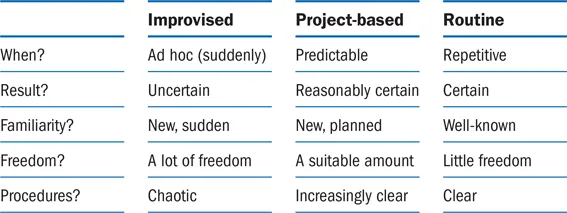
Table 1.1 contains a summary of the properties of the various types of activities.
Table 1.1 Types of activities
1.2Examples of projects
The following overview gives a number of examples of projects. The website accompanying this book (www.projectmanagement-english.noordhoff.nl) contains further examples.
Building a new shopping centre, bridge, housing estate, nursing home or factory
The technical development of a new product such as an electric razor, a computer or a car
Developing a marketing plan or export plan for a new product like the iPad
Reducing waiting lists in the field of healthcare
Designing a new school course
Formulating an information plan, sales plan, personnel plan or training plan
Doing a theatre production such as “We Will Rock You” or producing a feature film or information film
Doing the research for a thesis
Developing a new house style for an organization
Organizing a major exhibition such as a retrospective on Rembrandt
Organizing a major event like Pink Pop, a major sports event or home fair
Implementing a large-scale software package at an organization, such as financial software, logistics software, client management software or patient information system
Setting up a website for an organization such as a hospital or commercial business
Arranging a logi...
Table of contents
Cover
Title
Copyright
Foreword to the Third Edition
Contents
Introduction
Part 1 Practical Theory
Part 2 Project tools
Final Assignments
Appendix 1 Risk Analysis
Appendix 2 Website
Bibliography
About the Author
Index
Trusted by 375,005 students
Access to over 1.5 million titles for a fair monthly price.
Study more efficiently using our study tools.
Frequently asked questions
Yes, you can cancel anytime from the Subscription tab in your account settings on the Perlego website. Your subscription will stay active until the end of your current billing period. Learn how to cancel your subscription
No, books cannot be downloaded as external files, such as PDFs, for use outside of Perlego. However, you can download books within the Perlego app for offline reading on mobile or tablet. Learn how to download books offline
Perlego offers two plans: Essential and Complete
Essential is ideal for learners and professionals who enjoy exploring a wide range of subjects. Access the Essential Library with 800,000+ trusted titles and best-sellers across business, personal growth, and the humanities. Includes unlimited reading time and Standard Read Aloud voice.
Complete: Perfect for advanced learners and researchers needing full, unrestricted access. Unlock 1.5M+ books across hundreds of subjects, including academic and specialized titles. The Complete Plan also includes advanced features like Premium Read Aloud and Research Assistant.
Both plans are available with monthly, semester, or annual billing cycles.
We are an online textbook subscription service, where you can get access to an entire online library for less than the price of a single book per month. With over 1.5 million books across 990+ topics, we’ve got you covered! Learn about our mission
Look out for the read-aloud symbol on your next book to see if you can listen to it. The read-aloud tool reads text aloud for you, highlighting the text as it is being read. You can pause it, speed it up and slow it down. Learn more about Read Aloud
Yes! You can use the Perlego app on both iOS and Android devices to read anytime, anywhere — even offline. Perfect for commutes or when you’re on the go. Please note we cannot support devices running on iOS 13 and Android 7 or earlier. Learn more about using the app
Yes, you can access Project Management, Third Edition by Roel Grit in PDF and/or ePUB format, as well as other popular books in Business & Business General. We have over 1.5 million books available in our catalogue for you to explore.