Educators learning how to meaningfully integrate technology into their teaching practice will find resources and action plans to prepare them for today's tech-infused lessons.
Advancing teacher preparation to full adoption of technology infusion is no small undertaking. Written by 20 experts in the teacher prep field, Championing Technology Infusion in Teacher Preparation provides research- and practice-based direction for faculty, administrators, PK-12 school partners and other stakeholders who support programwide technology infusion in teacher education programs. Such organizational change involves almost every individual and system involved in teacher preparation.
Topics addressed include:
Defining technology infusion and integration.
Systemic planning and readiness of college-level leadership.
Programwide, iterative candidate experiences across courses and clinical work.
Technology use and expectations for teachers and students in PK-12 settings.
Instructional design in teacher preparation programs to include integration of technology in face-to-face, blended and online PK-12 teaching and learning.
Strategies to support induction of new teachers in PK-12 settings.
Technology use, expectations, and professional development for teacher educators
Models for effective candidate and program evaluation.
Roles for government agencies and non-governmental organizations (NGOs) in nationwide collaboration for technology infusion in teacher preparation.
This book will help administrators in colleges and schools of education as well as teacher educators in preparation programs support the developmental needs of teacher candidates as they learn how to teach with technology. With action steps and getting started resources in each chapter, the book is well-adapted for small group study and planning by collaborative leadership teams in colleges and schools of education. The book is also appropriate for the study of effective organizational change in education by graduate students.
Audience: Teacher educators, professional developers, instructional designers, district and school administrators
Frequently asked questions
Yes, you can cancel anytime from the Subscription tab in your account settings on the Perlego website. Your subscription will stay active until the end of your current billing period. Learn how to cancel your subscription.
No, books cannot be downloaded as external files, such as PDFs, for use outside of Perlego. However, you can download books within the Perlego app for offline reading on mobile or tablet. Learn more here.
Perlego offers two plans: Essential and Complete
Essential is ideal for learners and professionals who enjoy exploring a wide range of subjects. Access the Essential Library with 800,000+ trusted titles and best-sellers across business, personal growth, and the humanities. Includes unlimited reading time and Standard Read Aloud voice.
Complete: Perfect for advanced learners and researchers needing full, unrestricted access. Unlock 1.4M+ books across hundreds of subjects, including academic and specialized titles. The Complete Plan also includes advanced features like Premium Read Aloud and Research Assistant.
Both plans are available with monthly, semester, or annual billing cycles.
We are an online textbook subscription service, where you can get access to an entire online library for less than the price of a single book per month. With over 1 million books across 1000+ topics, we’ve got you covered! Learn more here.
Look out for the read-aloud symbol on your next book to see if you can listen to it. The read-aloud tool reads text aloud for you, highlighting the text as it is being read. You can pause it, speed it up and slow it down. Learn more here.
Yes! You can use the Perlego app on both iOS or Android devices to read anytime, anywhere — even offline. Perfect for commutes or when you’re on the go. Please note we cannot support devices running on iOS 13 and Android 7 or earlier. Learn more about using the app.
Yes, you can access Championing Technology Infusion in Teacher Preparation by Arlene Borthwick,Teresa Foulger,Kevin Graziano in PDF and/or ePUB format, as well as other popular books in Éducation & Technologie de l'éducation. We have over one million books available in our catalogue for you to explore.
The chapters in this section share methods and guidance for enhancing technology infusion in teacher preparation.
CHAPTER 4
Frameworks That Scaffold Learning to Teach with Technology
by Liz Kolb
CHAPTER 5
Professional Expectations for Teacher Educators: The Teacher Educator Technology Competencies (TETCs)
by David A. Slykhuis, Denise A. Schmidt-Crawford, Kevin J. Graziano, and Teresa S. Foulger
CHAPTER 6
The Necessity of Preparing Teacher Candidates to Teach Online
by Michael McVey
CHAPTER 7
Technology Infusion in Clinical Experiences
by Debra R. Sprague, Seth A. Parsons, and Audra K. Parker
CHAPTER 8
Technology Integration in the Induction Years: The Importance of PK–12 Partnerships
by Jo Williamson and Julie Moore
CHAPTER 4
Frameworks That Scaffold Learning to Teach with Technology
LIZ KOLB
UNIVERSITY OF MICHIGAN
Overview
This chapter describes four frameworks in educational technology—SAMR, PICRAT, TIM, and Triple E—and proposes how each might be used as a scaffold in teacher preparation programs for teacher candidates who are learning how to teach with technology. This chapter calls on teacher educators to use the frameworks as tools to support teacher candidates in improving their effectiveness in integrating technology into their teaching. Recommendations are provided for which framework to use during various phases of teacher preparation.
Scenario: Modeling Technology in a Math Methods Course
Recently, a field supervisor was observing a teacher candidate teaching a lesson to a classroom of second grade students. The teacher candidate wanted to demonstrate how technology could be integrated to address mathematics standards. The math objective for the lesson was telling time on a dial clock. In her attempt to demonstrate the use of technology to scaffold content learning, the teacher candidate integrated Spheros (www.sphero.com), small robotic balls that can be programmed to move by using an application on an iPad. The students were placed in a small group, were provided two Sphero balls, and asked to sit near one of the floor mats. Each floor mat had a “dial clock” face painted on it. Students were asked to take turns using the iPad to program the Sphero balls to “tell time.” The teacher candidate explained to the second-graders that one ball was to represent where the hour hand would be on a dial clock and the other ball was to represent where the minute hand would be on a dial clock. The teacher candidate asked the second-graders to take turns programming the Spheros to roll to the proper spots that would represent 2:00 p.m. on the floor mat.
While the students were working in their groups, the field supervisor observed the students’ attempts, interactions, and struggles with the Sphero balls. She noted that, on occasion, some students asked for technical help from their group members. She wondered if the trial-and-error attempt by the second-graders to program the Sphero was overshadowing the learning objective to tell time on a dial clock. As well, she had thoughts about the amount of time and cognitive energy spent programming the Sphero versus attending to the math content.
After the observation, the field supervisor asked the teacher candidate if she felt the lesson with the Sphero balls was an effective way to integrate technology. The teacher candidate answered, “I am not sure.” When the field supervisor probed further, the candidate was at a loss as to how to explain the relationship between the learning objective and the use of the technology tool. It was difficult for the teacher candidate to ascertain whether or not technology affected student learning. This made the field supervisor realize the candidate lacked a method or framework to view technology integration, determine the effectiveness of technology, and discuss the impact of technology on teaching experiences.
This scenario posed some significant concerns for the field supervisor, and she began to think about how she might better scaffold her teacher candidates as they learn to teach with technology. Specifically, she wondered:
• How can I support teacher candidates to make informed decisions about when to use technology?
• What scaffolds might I use to provide insight for teacher candidates about the added value technology can bring to content-based learning?
• How can I better frame and discuss technology with teacher candidates after a field observation?
Subsequently, the field instructor decided to analyze the Sphero lesson with the teacher candidate by using the lens of education technology frameworks. Education technology frameworks can be used as instructional guides to scaffold teacher educators and field instructors who work with candidates as related to the above needs. These frameworks can help identify deficits and affordances of technology used during teaching and learning and provide insight that will help generate reflective conversations. In order to understand how various educational technology frameworks can support these reflective conversations, this chapter provides the description of four frameworks, as well as the dialogue that the field instructor could have with the teacher candidate as a result of analysis of the Sphero lesson using these frameworks.
Why Learning How and When to Teach with Technology Is Complicated
As noted in the scenario above, learning to effectively use technology in teaching is not a simple endeavor. It involves simultaneously thinking about technological choices, curriculum goals, and pedagogical opportunities. Technological Pedagogical and Content Knowledge (TPACK) is a conceptual framework commonly used to depict the nature of teaching with technology (Mishra & Koehler, 2006). The framework originated when scholars were discussing prior research by Shulman that defined how effective teachers must employ both content knowledge and pedagogical knowledge, commonly referred to as pedagogical content knowledge (Shulman, 1986). Expanding upon Schulman’s work, Mishra and Koehler (2006) positioned technology as an equally important and integral knowledge base to form technological pedagogical content knowledge (TPACK). TPACK emphasizes how these three knowledge bases—technological knowledge (TK), pedagogical knowledge (PK), and content knowledge (CK)—interrelate with one another. The framework also includes a heightened emphasis on teachers’ contextual knowledge (XK) when technology is used in their teaching (Mishra, 2019). Applying these knowledge bases within the practice of real-life teaching situations is a challenge for teacher educators as they think about how to best scaffold teacher candidates to account for the unique context of a school and community. In order for a teacher preparation program to effectively infuse technology throughout all coursework, all the knowledge bases (CK, PK, TK, and XK), as well as how they influence one another, should be seamlessly woven into preparation program curriculum. See Figure 4.1 for an illustration of TPACK.
Four Frameworks to Help Teacher Educators Scaffold Teacher Candidates Learning to Teach with Technology
What follows are four frameworks that can be used by teacher educators and those individuals who work with teacher candidates to support the development of candidates’ TPACK. The four frameworks are not an exhaustive list but were selected because they are aligned to and draw on the power of TPACK. Each framework has the ability to provide teacher candidates a way to evaluate and inform instructional tool choices that are supported with research. Because the frameworks have unique affordances and limitations, employing a selection of frameworks will help teacher educators personalize the support they provide teacher candidates.
An overview of each framework is provided in the sections that follow, along with an explanation of how each framework aligns with the knowledge bases in TPACK and selected research that demonstrates the validity of the framework. As a demonstration of how each framework might be used within preparation programs, each framework will be applied to the Sphero scenario. Each section will conclude with general recommendations for appropriate use of the framework based on the developmental needs of teacher candidates across the span of a teacher preparation program.
SAMR
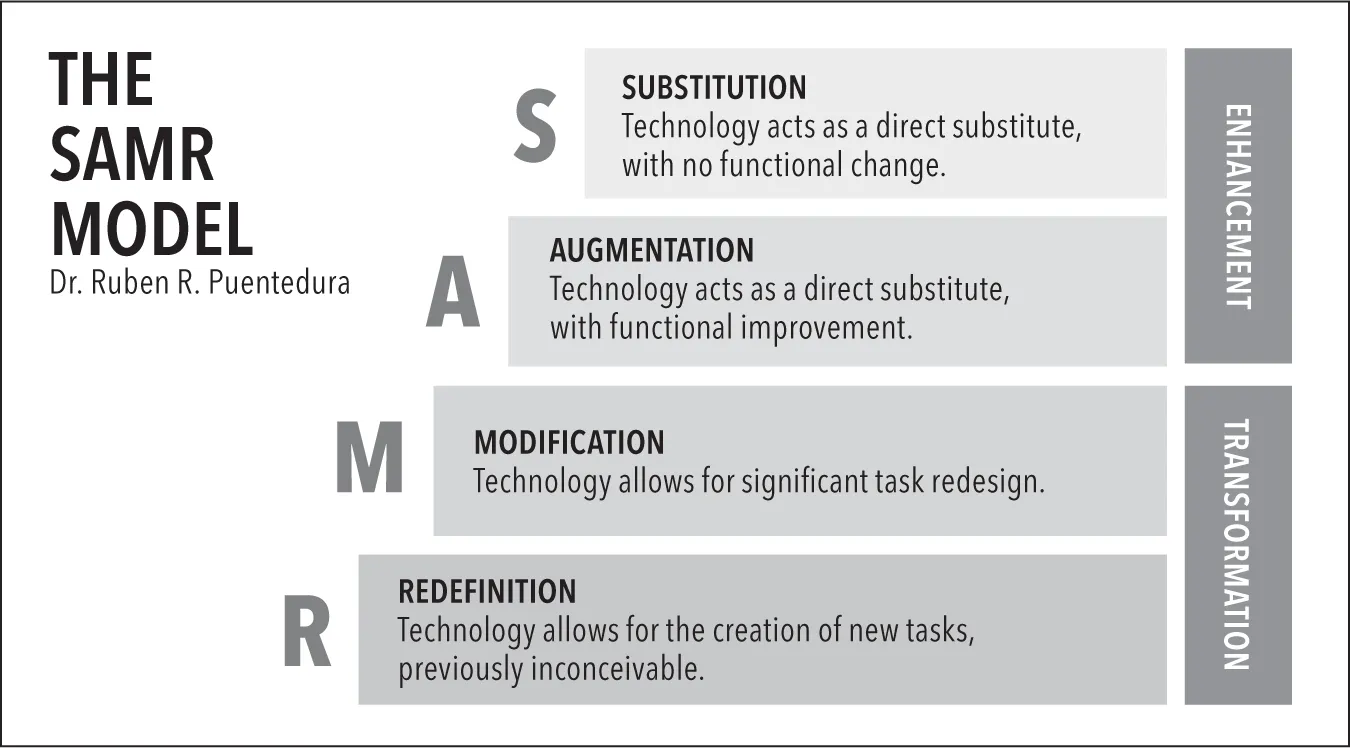
The first framework teacher educators might use as a scaffold with their teacher candidates is the Substitution, Augmentation, Modification, and Redefinition model (SAMR) developed by Puentedura (2013). SAMR is based on four classifications of technology use in the classroom: substitution, augmentation, modification, and redefinition. See Figure 4.2 for an illustration of SAMR. At the substitution classification, students use technology to substitute for a traditional learning activity. As an example, when students write and edit a story using pencil and paper and then type their final stories in Microsoft Word (without using any editing features in Word), they are substituting word processing for handwritten work. At the augmentation classification, students use technology to substitute a traditional learning activity, and the substitution provides added value over the traditional method. As an example, students use Word to draft a story and are expected to use the editing features of Word such as spellchecker and grammar check. At the modification classification, students use technology to modify a traditional learning activity in a way that would change what or how it is produced. As an example, students use Word to type a story with embedded links to web-based media, additional resources, and references, making the story interactive for the reader. At the redefinition classification, the traditional learning task is completely changed by the technology tool. As an example, small groups of students work collaboratively in Google Docs to create a script for a podcast that will be shared via a web-based archive with a targeted audience. According to SAMR, learning activities that fall within the classifications of substitution and augmentation apply technology in ways that enhance learning, while learning activities that fall within the classifications of modification and redefinition transform learning (Puentedura, 2013).
Figure 4.2 Model of the SAMR framework by Lefflerd, distributed under a CC BY-SA 4.0 license.
Puentedura intended SAMR to be used by educators to classify the type of technology used in learning, ultimately hoping that the framework could be used as a tool to enhance the quality of learning with technology in a lesson (2013). Asking teacher candidates to classify the type of technology used in a teaching and learning experience and consider if the activity could be redesigned to “level up” to another classification level (i.e., devising ways to make technology more necessary and powerful) can support candidates to hone their understanding of technological knowledge (TK). While SAMR explicitly stresses the type of technological tool uses (TK), there is minimal emphasis on how using technology might amplify the content learning goal (CK) or allow for more sophisticated pedagogical techniques when using technology (PK). Therefore, the three knowledge bases in TPACK are not necessarily given equal attention, which means candidates may be able to define the type of technology used in a lesson but not necessarily understand the impact of that technology on the content learning goals or explain how pedagogical choices were affected by the technology. With that said, SAMR, focusing on only four identification levels, creates a simple classification structure that new teacher candidates may find beneficial when they are first introduced to the design of instruction that integrates technology.
Thus far, studies that have applied SAMR to evaluate technology use in the classroom (e.g., Azama, 2015; Speirs, 2016) were found to be valid for measuring the use of technology in education at the modification and redefinition levels but not valid at the substitution and augmentation levels (Batiibwe, Bakkabulindi, & Mango, 2017). As the validity of this model is still being researched, teacher preparation programs using the SAMR framework as a tool to support teacher candidates should stay abreast of new research about the use of SAMR.
Analyzing the Sphero Lesson Using...
Table of contents
Cover
Title Page
Copyright
About ISTE
About the Editors and Contributors
Contents
FOREWORD: A Systems View of Technology Infusion
PREFACE: Champions as Water Carriers: Prioritizing Technology Infusion in Teacher Preparation