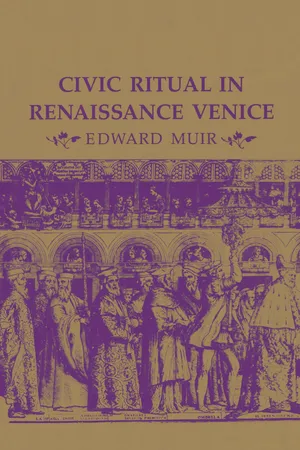
Venice's reputation for political stability and a strong, balanced republican government holds a prominent place in European political theory. Edward Muir traces the origins and development of this reputation, paying particular attention to the sixteenth century, when civic ritual in Venice reached its peak. He shows how the ritualization of society and politics was an important reason for Venice's stability. Influenced in part by cultural anthropology, he establishes and applies to Venice a new methodology for the historical study of civic ritual.
- English
- ePUB (mobile friendly)
- Available on iOS & Android
eBook - ePub
Civic Ritual in Renaissance Venice
About this book
Information
Publisher
Princeton University PressYear
2020Print ISBN
9780691102009
9780691053257
eBook ISBN
9780691201351
PART ONE
MYTH AND RITUAL
Sun-girt city, thou hast been
Oceans child, and then his queen;
Now is come a darker day,
And thou soon must be his prey.
— Shelley, Lines Written Amongst
the Euganean Hills
Oceans child, and then his queen;
Now is come a darker day,
And thou soon must be his prey.
— Shelley, Lines Written Amongst
the Euganean Hills
In order to make up our minds we must know how we feel about things; and to know how we feel about things we need the public images of sentiment that only ritual, myth, and art can provide.
— Clifford Geertz, The Interpretation of Cultures
ONE

THE MYTH OF VENICE
THE MEANING OF THE MYTH
In an act of communal genius, late medieval and Renaissance Venetians intertwined the threads of parochialism, patriotism, and the ideal of la vita civile to weave their own sort of republican, popular piety. In this endeavor Venice anticipated Rousseau’s warning in the Contrat sociale that a state, if it is to endure, must enlist not only the interests of men but their passions as well. Venice endured as a republic while its neighbors did not, thus achieving for itself an international reputation as a state in which the interests and passions of the citizens were almost mystically bound to the system of government. Until its capture by Napoleon, in 1797, Venice had been an independent community for nearly a millennium; for the last five hundred years of its sovereignty, it had been a republic under the continuous rule of a hereditary patriciate that styled itself as a nobility. During that period of independence the Venetian patriciate created social and political institutions so outwardly stable, harmonious, and just that the tensions inherent in any community seemed to be contained in Venice, and self-interest subordinated to the common good. The fundamental problem of the historians of Venice since then has been to separate outward appearance from reality, to uncover from the veneer of propaganda and mythology the actual social and political structure of the city.
Burckhardt painted the classic, if somewhat misleading, portrait of Venice. Contrasting the dynamic restlessness and creativity of Florence with the stagnant repose and traditionalism of Venice, he depicted Venice as a strange and mysterious creation formed without turbulent divisions of political parties, with exceptional concern for citizens in need, and with mutual acceptance of common interests between rulers and subjects. Burckhardt attributed Venice’s political success more to the virtue imposed on the citizenry than to the institutions of government themselves: “No state, indeed, has ever exercised a greater moral influence over its subjects, whether abroad or at home.”1 In some sense Burckhardt was misled by Renaissance rhetoric about Venice, which rather more often took the form of righteous sentimentality than the shape of precise fact.
Today much of what Venetians and their admirers declaimed about Venice sounds too self-serving, too daintily melodious to be considered accurate; yet these words do reveal much about the Venetian point of view, the Weltanschauung of a people whose city was to have a tremendous influence on the imagination and aspirations of other Europeans. The Venetians were fond of writing about themselves, praising their city and its institutions. But, as is often the case in patriotic matters, the parvenu citizen, the adopted foreigner, or even the conquered subject was as often responsible for articulating the values of civic patriotism as was the citizen of ancient lineage; what someone born in a city takes for granted, an outsider often discovers like one newly converted to a religious creed. In Florence, another city noted for its civic values, it took a man from Arezzo, Leonardo Bruni, to trace the ideal of civic life for the natives; and it took a Ferrarese, Savonarola, to transform the civic myth into a millenarian promise.2 Venice, too, was served by stranieri.
Praise of Venice during the Renaissance invariably began with applause for its unparalleled beauty and urban charm as a city quite literally built upon the sea. An emissary from Friuli, Cornelio Frangipane, in a characteristic oration to Doge Francesco Dona (1545-53) once lauded Venice as incomparably beautiful to see, marvelous to contemplate, secure, peaceful, and rich; on another occasion he added that, after Paradise, Venice was the best place in the universe.3 An ambassador from Belluno, Paolo Novello, in his oration to the doge cleverly transported the seven marvels of the ancient world to a Venetian setting, listing among Venice’s seven “miracles" its openness to the sea (a metaphor for its political liberty), the protection afforded by the Lido, and its physical setting on the water. The urban wonders in Novello’s discourse metamorphosed into images of Venice’s political and historical traditions, as if Venice’s destiny had been foreordained by its relationship with nature.4 Venice’s natural beauty, always a point of civic pride, was heightened by striking architecture, imposing public monuments, and the vast Piazza San Marco. As in other Italian cities, building projects in Venice were often expressions of communal values and devotion. The identification of Venice in the arts and in rhetoric with its picturesque qualities, as in the sixteenthcentury iconography that symbolized the city as the sea-born Venus, was an unchanging feature of the Venetians’ perpetual encomium to their city Many of the cultural preoccupations of the Renaissance, especially the humanists’ emphasis on rhetorical hyperbole and the Neoplatonic belief that outward beauty was a sign of inward virtue, encouraged the cultivation of pleasant appearances; so to many Renaissance minds a stunning cityscape alone gave proof of a well-arranged political and social order.5
Likewise, the outward show of religious faith in Venice led panegyrists to argue that Venice was exceptionally pious. Not only did the city harbor the body of the Evangelist Mark, but it gloried in numerous churches, in patronage of religious orders, in charity to the poor, in unflagging opposition to the infidel Turks, and in devout processions.6 These works were, of course, everywhere encouraged by Catholic dogma as a means to attain salvation, but to the civic-minded Venetians such extraordinary devotion proved Venice a chosen city of God, a city infused with grace. According to the fifteenth-century Venetian humanist, Giovanni Caldiera, the cardinal virtues —Faith, Hope, and Charity—underlay the republican virtues; so obedience to the state was metaphorically obedience to the will of God.7 Thus, in Venice patriotism equaled piety. The Venetians’ conception of themselves as a chosen people, in consequence, was always revealed in their attachment to certain sacred institutions, such as the state church, housed by the basilica of San Marco, and the republic itself, and rarely in the chiliastic forms that swept Florence during the Savonarola mania and many other cities during times of political tension or social upheaval.8 Belief in Venice-as-the-chosen-city and adherence to the historical institutions of the republic enabled the Venetians to withstand the tremendous forces for change, including the temptations of millenarian enthusiasm, that ravaged the rest of Italy during the late fifteenth and sixteenth centuries. Instead, the Venetians cautiously accepted the legacy of their social order, their special place in the divine plan, and so transcended the outcome of événements. Venice’s first contribution to European political thought was, therefore, a conservative example of the long-term preservation of so-called divinely ordained institutions.
In addition to esteeming the beauty and religiosity of Venice, characteristics derived simply from its geographical setting and from its most public demonstrations of communal faith, partisans admired Venice’s liberty, peacefulness, and republican form of government. For the Venetians “liberty" was a matter not of personal freedom, but rather of political independence from other powers. According to Frangipane, the Venetians had never been anyone’s subjects, since they were by nature rulers over others —"peroche soli per natura signoreggiano.”9 Venice’s historical pretentions to liberty were given their best exposition in Scipione Feramesca’s 1640 treatise on the diplomatic precedence of Venice over the imperial electors, in which Feramesca claimed Venice to be the only republic ever born in freedom, comparing it to Athens, Sparta, Rome, Florence, Lucca, Genoa, and unnamed others. He further asserted that the independence of Venice had been recognized by numerous emperors and popes and that its liberty and power had been upheld by the virtù of its rulers, rights (ragioni), laws, and customs (consuetudine).10 Venice’s libertà was consequently an ideological inheritance, a gift of fortune that the Venetians had valued and preserved, and a political fact that the two great claimants to universal sovereignty, the pope and emperor, had been forced to recognize.
The city’s liberty, Venetian apologists were anxious to demonstrate, coexisted with domestic harmony and respect for the territory of its neighbors, never with military might or aggression. Yet Venetians also loved to boast of their imperial possessions, obtained undeniably by war. A sixteenth-century English traveler to Venice, William Lithgow, reconciled this apparent contradiction by observing that
The Venetians, howsoever of old, they have bene great warriours; they are now more desirous to keepe, then inlarge their Dominions, and that by presents and money, rather than by the sword or true valour, so whatsoever they loose by battell, it is observed, they recover again by treatise.11
The Venetians, who were less cynical about this supposed proclivity toward bribery, argued that they had inherited a clement approach to foreign affairs.12 They contrasted their experience to the fate of the Romans, who, although great, valorous, and victorious warriors, had nonetheless suffered from the domestic turmoil and political instability created by their dependence on overly powerful armies. The Venetians had preferred intelligent negotiation, prudence, and temperance.13 As the Venetians often boasted, whoever lived in Venice was free from the sufferings of war, from its mental anquish, fear, and economic ruin; shops and homes were secure from both plundering troops and tax collectors; and the absence of factions liberated the republic from internal treacheries. As the saying went, “non est vivere extra Venetiis.”14 The ancient Venetians, according to one author, had even introduced a style of dress for men that encouraged gravity of bearing, modesty, and a quiet demeanor; if clothes make the man, then long trousers made the Venetian a lover of peace.15 Through such reasoning, specious or not, Venice became the Most Serene Republic, La Serenissima.
The rather ambiguous Venetian attitudes about peacefulness and serenity were, however, little more than shadows of the more substantial institutional forms of the republic. Controlled by a hereditary caste of some 2,500 nobles, Venice became the most famous living example in early modern Europe of the advantages gained from government by a thoughtful few Admiration for the Venetian republic largely took two forms, in praise either for the wisdom embodied in Venice’s political institutions or for the devoted civic service practiced by the patrician rulers. The government consisted of a disciplined corps of magistrates, who usually held office for short terms of a few months or a year. Since 1297, when its membership rolls had been definitively drawn up, the Great Council, consisting of all noblemen over twenty-five, served as the electorate, voting to select magistrates for the other judicial, administrative, and legislative offices of the republic.16 In effect the Great Council delegated the responsibility of government to other bodies, principally the Senate, which was the real center of political life in Venice.17 The Collegio of the Senate, composed of the doge, his counselors, and three standing committees whose members were known as savii, handled the day-to-day business of the Senate. The duties of the savii encompassed diploma...
Table of contents
- Cover Page
- Title Page
- Copyright Page
- Dedication
- Contents
- List of Figures
- Acknowledgments
- Abbreviations and A Note on Dating
- Introduction
- Map: The Ritual Geography of Venice
- Part One: Myth and Ritual
- Part Two: An Inheritance of Legend and Ritual
- Part Three: Government by Ritual
- Conclusion
- Manuscript Sources
- Bibliography
- Index
- Library of Congress Cataloging in Publication Data
Trusted by 375,005 students
Access to over 1.5 million titles for a fair monthly price.
Study more efficiently using our study tools.
Frequently asked questions
Yes, you can cancel anytime from the Subscription tab in your account settings on the Perlego website. Your subscription will stay active until the end of your current billing period. Learn how to cancel your subscription
No, books cannot be downloaded as external files, such as PDFs, for use outside of Perlego. However, you can download books within the Perlego app for offline reading on mobile or tablet. Learn how to download books offline
Perlego offers two plans: Essential and Complete
- Essential is ideal for learners and professionals who enjoy exploring a wide range of subjects. Access the Essential Library with 800,000+ trusted titles and best-sellers across business, personal growth, and the humanities. Includes unlimited reading time and Standard Read Aloud voice.
- Complete: Perfect for advanced learners and researchers needing full, unrestricted access. Unlock 1.5M+ books across hundreds of subjects, including academic and specialized titles. The Complete Plan also includes advanced features like Premium Read Aloud and Research Assistant.
We are an online textbook subscription service, where you can get access to an entire online library for less than the price of a single book per month. With over 1.5 million books across 990+ topics, we’ve got you covered! Learn about our mission
Look out for the read-aloud symbol on your next book to see if you can listen to it. The read-aloud tool reads text aloud for you, highlighting the text as it is being read. You can pause it, speed it up and slow it down. Learn more about Read Aloud
Yes! You can use the Perlego app on both iOS and Android devices to read anytime, anywhere — even offline. Perfect for commutes or when you’re on the go.
Please note we cannot support devices running on iOS 13 and Android 7 or earlier. Learn more about using the app
Please note we cannot support devices running on iOS 13 and Android 7 or earlier. Learn more about using the app
Yes, you can access Civic Ritual in Renaissance Venice by Edward Muir in PDF and/or ePUB format, as well as other popular books in History & European Renaissance History. We have over 1.5 million books available in our catalogue for you to explore.