This second edition of No other Way To Tell It defines the form, analyses its codes and conventions, and reviews contrasting histories in America and British practice - taking into account new developments since the first edition.
These include television's radically new ecology; with factual formats a growth area. Docudrama in film has also burgeoned recently, partly because the industries themselves have grown closer and partly because of continued interest in the lives of the famous and of those in the news. International co-production now exploits many different screening opportunities and possibilities, with the result that docudrama and become a cinematic as well as televisual staple. Docudrama is not only popular with audiences; it also causes constant flurries of commentary and controversy. Concerns about 'borders' and 'boundaries', a questioning of documentary's claim to represent the real, doubts about the popular audience's ability to cope with new approaches to the ideas of witness, testimony and confession, authenticity and truth - all fuel the debate.
This new edition situates docudrama and its ongoing debates within a newly vibrant and still highly contentious field of practice. This book will interest readers - academic and general - with an interest in fact-based drama in film, theatre and television
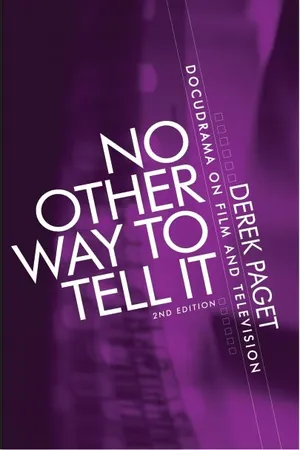
- 328 pages
- English
- ePUB (mobile friendly)
- Available on iOS & Android
eBook - ePub
About this book
Information
Publisher
Manchester University PressYear
2013Print ISBN
9780719084478
9780719084461
eBook ISBN
9781847798046
1
Working on docudrama
Research and writing
Docudramas require pre-production research and this is a key marker of difference between docudrama and other kinds of drama. Sita Williams, researcher as well as producer, tellingly described to me the kind of knowledge acquired through docudrama research as ‘real short-term memory stuff, like revising for an exam!’ Kathy Chater, writing on the work of the researcher in television, notes that there are ‘two forms of factual research’. The first comprises the collecting of generally accepted facts. This research is unlikely to be controversial. Chater calls the second form ‘the exposé method’. Here the aim is to find ‘facts that have either not been considered or which have been rejected by the general consensus’ (1992: 16–17).1 The stakes here become higher. The information-gathering methods used to provide material for the classic British investigative ‘drama-documentaries’ of the late twentieth century were identical to those used for documentary proper; the films were prepared like any other piece of television journalism. As a matter of course some docudramas ran identical risks to any documentary that attempted to shine a light into dark places.
The docudramas produced for many years by Granada were underpinned by a flagship current affairs programme World in Action (1963–98). In former times, an employees-only library, an archive of film and video tapes, journalists’ own newspaper cuttings collections and personal contacts, plus the usual public information services, underwrote the research background to a docudrama as it did to a documentary. Looking back, producer David Boulton has said, ‘We really did turn the world of TV current affairs on its head, even if the world itself remained stubbornly the right way up.’2 Today, with a television ecology comprising more independent production companies, independent agencies deliver this kind of service, and anyway computers are there to back up ‘hard copy’ archives.
‘Field work’, which might include interviews with real-world individuals, is also a factor in any research process. In the case of Granada’s 1992 Hostages, returned hostages such as Frank Reed, and families and friends such as Jill Morrell, working for the release of their loved ones in Beirut, were interviewed by Alasdair Palmer the Associate Producer. For The Government Inspector, a 2005 Channel 4 film about the British weapons inspector Dr David Kelly, producer Simon Chinn and his researchers worked for eighteen months and conducted 120 interviews.3 The facts portrayed in television docudrama are subject to pre-production checks, with the script drafts constantly referred to lawyers to ensure that films will be legally defensible at the level of fact (see Chapter 2). In the case of the ‘co-pro’ (co-production with other countries’ television companies), other lawyers too will check material against their own national law. There is a widespread anxiety in television especially about getting right the facts of any television film. Professional and ethical motives are behind this anxiety, but legal – and ultimately financial – concerns are ever present. It is rare (though not unknown) for the facts of a television docudrama to be disputed in a law court. Even in times where competition and cost-cutting are the order of the day the research effort still has to be made. Anything already in the public domain is beyond legal dispute, of course, and a good deal of the material used in docudrama is likely to be in Chater’s first, uncontentious, category.
Because the lead-time in film production is different from television, and because film is not subject to such stringent regulation as television, there tends to be less anxiety within the film industry. It is hard to imagine, for example, a television docudrama on the Guildford Four being able to get away with the sometimes extravagant liberties taken with facts in the 1993 film In the Name of the Father. This film has been accused of
debasing its own authenticity with its final, hollow court-room scene which is not only completely invented and inaccurate in its portrayal of British procedure, but is played like the climax from a Perry Mason movie. (Halliwell and Walker, 2002: 406)
In the scene in question, Emma Thompson plays defence lawyer Gareth Peirce and passionately harangues the jury. Peirce was actually a behind-the-scenes legal figure at appeal, and so she never had to speak to a jury at all. There were other invented scenes. For example, Giuseppe and Gerry Conlon (Pete Postlethwaite and Daniel Day-Lewis) were depicted inhabiting the same jail cell. They were never even held in the same prison. These aspects of his film have been vigorously defended by writer/director Jim Sheridan:
Films always and necessarily distort the truth: Daniel is not really Gerry Conlon, and the bomb did not really go off in slow-motion. (Domaille 2001: 70)
Sheridan made no secret of his intention to wring heart-strings rather than produce a factual report in his film. His insouciance regarding factual accuracy can be seen as provocation, an articulation of a political point about Irish oppression by Britain. But, to repeat, it is hard to imagine such a version of the facts being prepared for a television audience.
For television docudrama makers the situation is more complicated and they more generally adduce research as evidence of their probity in the event of post-transmission attack. Docudrama makers habitually describe their research in adjectives signifying conscientiousness. Research is never other than ‘detailed’, ‘extensive’, ‘painstaking’, or ‘voluminous’. Yet as any researcher knows, no matter what the field, it is always possible to do more research (and who in any case would ever deliberately describe their research as ‘sketchy’, ‘superficial’ or ‘incomplete’?). There is also an ongoing stand-off between print and television journalism, the former exulting whenever it can show slipshod work in the latter. A classic argumentational move for the television filmmaker is the one Peter Kosminsky used when discussing No Child of Mine, his ITV film about child-abuse, at a 1997 BAFTA debate. He angrily contrasted his own (faithfully-kept) promise not to reveal the identity of ‘Kerry’ – the main protagonist, a prostituted child – to the door-stepping depredations of the tabloid hacks who had made the real girl’s life a misery in the weeks following transmission.
In addition to researchers working with individuals and information agencies, docudramas also employ writers who occasionally do their own research. Writing docudrama is a specialist task, one not relished by all writers. Factual material must be turned into believable dialogue for actors to exchange in scenes organised into a narrative text. Just like works of the imagination, docudrama text is composed with aesthetic as well as factual considerations. Research material is passed to the dramatist, who tends either to benefit from this work and acquire ownership of it as they shape it further, or to feel like a kind of ‘hired hand’ as they begin to resent the straitjacketing that working with facts can impose. Dramatists are expected at the very least to familiarise themselves with often highly detailed research material very quickly. Michael Eaton’s case on Yorkshire Television’s 1990 Shoot to Kill (also directed by Kosminsky) is instructive here. At the moment in which Eaton entered the project, the journalists on the team had already done three years research into the Stalker affair.4 His job was to synthesise what was there. ‘We are’, Eaton has said, ‘structuralists rather than dramatists – producers want us to supply form and structure.’5 Some writers enjoy the constraints this inevitably provides, but others find them irksome. As far as the industry is concerned, it is the job of drama to supply form and structure and ultimately a ‘shooting script’. This more or less final print version will have had many drafts, all of which have to be run past lawyers in what amounts to a negotiation. This tricky process has two protagonists: a writer keen to represent the facts but focused on creating meaningful dialogue, scenes and narrative; and a lawyer focused on combating prospective libel suits.6
The method by which a production team works on a docudrama text is then broadly that of any fiction film. In the first stage there is concept, writing and setting up finance. In the next stage there is casting, negotiating with actor’s agents, finding a director and a crew, drawing up contracts, organising schedules to ensure the smoothest possible running of read-throughs, rehearsals, location work, and studio sessions. Writers draft, and actors work with scripts, rehearse and perform for the camera. Realisation in performance before the camera depends upon skills from outside the world of factual journalism – skills of credible performance in environments both simulated and actual, recorded on film by complex technical means. Dubbed, shaped and edited by further exercise of technical skill, the docudrama then reaches its audience. The process for a feature film docudrama is similar in many respects to television but crucially different in its focus: less hedged around by regulation, it has a freer attitude towards the letter of the fact and more focus on narrative dynamics. But film and television docudrama have converged gradually over a quarter of a century, and many films that start as features end up as ‘movies-of-the-week’, or are even aimed at both film and television markets.
Take the example of two 2002 docudramas about the Bloody Sunday incident. Bloody Sunday was first to be screened on ITV. In the week of first transmission this film also had a limited cinema release, neatly illustrating the current synergy of the film and television industries. In the same week another film on the subject, Sunday, was broadcast on Channel 4. The research background for both Sunday and Bloody Sunday included input from historical participants and the films were made in a new context of interest in the historical incident. In 2002 an official inquiry into the actions of 30 January 1972 (when the British Army’s Parachute Regiment entered Londonderry, shooting 13 civilians) was in process. Bloody Sunday was directed by Paul Greengrass; Sunday was written by Jimmy McGovern. Both these individuals have catalogues that heavily feature docudrama.7 Neither film could be called a ‘documentary’ in the usual sense of that word, even though they were prepared in a similar way, and had some similar intentions to those of documentaries on this subject (to expose original tragic injustices in a context in which the case of Bloody Sunday was being re-examined by the British judiciary).8
The very fact that actors had rehearsed specially written scripts is enough to deny these films any documentary categorisation. But nor were the films strictly ‘dramas’ in the sense of freely-imagined works of fiction, made ‘originally’ in the mind of writers. In the case of Granada’s 1992 Hostages, writer Bernard MacLaverty was not the only ‘creative’ policed by facts. Producers Alasdair Palmer and Sita Williams intervened so often on the set – to correct or to insist upon particular matters of fact – that they were only semi-jokingly dubbed by disgruntled members of cast and crew, the ‘fact fascists’. For the ‘artists’ involved – the director and the actors – any hint of improvisation, any deviation from the legally-vetted script, was quite simply out of the question. Like it or not, the ‘fact fascists’ had an on-set role – as mouthpieces for off-set lawyers.9
Treating facts
Docudramas begin – as do films and television programmes of all kinds – with someone’s bright idea developed into a formal ‘pitch’ or ‘proposal’ made to someone with the power to produce and/or finance a film. If a pitch is given the green light, it is developed into a ‘treatment’, or an outline that includes the subject matter of a proposed film or television programme, a description of the kind of approach the film might take, and details about characters and incidents to be portrayed. According to Sita Williams, ‘the treatment isn’t a straitjacket, it’s only to give whoever needs to know a kind of feeling for the story’ (the people who ‘need to know’ being principally executives likely to have commissioning powers). A treatment defines genre or genre-mix, too, the citing of film or programme categories helping in its turn to mark out the kind of audience to whom the finished product might appeal, and (for television) the scheduling slot for which it will be most suitable. If researched facts are evident in the treatment this in itself marks the intended territory and trajectory of the film for planners in both film and television industries. A successful treatment also becomes the basis for budgetary and logistical planning. It will eventually shape a writer’s work in fundamental ways. This has been described by Todd Gitlin as a ‘filtration’ process through which the industries control ideas (1994: 21). In the open competition that characterises American film and television the process reduces thousands of ideas pitched each year ‘by a factor,’ says Gitlin, ‘of five, ten, or thirty’ at each stage. Only a handful of ideas can survive this Darwinian process. Even highly successful writers and directors can point to numbers of unrealised projects at various stages of aborted preparation.
The dramatic element in docudrama makes for many of the form’s complications. Just as the concept of the ‘unrehearsed’ is fundamental to documentary, so the ‘rehearsed’ is integral to drama. In the classic narrative film the spectator is sucked into the frame through the cathartic power of identification with a fictional ‘other’. By contrast, the spectator in classic documentary is positioned as ‘person-to-be-addressed’ and held at the distance appropriate to a dispassionate observer. Latterly these spectatorial positions have become far more complicated, but the clash between these competing ‘ways of seeing’ is still a factor. In the USA many of docudrama’s difficulties are resolved financially, by bringing actual participants in historical events ‘on board’ with projects. Alan Rosenthal notes that ‘most of the [US] networks and major producers of docudramas not only employ scouts to search for the hot stories, but also spend vast amounts of money in purchasing the story rights’ (1995: 26). This has led occasionally to bizarre consequences at the tabloid end of docudrama production (see Chapter 8). Home Box Office (HBO) wittily satirised the sensational excesses of tabloid docudrama in their 1992 The Positively True Adventures of the Alleged Texas Cheerleader-Murdering Mom. The jokey quality of this reflexive docudrama is evident in an early scene that depicts the eponymous ‘Mom’ objecting vociferously to the idea of actress Holly Hunter playing her in the film. It is of course Hunter speaking this objection.10
Historically the British drama-documentary tradition has been far closer to the project of the journalist and the documentarist than its American cousin. As Jeremy Tunstall notes: ‘British documentary film-makers see themselves as heirs to two great traditions – one in public service broadcasting, the other in 1930s documentary film-making’ (1993: 33). The BBC and Granada in particular have highlighted journalistic values in the past, working invariably with stories already in the public domain. In refusing to enter into story-auctions British producers in general have invoked a system of rights and ethics shared with the investigative journalist. But the cultural crisis over ownership of real-life stories, social anxieties around the concept of privacy, and the increasing convergence of broadcasting institutions now complicate this apparently straightforward moral stance. A fierce turn-of-the-century public debate about celebrity and privacy has raised the stakes even higher.
In the UK, the stages of proposal, optioning, production and transmission were re-shaped in the 1990s owing to ...
Table of contents
- Cover page
- Title Page
- Copyright Page
- Contents
- Acknowledgements
- Introduction to the second edition
- 1 Working on docudrama
- 2 The law and regulation – docudrama in the new millennium
- 3 Codes, conventions and change
- 4 Keywords, key debates
- 5 Histories: antecedents and first phase
- 6 Histories: second-phase developments
- 7 Histories: third-phase ‘co-pros’
- 8 Histories: fourth-phase hybridisation
- Bibliography
- Index
Trusted by 375,005 students
Access to over 1.5 million titles for a fair monthly price.
Study more efficiently using our study tools.
Frequently asked questions
Yes, you can cancel anytime from the Subscription tab in your account settings on the Perlego website. Your subscription will stay active until the end of your current billing period. Learn how to cancel your subscription
No, books cannot be downloaded as external files, such as PDFs, for use outside of Perlego. However, you can download books within the Perlego app for offline reading on mobile or tablet. Learn how to download books offline
Perlego offers two plans: Essential and Complete
- Essential is ideal for learners and professionals who enjoy exploring a wide range of subjects. Access the Essential Library with 800,000+ trusted titles and best-sellers across business, personal growth, and the humanities. Includes unlimited reading time and Standard Read Aloud voice.
- Complete: Perfect for advanced learners and researchers needing full, unrestricted access. Unlock 1.5M+ books across hundreds of subjects, including academic and specialized titles. The Complete Plan also includes advanced features like Premium Read Aloud and Research Assistant.
We are an online textbook subscription service, where you can get access to an entire online library for less than the price of a single book per month. With over 1.5 million books across 990+ topics, we’ve got you covered! Learn about our mission
Look out for the read-aloud symbol on your next book to see if you can listen to it. The read-aloud tool reads text aloud for you, highlighting the text as it is being read. You can pause it, speed it up and slow it down. Learn more about Read Aloud
Yes! You can use the Perlego app on both iOS and Android devices to read anytime, anywhere — even offline. Perfect for commutes or when you’re on the go.
Please note we cannot support devices running on iOS 13 and Android 7 or earlier. Learn more about using the app
Please note we cannot support devices running on iOS 13 and Android 7 or earlier. Learn more about using the app
Yes, you can access No other way to tell it by Derek Paget in PDF and/or ePUB format, as well as other popular books in Media & Performing Arts & Film & Video. We have over 1.5 million books available in our catalogue for you to explore.