eBook - ePub
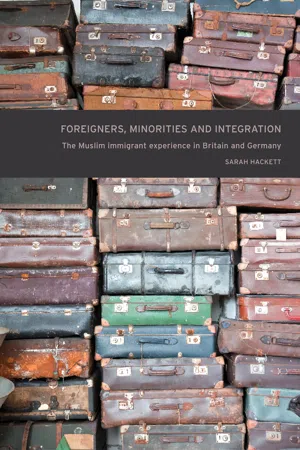
Foreigners, minorities and integration
The Muslim immigrant experience in Britain and Germany
- 292 pages
- English
- ePUB (mobile friendly)
- Available on iOS & Android
eBook - ePub
Foreigners, minorities and integration
The Muslim immigrant experience in Britain and Germany
About this book
This book explores the arrival and development of Muslim immigrant communities in Britain and Germany during the post-1945 period through the case studies of Newcastle upon Tyne and Bremen. It traces Newcastle's South Asian Muslims and Bremen's Turkish Muslims from their initial settlement through to the end of the twentieth century, and investigates their behaviour and performance in the areas of employment, housing and education. At a time at when Islam is sometimes seen as a barrier to integration and harmony in Europe, this study demonstrates that this need not be the case. In what is the first comparison of Muslim ethnic minorities in Britain and Germany at a local level, this book reveals that instances of integration have been frequent. It is essential reading for both academics and students with an interest in migration studies, modern Britain and Germany, and the place of Islam in contemporary Europe.
Information
Publisher
Manchester University PressYear
2015Print ISBN
9781784992811
9780719083174
eBook ISBN
9781526102461
1
Self-preservation to determination: the employment sector
Ethnic minorities in Britain and Germany’s labour markets
There is no doubting the importance of the employment sector when assessing the experiences and integration of ethnic minority groups in Britain and Germany. Indeed this area has occupied a prominent position at the centre of political debate and academic research in both countries. Economic opportunities were often the main motivation for immigration to Britain and Germany in the first instance. In Britain, New Commonwealth immigrants began arriving in the late 1940s because both post-war reconstruction and the expanding economy created labour positions that could not be filled by British workers. Both West Indian immigrants and later those from the Indian subcontinent played a vital part in Britain’s labour market.1 It is essential to recognise the aforementioned connection that existed between Britain and her colonial immigrants, with many having a familiarity with the British way of life.
In Germany, the correlation between post-war immigration and labour has been even more clearly defined. Whilst immigrants who travelled to Britain largely did so independently and paid their own costs, Germany implemented a guest-worker rotation system that generated privately negotiated economic immigration and one that by its very nature was meant to be a temporary phenomenon. Guest-workers were defined and perceived by the work they carried out, were expendable and could be returned home should unemployment increase, and the West German authorities had the power to determine both their length of stay and their access to the labour market.2 They filled jobs rejected by German workers, permitted an upwards shift amongst the German workforce, and appeared to allow the expansion of the economy without the burden of long-term financial investment and social costs.3
Whilst there is no need to offer an in-depth analysis of the well-documented features of the guest-worker rotation system, it is necessary to realise that this inherent difference between Britain as the recipient of permanent immigration and Germany’s perception of itself as the receiver of temporary economic workers sets the context and the starting point for both the book and this chapter more specifically. Furthermore, although it is forcefully argued that the underlying social and cultural factors that accompanied the guest-worker recruitment scheme tended to be largely neglected, it is this group of immigrants which, whilst initially identified by their economic purpose, is largely responsible for Germany’s ethnically diverse population at the beginning of the twenty-first century.
Not only were economic opportunities the reason why many Muslim immigrants arrived in Britain and Germany in the first instance, but these labour market experiences have also shaped their daily lives since. With regard to Britain, findings often cite the existence of an ethnic or Islamic penalty, asserting that ethnic minority communities, and particularly Muslims, suffer from discrimination in the employment sector, high rates of unemployment, low wages and poor working conditions. Such conclusions have largely dominated the historiography on the employment of post-war migrants in Britain, from the ground-breaking studies of the 1960s and 1970s right through to the most recent analyses of the 2000s.4 Furthermore, there has been an increasingly widespread concern that the second generation of Pakistani and Bangladeshi communities especially are experiencing the same patterns of disadvantage as the first and that Muslims in particular are suffering an inexplicable labour market penalty.5
Despite the inherent differences between Britain’s colonial immigration and Germany’s guest-worker rotation system, and the fact that guest-workers were perceived as temporary economic relief from the outset, ethnic minorities in both countries have experienced similar disadvantages and obstacles during the post-war period. Whilst the Pakistanis and Bangladeshis have been singled out as the most disadvantaged groups in Britain’s employment sector, an overwhelming proportion of the literature on Germany focuses on the Turkish community. It has repeatedly highlighted long-term unemployment, a concentration in unskilled work, discriminatory practices and little opportunity for upward mobility.6 As with that addressing Britain, it raises concerns about the second generation who, whilst enjoying better labour market prospects than their parents, still have a long way to go before matching those of their German counterparts.7 Furthermore, although not as established and advanced as in Britain, the debate in Germany is also increasingly citing Islam as a defining feature in shaping these experiences. Muslim women, for example, are often discriminated against or criticised for wearing headscarves in the workplace, and a 2009 study conducted by the Federal Office for Migration and Refugees concluded that Muslim migrants in Germany endure higher unemployment rates than those of other religious affiliations, and continue to be disadvantaged by the close link between educational attainment and labour market performance.8
The employment sector is also a topic worthy of research in the study of ethnic minority communities because of the manner in which it continuously permeates other areas of migrants’ lives. There is a clear link between the performance of ethnic minority populations in the British and German labour markets, and their experiences in the other two sectors investigated in this study, those of housing and education. Research has concluded that ethnic minorities in Britain who live largely in white neighbourhoods are economically advantaged compared those in more ethnically mixed areas.9 Low educational attainment and a lack of qualifications are reasons repeatedly given for the difficulties faced by ethnic minorities in the British labour market.10 In Germany, the correlation between the employment and education sectors is even more apparent, and is consistently reinforced by the fact that the German school system requires pupils to be streamed at an early age, a process that is argued to disadvantage youths of ethnic minority origin.11 Regarding housing, not only did guest-workers largely initially live in barrack accommodation provided to them by their employers, but they have since often resided in inexpensive neighbourhoods and housing as a result of low wages, with some making a conscious economic decision to live in areas that can provide them with the necessary financial and social support for their business ventures. Furthermore, it has been argued that there is also a clear correlation between ethnic minority labour market performance and the economic and social exclusion of migrants and their children, the contribution they make to the economy, and the perception held of them by the host population.12
Muslim ethnic minorities in Britain and Germany’s labour markets
It is perhaps surprising that despite the ever-increasing importance awarded to Islam in the study of Europe’s migrant communities, the recognition of religion as an influential factor in the shaping of labour market experiences in both Britain and Germany has been a more recent phenomenon. In Britain, it was not until the 1990s that research of this type began to emerge in any volume, and there certainly existed a well-established and vibrant debate on Muslims in the British employment sector before the inclusion of a question regarding religious affiliation in the 2001 Census. The works of Kenneth Clark, Stephen Drinkwater and Ceri Peach, to name but a few, have pointed to higher unemployment rates and lower occupational profiles amongst Muslims, with Joanne Lindley referring to an ‘Islamic penalty’ within Britain’s employment sector.13 Kenneth Clark and Stephen Drinkwater go so far as to assert that there is a link between religions that values entrepreneurship, such as Islam, Hinduism and Sikhism, and higher levels of self-employment.14 In his work that drew upon the 1994 National Survey of Ethnic Minorities, Mark S. Brown concluded that there was a higher proportion of Sikhs and Muslims amongst self-employed managers, employers and professionals, and argued that a religious classification could potentially offer a more in-depth insight into South Asian economic activity at a local level than an ethnic one.15
The literature addressing Germany has followed a different path to that regarding Britain. Apart from the aforementioned 2009 Federal Office for Migration and Refugees study, there has been an absence of research that has clearly distinguished between Muslim and non-Muslim migrants, not only with regard to the labour market, but also housing, education and ethnic minority levels of integration more widely. Instead, the primary focus of a large proportion of the historiography has been on the Turkish community in a Germany where Türke has become synonymous with Ausländer, and is often perceived as being politically, religiously and culturally at odds with German society.16 It is not surprising that the Turkish community should receive so much attention. Firstly, Turks have steadily become the largest ethnic minority group, comprising approximately 2.5 to 2.7 million out of 3.8 to 4.3 million muslims living in Germany in 2009.17 Secondly, much of the data drawn upon by the academic literature, such as the German Socio-Economic Panel (GSOEP) and the Micro-census, did not include information on Islamic affiliation, thus encouraging research along ethnic lines. Thirdly, the focus on the Turkish community has no doubt been reinforced by the conclusions reached, which often set Turks apart from other ethnic minority groups. Over recent decades, Turks have suffered the highest rates of unemployment, have been forced into unskilled work and have constituted the largest proportion of non-German self-employed workers.18
Yet there is no doubt that the religious affiliation of Muslim migrants is increasingly being recognised as an important factor when studying and assessing their position in and approach to the German labour market, although it should be noted that this is largely the case amongst works of an international scope. Some Turkish Muslims in Berlin who took part in a 2008 study, for example, maintained that their religious and ethnic backgrounds had limited their career opportunities, and it has been argued that unemployment rates amongst Muslims in Germany are higher than those amongst non-Muslims.19 Furthermore, a 2006 Pew ...
Table of contents
- Cover
- Half Title Page
- Title Page
- Copyright Page
- Contents
- Tables
- Preface and acknowledgements
- Introduction: A history of immigration to modern Britain and Germany: national and local perspectives
- 1: Self-preservation to determination: the employment sector
- 2: Neighbourhood which? The housing sector: owner-occupation and ethnic neighbourhoods
- 3: The education sector: the three Rs – race, relations and arithmetic
- 4: Conclusion: comparing communities, challenging conceptions
- Bibliography
- Index
Trusted by 375,005 students
Access to over 1.5 million titles for a fair monthly price.
Study more efficiently using our study tools.
Frequently asked questions
Yes, you can cancel anytime from the Subscription tab in your account settings on the Perlego website. Your subscription will stay active until the end of your current billing period. Learn how to cancel your subscription
No, books cannot be downloaded as external files, such as PDFs, for use outside of Perlego. However, you can download books within the Perlego app for offline reading on mobile or tablet. Learn how to download books offline
Perlego offers two plans: Essential and Complete
- Essential is ideal for learners and professionals who enjoy exploring a wide range of subjects. Access the Essential Library with 800,000+ trusted titles and best-sellers across business, personal growth, and the humanities. Includes unlimited reading time and Standard Read Aloud voice.
- Complete: Perfect for advanced learners and researchers needing full, unrestricted access. Unlock 1.5M+ books across hundreds of subjects, including academic and specialized titles. The Complete Plan also includes advanced features like Premium Read Aloud and Research Assistant.
We are an online textbook subscription service, where you can get access to an entire online library for less than the price of a single book per month. With over 1.5 million books across 990+ topics, we’ve got you covered! Learn about our mission
Look out for the read-aloud symbol on your next book to see if you can listen to it. The read-aloud tool reads text aloud for you, highlighting the text as it is being read. You can pause it, speed it up and slow it down. Learn more about Read Aloud
Yes! You can use the Perlego app on both iOS and Android devices to read anytime, anywhere — even offline. Perfect for commutes or when you’re on the go.
Please note we cannot support devices running on iOS 13 and Android 7 or earlier. Learn more about using the app
Please note we cannot support devices running on iOS 13 and Android 7 or earlier. Learn more about using the app
Yes, you can access Foreigners, minorities and integration by Sarah Hackett in PDF and/or ePUB format, as well as other popular books in Social Sciences & Social Policy. We have over 1.5 million books available in our catalogue for you to explore.