- 317 pages
- English
- ePUB (mobile friendly)
- Available on iOS & Android
eBook - ePub
About this book
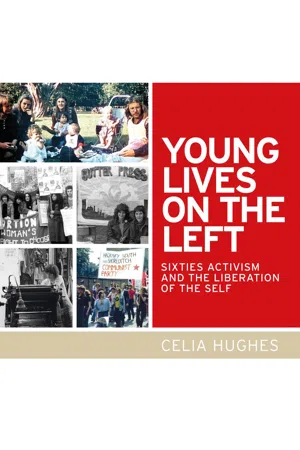
This book examines the coming of age experiences of young men and women who became active in radical Left circles in 1960s England. Based on a rich collection of oral history interviews, the book follows in depth the stories of approximately twenty individuals to offer a unique perspective of what it meant to be young and on the Left in the post-war landscape. The book will be essential reading for researchers of twentieth-century British social, cultural and political history. However, it will be of interest to a general readership interested in the social protest movements of the long 1960s.
Information
Publisher
Manchester University PressYear
2015Print ISBN
9781526133779
9780719091940
eBook ISBN
9780719098307
1
Post-war childhood and adolescence
Young sixties activists grew up in a historically distinct landscape. Allowing for the social and psychological dislocations of war, post-war Britain remained a stable and conservative place to be. Simon J. Charlesworth explained the importance of understanding place as a ‘natural starting point for understanding being’.1 Autobiographies of fifties middle- and working-class childhood have commonly identified the psychological security deriving from the stable social and economic conditions of the post-war boom.2 These are the retrospective narratives of British ‘baby-boomers’, the generational cohort who escaped the privations of inter-war depression, the disruptions of war, and who were still infants during the austerity years. This experiential and psychic gulf between post-war parent and child formed a key component of the generation gap that social commentators began to pay attention to following the student protests of the late 1960s.3
Self-belief for fifties and early-sixties youngsters was intertwined with the fabric of the landscape. It came packaged in the bottles of free school milk and the grammar school education that instilled expectations of academic achievement and hopes of social advancement. This post-war subjectivity may be seen as an outcome of the social citizenship rights that 1940s welfare and educational policies conferred upon children. Shaped by authorities concerned about the child’s subjective development and the universal human rights enshrined in the charter and resolutions of the United Nations, state services had extended to the child what Cambridge sociologist Thomas Marshall called ‘a kind of basic human equality associated with the concept of full membership of a community’.4 These policies were part of the material building blocks for the modern, entitled self.
As children, young sixties activists exhibited belief in their material and emotional entitlement. Yet from within their homes and communities they saw the actions of a benevolent state cut through with inequalities that told some citizens they were worth more than others. Early memories railing against the unfairness of material and emotional distribution provide insight into the psychic structures moulded by post-war welfare and education. Childhood outrage at human inequality was the subjective response of the young citizen speaking as a member of an equally entitled community. From an early age the men and women of this book exercised claims, as ‘citizens in potentia’, to improve everyday social and emotional life for themselves and others.5
The relationship between place and selfhood is an important component of this study and a useful starting point for thinking about how young sixties activists began to live out a sense of who and what they were. This chapter considers how interviewees started out on their journeys towards life on the Left. It addresses the role of childhood and adolescent experience in shaping radical subjectivity. Through attention to childhood memory, it seeks to understand the structures of feeling underlying youngsters’ encounters within particular social, cultural and political sites. The chapter argues that, as agents challenging the social and domestic consensus, young activists’ desire for new ways of seeing and being on the Left can be found rooted in their experiences in the family, school and local community. It situates their stories against existing studies of post-war family life in order to show how they fit into prevalent patterns of social continuity and change. The chapter shows how sensitivity to class dynamics, social injustice, racism and emotional and intellectual affinity for the Left developed, and how and when the local, national and international world began to collide. It argues that close attention to the ‘shifting reciprocal relationship’ between ‘psychic life’ and individual histories provides the key to understanding why young men and women became drawn towards particular left spaces and why they began to carve out new cultural channels within them.6
The post-war family
Stories of sixties activism began in the family. Sally Alexander has shown how ‘iconic moments in spoken and written [London] childhood memories reveal the (remembered) child’s self-awareness in relation to the outside world and to the child’s own place within it’.7 These moments of self-awareness often arose through the child’s feelings as they observed and communicated with family members. Childhood memories, mediated through the trope of the mother and father, illuminate the emotional signals and unfulfilled, even unconscious dreams children picked up from parents and relatives, all of which helped to foster an early relationship to the wider world. Paul Thompson has shown how the family transmits ‘social values and aspirations, fears, world views, domestic skills, and taken-for-granted ways of behaving’.8 Fragments of childhood memory redolent with ‘primitive’ and ‘visceral feeling’ suggest possibilities for understanding the relationship between the childhood landscape and subjectivity.9 Thinking about how children come to form relationships with the world around them is fundamental to thinking about how structures of feeling or ‘underlying feeling’ came to be shaped into critical and even political thought. Raymond Williams and Carolyn Steedman offer insight into childhood cognition and its connection to the social world. Williams wrote of the ‘real … physical and material relational processes’ which occur as an ‘activation of specific relations’ when poems are read, stories told, plays enacted and watched.10 Although he was discussing a specific interaction with culture, his reflections might be extended to children’s interactions with parents’ social and political behaviour and emotional signals. These were individual and collective ‘means of cognition, ways of thought’ which then moved into social worlds.11
Young activists grew up in a home-centred society in which the family was widely understood to be at the heart of national life. Following on from wartime, the family was the subject of unprecedented psychological and social scientific investigation, and a contemporary preoccupation. It was the place where individually and as a collective body the nation invested its hopes, desires and fears. The view that a happy home and family life were the secrets to national stability and wellbeing informed the post-war reconstruction project. In dialogue with social and cultural discourses, men and women looked to the home and family as the centre of their lives; their roles as husbands, wives, fathers and mothers became highly important in shaping their sense of self. Whilst Claire Langhamer has acknowledged that the aspiration and reality of the private home was ‘never a uniform experience’,12 Laura King has suggested that, overall, increasing material and emotional investment in the family home made it for many ‘a pleasant place to spend one’s time’.13 However, the narratives of the individuals in this book show that for a minority of children the family home was far from a self-contained private site and not always conducive to a secure identity. It frequently provided connections to wider political and social communities where parents and relatives provided models of engaged and dissident citizenship. The home was often the starting point for children thinking about themselves in relation to a wider social and gendered body: a problematic experience for some that led to journeys outside it for explanations and alternative sites for belonging. Social and emotional dislocations inside the home raised complex questions about social norms, justice, democracy and identity.
The narratives of young sixties activists show that material circumstances of family life continued to shape uneasy relationships with the social landscape. Their experiences contested descriptions of the post-war working class that emphasised new patterns of everyday life and relationships rooted in affluence and welfare legislation. Recent histories of the 1950s and early 1960s emphasise the continuing dominance of class as a relational social identity.14 The testimonies underlying this study confirm the complexities of this identity, as class differences increasingly interacted with affluence, consumption and teenage culture as well as with new tenets of gender and sexuality to create new subjectivities. Yet, as Pat Thane has argued, economic boom and the welfare state did not herald a total transformation, and relative deprivation continued to be an important subjective marker for many working-class children in this book. Consciousness of having or not having continued to define early life experiences and social relations, arousing in the child their first sense of awareness that they existed in relation to other people who had more or less than themselves. From such awareness often came the realisation that ‘their lives were controlled by more powerful people’ who acted seemingly without care for those below them.15
Sue Bruley grew up in a newly built Surrey council estate close to Epsom Downs race course. The working-class estate was part of the extensive post-war urban redevelopment that included council housing programmes financed from government subsidies paid to local authorities. Sue’s parents took part in the working-class migration from inner cities to suburbs situated in the New Towns constructed after 1946. Yet the estate’s leafy surroundings failed to disguise her parents’ weekly struggle to make ends meet. The sight of the Friday money pile denoted the family’s hand-to-mouth existence where ‘every penny had to be justified’.16 Sue’s memory confirmed the findings of post-war sociologists that, despite welfare-state provision and high labour demand, working-class families remained vulnerable to poverty in the suburbs as well as the inner cities.17 As in many working-class households, her mother combined part-time work with family management. Elizabeth Roberts has argued that this period saw a weakening of women’s traditional control over the family finances.18 However, Sue’s mother was one of the minorities of working-class women who retained control over the household budget. The household’s traditional gender balance gave Sue close insight into the strain this weekly responsibility placed on her mother:
My father would get paid on a Friday and there would be piles of money on the table to sort out the bills, and it was weekly pay, you know, and so they would have these conversations about what they could afford … then on Tuesday she would get the family allowance, which was I think seventeen or eighteen shillings … I had to go down the shops with her … because we didn’t have a car or anything like that … she was waiting for that money on a Tuesday to feed us...
Table of contents
- Cover
- Half title page
- Title page
- Imprint
- Contents
- Acknowledgements
- Abbreviations
- Introduction
- 1 Post-war childhood and adolescence
- 2 Youth subcultures
- 3 The student movement and the Vietnam Solidarity Campaign
- 4 New Left politics and Women’s Liberation
- 5 Adulthood and activism in the 1970s
- 6 Trotskyism and the revolutionary self
- Conclusion
- Select bibliography
- Index
Trusted by 375,005 students
Access to over 1.5 million titles for a fair monthly price.
Study more efficiently using our study tools.
Frequently asked questions
Yes, you can cancel anytime from the Subscription tab in your account settings on the Perlego website. Your subscription will stay active until the end of your current billing period. Learn how to cancel your subscription
No, books cannot be downloaded as external files, such as PDFs, for use outside of Perlego. However, you can download books within the Perlego app for offline reading on mobile or tablet. Learn how to download books offline
Perlego offers two plans: Essential and Complete
- Essential is ideal for learners and professionals who enjoy exploring a wide range of subjects. Access the Essential Library with 800,000+ trusted titles and best-sellers across business, personal growth, and the humanities. Includes unlimited reading time and Standard Read Aloud voice.
- Complete: Perfect for advanced learners and researchers needing full, unrestricted access. Unlock 1.5M+ books across hundreds of subjects, including academic and specialized titles. The Complete Plan also includes advanced features like Premium Read Aloud and Research Assistant.
We are an online textbook subscription service, where you can get access to an entire online library for less than the price of a single book per month. With over 1.5 million books across 990+ topics, we’ve got you covered! Learn about our mission
Look out for the read-aloud symbol on your next book to see if you can listen to it. The read-aloud tool reads text aloud for you, highlighting the text as it is being read. You can pause it, speed it up and slow it down. Learn more about Read Aloud
Yes! You can use the Perlego app on both iOS and Android devices to read anytime, anywhere — even offline. Perfect for commutes or when you’re on the go.
Please note we cannot support devices running on iOS 13 and Android 7 or earlier. Learn more about using the app
Please note we cannot support devices running on iOS 13 and Android 7 or earlier. Learn more about using the app
Yes, you can access Young lives on the Left by Celia Hughes in PDF and/or ePUB format, as well as other popular books in Politics & International Relations & Film History & Criticism. We have over 1.5 million books available in our catalogue for you to explore.