Available in paperback for the first time, this first book-length study explores the history of postwar England during the end of empire through a reading of novels which appeared at the time, moving from George Orwell and William Golding to Penelope Lively, Alan Hollinghurst and Ian McEwan. Particular genres are also discussed, including the family saga, travel writing, detective fiction and popular romances.
All included reflect on the predicament of an England which no longer lies at the centre of imperial power, arriving at a fascinating diversity of conclusions about the meaning and consequences of the end of empire and the privileged location of the novel for discussing what decolonization meant for the domestic English population of the metropole.
The book is written in an easy style, unburdened by large sections of abstract reflection. It endeavours to bring alive in a new way the traditions of the English novel.
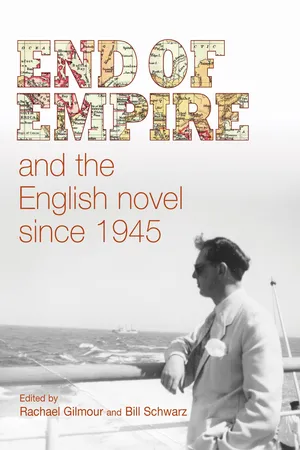
eBook - ePub
End of empire and the English novel since 1945
- 244 pages
- English
- ePUB (mobile friendly)
- Available on iOS & Android
eBook - ePub
End of empire and the English novel since 1945
About this book
Information
Publisher
Manchester University PressYear
2015Print ISBN
9780719097454
9780719085789
eBook ISBN
9781784991791
1
The road to Airstrip One: Anglo-American attitudes in the English fiction of mid-century
Patrick Parrinder
Far from being a time of dramatic change in the novel, as 1750 and 1850 had been, the year 1950 in Britain shows all the signs of cultural exhaustion. The journals Horizon, Penguin New Writing and World Review all ceased publication, with the editor of Horizon, Cyril Connolly, firing a memorable parting shot in the final double number (December 1949–January 1950): ‘It is closing time in the gardens of the West.’ The June 1950 issue of World Review was a tribute to George Orwell, who had died five months earlier at the age of forty-seven. Much of this special number was given over to Orwell’s unpublished notebooks from 1940–41, in which he commented on the progress of the second world war from Dunkirk to the German occupation of the Ukraine. In 1950 the aftermath of war was everywhere, both in literature – novels set in wartime London included Elizabeth Bowen’s The Heat of the Day (1949) and Graham Greene’s The End of the Affair (1951) – and in everyday life. Postwar austerity under the Attlee government included military conscription, food rationing, import restrictions, and a state petrol monopoly. Children who had never seen a fresh banana were brought up on cod liver oil and National Health Service orange juice.
Orwell’s Nineteen Eighty-Four (1949) portrays a terrifying future which is, nevertheless, full of echoes of postwar London. As he enters Victory Mansions on the novel’s opening page, Winston Smith immediately notices the smell of ‘boiled cabbage and old rag mats’ in the communal hallway.1 He drinks Victory Gin (evidently a state brand), smokes government cigarettes and struggles to shave with a blunt razor-blade. Everything except political propaganda is in short supply. Orwell’s satirical exaggerations have a real basis, as do the geopolitics of Nineteen Eighty-Four. The bomber squadrons of the US Strategic Air Command had returned to Europe in 1947, and the North Atlantic Treaty was signed in Washington in the spring of 1949.2 This no doubt is why Orwell makes Britain the forward base of Oceania, suitably renamed as Airstrip One. War between the three great power blocs of Oceania, Eurasia and Eastasia is incessant in Orwell’s novel, though for the most part remote from the metropolitan centres. The Korean war of 1950–53 was very much the kind of conflict he had envisaged.
Nineteen Eighty-Four is a story not just of ideological tyranny but of national humiliation and defeat. Historical memory has been crushed, and the familiar English language is being systematically eradicated. The currency of Airstrip One is no longer the pound sterling but the dollar. Nevertheless London, so far as we can tell, is still the centre of government (dominated by its three huge ministry buildings), and America and Americans are entirely absent. The ruling doctrine is Ingsoc (‘English Socialism’), while Big Brother is far more reminiscent of ‘Uncle Joe’ Stalin than of Uncle Sam. It is hard to say whether this absence of anything directly connected with the United States (apart from the dollar) from Orwell’s satirical targets is deliberate, or whether it results from an unconscious refusal to grasp the full implications of Britain’s diminishing place in the world. At all events, Nineteen Eighty-Four is remarkably Anglocentric, even though the novel’s worldwide fame might suggest otherwise. Its combination of local setting with universal relevance aligns Orwell’s vision of a totalitarian future both with earlier British disaster fiction – most notably H.G. Wells’s The War of the Worlds (1898) – and with such contemporary works as John Wyndham’s The Day of the Triffids (1951).
The ‘shrinking island’ thesis
Not all English novelists of the mid-century restricted themselves to the local. In Graham Greene’s oeuvre, for example, The End of the Affair was preceded by The Heart of the Matter (1948) set in West Africa and by the screenplay for The Third Man (1949) located in divided Vienna. Greene’s pursuit of international perspectives would be continued in his Vietnamese novel The Quiet American (1955), to be discussed below. Similarly, C.P. Snow’s The Masters (1951) seems at first sight to reduce the whole of political life to the narrow confines of a Cambridge college; but Snow’s portrait of an academic microcosm forms part of a long novel-sequence tackling major historical themes including the development of atomic weapons and the co-option of scientific research into the defence and security establishment during the cold war.3 Perhaps more representative of the time, however, is the insularity of William Cooper’s Scenes from Provincial Life (1950), the story of a young physics teacher in an unnamed Midlands town which would influence writers as diverse as Kingsley Amis, John Braine, Alan Sillitoe, David Storey and John Wain. What appealed to Cooper’s contemporaries was his quietly comic first-person narrative with its rejection of modernist experiment in favour of a more traditional, plain style of storytelling; nothing could be further removed from the complicated time-schemes and intricate theological ironies of Greene’s best fiction.
In 1961, in a Sunday Times review of the Penguin edition of Cooper’s novel, John Braine – by now the bestselling author of the equally insular Room at the Top (1957) – contrasted the impact of Greene and Cooper in the preceding decade:
We hear a great deal about Greeneland now, and I don’t deny its importance, I don’t deny the appalling grandeur of its spiritual vistas. I lived there once myself; but since 1950, when I discovered Scenes from Provincial Life, I prefer the Cooper country.4
What Braine was discovering in 1950 could be expressed in the terms put forward by Jed Esty in 2004 in his A Shrinking Island: Modernism and National Culture in England as a ‘resurgent concept of national culture’, whose ‘insular integrity’ more than made up for its plain, even humdrum, mode of expression.5 Esty, whose title alludes to Hugh Kenner’s 1988 A Sinking Island: The Modern English Writers, sees the Anglocentricity of modern English writing as at once a reflection and a denial of the long decline in British power which began with the first world war. He is especially concerned with the work of writers from the Bloomsbury Group to the 1960s New Left who portrayed an England that was ‘self-consciously historical, even antiquarian’ – an England that, thanks to a reversal of the traditional ethnographic preoccupation with the exotic, could function as a ‘symbolic replacement for its colonies’.6 Both cultural analysis and the sense of the picturesque were turned inwards, so that ‘England’, having lost its status as the all-conquering heart of empire, became potentially (if not actually) a centre of resistance against the forces of metropolitan modernity. The same broad process, according to Esty, links the pageant plays of E.M. Forster and the visionary fiction of John Cowper Powys in the 1930s to the rise of academic cultural studies two decades later. The emotional and spiritual force of this new Anglocentricity is captured in T.S. Eliot’s Little Gidding (1942) with its conception of history as ‘a pattern/Of timeless moments’, yielding the revelation that ‘On a winter’s afternoon, in a secluded chapel/History is now and England’.7
Nineteen Eighty-Four offers a crushing reply to such aspirations for national cultural resurgence, yet Orwell’s novel has its own kind of Anglocentricity, as we have seen. When towards the end of A Shrinking Island Esty divides twentieth-century British writers and intellectuals into two camps – those who ‘take imperial decline to imply some sort of national revival’, and those, ‘typically associated with the ebb of British power’, who ‘take imperial decline to imply national decline’ – with Greene, Orwell and Evelyn Waugh in the second category – the oversimplification is manifest.8 Representations of national decline at mid-century are as intricate, and often as ambiguous, as are the visions of national and provincial self-sufficiency. Sometimes the two are combined.
For example, Cooper’s Scenes from Provincial Life looks back to the spring and summer of 1939 when the narrator, Joe Lunn, and his best friend Tom were convinced that British democracy was on the verge of collapse. They have no confidence in the Chamberlain government and spend much of their time making ineffectual plans to emigrate to the United States. These plans are quickly abandoned when Britain at last declares war on Germany. In a final chapter significantly called ‘Provincial life-histories’, Joe reveals that Tom did eventually get to America on a wartime diplomatic mission, and decided to stay on after the war. This leads to the following tight-lipped comment: ‘In America Tom found a limitless field for his bustling bombinations, spiritual, emotional and geographical.’9 Joe’s disenchantment with both Tom and the United States corresponds to his belated discovery of the value of the provincial life he found so irksome in 1939. Once instinctively pro-American, he is now instinctively anti-American. Maturity has turned him into the first of the typically English heroes of the 1950s, chippy, resentful and small-minded.
Seen from the ‘Cooper country’, America is the new metropolis, a land of failed promise and a suitable destination for the big-headed and over-ambitious. But William Cooper was not Joe Lunn; nor, for that matter, was he ‘William Cooper’, since he had earlier published several novels under his real name, H.S. Hoff. While Hoff’s own background is a little uncertain – he was born in Crewe and baptised as an Anglican – it is notable that Tom, an active bisexual who is first introduced to the reader as ‘red-haired and Jewish – it fairly knocked you down’, is always an outsider in the provincial milieu where Joe Lunn will eventually settle down.10 Since Joe plays the straight man (more or less) to the outrageous Tom, it seems reasonable to speculate that Tom too is a self-projection, a version of ‘Harry Hoff’ where Joe is a version of ‘William Cooper’. What is clear, at least, is that a novel which at first sight seems a perfect expression of Esty’s ‘shrinking island’ thesis is less straightforward than it looks. One aspect firmly linking it to other novels of its time is its exploration of English provincial identity in relation to the cultural pressure of the United States, now acknowledged as Britain’s imperial successor.
‘The U.S.A. Threat to British Culture’
In 1951, the year of the dying Labour government’s Festival of Britain, the Communist Party, not to be outdone, staged its own one-day national festival: a conference at Holborn Hall on 29 April devoted to ‘The U.S.A. Threat to British Culture’. The proceedings, together with essays by the American radicals W.E.B. DuBois and Howard Fast, were immediately printed in the Party journal Arena. The contributions range from Diana Sinnot on ‘Our historical tradition’ and E.P. Thompson on ‘William Morris and the moral issues to-day’ to pieces on newspapers, film, and ‘Children’s reading’ – a diatribe against American comics. A prefatory note (presumably by Arena’s editor Jack Lindsay) clarifies that ‘the threat comes from the reactionary elements now dominant in U.S.A. society, and there is no question of an attack on American culture as such’. The enemy is not ‘the U.S.A. common man’, but ‘the synthetic imperialist culture of the State, coldly and cynically devised for the debasement of man’.11 Moreover, as E.P. Thompson (who would leave the Communist Party in 1956) tells his readers, US imperialist culture has its ‘British apologists’, such as T.S. Eliot and George Orwell.12
This was the height of the McCarthy period as well as the cold war, so that British Communists had particular reasons for detesting the ‘American threat’. Their arguments were framed in the populist terms of a defence of national autonomy, not primarily as a commitment to the socialist societies of China and the Soviet Union. The Party’s election manifesto at this time was The British Road to Socialism. As Sam Aaronovitch put it in h...
Table of contents
- Cover
- Half Title Page
- Title Page
- Copyright Page
- Contents
- Acknowledgements
- Contributors
- Introduction: End of empire and the English novel
- 1 The road to Airstrip One: Anglo-American attitudes in the English fiction of mid-century
- 2 Josephine Tey and her descendants: conservative modernity and the female crime novel
- 3 Colonial fiction for liberal readers: John Masters and the Savage family saga
- 4 The entropy of Englishness: reading empire’s absence in the novels of William Golding
- 5 The empire of romance: love in a postcolonial climate
- 6 Passage from Kinjanja to Pimlico: William Boyd’s comedy of imperial decline
- 7 Unlearning empire: Penelope Lively’s Moon Tiger
- 8 ‘I am not the British Isles on two legs’: travel fiction and travelling fiction from D.H. Lawrence to Tim Parks
- 9 Queer histories and postcolonial intimacies in Alan Hollinghurst’s The Line of Beauty
- 10 The return of the native: Pat Barker, David Peace and the regional novel after empire
- 11 Saturday’s Enlightenment
- Afterword: The English novel and the world
Trusted by 375,005 students
Access to over 1.5 million titles for a fair monthly price.
Study more efficiently using our study tools.
Frequently asked questions
Yes, you can cancel anytime from the Subscription tab in your account settings on the Perlego website. Your subscription will stay active until the end of your current billing period. Learn how to cancel your subscription
No, books cannot be downloaded as external files, such as PDFs, for use outside of Perlego. However, you can download books within the Perlego app for offline reading on mobile or tablet. Learn how to download books offline
Perlego offers two plans: Essential and Complete
- Essential is ideal for learners and professionals who enjoy exploring a wide range of subjects. Access the Essential Library with 800,000+ trusted titles and best-sellers across business, personal growth, and the humanities. Includes unlimited reading time and Standard Read Aloud voice.
- Complete: Perfect for advanced learners and researchers needing full, unrestricted access. Unlock 1.5M+ books across hundreds of subjects, including academic and specialized titles. The Complete Plan also includes advanced features like Premium Read Aloud and Research Assistant.
We are an online textbook subscription service, where you can get access to an entire online library for less than the price of a single book per month. With over 1.5 million books across 990+ topics, we’ve got you covered! Learn about our mission
Look out for the read-aloud symbol on your next book to see if you can listen to it. The read-aloud tool reads text aloud for you, highlighting the text as it is being read. You can pause it, speed it up and slow it down. Learn more about Read Aloud
Yes! You can use the Perlego app on both iOS and Android devices to read anytime, anywhere — even offline. Perfect for commutes or when you’re on the go.
Please note we cannot support devices running on iOS 13 and Android 7 or earlier. Learn more about using the app
Please note we cannot support devices running on iOS 13 and Android 7 or earlier. Learn more about using the app
Yes, you can access End of empire and the English novel since 1945 by Rachael Gilmour,Bill Schwarz,Bill Schwarz, Rachael Gilmour, Bill Schwarz in PDF and/or ePUB format, as well as other popular books in Literature & Social History. We have over 1.5 million books available in our catalogue for you to explore.