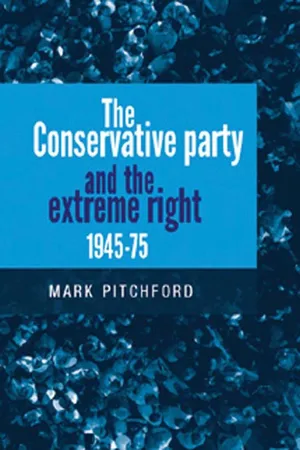
This book reveals the Conservative Party's relationship with the extreme right between 1945 and 1975. For the first time, this book shows how the Conservative Party, realising that its well known pre-Second World War connections with the extreme right were now embarrassing, used its bureaucracy to implement a policy of investigating extreme right groups and taking action to minimise their chances of success.
The book focuses on the Conservative Party's investigation of right-wing groups, and shows how its perception of their nature determined the party bureaucracy's response. The book draws a comparison between the Conservative Party machine's negative attitude towards the extreme right and its support for progressive groups. It concludes that the Conservative Party acted as a persistent block to the external extreme right in a number of ways, and that the Party bureaucracy persistently denied the extreme right within the party assistance, access to funds, and representation within party organisations. It reaches a climax with the formulation of 'plan' threatening its own candidate if he failed to remove the extreme right from the Conservative Monday Club.
- 248 pages
- English
- ePUB (mobile friendly)
- Available on iOS & Android
eBook - ePub
The Conservative Party and the extreme right 1945–1975
About this book
Information
Publisher
Manchester University PressYear
2013Print ISBN
9780719096730
9780719083631
eBook ISBN
9781847797889
1
The shock of opposition, 1945–51
A right response to defeat?
The Conservative Party entered the 1945 General Election suspicious of its leaders and split over social policy. The direction of Party policy was uncertain, with the Tory Reform Group, Progress Trust, Imperial Group, and numerous smaller bodies fighting for predominance in a party with a moribund and bankrupt machine. The progressive Tory Reform Committee had already welcomed publication of the Beveridge Report advocating extensive social reform, but right-wing Conservatives had attacked it, noticeably in publications connected with the extreme right such as the National Review and Truth. The right of the party relished the opportunity to end the wartime coalition with Labour. At the party conference in March 1945, Sir Herbert Williams MP spoke of being free of the coalition’s chains. Churchill’s conference address, on the other hand, suggested a desire to maintain the coalition, and even including in it MPs who had defeated Conservative candidates. Despite Churchill’s desire, there was a genuine expectation of an outright Conservative victory. Conservative MP Christopher Hollis, writing in the New English Review, wrote that, ‘nobody seriously thinks that the Labour Party have any chance of gaining a clear majority at the election’.1 Hollis had precedent on his side. Victorious wartime Prime Ministers had won in 1900 and 1918. On polling day, the Conservative-supporting Daily Express announced, ‘we are winning’, and some regional Conservative-inclined newspapers stated belief in a three-figure majority. However, the Labour Party won such a majority. The Conservative Party was profoundly shocked not only over the electorate’s rejection of it, but at the scale of defeat and the size of Britain’s first majority Labour administration. Some Conservatives even feared permanent loss of office, a feeling strengthened by their Party’s inability to win a single seat in by-elections during the period 1945–50, despite fuel and sterling crises, and continuing rationing.
There were a number of reasons for Labour’s stunning victory. After the First World War, the government had promised a land ‘fit for heroes’. This promise remained unfulfilled due to the Depression of the later 1920s and 1930s. The Labour Party offered a coherent programme to implement this promise in 1945, and the electorate voted for it. The Labour leadership had made a significant contribution to the war effort, especially in domestic affairs where they implemented state controls to ensure that the economy endured and funded the massive demands of the war effort. Their actions meant that the Labour Party’s opponents could not portray them as an inexperienced, unpatriotic party that was unfit for government, which Churchill discovered to his cost during the General Election when his comparison of the Labour Party to the Gestapo brought widespread condemnation. Instead, the electorate saw in the Labour Party the possibility of a better future.
In contrast, the electorate in 1945 viewed the Conservative Party’s actions before the Second World War negatively. Economic depression had blighted the inter-war period and led to the formation of a coalition National Government. High unemployment had affected many voters and their families. The Conservative Party leadership’s alleged doctrinaire adherence to the prevailing policy of laissez-faire exacerbated the hardship many electors had suffered. Laissez-faire ruled out state intervention in favour of free trade, but also meant the acceptance of high unemployment until market forces readjusted the economy. Associating this policy with the Conservative Party alone was arguably unfair because, although there was a strand within Conservatism that advocated laissez-faire, the most prominent exponent of it during Ramsay MacDonald’s National Government was in fact the Labour Chancellor Phillip Snowden. However, three factors ensured that the electorate associated their economic hardship with the Conservative Party. First, the Conservative Party governed for much of the inter-war period, either in administrations that were wholly Conservative or in coalitions that they dominated. Secondly, the Conservative Neville Chamberlain replaced Snowden as Chancellor in 1931, and although he moved away from strict laissez-faire, his equally doctrinaire adherence to balanced budgets meant the continuing acceptance of existing high levels of unemployment rather than the adoption of deficit financing to reduce it. Thirdly, Chamberlain introduced the ‘Means Test’ in 1931, a policy that was more understandable to the electorate than debates over economic policies. The Means Test disproportionately harmed the poorest. It resulted in the electorate viewing the Conservatives as the hard-faced men of the inter-war slump, callously disregarding their hardship and prepared to see individuals face the iniquity of National Assistance interviews rather than provide adequate social security. Similarly affecting the electorate’s image of the Conservative Party in 1945 was the pre-war policy of appeasement. In 1938, Chamberlain had signed the Munich Agreement that abandoned Czechoslovakia in return for a promise of peace between Britain and Hitler’s Germany. Leading Conservatives had fully supported Chamberlain. Dissidents like Churchill were very much in the minority within the Conservative Party. Although people joyfully welcomed Chamberlain’s announcement that the Munich Agreement meant ‘peace in our time’, the Second World War altered their view. By 1945, people viewed Chamberlain as Hitler’s dupe, and possibly even someone who was prepared to pander to fascism.
In the 1945 General Election, the electorate rejected a Conservative Party tainted by indifference to economic hardship and appeasement of the country’s enemies. The former was a charge of callousness, which meant that it would be difficult for the Conservative Party leadership to advocate policies that could lead to high unemployment, no matter how many Conservatives favoured it. The latter was a charge that bordered on treachery, which was particularly difficult for the Conservative Party in 1945. In Europe, the right was associated with fascism. The Conservative Party was Britain’s right-wing party, and it had clear connections with the extreme right and even fascism before the Second World War. Connections with any group or individual deemed ‘extreme right’ were no longer tolerable, and no Conservative leader could take Baldwin’s sanguine attitude to them.2 Consequently, the Conservative leadership did what it usually did when confronted by a new paradigm, and adapted. There is evidence that the Conservative leadership understood the need to adapt and counter the party’s inter-war image even before the Second World War ended. It set up the Post-War Problems Central Committee (PWPCC) in 1941. It was to the PWPCC that the Tory Reform Committee and Tory Reform Group advocated state interventionism. In addition, Central Office tasked one of its existing bodies with investigating outside organisations.3 After the war, the Conservative leadership openly implemented a policy review that moved significantly away from its inter-war stance and accepted much of the Labour programme. Behind the scenes, the leadership strengthened the party bureaucracy. This bureaucracy put the job of investigating those extreme-right groups and individuals that could damage the leadership’s objectives on a more formal basis. In the period 1945–51, it monitored the extreme right and took whatever action it saw fit. Those whose extremism Central Office considered merely inexpedient attracted minimal action, but those it associated in any way with fascism received harsher attention.
Conservative reaction to Attlee’s first government and re-emerging Fascism
The Conservative Party’s public response to the 1945 General Election defeat was a thorough policy review that culminated in the Industrial Charter and Maxwell-Fyfe Report. The Industrial Charter emphasised traditional Conservative themes, but also accepted some nationalisation and an increased role for the state. Many Conservatives welcomed the charter, but the Conservative right thought that it was too much of a step towards Socialism. Right-wing Conservative publications ran articles with headlines such as ‘Under Which Flag’, ‘Has Anyone Heard of Capitalism?’ and ‘The Milk-and-Water Charter’, with journals such as Truth and National Review prominent in this criticism. The left claimed that the charter would result in the Tory Party’s worse split for half a century, and the right agreed. The grounds on which right-wing Conservative MPs attacked the charter on its presentation at the 1947 Party Conference is instructive why it caused a problem. Sir Waldron Smithers informed conference that the charter was a threat not only to the Conservative Party, but also to Great Britain, as it represented an inordinate concession to Socialism at a time when Communism in the Soviet Union appeared the more vigorous ideology. The language he employed was unambiguous and emotive: ‘There can be no compromise with Socialism or Communism. You must not let the Conservative Party become infected with the Socialist bug. The Conservative Party must stick to its principles or perish.’4 Sir Waldron Smithers told delegates to have no fear of Central Office or the party platform, and to save the Conservative Party and England by rejecting the Charter. Smithers wished the Conservative Party to maintain its pre-war laissez faire stance. One commentator thought that at least half the conference supported these views.5 The Party’s right wing, however, suffered an overwhelming defeat at conference. Hoffman described this as the ‘rout of the right’, explaining that this was because virtually nobody at conference wished to be linked with a doctrine that was associated with the pre-war period and that was now ‘out of keeping with the spirit of the times’.6
Nor was the Conservative Party’s conversion limited to domestic issues. Virtually nobody in Whitehall saw the imminent collapse of the Empire in 1945. For many, there was little suggesting anything other than imperial continuance. The British Empire had proved its ability to endure. It had stood alone in 1940 and remained intact while Nazism and Fascism collapsed. The number of civil servants that departed annually for the colonies trebled after the Second World War. Only Keynes foresaw the possible consequences for the Empire of Britain’s severe economic problems. Nobody actually wanted the end of Empire, other than the anti-colonial left. Instead, there were expectations of a new, reinvigorated empire. Indian independence may have been a foregone conclusion, but many, including Labour Foreign Secretary Ernest Bevin, sought a viable replacement. Expectations focused on creating a revitalised oil and mineral-rich imperial dispensation stretching from Cape Town to Iraq, with Africa identified as the new jewel in the Crown. Academics described it as a fourth empire arising out of the debris of the third. This was collective political delusion. Britain was unable to withstand the wave of post-war nationalism because it was economically overstretched. Thus, the impact was great when Transjordan (1946), Burma (1948), Ceylon (1948), and Palestine (1948) accompanied Indian Independence, and revealed the impotence of Britain’s imperial ambitions. Nowhere was this impotence more obvious than in the Conservative Opposition’s response. Churchill, hero of the Boer War and a staunch imperialist who consistently opposed Indian Independence before the Second World War, did nothing to obstruct the Indian Independence Bill (1947). Sir Herbert Williams complained about his party’s failure to even vote against the bill, but could do little else. Conservative Associations protested, but their calls for the party to do more to prevent the disintegration of the Empire went unanswered. One young right-wing researcher at the Conservative Research Department later recalled feeling unable to do anything other than bury his head in his hands.
Shock at the size of the 1945 defeat only partly explained this picture of a lacklustre Conservative Opposition. The Conservative Party under Lord Salisbury, facing the demands of extended suffrage in the late nineteenth century, had realigned itself to attract lower-middle and working-class votes. Thereafter, imperialism remained at the heart of Conservatism, contributing to electoral success. Doubtless, there were many right-wing Conservative voters in 1945 who were disgusted at the result. Perhaps, therefore, imperialism could perform a similar role in the mid-twentieth century to win the working class back from Labour. However, the impact of the 1945 General Election was not simply a matter of scale, as Alan Clark noted. Many right-wing Conservative MPs had lost their seats. Progressives now dominated the parliamentary party, determined to avoid connection with any embarrassments of the past. One progressive even advocated the Conservative Party changing its name to the ‘New Democratic Party’. What was left of the right wing of the parliamentary party was unable, therefore, to impose their views on their colleagues, hence lacklustre opposition. This explains why there were only a limited number of clashes within the parliamentary Conservative Party over decolonisation. Very few MPs actually disagreed with it. Unlike domestic policy, therefore, this conversion would be more difficult to reverse. The election result was the real ‘rout of the right’.
Yet, this image of an ineffective right within a demoralised Conservative Party is not the whole picture. The right was sufficiently strong to propose resolutions at the party conference expressing its dissatisfaction at the lacklustre attack on the Labour Government. The chosen motion was heavily defeated, but it indicated that a repository for such views still existed. Individual Conservative MPs openly attacked their party’s ineffective opposition in the New English Review. There were even instances of rebellion against the frontbench when the right thought a bill was ‘bad socialist business which should be fought every inch of the way’.7 Moreover, the notion that the Charter’s acceptance signalled the complete collapse of the right was misleading. When the leadership responded to unfilled expectations of victory at the 1949 Hammersmith South by-election by issuing a revised policy statement, The Right Road for Britain, the Daily Express, the Spectator, and Truth carried articles attacking it for failing to move sufficiently rightwards. This also meant that the Conservative Party was presenting a confusing message to those holding extreme-right views or antecedents, whether in the Conservative Party or not. On the one hand, the leadership and even some MPs appeared to be appeasing Socialism. This was evident in the view of one MP responsible for drawing up the Charter, who believed that government was impossible if trade unions were hostile. On the other hand, a body of opinion and representation existed within the Conservative Party that was fundamentally at odds with this position. Individuals and groups opposed to the latter message had to make a choice of whether to act within the party or not. Some fought from within, while others formed outside pressure groups.
There is strong evidence that pre-war consanguinity between some Conservatives and erstwhile fascists continued. The circumstances in which a British Union of Fascists (BUF) leader could claim that thirty MPs and twelve peers were ready to declare themselves Fascists may have gone, but former BUF member Arthur Winn revealed in the Daily Mirror that he intended to vote Conservative in the 1945 General Election. The reason Winn gave was that the Conservatives would allow him, and presumably those like him, to ‘get away with more than we could with any other party’.8 The Daily Mirror reported that ex-BUF members’ first move after the war was to ‘throw themselves and their organisation on the side of the Tory Party’.9 One local paper even argued that Mosley was reforming his organisation to ‘keep Toryism alive’.10 Dorril highlighted this consanguinity by recounting Mosley’s interest in an ‘anti-alien’ campaign in Hampstead in 1945,11 where the Conservative MP, Charles Challen, had organised a petition against Jewish residents. Dorril described Challen’s petition as owing much to an organisation called the Fighting Fund for Freedom (FFF), led by the Conservative MP Sir Waldron Smithers, and intersecting with a similar, national campaign led by the Briton’s Vigilante Action League (BVAL), which Lord Kemsley funded. Advising Kemsley was former editor of Truth Sir Henry Newnham. Dorril noted that Conservative parliamentary candidate Eleonora Tennant was having meetings with Jeffrey Hamm during which they discussed their mutual anti-Semitism. Hamm was an ex-BUF internee and was instrumental in Mosley’s return to politics at the head of Union Movement. These events occurred at the same time, according to Mosley, that friends tried to secure his return to the Conservative fold.
The radical right, in the shape of the British People’s Party (BPP), also exhibited anti-Semitism, a fear of communism, and support for Franco, similar to Conservative MPs. The BPP’s importance lay partly in its survival of the war intact, despite the internment of its leading political figure, John Beckett. However, the BPP also had a pre-war connection with the Conservative Party via Beckett’s association with Lord Lymington in the British Council against European Commitments (BCAEC), which linked it with a number of other extreme-right groups containing Conservatives.12 Beckett’s membership of the British Council for a Christian Settlement in Europe also linked the BPP with the anti-war faction in the Conservative Party. Linking Beckett personally with the Conservative Party was his friendship with Henry Newnham. However, the strongest revelation of the BPP’s concordance with some Conservatives was in its regular post-war publications. The Duke of Bedford funded these publications, and sometimes used them personally to attack Jews, albeit using euphemistic language such as ‘international finance’ to do so. One regular BPP publication, the Fleet Street Preview, provided a mine of language that would not have been out of place coming from Sir Waldron Smithers, Charles Challen, Eleonora Tennant and many pre- and post-war Conservatives. This journal lauded Franco for being correct in ‘exposing the true nature of the undeviating aims of Stalin and his coterie’, and compared the silence of others over Stalin’s actions to the outcry over Nazi atrocities.13 It described immigrants as a ‘foreign invasion’ coming from the ‘refuse of Europe’, and as ‘trash’, ‘alien’, and ‘poison’, frequently juxtaposing them with references to ‘true-born Englishmen’.14 These comments were similar to those raised by Conservative MPs after the disembarkation of the Empire Windrush brought New Commonwealth immigrants to Britain. The Fleet Street Preview also stated that unions were ‘holding the country to ransom with impunity’, and denounced their members as ‘oblivious to anybody’s welfare but their own’,15 views that closely resembled Sir Waldron Smithers’ denunciation of the Conservative Party’s surrender to the left, Save England. The Fleet Street Preview also implicitly supported a Conservative MP’s proposal that a prospective parliamentary candidate disclose his place of birth, and criticised the Conservative Party for failing to expose the Labour Government’s shortcomings sufficiently, and for its poor performance at the Hammersmith South by-election.16
What can we conclude from this evidence? There is clear consanguinity between the right wing of the Conservative Party and the external extreme right, which extended to connections between a long-standing extreme-right Conservative publication, non-parliamentary groups and even pre-war fascists. It is also fair to surmise that electors holding similar views to former BUF members probably considered that the Conservative Party was the best pl...
Table of contents
- Front Cover
- Title Page
- Copyright Page
- Contents
- Abbreviations
- Preface
- Introduction
- 1 The shock of opposition, 1945–51
- 2 Consensus Conservatism and extreme-right revival, 1951–57
- 3 Macmillan and Home: ‘pink socialism’ and ‘true-blue’ Conservatism, 1957–64
- 4 Edward Heath: a rightwards turn and the coalescence of the extreme right, 1964–70
- 5 ‘Heathco’ meets the extreme-right’s challenge, 1970–75
- Conclusion: keeping it right
- Bibliography
- Index
Trusted by 375,005 students
Access to over 1.5 million titles for a fair monthly price.
Study more efficiently using our study tools.
Frequently asked questions
Yes, you can cancel anytime from the Subscription tab in your account settings on the Perlego website. Your subscription will stay active until the end of your current billing period. Learn how to cancel your subscription
No, books cannot be downloaded as external files, such as PDFs, for use outside of Perlego. However, you can download books within the Perlego app for offline reading on mobile or tablet. Learn how to download books offline
Perlego offers two plans: Essential and Complete
- Essential is ideal for learners and professionals who enjoy exploring a wide range of subjects. Access the Essential Library with 800,000+ trusted titles and best-sellers across business, personal growth, and the humanities. Includes unlimited reading time and Standard Read Aloud voice.
- Complete: Perfect for advanced learners and researchers needing full, unrestricted access. Unlock 1.5M+ books across hundreds of subjects, including academic and specialized titles. The Complete Plan also includes advanced features like Premium Read Aloud and Research Assistant.
We are an online textbook subscription service, where you can get access to an entire online library for less than the price of a single book per month. With over 1.5 million books across 990+ topics, we’ve got you covered! Learn about our mission
Look out for the read-aloud symbol on your next book to see if you can listen to it. The read-aloud tool reads text aloud for you, highlighting the text as it is being read. You can pause it, speed it up and slow it down. Learn more about Read Aloud
Yes! You can use the Perlego app on both iOS and Android devices to read anytime, anywhere — even offline. Perfect for commutes or when you’re on the go.
Please note we cannot support devices running on iOS 13 and Android 7 or earlier. Learn more about using the app
Please note we cannot support devices running on iOS 13 and Android 7 or earlier. Learn more about using the app
Yes, you can access The Conservative Party and the extreme right 1945–1975 by Mark Pitchford in PDF and/or ePUB format, as well as other popular books in Politics & International Relations & Politics. We have over 1.5 million books available in our catalogue for you to explore.