- 230 pages
- English
- ePUB (mobile friendly)
- Available on iOS & Android
eBook - ePub
About this book
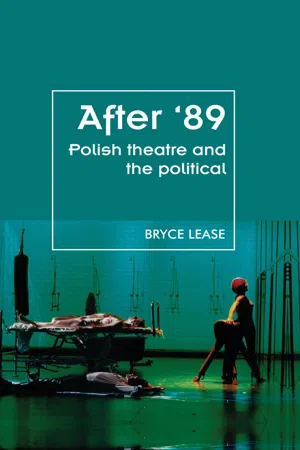
After '89 takes as its subject the dynamic new range of performance practices that have been developed since the demise of communism in the flourishing theatrical landscape of Poland. After 1989, the theatre has retained its historical role as the crucial space for debating and interrogating cultural and political identities. Providing access to scholarship and criticism not readily accessible to an English-speaking readership, this study surveys the rebirth of the theatre as a site of public intervention and social criticism since the establishment of democracy and the proliferation of theatre makers that have flaunted cultural commonplaces and begged new questions of Polish culture. Lease argues that the most significant change in performance practice after 1989 has been from opposition to the state to a more pluralistic practice that engages with marginalized identities purposefully left out of the rhetoric of freedom and independence.
Information
Publisher
Manchester University PressYear
2016Print ISBN
9781526139542
9781784992958
eBook ISBN
9781526101051
Subtopic
Television1
The move to neoliberalism
The collapse of communist regimes in Eastern and Central Europe, the so-called ‘velvet revolution,’ unfolded quickly and superseded the political dreams of most dissidents. In 1989, General Jaruzelski initiated the famous Round Table Talks that resulted in the first partially free elections in Poland since the interwar period in the 1930s. Jaruzelski’s motivation for these talks was a response to growing social unrest and workers’ strikes. When Solidarity, which became a legal and legitimate political party after the Round Table Agreement, agreed to the snap elections in June 1989 Jaruzelski hoped they would shoulder the burden of the economic disaster. Although the elections were only partially free – Solidarity was only allowed to contest 35 percent of the seats in the lower house of Parliament – the electorate overwhelmingly sided with Solidarity with most of the Communists losing their seats. With the governing authority in disarray and the Solidarity party refusing to join forces with a Communist coalition, Solidarity found itself leading the government of Poland in September 1989. The rapid and intoxicating success of this political transformation left many theatre artists feeling disorientated and bewildered. On the one hand, many artists had built their practice around the explicit or implied critique of the communist regime, largely restricted to the alternative theatre scenes, while others, who had worked within the professional sphere, were subordinated to the communist authorities and the censorship of the state. Across this deeply complex spectrum from dissidence to conformity, the situation for theatre artists working within free-market capitalism changed drastically and suddenly. Many theatres struggled to maintain their former structures, despite a loss in prestige and funding. Eleanora Udalska pinpointed an attendant transformation in audience demographics. The disappearance of the so-called ‘artificial’ spectator, who was introduced to the theatre through her trade union, was accompanied by the undermining of the ‘real’ spectator, those who chose to attend for their own personal or political convictions, largely because theatre performances in the PRL constituted a significant place to stay in touch with free thought (Udalska, 1997: 167). Intellectualism was and remains today a key referent in discussing spectatorship in Poland. Audiences are often concerned with they perceive as ‘intellectual spectating,’ which the director and dramaturge Bartosz Frąckowiak sees as a ‘cognitive integrity, a curiosity about the world that is not overly concerned with superficial, everyday observations’ (cited in Gruszczyński, 2012). Losing its unique mission to speak on behalf of society and express its ideals, the theatre no longer appeared to be a ‘stronghold of freedom’ (Udalska, 1997: 168). There was indeed a moment of profound hesitation in response to the unfixing of values and the monumental changes occurring in politics, the economy, culture and society that followed political transformation. It took nearly a decade to reconstitute the theatre as a bastion for democracy and pluralism, which required the abandonment and mourning of precisely such a singular articulation of society that was crucial to experiences of spectating before 1989.
The first few years of the 1990s were defined by cultural dislocation and disequilibrium. State-funded theatres quickly lost audiences to cinema and television, VCRs and, for the wealthy elite, a burgeoning restaurant culture and travel industry that quickly exploited previously closed borders. Theatre in Poland before independence was suffused with a relentlessly political agenda where audiences found crucial relevance in decoding theatrical allusions to oppression and marginalization entrenched in director-led productions, where stage semiotics often frustrated state censorship. In the early part of the 1990s, cultural life unhampered by political subjugation also had a detrimental impact on audience attendance, given the theatre’s former role as the locus of national identification, collective gathering and critique of the communist regime. Following Western models, many theatres changed their repertoires to more commercially viable, entertainment-oriented fare. Independence made such a dramatic shift in the cultural landscape that it took several years for the professional theatres to develop an appropriate language to address the new reality.
Shock therapy
In the 1990s, the ‘shock therapy’ of the transformation to neoliberalism resulted in economic devastation, the rise of mass unemployment, growth in social inequality and severe cuts in state expenditure. No meaningful alternative to this political system has been presented and, as political economist Stuart Shields has argued, ‘both opposition and former state-socialist social forces have been co-opted into reproducing neoliberalism’ (2007: 161). Buttressing this system against critique, successive Polish governments denigrated cultures of labor and the working classes, which Michael Fleming suggests is the ‘flip side of the promotion of discourses of individualism and responsibilization’ (2012: 489). This position is further sharpened by the pejorative ideological associations of the working classes with the former communist regimes. The result of this has been the representation of Polish workers in mainstream media and politics as parochial, unchanging, old-fashioned and, perhaps even worse, incapable of garnering the skills necessary for labor in a market-focused economy. The West’s belief that the invention of neoliberalism would easily accommodate political transition in postcommunist countries was reliant on a simplistic formulation in which the free exchange of commodities would logically provoke individual self-interest that would ultimately produce a middle class who would demand civil rights and vote for governments that facilitate ‘trade, prosperity, freedom and growth’ (Don Kalb cited in Hann, 2002: 321). This prescription also neglects the particular ways in which vulnerable postcommunist countries were quickly manipulated by Western capitalist investment.
Geographers Michael J. Bradshaw and Alison Stenning observe two primary modes in which this was a misguided belief. First, there is not a singular articulation of capitalism. The relation between capital and labor is culturally bounded and regulated through a broad set of social relations, and, second, really existing capitalism is historically contingent and resistance to its ascendancy is culturally inflected by the terms of its historical evolution (2004: 3–23). In short, just like communism, capitalism is not self-evident nor is it straightforward; unlike communism, its success is dependent upon the marginalization of the working classes. Neoliberalism can be broadly defined as the ‘mobilization of state power in the contradictory extension and reproduction of market(-like) rule,’ which indicates that there is no ‘pure’ neoliberalism but rather ‘geographically specific manifestations of neoliberalization-in-process’ (Tickell and Peck, 2003: 163, 168). Conceiving of neoliberalism in these terms helps to break the longstanding temporal injunction against East and Central Europe to ‘catch up’ with the West, reconfiguring this label for economic liberalism as diverse and diachronic rather than singular and simultaneous.
Historian Michael Fleming has argued that the ‘non-intentional structural violence of the market [has replaced] the intentional structural violence of the state as the dominant form of violence’ after 1989 (2012: 483). Fleming differentiates between disparate forms of violence in order to theorize the shift in focus from communist regimes to postcommunist societies. Under communism, ‘as a consequence of power transparency and the relatively automatic organizing of social anger against the Party,’ Fleming argues, ‘it [was] absolutely essential that the Party [found or created] alternative targets for the expression of negative emotions and passions to inhibit challenges to its rule,’ which in Poland were frequently minority communities (ibid.: 487–8). Using political historian David Ost’s point that the transparency of political power is particular to communist societies whereas capitalism diffuses the ‘face of evil,’ displacing the social frustration and anger that was directed towards the Party in communism. Precisely because the execution of power in postcommunist countries is more enigmatical, it became crucial in the 1990s to find an alternative scapegoat, which was, once again, minorities and former Communists who had retained their positions of political power. In order to garner support within a country that was by majority anti-Communist, the PRL consistently espoused a rhetoric of national homogeneity, which it used to justify the so-called Ziemie Odzyskane (Recovered or Regained Territories or Lands), which were formerly part of Germany, and to displace social anger away from the Party. In the 1990s, the ‘shock therapy,’ economic devastation that followed regime change, led to a problematic process of lustration that sought to purge former Communists from positions of authority in the political sphere.
This same shift in forms of violence also meant that the theatre as a locus of community spirit and a hotbed of political resistance also had to transform its practices and methods, the very nature of its being. While on the one hand, companies such as Teatr Ósmego Dnia (Theatre of the Eighth Day) were able to explicitly engage in political critique directly after political transition, there was no longer an obvious foe to target when venting social frustrations. While past forms of repression, propaganda and censorship at work under communism were dismantled, it took time to discover the precise modes in which these were reworked through neoliberalism; that is, the unintentional violence inflicted on the population through the establishment of the primacy of the market and the neoconservative attempts to redefine Polishness through prescriptive and exclusionary strategies. One of the key issues to arise in the 1990s is the shift in focus from communism to neoliberalism that entailed a new paradigm for cultural identities that relied on old forms of marginalization of non-ethnic Poles, women, gays and lesbians and other minority communities. As Fleming notes, the ‘narrative that Poles were victims of assorted national other in the socialist period has been reused to account for difficulties after 1989,’ and therefore re-creating capitalist social relations after a several decade hiatus has demanded higher levels of representational violence than in Western countries (ibid.: 490). By ‘representational violence,’ Fleming means the damaging and hegemonic stereotypes around gender, sexuality and ethnicity that are embedded in language and discourses that underpin wider social relations.
Corporeal readings
Productions at Kraków’s Stary Teatr had some of the most profound influence on the shaping of culture in this decade. In 1991, the Stary Teatr was given the exclusive title ‘The National’ – the Teatr Narodowy (National Theatre) in Warsaw had been destroyed by a fire in 1985 and would not reopen until 1997 – a recognition of its significant status in Polish culture as the venue for serious discussion of national identity. Jerzy Got contends that the Stary Teatr, in contrast to Warsaw’s National Theatre’s association with the aristocracy, was the first to be born out of a civil initiative that was middle-class and democratically oriented (cited in Burzyńska, 2012: 48). This honor placed an increased pressure on the theatre to commit to Poland’s future and show guidance in the new capitalist reality. One of the theatre productions that is now considered to be paradigmatic of the 1990s was Jerzy Jarocki’s restaging of Witold Gombrowicz’s Ślub (The Marriage) in 1991.1 Celebrated for his rejection of communal, national or patriotic values in favor of the rights of the individual, Gombrowicz was perhaps the most appropriate writer for the early 1990s in the immediate collapse of communism. In a moment of profound culture shock, the habit in Polish theatre was to seek out and emphasize obvious political and spiritual connotations in the new reality. However, mainstream theatre’s responses to the social field failed, for the most part, to entice audiences. Jarocki’s use of Gombrowicz was particularly noteworthy precisely because of the director’s refusal to introduce external meanings into a play that ‘contains no political journalism or discourse, carries no political message, incites to nothing and does not speak out in favour of anything’ (Baniewicz, 1992: 98).
Ślub takes place in an oneiric world somewhere between sleeping and wakefulness, in which reality cannot be easily distinguished from a dream or merely attributed to consciousness. In this way, Gombrowicz’s play calls attention to the artificiality of the theatre itself as a location that is both real and imagined. A sharp and often grotesque depiction of the moral chaos that followed the Second World War, the play follows Henryk, a soldier who faces a moral war staged as a debate between individualism and collectivism, authoritarianism and anarchy, honor and ambition. Cherished by theatre directors and audiences alike in the late 1970s and early 1980s, Gombrowicz was no longer seen as scandalous or entirely relevant when Jarocki chose to stage the play for the final time.2 Nevertheless, Jarocki’s ability to highlight the dizzying sense of social disorientation and the widely felt pessimism that accompanied the introduction of liberal capitalism added to its monumental success.
Often referred to as ‘intellectual’ by the Polish theatre critical establishment, Jarocki’s productions were known for their cold precision, mathematical specificity, emotional restraint and careful stage design. Anna R. Burzyńska (2012) argued that Jarocki created performances for skeptics, doubters or rationalists who longed to experience significance in the theatre without recourse to cheap sentiment or gaudy grandeur. Ślub epitomized the director’s style in an unparalleled fashion. The opening scene revealed the blackness of the theatre space at the Stary Teatr, with the actor Jerzy Radziwiłowicz emerging from a dark void that could only be filled in by his imaginative constructions. Having crossed the liminal threshold of the stage space before fully assuming the role of Henryk, this initial image, which would be inverted at the end of the performance when Radziwiłowicz turned his back to the audience to face the black screen of the once-again emptied stage with hands raised in a gesture of humble supplication, was hailed by critics as radically embodying the historical moment of moral vacuity that accompanied the demise of the totalitarian regime. As Henryk’s thoughts and desires fluctuated in this indistinct and blurred universe, the scenery followed suit. Using precise lighting and simple stage machinery, props and furniture appeared and then evaporated with the fluidity and fleetingness of an actual dream.
In Jarocki’s staging, Henryk’s parents appear as spectral figures from an indistinguishable past, a reminder of nationhood, obedience and education. Jerzy Trela’s performance as the father, too shaky and physically fragile to be sublimated to the level of a majestic or epic hero, highlighted the instable category of traditional Polish virtues. Emerging from the power games played between father and son, the narrative turns towards patricide. The death of the father figure as ultimate arbiter of moral order was popular in a number of postcommunist countries in this period, Lithuania in particular. A Drunkard appears as a foil to the Father, promising a revolution in which man will replace God in his ability to construct his own universe. After deposing the King-cum-Father, Henryk’s resolve to stage a wedding functions as an attempt to re-establish civic and moral order; however, Henryk’s victory simultaneously signals his downfall and the incursion of total chaos. Having triumphed as the ultimate vanquisher and constructor of reality, both meaning and the ‘natural order’ of the world collapse, signaling the experience of what Adam Michnik famously termed ‘grey democracy’ in the immediate years following political transformation.
Two major productions by Krystian Lupa in the early 1990s at the Stary Teatr have been cited by nearly every major critic as the most powerful and accomplished stagings of that decade in Poland. The first was the 1990 adaptation of Bracia Karamazow (The Brothers Karamazov), Dostoyevsky’s classic tale of sin and redemption. Although audiences of the Stary Teatr were familiar with the Russian author – three of Dostoyevsky’s novels were staged in the theatre between 1971 and 1984 – Lupa’s nearly nine-hour production was unlike any of its predecessors. The production was characterized by extended periods of almost complete inactivity on stage that tested the patience of most audiences to the extreme. Theatre scholar and critic Grzegorz Niziołek defended Lupa, arguing that the director successfully explored the burden of time, and while his performances delight and torment the spectator in equal measure, the multiplicity and diversity of ways of experiencing time – swelling and shrinking, jumps and turns, flows and blocks – is the key to the success of his performance (Niziołek, 1990: 27–8). In many ways Dostoyevsky’s portrayal of a period of radical modernization in Russia, accompanied by a crisis of spiritual values, perfectly mirrored the period of transition at the end of communism in which Lupa was working.
The next and perhaps best realized of Lupa’s adaptations was Thomas Bernhard’s Kalkwerk (The Lime Works), first staged in 1992. Ruthlessly rejecting sentimentality, the production was seen as a shocking account of man’s metaphysical search for meaning in a world composed of outmoded routines and hollow rituals. Fittingly, in the same year Kalkwerk premiered, Halina Filipowicz wrote in the pages of The Drama Review, ‘For the Polish theatre, the present is a time of disorientation and traumatic discontinuity. The old certainties have disappeared: visions of the future are plagued with doubt’ (1992: 76). The novel is loosely based on a formerly affluent married couple, Konrad and Konradowa, who have moved to a deserted lime works in the Austrian countryside in order for Konrad to finish his major academic study on hearing. Set up as a murder mystery, Konradowa’s corpse is discovered on the premises of the lime works at the outset of the performance. The scene opened with the testimony of three unreliable narrators incapable of finding agreement on the basic facts of the case. While it w...
Table of contents
- Cover
- Half Title
- Series Information
- Title Page
- Copyright Page
- Contents
- List of figures
- Acknowledgments
- Note on the text
- Introduction: really existing democracy
- 1 The move to neoliberalism
- 2 No more heroes
- 3 Beyond a teatr kobiecy
- 4 Gay emancipation and queer counterpublics
- 5 Rethinking Polish/Jewish relations
- 6 Equivalencies of exclusion
- Conclusion
- Bibliography
- Index
Trusted by 375,005 students
Access to over 1.5 million titles for a fair monthly price.
Study more efficiently using our study tools.
Frequently asked questions
Yes, you can cancel anytime from the Subscription tab in your account settings on the Perlego website. Your subscription will stay active until the end of your current billing period. Learn how to cancel your subscription
No, books cannot be downloaded as external files, such as PDFs, for use outside of Perlego. However, you can download books within the Perlego app for offline reading on mobile or tablet. Learn how to download books offline
Perlego offers two plans: Essential and Complete
- Essential is ideal for learners and professionals who enjoy exploring a wide range of subjects. Access the Essential Library with 800,000+ trusted titles and best-sellers across business, personal growth, and the humanities. Includes unlimited reading time and Standard Read Aloud voice.
- Complete: Perfect for advanced learners and researchers needing full, unrestricted access. Unlock 1.5M+ books across hundreds of subjects, including academic and specialized titles. The Complete Plan also includes advanced features like Premium Read Aloud and Research Assistant.
We are an online textbook subscription service, where you can get access to an entire online library for less than the price of a single book per month. With over 1.5 million books across 990+ topics, we’ve got you covered! Learn about our mission
Look out for the read-aloud symbol on your next book to see if you can listen to it. The read-aloud tool reads text aloud for you, highlighting the text as it is being read. You can pause it, speed it up and slow it down. Learn more about Read Aloud
Yes! You can use the Perlego app on both iOS and Android devices to read anytime, anywhere — even offline. Perfect for commutes or when you’re on the go.
Please note we cannot support devices running on iOS 13 and Android 7 or earlier. Learn more about using the app
Please note we cannot support devices running on iOS 13 and Android 7 or earlier. Learn more about using the app
Yes, you can access After '89 by Bryce Lease in PDF and/or ePUB format, as well as other popular books in Media & Performing Arts & Television. We have over 1.5 million books available in our catalogue for you to explore.