eBook - ePub
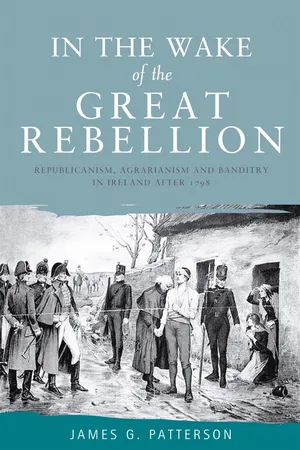
In the wake of the great rebellion
Republicanism, agrarianism and banditry in Ireland after 1798
- 202 pages
- English
- ePUB (mobile friendly)
- Available on iOS & Android
eBook - ePub
In the wake of the great rebellion
Republicanism, agrarianism and banditry in Ireland after 1798
About this book
On Monday 19 September 1803, the most significant trial in the history of Ireland took place in Dublin. At the dock stood a twenty-five year old former Trinity College student and doctor's son. His name was Robert Emmet and he was standing trial for heading a rebellion on 23 July 1803. The iconic power of Robert Emmet in Irish history cannot be overstated. Emmet looms large in narratives of the past, yet the rebellion, which he led, remains to be fully contextualised. Patterson's book repairs this omission and explains the complex process of politicisation and revolutionary activity extending into the 1800s. He details the radicalisation of the grass roots, their para-militarism and engagement in secret societies. Drawing on an intriguing range of sources, Patterson offers a comprehensive insight into a relatively neglected period of history. This work is of particular significance to undergraduate and post-graduate students and lecturers of Irish history.
Information
Publisher
Manchester University PressYear
2013Print ISBN
9780719085567
9780719076930
eBook ISBN
9781847797056
Antrim and Down
1
Antrim and Down: an introduction
Historians have traditionally considered the non-sectarian republicanism of the United Irish movement in east Ulster to have died a sudden death in the wake of the crushing defeat of the rebel armies of Antrim and Down in June 1798. The traditional view also holds that the Presbyterians of the two counties, who had been at the heart of the movement from its inception seven years earlier, made a rapid transition from rebel to loyalist often embracing the Orange Order in the process. Completing this model is the re-emergence of Defenderism, which, with equal speed, reverted to its Catholic sectarian roots.1 The untimely demise of northern republicanism is attributed to several factors, including the increasing distrust of the methods and motives of the United Irishmen’s French allies and the impact of government-sanctioned repression. Yet these factors are of secondary or tertiary importance, the pivotal role being played by the fear engendered by the denominational violence that supposedly dominated the rebellion in the southern counties, particularly Wexford. Ultimately then, the middle-class Presbyterian merchants and farmers of the North abandoned their radical political principles when faced with the prospect of losing their property, and possibly their lives, to a Catholic peasant jacquerie. Simply put, the alliance between Presbyterian United Irishmen and Catholic Defenders collapsed under the weight of religious animosity.2
Although there are slight historiographical variations, the relatively small numbers of historians who have addressed the period following the rising concur on the major points of interpretation. For example, R. F. Foster believes that news of the sectarian outrages in the South drove a large number of Presbyterians to loyalism, stating: ‘when the Wexford pattern was known in Ulster, many insurgents defected or even became yeomen’.3 Thus, for Foster, the ultimate legacy of the rebellion was sectarianism. As proof that ‘the sectarian rationale had triumphed’, he cites a Defender toast from 1799 that expressed the desire to mutilate Orangemen and finds that loyalism had become synonymous with Protestantism.4
In her ground-breaking study Partners in revolution, Marianne Elliott argues that by 1799 the inactivity of the remaining United Irish leadership allowed popular disaffection to flow ‘into pervasive Defenderism’.5 Elliott uses the example of William Caulfield, a Ballymoney flax-dresser, to demonstrate the process by which Catholic Defenders who had joined the United Irishmen during the mid-1790s reverted to Defenderism in the aftermath of the 1798 rebellion. She sees the low social status of Caulfield’s recruits as an indication of their alienation from the middle-class leadership of the United Irishmen, holding that this ‘pattern of class polarization’ was repeated throughout the province. In Elliott’s opinion, oaths from the post-1798 period show that the republican goals of ‘aiding the French’ and ‘overturning the constitution’ had indeed been adopted by the Defenders. On the other hand, she also feels that ‘the rebellion had revived sectarianism with a vengeance’, as is demonstrated by the fact that the Defenders became as concerned with taking the lives of loyalists as they were with overthrowing the government.6
It is in this common focus on sectarianism that the most significant oversight in the traditional interpretation can be found. For although Elliott claims that the revival of Defenderism is indeed demonstrative of class polarization, she fails to recognize that lower-class alienation was not an exclusively Catholic phenomenon. Correspondingly, there is a failure in the traditional interpretation to differentiate between the activities of the varying social strata within Protestant dissent. Elliott asserts that ‘as dissenters withdrew from republicanism, the division between Protestant and Catholic became more rigid’ and there was ‘a corresponding flood into Orangeism’.7 Thus, the Presbyterians are seen to have moved in a monolithic fashion from radical republicanism to reactionary loyalism in the space of a few brief months. In reality, the range of Presbyterian responses in the period following the rebellion were quite broad, and many lower-class dissenters shared the disillusionment of their Catholic neighbours with the United Irishmen’s middle-class leadership.
The purpose of the first part of this book is to demonstrate that the old view requires significant modification. Specifically, there is strong evidence to suggest that republicanism remained strong in east Ulster after 1798. Moreover, it was Presbyterian radicals who were responsible for much of this continued resistance to the state.
Backgrounds
In order to understand the diverse roles played by Presbyterians in the aftermath of the rebellion of 1798, it is first necessary to examine the cultural geography of east Ulster in the preceding century. The dissenting population’s political reactions to the events of the 1790s corresponded to settlement patterns, which varied regionally and often locally within individual counties. The closing decades of the eighteenth century had witnessed a period of widespread Presbyterian expansion into areas of traditional Catholic settlement in much of south Ulster and north Leinster. This migration bred sectarian disharmony on the local level, and it has been shown that Defenderism was established initially, and most permanently, in places where ‘cultural frontiers’ were created by this Presbyterian influx (particularly in south Armagh and south Down). Relatively recent losses of land and social status had alienated the descendants of the Catholic gentry, many of whom remained in the region. These dispossessed families remained influential with the general Catholic population and provided leadership to their lower-class co-religionists, who were themselves experiencing increasing economic competition from encroaching Presbyterian tenants at a time of rapid population growth. The most severe Defender disturbances took place in areas where the local Protestant gentry demonstrated an anti-Catholic bias by favouring lower-class Protestants both officially in their role as magistrates and, later, unofficially as sponsors of the Orange Order.8
In contrast to the areas of cultural frontier in south Ulster, the Presbyterian migration from Scotland to east Ulster was long term and was accomplished peacefully. As a result, little of the lingering resentment between Catholics and dissenters that existed elsewhere in the province occurred in Antrim and north Down.9 Furthermore in these areas, overwhelming Presbyterian majorities and the relative distance from Catholic population centres helped to limit the emergence of the garrison mentality, which became so prevalent among Protestant populations elsewhere in Ireland during the 1780s and 1790s. Additionally, familial, cultural, and educational ties had carried the liberal ideals of the Scottish Enlightenment to Ulster during the eighteenth century, where they had their greatest influence on the Presbyterians of Antrim and Down.10 At the same time, the absence of a strong Protestant ‘ultra’ loyalist faction and a liberal political environment appear to have facilitated cooperation between the sects in Antrim.11 Other forces that helped to create the persistent militancy of the Presbyterians of east Ulster included the well-documented radical vein that ran through the body of the Presbyterian Church, which in turn combined with a legacy of resentment among dissenters over the second-class status that had been imposed on them (and codified in the Penal Laws of 1704) by the Anglican elite. Presbyterians were particularly incensed because they believed that they had saved Protestant Ireland from the Catholic threat of 1688–1690. Thus in the absence of significant local religious frictions, the dissenting population of much of east Ulster focused its political energy on its grievances against the Anglo-Irish ascendancy without being distracted by the sectarian concerns, which ultimately crippled the republican movement in much of the rest of Ulster. The above-described forces tended to act on all sections of the dissenting population of east Ulster in varying degrees. Yet important distinctions can be made in the motivations of the varying social strata of Protestant dissent. By the end of the eighteenth century, middle-class Presbyterian resentment was focused largely – in nineteenth-century liberal fashion – on the continued denial of political participation, which it found particularly galling in the face of its rapidly rising prosperity. The belief that English domination of the corrupt Irish parliament impeded economic development underlay the more theoretical aspects of the United Irishmen’s political thought, which was itself a combination of classical republicanism, Lockean contract theory and Painite popular sovereignty and natural rights ideology.12 Efforts by the middle-class founders of the United Irishmen to politicize the dissenting population of the countryside were facilitated greatly by the extremely high literacy rates of the Presbyterian lower classes. Indeed, it has been argued that it was the indigenous radicalism of east Ulster’s weavers that was the most significant factor in the successful politicization of the rural population of Antrim and Down.13 Whether the farmers and weavers of Antrim and Down were politicized by middle-class emissaries from Belfast or radical ideology came from within, it worked on a pre-existing hostility to the Anglo-Irish landholding class and the state that supported it. It is here that the motivations of rural radicals diverged significantly from those of their urban counterparts.
In the countryside differences in religion and ethnicity combined with the egalitarian tendencies within the Presbyterian Church to critically weaken the bonds of patronage and deference between dissenting tenant and Anglican landlord. Additionally, conflicts between Presbyterian farmers and weavers and the Anglo-Irish elite were not confined solely to rhetorical questions of political status, for there were also outward manifestations of physical violence, which can be attributed directly to social and economic issues. By about 1750, rising population, commercialized agriculture and rapidly expanding linen markets began to drive up the value of land in Ulster. The coincidental expiration of a large number of leases in the 1760s and 1770s led to an effort by landlords and middle-men to increase rents and entry fines in order to take advantage of the rising land values. When higher rents, rack renting, canting and occasional evictions coincided with a severe economic downturn in the late 1760s, agrarian grievance manifested itself in the large-scale Steelboy Movement of 1769–1773. The Steelboys were a mostly Presbyterian alliance of cottier/weavers and farmers whose activities were concentrated in Antrim, Down and the adjacent districts of Derry, Tyrone and Armagh. Resistance consisted mostly of cattle houghing and house burnings.14
In March 1772, the military descended on Antrim and Down in an effort to suppress the discontent. Mass arrests followed and sixteen Steelboys were killed in open battle with the army. The Steelboys themselves committed few acts of actual physical violence (only three ...
Table of contents
- Cover Page
- Title Page
- Copyright Page
- Contents
- Acknowledgements
- Introduction
- Part I Antrim and Down
- Part II South Munster, Galway and Mayo
- Part III South Leinster
- Conclusion
- Bibliography
- Index
Trusted by 375,005 students
Access to over 1.5 million titles for a fair monthly price.
Study more efficiently using our study tools.
Frequently asked questions
Yes, you can cancel anytime from the Subscription tab in your account settings on the Perlego website. Your subscription will stay active until the end of your current billing period. Learn how to cancel your subscription
No, books cannot be downloaded as external files, such as PDFs, for use outside of Perlego. However, you can download books within the Perlego app for offline reading on mobile or tablet. Learn how to download books offline
Perlego offers two plans: Essential and Complete
- Essential is ideal for learners and professionals who enjoy exploring a wide range of subjects. Access the Essential Library with 800,000+ trusted titles and best-sellers across business, personal growth, and the humanities. Includes unlimited reading time and Standard Read Aloud voice.
- Complete: Perfect for advanced learners and researchers needing full, unrestricted access. Unlock 1.5M+ books across hundreds of subjects, including academic and specialized titles. The Complete Plan also includes advanced features like Premium Read Aloud and Research Assistant.
We are an online textbook subscription service, where you can get access to an entire online library for less than the price of a single book per month. With over 1.5 million books across 990+ topics, we’ve got you covered! Learn about our mission
Look out for the read-aloud symbol on your next book to see if you can listen to it. The read-aloud tool reads text aloud for you, highlighting the text as it is being read. You can pause it, speed it up and slow it down. Learn more about Read Aloud
Yes! You can use the Perlego app on both iOS and Android devices to read anytime, anywhere — even offline. Perfect for commutes or when you’re on the go.
Please note we cannot support devices running on iOS 13 and Android 7 or earlier. Learn more about using the app
Please note we cannot support devices running on iOS 13 and Android 7 or earlier. Learn more about using the app
Yes, you can access In the wake of the great rebellion by James Patterson,James G Patterson in PDF and/or ePUB format, as well as other popular books in History & French History. We have over 1.5 million books available in our catalogue for you to explore.