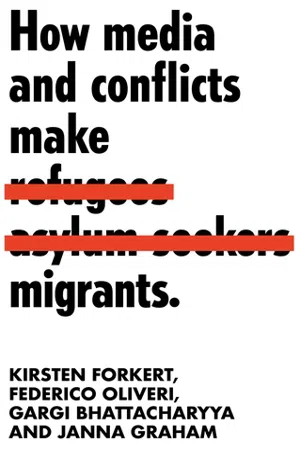
Has 'migrant' become an unshakeable identity for some people? How does this happen and what role does the media play in classifying individuals as 'migrants' rather than people? This volume denaturalises the idea of the 'migrant', pointing instead to the array of systems and processes that force this identity on individuals, shaping their interactions with the state and with others. Drawing on a range of empirical fieldwork carried out in the United Kingdom and Italy, the authors examine how media representations construct global conflicts in a climate of changing media habits, widespread mistrust, and fake news. How media and conflicts make migrants argues that listening to those on the sharpest end of the immigration system can provide much-needed perspective on global conflicts and inequalities.In challenging the conventional expectation for immigrants to tell sad stories about their migration journey, the book explores experiences of discrimination as well as acts of resistance. Interludes, interspersed between chapters, explore these issues through songs, jokes and images. Offering an essential account of the interplay between a climate of diversifying but distrustful media use and uncertainty about the shape of global politics, this volume argues that not only is the world itself changing rapidly, but also how people learn about the world. Understanding attitudes to migrants and other apparently 'local' political concerns demands a step back to consider this unstable global context of (mis)understanding.
eBook - ePub
How media and conflicts make migrants
- 224 pages
- English
- ePUB (mobile friendly)
- Available on iOS & Android
eBook - ePub
How media and conflicts make migrants
About this book
Information
1
How postcolonial innocence and white amnesia shape our understanding of global conflicts
Introduction
In this chapter, we examine the main narratives used to make sense of the so-called ‘European migration crisis’ and the relationship to global conflicts. Through the powerful yet highly questionable ‘crisis’ frame (De Genova 2016a), certain events have received international news coverage and play an important role within common-sense visions of ‘reality’, whilst others have been largely ignored. Bearing in mind the available cross-European media coverage analyses of the migration crisis (Berry et al. 2016; Chouliaraki, Georgiou and Zaborowki 2017), we focus on the narratives which shape the way British and Italian news media and public discourses interpret population movement in relation to wars and violent conflict from 2014 to 2016. We also explore how these narratives perpetuate distrust of national and European institutions, undermine solidarity and empathy, and strengthen popular support for populist legal reforms aimed at undermining the right of asylum, and the rights of migrants in general.
We argue that the mediatisation of global conflicts and the ‘European migration crisis’ has been primarily constructed around the self-interests of ‘receiving countries’, and this undermines any serious effort to grasp the socio-economic and political contexts of people's decision to leave. In this chapter, we discuss how Italian and British media have covered global conflicts and how the movement of people is presented when they flee these conflicts. We explore how narratives of global conflicts are shaped by the forgetting of Western responsibilities for old and new colonialism, including military interventions abroad and militarised border controls. We are examining these narratives as a postcolonial discourse produced by ‘receiving countries’ about themselves and ‘the others’ crossing their borders.
Questioning the ‘crisis’ frame
Refugee crisis. Migrant crisis. Humanitarian crisis. Solidarity crisis. EU governance crisis. Crisis of European values and principles. Crisis of humanity. Crisis of asylum law. There has been a proliferation of crisis discourses in the media and in public discourses, aiming to make sense of recent mass movements of people arriving from the Middle East, Asia and Africa to Europe. Our aim is to deconstruct this widespread and often unquestioned use of a ‘crisis’ frame, arguing that the autonomous free movement of non-European people confronts us with a border crisis (Vaughan-Williams 2015; De Genova 2016a) and a racial crisis (De Genova 2016b). This puts into question the current political construction of Europe and, more generally, the current global border regime based on differential mobility rights (Oliveri 2017). From this perspective:
The ‘crisis’ of border control and ‘migration management’ may […] be seen to be a crisis of state sovereignty that is repeatedly instigated, first and foremost, by diverse manifestations of the autonomous subjectivity of human mobility itself. (De Genova 2016a)
Thinking of a situation as a crisis creates a vicious cycle, whereby the very definition of a situation as a crisis puts in motion the ‘catastrophisation’ of events (Ophir 2010). This catastrophisation legitimises exceptional measures, including the use of force, over established practices or the rule of law. The human suffering eventually caused by these states of exception produces new emergency conditions (a crisis within the crisis), requiring further exceptional measures. In the case of the ‘European migration crisis’, the subversive effects of human mobility have served as a justification for the re-bordering of territories and societies across the Euro-Mediterranean space. For instance, Central and Central-Eastern European states closed and militarised their borders in order to close the Balkan route after the ‘long summer of migration’ in 2015. After the terrorist attack in Paris in November 2015, fears about a large influx of people seeking protection provoked several European countries to suspend the Schengen Convention on the abolition of internal border controls. In the case of the French-Italian border (as discussed in chapter 3) this arrangement lasted much longer and extended further than the temporary suspensions normally allowed by the Schengen Borders Code.
The Hotspot approach,1 the EU-Turkey agreement and further plans for externalising asylum procedures to countries outside of Europe have been put into place since 2015 to reinforce the European border regime. For example, EU leaders have discussed co-operation on development policies serving the purpose of preventing migration, such as, for example, in the case of Niger, a country crossed by migratory routes from Western and Central Africa towards Libya and the Mediterranean Sea. Niger has been the primary beneficiary of the EU Emergency for Africa Trust Fund, launched after the 2015 Valletta Summit in order to finance projects aimed at eradicating the root causes of migration directly in African countries, but also at co-operation with border authorities in order to prevent people from travelling to Libya. In Summer 2018 the EU leaders adopted the strategic concept of ‘regional disembarkation platforms’: reception centres in North Africa aimed to provide rapid processing of asylum claims, and to distinguish between economic migrants and those in need of international protection. This approach had the officially stated aim of ‘[reducing] the incentive to embark on perilous journeys’ (European Commission 2018). In September 2015 EU states committed to relocating up to 160,000 asylum seekers from Italy and Greece to other countries within two years, later revising the figure down to 98,000: 39,600 from Italy. Only asylum seekers from countries such as Syria, Eritrea and Somalia, for which the recognition rate at EU level is 75% or higher, were in fact eligible for relocation. Only 9,078 applicants had been relocated by the end of the relocation programme on 27 September 2017, while by 30 October 2018 12,700 had been relocated. This demonstrates how efforts to relocate asylum seekers or refugees across EU members states have essentially failed.
In this way, official political and media discourses have operationalised the language and tactics of crisis:
What is fundamentally a moment of governmental impasse – in short, a ‘crisis’ of territorially – defined state power over transnational, cross-border human mobility – has been mobilised and strategically deployed as ‘crisis’ for the reconfiguration of tactics and techniques of border policing and immigration and asylum law enforcement. (De Genova 2016a)
These crisis discourses normalised the narrative of a low–medium intensity conflict against unwanted and uncontrolled human mobility. Common-sense, twentieth-century understandings of global conflict are of limited use in grappling with the complexities of ‘new wars’ (Kaldor 2012). This might partly explain the ambiguity of European public opinion towards shipwrecks in the Mediterranean, ranging from official compassion to indifference or even satisfaction at migrant deaths, as has been expressed in Italian news media and on social media. Ultimately, if migrants are constructed as the enemies, their lives are not ‘grievable’ (Butler 2009).
Crisis discourses also give the impression that events take place within a very narrow timeframe, making it more difficult to situate them within longer historical continuities; with ‘always-on’ digital media, this question of temporality becomes even more pronounced. The dominant narrative of the ‘refugee crisis’ presents the crisis as beginning as the spring of 2015, peaking in autumn of 2015 and then subsiding in 2016 with the closure of the Balkan route and the implementation of the EU-Turkey deal. However, examining migration trends across Italy challenges this narrative of the ‘European migration crisis’ as primarily a Central and Northern-European phenomenon affecting wealthy Western European nations during and after 2015. In reality, semi-peripheral and peripheral European states such as Italy have already experienced significant flows at least since the aftermath of the 2011 Arab Revolutions. In October 2013 many Syrian families and single parents with children began to arrive in Milan and set up camp in the city's busy rail hub, with the camp growing by the day as charities and city officials tried to assist those travelling to other European countries.
Postcolonial representations of Europe and its ‘others’
Narratives framing the situation as a ‘crisis’ which only began in 2015 and only affects wealthy European countries reflects a particular blindness around longer legacies of conflict and violence, and particularly those resulting from colonial oppression. In exploring this legacy, we are drawing on concepts of white amnesia (Hesse 1997) and postcolonial innocence to grasp the deeper political dimensions underlying the mediation of the ‘European refugee crisis’. In doing so, we stress the lack of will or capacity by former colonisers to recognise how longer histories of colonialism shape contemporary global politics including global inequalities, violent conflicts, conflict-related migration and border controls. Receiving countries do not accept responsibility in relation to the reasons why people flee their countries, or for their deaths at the border: both circumstances are ‘depoliticised’ as natural events (Oliveri 2016). Instead, others are held responsible: for example, in Italy border deaths have been attributed to human traffickers and even to NGOs engaged in search and rescue operations in the Mediterranean (the latter being seen as implicated within organised crime, to be discussed below).
If European nations are not seen to bear any responsibility for global conflicts, this reinforces their perceived role as global peacekeepers who play a largely benign role within foreign interventions. Wars taking place outside the West are perceived as the result of atavistic religious or ethnic conflicts and as intrinsic to racialised communities in non-Western countries. In the most paranoid versions of this logic, migrants threaten to import the ‘barbaric’ world-views into Western cultures, provoking social conflict.
Raising the question of responsibility is not only about recognising, as Ida Danewid points out in ‘White Innocence and the Black Mediterranean’, that:
the majority of migrants seeking asylum in Europe are coming from countries that until recently were under colonial rule. Libya and Eritrea were Italian colonies until 1947; Somalia was ruled by Italy and Britain until 1960; Syria was a French protectorate under the Mandate System until 1946; Britain invaded and occupied Afghanistan three times until formal independence in 1919. (Danewid 2017: 1680)
More radically, it is about recognising that the majority of ‘refugee-producing countries’ have been the target of Western armed interventions or political interference during the post-Cold War era: for example, Afghanistan, Iraq, Syria, South Sudan and Somalia (UNHCR 2018).
In considering the ‘crisis’ framing within postcolonial terms it is important to bear in mind the differences between the colonial and imperial histories of the UK and Italy, not only in terms of specific practices of colonisation during the last two centuries, but also in terms of diverging processes of decolonisation, different immigration paths from former colonies and uneven consciousness of their colonial past. It is also important to understand the prefix ‘post’ followed by ‘colonialism’ in terms of an ongoing, yet systematically denied or forgotten, continuity in the domination of Western powers on the rest of the world, despite the decolonisation and formal independence of former colonial states.
The concept of ‘white amnesia’, developed by Barnor Hesse in ‘White Governmentality’ (199...
Table of contents
- Cover
- Half-title page
- Title page
- Copyright page
- Contents
- List of figures
- Acknowledgements
- Introduction: conflict, media and displacement in the twenty-first century
- 1 How postcolonial innocence and white amnesia shape our understanding of global conflicts
- Interlude 1 Global power and media absences
- 2 War narratives: making sense of conflict
- Interlude 2 Songs, jokes, movies and other diversions
- 3 Social media, mutual aid and solidarity movements as a response to institutional breakdown
- Interlude 3 How it feels to be made a migrant: restrictions, frustration and longing
- 4 The processes of migrantification: how displaced people are made into ‘migrants’
- Interlude 4 Telling stories about war differently
- 5 Refusing the demand for sad stories
- Conclusion: unsettling dominant narratives about migration in a time of flux
- Bibliography
- Index
Trusted by 375,005 students
Access to over 1.5 million titles for a fair monthly price.
Study more efficiently using our study tools.
Frequently asked questions
Yes, you can cancel anytime from the Subscription tab in your account settings on the Perlego website. Your subscription will stay active until the end of your current billing period. Learn how to cancel your subscription
No, books cannot be downloaded as external files, such as PDFs, for use outside of Perlego. However, you can download books within the Perlego app for offline reading on mobile or tablet. Learn how to download books offline
Perlego offers two plans: Essential and Complete
- Essential is ideal for learners and professionals who enjoy exploring a wide range of subjects. Access the Essential Library with 800,000+ trusted titles and best-sellers across business, personal growth, and the humanities. Includes unlimited reading time and Standard Read Aloud voice.
- Complete: Perfect for advanced learners and researchers needing full, unrestricted access. Unlock 1.5M+ books across hundreds of subjects, including academic and specialized titles. The Complete Plan also includes advanced features like Premium Read Aloud and Research Assistant.
We are an online textbook subscription service, where you can get access to an entire online library for less than the price of a single book per month. With over 1.5 million books across 990+ topics, we’ve got you covered! Learn about our mission
Look out for the read-aloud symbol on your next book to see if you can listen to it. The read-aloud tool reads text aloud for you, highlighting the text as it is being read. You can pause it, speed it up and slow it down. Learn more about Read Aloud
Yes! You can use the Perlego app on both iOS and Android devices to read anytime, anywhere — even offline. Perfect for commutes or when you’re on the go.
Please note we cannot support devices running on iOS 13 and Android 7 or earlier. Learn more about using the app
Please note we cannot support devices running on iOS 13 and Android 7 or earlier. Learn more about using the app
Yes, you can access How media and conflicts make migrants by Kirsten Forkert,Federico Oliveri,Gargi Bhattacharyya,Janna Graham in PDF and/or ePUB format, as well as other popular books in Social Sciences & Cultural & Social Anthropology. We have over 1.5 million books available in our catalogue for you to explore.