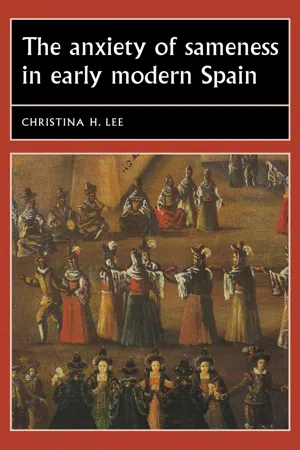
This book explores the Spanish elite's fixation on social and racial 'passing' and 'passers', as represented in a wide range of texts. It examines literary and non-literary works produced in the sixteenth and seventeenth centuries that express the dominant Spaniards' anxiety that socially mobile lowborns, Conversos (converted Jews), and Moriscos (converted Muslims) could impersonate and pass for 'pure' Christians like themselves. Ultimately, this book argues that while conspicuous sociocultural and ethnic difference was certainly perturbing and unsettling, in some ways it was not as threatening to the dominant Spanish identity as the potential discovery of the arbitrariness that separated them from the undesirables of society – and therefore the recognition of fundamental sameness.
This fascinating and accessible work will appeal to students of Hispanic studies, European history, cultural studies, Spanish literature and Spanish history.
- 249 pages
- English
- ePUB (mobile friendly)
- Available on iOS & Android
eBook - ePub
The anxiety of sameness in early modern Spain
About this book
Information
Publisher
Manchester University PressYear
2015Print ISBN
9781526134349
9781784991203
eBook ISBN
9781784996352
I
The usurpation of nobility and low-born passers
‘I took her life so that my noble blood would not be mixed with that of a peasant’ – Don Alonso.
María de Zayas y Sotomayor, Desengaños amorosos (1647)
1
Theorising and practising nobility
María de Zayas’s short novel ‘El traidor contra su sangre’ (‘The Traitor to his Own Blood’) relates the following story: Don Pedro is a wealthy and highly respected nobleman in Jaén who is obsessed with preserving or augmenting the purity of his noble lineage and his material possessions. Don Alonso, his son, shares in his father’s extreme ideology and when he finds out that his only sibling, Doña Mencía, intends to secretly wed Don Enrique, he – with his father’s approval – contrives their murders. After stabbing his sister multiple times, he leaves a note beside her body in which he succinctly justifies his action. It reads: ‘I took her life so that my noble blood would not be mixed with that of a peasant.’1
Don Enrique is not technically a peasant himself. He is the grandchild of Old Christian peasant-farmers whose success in the market-based economy allowed their children and grandchildren greater social mobility. The narrator of Zayas’s story, Doña Francisca, tells us that Don Enrique’s family was quickly inducted into the social elite and became one of the most influential in Jaén, because of the financial provisions they made available to the nobility in times of economic crisis. Doña Francisca suggests that the residents in Jaén were unsuspecting, unconcerned, or complicit in Don Enrique’s social passing. The ‘taint [of commonness] in the blood’, she adds, is easy to dissimulate with an Old Christian lineage and money.2 But Doña Francisca does not censure Don Enrique for his origins and admits that, for all intents and purposes, Don Enrique should be recognised as an honourable nobleman. While she attributes Don Pedro’s disdain for Don Enrique and his family to ‘hubris’ (‘soberbia’), she also implies that his contempt is motivated by his fears of social demotion.3 She conveys that Don Pedro and Don Alonso are troubled by financial instability and that, unlike many of the other petty nobles in Jaén, they have refused to befriend Don Enrique’s family, which would be to their benefit. Don Pedro lacks the funds to grant a desirable dowry for his daughter, but he is neither willing to split his family estate nor have her marry beneath her rank. Rather than stain his blood, Don Pedro prefers to have his daughter Mencía enter a convent.
Don Alonso and Don Pedro’s reaction to Don Enrique’s ‘impersonation’ of nobility reflects the insecurity that some established petty noblemen in the sixteenth and seventeenth centuries experienced regarding their own status. This kind of angst about social impersonators was caused by their perception that their ranks were under siege by wealthy commoners whose goal was to promote themselves while demoting the lineages of the established nobility. Unlike Don Francisca or Don Enrique’s allies, Don Pedro and his son resolve to force their ideology of nobility into the realm of experience. The predominant theory of nobility was that it was determined by ‘birth’, but as historians have already shown, nobility had more to do with the wealth, the social networks, and the convincing performance of the parties claiming it.4 Don Pedro and Don Alonso refuse to accept the fact that their monolithic world-view is questionable and decide to eliminate the two individuals who expose the conflict. Although Don Alfonso does successfully murder his sister, he fails to eliminate the socially mobile Don Enrique, who survives the attack.5
While I dedicate the second part of this book to discussion of the presumed Old Christians’s responses to passing Conversos, I focus this part on the representations of the anxieties that rose from the belief that fraudulent nobles were actively engaged in exploiting privileges that did not belong to them by birth and in tarnishing the lineage of unsuspecting nobles. The categories are not mutually exclusive, as passing Conversos might be discovered to be false nobles and vice versa. As Zayas’s story evinces through the example of Don Enrique, nobility did not necessarily imply limpieza de sangre.6 Even after limpieza became an essential prerequisite to acquire or to legitimise one’s nobility, it was only one requirement for achieving the status.7 Old Christians and New Christians used similar strategies of masking and impersonation to achieve upward mobility. This chapter’s emphasis on the anxiety about potential social passers highlights the significance that the rhetoric of genealogy could play in determining the moral and social value of an individual, regardless of his or her religious origins. In the texts I examine in the next two chapters, the established nobility is seen as resisting similitude with plebeian trespassers through discourses that assert the genealogical superiority of ‘natural’ nobles – even if they themselves are not – and the indomitable desire of commoners to destroy their lineages. Social passers are figured in these texts as dangerous to the stability of the nobility precisely because their passing proves its very instability. Successful trespassers, in turn, are shown to adapt the behaviour of their models and join them in obstructing the upward mobility of other potential passers.
Defining hidalguía in early modernity
A consideration of the prevailing ideology of nobility and the actual processes by which nobility was attained or maintained is conducive to a better appreciation of the chasm that existed between the two and of the general anxiety that the awareness of this chasm provoked among the lesser nobility. The literal meaning of hidalgo or hijodalgo was ‘the son of something’. Sebastián de Covarrubias may be trusted to provide the dominant interpretation of who was an hidalgo. According to Covarrubias, hidalgo is equivalent to “noble, of a good and ancient lineage.”8 Covarrubias explains that “something” stands for the long-time nobility, royal grants, tax-exemptions, honour, and material possessions given to a nobleman by inheritance.9 Hidalguía denoted the condition of being an hidalgo or nobleman. Covarrubias recognises that an hidalgo inherits a high moral calibre by virtue of his rank, but clarifies that the latter does not guarantee honourable behaviour.10 The term hidalgo was used generically to denote anybody who belonged to the noble class – from a destitute squire to a grandee – and who was not a pechero (tax-payer). There were material and symbolic benefits to possessing the condition of hidalguía. All noblemen were exempt from direct personal taxation, as well as conscription, billeting, forced levies, degrading punishments, and imprisonment for debt. They commanded the right to display their coat of arms on their shields, houses, and tombs. Their residences, horses, and weapons could not be seized as payments for debts. In some towns, half of all of the municipal and judicial offices were reserved for noblemen.11 Most Spaniards did not seem to consider the status of New Christians as equivalent to those of Old Christian noblemen, despite the fact that exceptional writers, such as Friar Juan Benito Guardiola, believed that Conversos should be recognised as hidalgos as long as they could prove that they had long inherited their nobility.12 If Conversos acquired nobility titles through legal means – and this was especially true after limpieza statutes began to be implemented more widely – it was never by claiming noble Jewish roots, but rather by alleging that they had high-born Old Christian ancestry.
Historians have estimated that in Castile, the largest region of the peninsula, up to 10 per cent of the population claimed to be hidalgos towards the end of the sixteenth century.13 About 80 per cent of Castile’s hidalgos were located to the North of the River Tagus, and among them most were concentrated in the mountainous regions north of the Duero and the Ebro rivers. The regions that were known more generally as ‘the mountains’ were the areas of León, Asturias, Santander, and Vizcaya. The people known as hidalgos from the mountains (hidalgos de montaña) claimed communal hidalguía because they maintained that they were the descendants of the original inhabitants of Spain and that their lineage had been preserved, that is, kept pure from Jewish or Muslim influences.14 Hidalgos were growing in number and started living in more densely populated towns and in close proximity to each other. In Palencia, for instance, there were thirty-four hidalgo families in 1622, in contrast to three households in 1530.15 For urban dwellers, it might have seemed that self-appointed hidalgos were swelling everywhere.
Categorising hidalgos into neatly drawn stations, even if only in theory, proved to pose some problems. One official who attempted to outline the different stations of hidalguía was Count-Duke of Olivares. In a discourse written for the young King Philip IV in 1624, Olivares identifies the stations in descending order: infantes (princes of the royal family), grandees (a singular group of nobles upon whom this special status was conferred), títulos (titled nobles), caballeros, and hidalgos. Although Olivares does not hesitate in clarifying that the first three categories are visibly recognisable by their distinguished titles and their sizeable estates, he is less clear in defining caballeros and hidalgos.16 Caballeros, he says, fall beneath the grandees and are divided into two classes: ‘the caballeros who are lords of manors and estates, a very small group ever since titles have been given out so liberally, and the other class being caballeros without manors’.17 Hidalgos, continues Olivares, ‘make up the lowest grade of the nobility, for it is from that rank that one ascends to all the others.’18 The precise elements that distinguish a caballero from an hidalgo (whether either possesses a manor or not) remain unresolved in Olivares’s text. In effect, his inability or unwillin...
Table of contents
- Cover
- Half Title
- Series Information
- Title Page
- Copyright Page
- Table of Contents
- Figures
- Acknowledgements
- Note on translations
- Introduction
- I The usurpation of nobility and low-born passers
- II Conversos and the threat of sameness
- III Moriscos and the reassurance of difference
- Conclusion
- Bibliography
- Index
Trusted by 375,005 students
Access to over 1.5 million titles for a fair monthly price.
Study more efficiently using our study tools.
Frequently asked questions
Yes, you can cancel anytime from the Subscription tab in your account settings on the Perlego website. Your subscription will stay active until the end of your current billing period. Learn how to cancel your subscription
No, books cannot be downloaded as external files, such as PDFs, for use outside of Perlego. However, you can download books within the Perlego app for offline reading on mobile or tablet. Learn how to download books offline
Perlego offers two plans: Essential and Complete
- Essential is ideal for learners and professionals who enjoy exploring a wide range of subjects. Access the Essential Library with 800,000+ trusted titles and best-sellers across business, personal growth, and the humanities. Includes unlimited reading time and Standard Read Aloud voice.
- Complete: Perfect for advanced learners and researchers needing full, unrestricted access. Unlock 1.5M+ books across hundreds of subjects, including academic and specialized titles. The Complete Plan also includes advanced features like Premium Read Aloud and Research Assistant.
We are an online textbook subscription service, where you can get access to an entire online library for less than the price of a single book per month. With over 1.5 million books across 990+ topics, we’ve got you covered! Learn about our mission
Look out for the read-aloud symbol on your next book to see if you can listen to it. The read-aloud tool reads text aloud for you, highlighting the text as it is being read. You can pause it, speed it up and slow it down. Learn more about Read Aloud
Yes! You can use the Perlego app on both iOS and Android devices to read anytime, anywhere — even offline. Perfect for commutes or when you’re on the go.
Please note we cannot support devices running on iOS 13 and Android 7 or earlier. Learn more about using the app
Please note we cannot support devices running on iOS 13 and Android 7 or earlier. Learn more about using the app
Yes, you can access The anxiety of sameness in early modern Spain by Christina H. Lee in PDF and/or ePUB format, as well as other popular books in History & British History. We have over 1.5 million books available in our catalogue for you to explore.