The first comprehensive discussion of the major Caribbean thinkers who came to Britain. Written in an accessible, lively style, with a range of wonderful and distinguished authors. Key book for thinking about the future of multicultural Britain; study thus far has concentrated on Caribbean literature and how authors 'write back' to Britain – this book is the first to consider how they 'think back' to Britain. A book of the moment - nothing comparable on the Carribean influence on Britain.. Discusses the influence, amongst others, of C. L. R. James, Una Marson, George Lamming, Jean Rhys, Claude McKay and V. S. Naipaul.
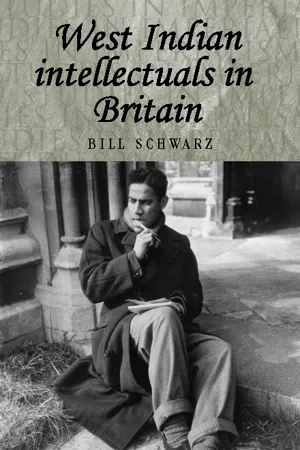
- 272 pages
- English
- ePUB (mobile friendly)
- Available on iOS & Android
eBook - ePub
West Indian intellectuals in Britain
About this book
Information
CHAPTER ONE
What is a West Indian?
Catherine Hall
For C. L. R. James West Indian identity was something to be celebrated, associated as it was for him, with the whole of the Caribbean, from Cuba and Haiti to Martinique, Trinidad and Jamaica.1 Its distinctive character he saw as intimately linked to its particularly modern history, with the plantation at the centre of a global capitalist system linking slavery with finance, industry and European domestic consumption. The intellectual tradition which came out of this history was associated for him with ‘the struggle for human emancipation and advancement’. West Indian writers and social actors were ‘a particular social product’ producing a ‘particular type of social activity which we can definitely call West Indian’. The carriers of this tradition were men such as Toussaint L’Ouverture, hero of the San Domingue revolution, J. J. Thomas, the Trinidadian schoolmaster who took on the celebrated Oxford professor James Froude, Marcus Garvey, the black nationalist born in Jamaica, Aimé Césaire, the Martiniquan poet and theorist of négritude, Frantz Fanon, also from Martinique, who became a critical anti-colonial voice, and Fidel Castro. They shared ‘an ocean of thought and feeling’ which provided the roots of what it was to be West Indian.2
James wrote his history of the revolution in San Domingue, The Black Jacobins, in 1938, after leaving Trinidad to live in the metropole, the place where journalists and writers from the colonies could hope to make a name for themselves. James was steeped in Victorian English culture, and perhaps was expressing in this book a confidence about the future which was characteristic of much Victorian thought.3 Such a desire for progress was also a tenet of the marxism which, from this period, he began to espouse. The book was about a revolution which, he imagined, would happen in Africa, and told the story of the one which had happened in Haiti. Reflecting on the writing of The Black Jacobins in 1971, James noted that his aim had been to demonstrate that we had a history and in that history there were men who were fully able to stand comparison with great men of that period … I was trying to make clear that black people had a certain historical past… by the historical record I tried to show that black people were able to make historical progress, they were able to show how a revolution was made, they were able to produce the men who could lead a revolution, and write new pages in the book of history… 4
James’s identification with the struggles of black people and the futures which were possible for him and them was central to his thinking. The capacities of black people and the part they had played in their own histories had been denied by the colonisers. His intellectual magic would allow others to see that heroic and tragic story and celebrate the distinctive West Indian virtues. His was a historical vision and consciousness. As Anthony Bogues argues, ‘The Black Jacobins is a rare text because it serves as marker for history, the practice of politics and a partial answer to the question of who and what is a Caribbean person’.5
The creation of intellectual traditions always involves inclusions and exclusions, remembering some and forgetting others. Roots ‘are not hallowed artefacts shrouded in mystery, but rather we seem continually to dig them up according to our needs at particular points in time’.6 While James sought a tradition of struggle for freedom as characteristically West Indian, his fellow Trinidadian, V. S. Naipaul, had a much more deeply pessimistic view. Naipaul came to England in 1950 to study English literature at Oxford. Thirty years younger than James, he also sought to make his name as a writer. In 1961 he wrote Middle Passage, his account of a return journey to the West Indies. He took as his epitaph Froude’s judgement on the islands in 1887. ‘There are no people here in the true sense of the word’, Froude had written, ‘with a character and purpose of their own.’ Naipaul shared this conviction. ‘Nothing was created in the British West Indies’, he wrote, ‘no civilization as in Spanish America, no great revolution as in Haiti or the American colonies. There were only plantations, prosperity, decline, neglect: the size of the islands called for nothing else.’ Or, ‘how can the history of West Indian futility be written? What tone shall the historian adopt? The history of the islands can never be satisfactorily told. Brutality is not the only difficulty. History is built around achievement and creation; and nothing was created in the West Indies.’7 This was a harsh legacy with which to live, the mirror-image, perhaps, of James’s high-tragic conception of history.
These two contrasting visions have provided my starting point for exploring the legacy of being West Indian from which Caribbean intellectuals have developed their own sense of West Indianness and, intimately connected with this, their sense of history. They inform my inquiry into the different meanings of West Indian – meanings which different generations have had to learn, confront and fashion anew. Like all the chapters in this book my investigation focuses on the metropole: what picture of the West Indian was generated in the metropole and for what purposes? When, how and where did a West Indian identity emerge? Who, at any one time, was included and who excluded? Like all cultural identities that of the West Indian is historically specific. But what kind of term was it? Did it refer to location, ethnicity, parentage, or culture? Did it refer to different groupings at different times? Is it perhaps an identity like ‘European’, a regional identity which transcended national borders? Was it ever conceived as a national identity? Could the West Indian islands be a nation? Who claimed it and when? I want to ask what a genealogy of the term would look like. Being a West Indian was neither fixed nor essential. My focus here is on the metropolitan lens: this is, of course, only a part of the story.8
The term West Indies is complicated in itself. Is it the West Indies of the colonial period, when the islands were named by their European ‘discoverers’? Is it the British West Indies, or the French or the Spanish or the Dutch? C. L. R. James’s West Indian consciousness crossed the whole of the Caribbean. My concern in this chapter, as with the other chapters in the book, is the islands, and parts of the mainland, which were colonised by the British from the early seventeenth century and named as the British West Indies. This process was in itself a long and complicated history of conquest, associated with the great European wars of the seventeenth, eighteenth and nineteenth centuries. By 1958, when the postwar migration of West Indians to Britain was well under way, and when a West Indian Federation came briefly into being, the participating territories comprised Jamaica in the western Caribbean, and Trinidad and Tobago, Barbados, Grenada, St Vincent, St Lucia, Dominica, Antigua, St Kitts, Nevis, Anguilla and Montserrat in the eastern Caribbean. Neither of the two mainland colonies, British Guiana (Guyana) and British Honduras (Belize) was included. These British West Indian colonies formed a link between North and South America and were strategically vital to the European powers, particularly in the era of the sailing ship. They shared a history, of colonisation, displacement, slavery, emancipation, indenture, nationalism and anti-colonialism: a history out of which a particular kind of West Indian identity has emerged, that of the anglophone Caribbean.
According to the Oxford English Dictionary the first recorded use of the term West Indian, in 1597, serves both to describe the indigenous inhabitants of the islands, and to condemn the acts of another colonising power: thus, ‘those cruelties that were practised by the Spanish nation upon the West Indians’. By 1661, only a few years after Cromwell’s forces had taken Jamaica, the term had come to mean ‘an inhabitant or native of the West Indies, of European origin or descent’. In a dramatic, if largely unacknowledged transformation, the West Indian had been whitened: he, and it is mainly he, is one of the settlers from England, Scotland or Ireland, fortune-seekers in the Wild West of the seventeenth century. This meaning held for many decades. As late as George Eliot’s Daniel Deronda in 1876, the OED notes, the West Indian was a byword for fabled wealth brought back to the metropole. By the 1960s, however, (according to the abbreviated genealogy the OED gives us) the West Indian had become black. So, The Times records in February 1957 that, ‘26,000 West Indians migrated to Britain in 1956’. Finally, the OED notes an inclusive use of the term West Indian in 1961: all inhabitants of the Federation, of European, African, American Indian, East Indian, Chinese, Portuguese or Jewish descent are named as West Indian. ‘In his message to West Indians on Christmas day Sir Grantley Adams, the Prime Minister of the Federation, spoke of West Indian unity.’ ‘Out of many one people’, as the newly independent nation of Jamaica claimed in its national motto in 1962.
According to the OED, then, West Indian was initially associated with the indigenous inhabitants of the islands, then became a white identity and not until the 1950s, with the migration of African-Caribbean men and women to the metropole, did it register as black. As the Trinidadian John La Rose pointed out, ‘When the term West Indian originated it was the Anglo West-Indian who claimed the honour of the description’. Yet it was to become ‘an uncertain amalgamation’.9 It is the postwar generation of migrants who tell of their discovery of becoming West Indian in the metropole: their meeting for the first time with those from other islands of the Caribbean, and recognising a common identity in the face of shared histories and the shared need to confront the racial realities of their new lives in Britain. Sam Selvon, one of those who found a language in order to tell this story, put it this way:
When I left Trinidad in 1950 and went to England, one of my first experiences was living in a hostel with people from Africa and India and all over the Caribbean. It is strange to think I had to cross the Atlantic and be thousands of miles away, in a different culture and environment, for it to come about that, for the first time in my life, I was living among Barbadians and Jamaicans and others from my part of the world.
And he continues, ‘As far as the English were concerned, we were all in one kettle of fish and classified as Jamaicans’.10 Islanders came to think of themselves as West Indian, while the English called them all Jamaican. Jamaica, the largest of the British West Indian colonies and source of great wealth in the eighteenth century, had always been the island best known in England and continued to dominate the English imagination.
If we then turn to the OED for the meaning of Negro, we find it a term firmly tied to black skin. A Negro signified ‘an individual belonging to the African race of mankind, which is distinguished by a black skin, black tightly-curled hair, and a nose flatter and lips thicker and more protruding than is common amongst white Europeans’. While the West Indian could be white or black, the Negro stayed Negro locked in his or her skin and hair.11
Identities are brought into being through discursive or symbolic work, demarcating the self from the other. Identity is formed by ‘the outside’: by the interconnections of the positive presence of the self, and the negative and excluded dimensions distinguished as the other. Being English or being West Indian meant being some things and not others. This distinction between self and other, between included and excluded, carried with it a desire to mark the boundaries of social authority. That which is external to an identity, the ‘outside’, marks the absence or lack which is constitutive of presence. The African’s ‘excitability’, for example, in nineteenth-century metropolitan discourse, was counterpoised to the Englishman’s rationality; ‘excitability’ signalled an incapacity for both self-restraint or self-government. Or, the African’s ‘indolence’ was contrasted to the Englishman’s capacity for hard work. Englishness and West Indianness have always existed in relation to each other: they have been mutually constitutive over a long connected history. But the colonial relation has been one of power: the British were the colonisers – English, Scots and Welsh – while the majority inhabitants of the islands – Africans, and then, following emancipation, Indians brought in as indentured labour – were the colonised. Complicating that binary division of coloniser and colonised was the ambivalent status of the white settlers, the creolised natives of the islands, who became West Indians and claimed rights of self-government from the mother country. They were both colonisers and colonised, for at critical moments their power to govern themselves was overruled by the imperial parliament, critically in the case of emancipation which the planters opposed to the end. At such times the white West Indian creoles debated the virtues of separating from the mother country and aligning themselves to those who had thrown off colonial rule in the United States.
From the moment of its ‘discovery’ the West Indies has always been one kind of inside/outside to Britain. In the seventeenth century it was imagined in the metropole as a frontier, a place of danger and adventure, where fortunes could be made and few questions asked.12 Initially the destination of buccaneers and pirates, it became transformed into the sugar-bowl of Europe, part of the great plantation settlement which stretched from the southern regions of colonial America to Brazil. By the late seventeenth century the sugar regime, dependent on the labour of enslaved Africans, was established in Barbados and Jamaica, and the West Indies became renowned as the site of slavery, where fabulous wealth could be accumulated but where no white person – let alone a white woman – would care to live. It was an unEnglish kind of place. By the eighteent...
Table of contents
- Cover Page
- Title Page
- Copyright Page
- Contents
- General editor’s introduction
- List of contributors
- Acknowledgements
- Introduction: Crossing the seas
- 1 What is a West Indian?
- 2 ‘To do something for the race’: Harold Moody and the League of Coloured Peoples
- 3 A race outcast from an outcast class: Claude McKay’s experience and analysis of Britain
- 4 Jean Rhys: West Indian intellectual
- 5 Una Marson: feminism, anti-colonialism and a forgotten fight for freedom
- 6 George Padmore
- 7 C. L. R. James: visions of history, visions of Britain
- 8 George Lamming
- 9 ‘This is London calling the West Indies’: the BBC’s
- 10 The Caribbean Artists Movement
- 11 V. S. Naipaul
- Afterword: The predicament of history Bill Schwarz
- Index
Trusted by 375,005 students
Access to over 1.5 million titles for a fair monthly price.
Study more efficiently using our study tools.
Frequently asked questions
Yes, you can cancel anytime from the Subscription tab in your account settings on the Perlego website. Your subscription will stay active until the end of your current billing period. Learn how to cancel your subscription
No, books cannot be downloaded as external files, such as PDFs, for use outside of Perlego. However, you can download books within the Perlego app for offline reading on mobile or tablet. Learn how to download books offline
Perlego offers two plans: Essential and Complete
- Essential is ideal for learners and professionals who enjoy exploring a wide range of subjects. Access the Essential Library with 800,000+ trusted titles and best-sellers across business, personal growth, and the humanities. Includes unlimited reading time and Standard Read Aloud voice.
- Complete: Perfect for advanced learners and researchers needing full, unrestricted access. Unlock 1.5M+ books across hundreds of subjects, including academic and specialized titles. The Complete Plan also includes advanced features like Premium Read Aloud and Research Assistant.
We are an online textbook subscription service, where you can get access to an entire online library for less than the price of a single book per month. With over 1.5 million books across 990+ topics, we’ve got you covered! Learn about our mission
Look out for the read-aloud symbol on your next book to see if you can listen to it. The read-aloud tool reads text aloud for you, highlighting the text as it is being read. You can pause it, speed it up and slow it down. Learn more about Read Aloud
Yes! You can use the Perlego app on both iOS and Android devices to read anytime, anywhere — even offline. Perfect for commutes or when you’re on the go.
Please note we cannot support devices running on iOS 13 and Android 7 or earlier. Learn more about using the app
Please note we cannot support devices running on iOS 13 and Android 7 or earlier. Learn more about using the app
Yes, you can access West Indian intellectuals in Britain by Bill Schwarz in PDF and/or ePUB format, as well as other popular books in History & 20th Century History. We have over 1.5 million books available in our catalogue for you to explore.