- 480 pages
- English
- ePUB (mobile friendly)
- Available on iOS & Android
eBook - ePub
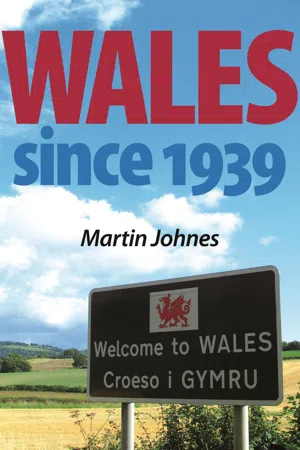
Wales since 1939
About this book
The period since 1939 saw more rapid and significant change than any other time in Welsh history. Wales developed a more assertive identity of its own and some of the apparatus of a nation state. Yet its economy floundered between boom and bust, its traditional communities were transformed and the Welsh language and other aspects of its distinctiveness were undermined by a globalizing world. Wales was also deeply divided by class, language, ethnicity, gender, religion and region. Its people grew wealthier, healthier and more educated but they were not always happier. This ground-breaking book examines the story of Wales since 1939, giving voice to ordinary people and the variety of experiences within the nation. This is a history of not just a nation, but of its residents' hopes and fears, their struggles and pleasures and their views of where they lived and the wider world.
Information
Publisher
Manchester University PressYear
2013Print ISBN
9780719086670
9780719086663
eBook ISBN
9781847795069
1
‘The waging of war.’ 1939–45
The waging of war has filled the valleys with work and wages. Boys swagger in the streets with pocketfuls of money. Omnibuses crowded with women and girls rumble to and fro between the scattered mining villages and the concentrated munition factories. The tide of migration has turned. The little houses of the hospitable miners are filled with English children from the ‘blitzed’ towns over the Border. The expulsive power of a new experience has dimmed the memories of the nineteen-thirties. The sufferings of enforced idleness have given place to the horrors of bombing and burning.
Thomas Jones, October 19411
The war, bad as it is in many ways, has been the making as well as the breaking of many. Young chaps that nobody had much use for in peacetime have helped to save their country from Hitler’s gang. Now our Gwen, instead of looking after those well able to look after themselves, is going to serve her country. What is there wrong in that?
Jack Jones, ‘Wales marches on’, radio broadcast, 19412
IN PONTYPOOL a twenty-five-year-old advertising canvasser spent the last days of August and the first of September 1939 working, deploring local traders for cutting down on advertising in a time of crisis and arguing with people about who was to blame for the impending war. He noted in his diary that such arguments were becoming more spiteful, perhaps because of people’s nerves. He made blackouts for his windows but also spent a lot of time in pubs, where he found little comfort because the constant talk of war annoyed him. People worried about the future, being called up and having to house evacuees. He had other problems too. His girl from down the valley had not written all week, a married woman wanted to go blackberrying with him and he wondered whether the stories of ‘easy availability’ during wartime were true. He was also avoiding listening to the radio, afraid he might hear a news bulletin announcing that war had started. Determined to occupy himself, he spent the morning of Sunday 3 September 1939 repairing his bicycle, meaning he missed Chamberlain’s announcement that Britain had declared war on Germany. When he found out from a friend, they went for a walk and discussed giving up their jobs to have some fun before being called up. Then they went to church to hear what the vicar had to say about the war. It was crowded with women and old men; he was one of the few young men there.3
It was unsurprising that people were worried. It was little more than twenty years since the Great War had ended, a conflict in which three-quarters of a million members of the British armed forces had been killed. Forty thousand of them had been Welsh. Technological developments meant that this war threatened far higher numbers of casualties, and not just in the armed forces. The government estimated that 600,000 British civilians might die in bombing in the first two months of a conflict. Thus when war broke out, a man from Aberystwyth remembered: ‘It cast a gloom everywhere…. One began to feel, as perhaps they hadn’t in previous generations, that now you were in the front line’.4 Yet, for all the memories of past horrors and the promise of future ones, there was little serious opposition to the decision to declare war. Nazi aggression in Europe was obvious and the conflict was widely believed to be a just one. Upon war’s outbreak, an editorial in the Western Mail proclaimed grandly:
The things against which we are fighting – ‘brute force, bad faith, injustice, oppression and persecution’ – all must be overthrown if we are not to be plunged back into the barbarism of the dark ages…. We are fighting neither for territory nor vengeance, neither for Danzig nor Poland, but to preserve values which transcend our purely national interests, values shared by all civilised humanity – for liberty, freedom, democracy, the reign of law, justice between nations, and against the most monstrous eruption of brute force in the history of the world.5
This was also the line peddled in the propaganda of the government, the BBC and the press; it was also true. There were other reasons to support the war. After the long, depressed years of the 1920s and 1930s, rearmament had already begun to bring some prosperity back to Wales’ shattered economy. Steel and coal were now needed and many young men were finding regular employment for the first time in their lives. But older heads remembered what had happened after the last war. Conflict might bring jobs and better wages but they were unlikely to outlast the emergency. And a global war was a hefty price to pay for simply having a job.
Thus while there was none of the patriotic fervour that had greeted the start of the Great War, there was an immediate willingness on the part of many to do their bit. On the day war was declared, hundreds gathered outside the recruitment offices in Cardiff only to find they were shut. One man dryly remarked, ‘Still what can you expect in Wales. Nothing opens on a Sunday.’6 In the following weeks thousands enlisted rather than waiting to be called up. In Glamorgan alone, 52,000 people volunteered during the war’s first month for what became the Home Guard.7 Yet much simply carried on as before. In November 1939 a young Cardiff woman wrote to her friend: ‘I remember when War was declared I thought it strange that practically every-thing went on as usual, you know milk-man, baker, fish-man all coming to the door as usual. Yet I guess if we didn’t it wouldn’t be British would it?’8
IN SEPTEMBER 1939 the poet Dylan Thomas wrote to a friend that he wanted to get something out of the war but put little in. He wrote to another that he was eager to secure something before ‘conscription, and the military tribunal, & stretcher-bearing or jail or potato-peeling or the Boys’ Fire League. And all I want is time to write poems.’ But beneath his commitment to his personal safety and comfort were more fundamental doubts. In another letter he asked: ‘What have we got to fight for or against? To prevent Fascism coming here? It’s come. To stop shit by throwing it? To protect our incomes, bank balances, property, national reputations? I feel sick. All this flogged hate again.’9 This mix of personal and political concerns was typical, although few would have shared Thomas’ interpretation. Most Welsh people enlisted with a sense of resigned inevitability, aware that they had little choice but knowing that, in some abstract way, it was the right thing to do. This sense of resignation meant that once in the forces it was very easy for soldiers to become preoccupied by the mundane realities of everyday life. One Welsh Guardsman recalled that the talk in the military huts ranged from
sex to the absolute bloody awful life of the British Soldier and then inevitably to the schemes for ‘working your ticket’, i.e. being thrown out as unfit for duty. Schemes like holding the little finger of the right hand just over the barrel of a 2” mortar and getting it blown off were discussed and discarded, the impact might blow the lot off, and in any case, the loss of a little finger was considered too trivial, there were many cases of soldiers with three fingers. Threatening the Sergeant Major with a bayonet, and many similar enterprises were all discarded. Surprisingly all this talk did no harm at all to the general moral[e] and discipline. Quite the opposite in fact, it kept the dream alive to beat the system, now that would be something!10
That such talk did not damage the willingness to fight was evident in the sacrifices made by the armed forces throughout the conflict. But it was not the great moral and political issues that made troops do this. Comradeship sustained people, not political ideals. People fought to survive, for their mates, for the ordinary things in life. After learning of his brother’s death, Cardiffian Brian Baker wrote to his father, ‘I have seen enough of this world to realise what home means. No Pop, I’m going to settle down at some job or other, and see if we cannot make up a little of the loss of Ron to each other. I would like to take up golf, and perhaps we can manage a little car between us … we could have some grand times eh?’ Brian was killed on active service two years later.11
Unlike in the Great War, the armed forces made no effort to keep local people together. Instead, recruits were sent to whatever units needed the skills or bodies. This meant that thousands of Welsh men and women ended up fighting and dying alongside other Britons. A few were angry at not being in Welsh units but a Merioneth man in the South Lancashire Regiment was probably more typical when he wrote in his memoirs that ‘the army was the army, and it hardly made any difference which badge I was given’.12 For those who were fighting, the constant danger created a powerful bond between them that transcended any differences arising from different cultural backgrounds but this does not mean that individuals’ Welshness was subsumed beneath a wider Britishness. The forces created an awareness of the diversity of Britain. A Welsh member of the Women’s Royal Naval Service recalled, ‘I don’t think I’d ever heard of a Scouse person or a Geordie until I joined up. Then, suddenly, all these different accents all around you. A lot of people didn’t know my accent. I’d be asked what part of Scotland I came from. Or Ireland – was I north or south?’13 Many men and women spent their war being known by everyone as Taff or Taffy, making their nationality central to who they were. Welsh was also spoken and tolerated in the forces. The Western Mail even thought it had been used to ‘deceive the Germans on the Western Front and confound the Japanese in the swamps and jungle of Burma’.14
The biggest demand for labour came not from the armed forces but from the industries that sustained the war effort. To combat the existing unemployment, six Royal Ordnance factories were set up in south Wales. The largest was at Bridgend, which employed 35,000 at its peak. Over the course of the war, there were 130,000 men and women employed in Wales in entirely new jobs created by the war effort, making everything from explosives and torpedoes to trucks, parachutes and radars. Such jobs ended the poverty of the 1920s and 1930s. Wages rose faster than living costs and there were substantial overtime opportunities too. In Britain as a whole, average earnings increased by 80 per cent, while prices rose by only 60 per cent. War also brought prosperity to Welsh agriculture, perhaps for the first time ever. There were directives and regulations to obey but farmers’ incomes rose substantially, as did those of their labourers. The war thus brought a more materialistic culture to rural communities because the profits that could be made out of farming were greater than in the days when there was little reward for innovating or working longer hours. Indeed, the wealth accumulated by many farmers allowed them to purchase their fa...
Table of contents
- Cover Page
- Title Page
- Copyright Page
- Dedication
- Contents
- List of figures and tables
- Acknowledgements
- Further resources
- Note on the use of place-names
- Maps of Wales
- Abbreviations used in endnotes
- Introduction
- 1 ‘The waging of war.’ 1939–45
- 2 ‘The spirit of reconstruction.’ 1945–51
- 3 ‘The hard times are finished.’ The coming of affluence, 1951–64
- 4 ‘Promiscuous living.’ Youth culture and the permissive society, 1951–70
- 5 ‘A new society.’ Class and urban communities, 1951–70
- 6 ‘Life among the hills.’ The Welsh way of life, 1951–70
- 7 ‘A cottonwool fuzz at the back of the mind.’ Language and nationhoods, 1951–70
- 8 ‘Nationalists of many varieties.’ 1951–70
- 9 ‘Black times.’ The passing of Labour, 1966–85
- 10 ‘Under an acid rain.’ Debating the nations, 1970–85
- 11 ‘Adapt to the future.’ The Tory remaking of Wales, 1979–97
- 12 ‘Who’s happy?’ Social change since 1970
- 13 ‘They don’t belong here.’ The countryside since 1970
- 14 ‘A nation once again.’ 1997–2009
- Conclusion. Wales 1939–2009
- Index
Trusted by 375,005 students
Access to over 1.5 million titles for a fair monthly price.
Study more efficiently using our study tools.
Frequently asked questions
Yes, you can cancel anytime from the Subscription tab in your account settings on the Perlego website. Your subscription will stay active until the end of your current billing period. Learn how to cancel your subscription
No, books cannot be downloaded as external files, such as PDFs, for use outside of Perlego. However, you can download books within the Perlego app for offline reading on mobile or tablet. Learn how to download books offline
Perlego offers two plans: Essential and Complete
- Essential is ideal for learners and professionals who enjoy exploring a wide range of subjects. Access the Essential Library with 800,000+ trusted titles and best-sellers across business, personal growth, and the humanities. Includes unlimited reading time and Standard Read Aloud voice.
- Complete: Perfect for advanced learners and researchers needing full, unrestricted access. Unlock 1.5M+ books across hundreds of subjects, including academic and specialized titles. The Complete Plan also includes advanced features like Premium Read Aloud and Research Assistant.
We are an online textbook subscription service, where you can get access to an entire online library for less than the price of a single book per month. With over 1.5 million books across 990+ topics, we’ve got you covered! Learn about our mission
Look out for the read-aloud symbol on your next book to see if you can listen to it. The read-aloud tool reads text aloud for you, highlighting the text as it is being read. You can pause it, speed it up and slow it down. Learn more about Read Aloud
Yes! You can use the Perlego app on both iOS and Android devices to read anytime, anywhere — even offline. Perfect for commutes or when you’re on the go.
Please note we cannot support devices running on iOS 13 and Android 7 or earlier. Learn more about using the app
Please note we cannot support devices running on iOS 13 and Android 7 or earlier. Learn more about using the app
Yes, you can access Wales since 1939 by Martin Johnes in PDF and/or ePUB format, as well as other popular books in History & 20th Century History. We have over 1.5 million books available in our catalogue for you to explore.