eBook - ePub
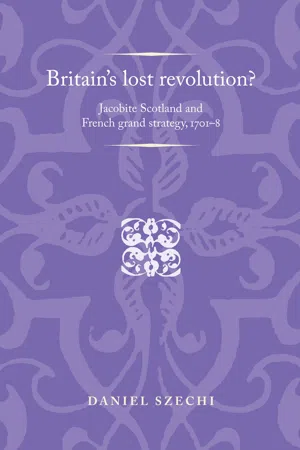
Britain's lost revolution?
Jacobite Scotland and French grand strategy, 1701–8
- 220 pages
- English
- ePUB (mobile friendly)
- Available on iOS & Android
eBook - ePub
About this book
This book is a frontal attack on an entrenched orthodoxy. Our official, public vision of the early eighteenth century demonises Louis XIV and France and marginalises the Scots Jacobites. Louis is seen as an incorrigibly imperialistic monster and the enemy of liberty and all that is good and progressive. The Jacobite Scots are presented as so foolishly reactionary and dumbly loyal that they were (sadly) incapable of recognising their manifest destiny as the cannon fodder of the first British empire. But what if Louis acted in defence of a nation's liberties and (for whatever reason) sought to right a historic injustice? What if the Scots Jacobites turn out to be the most radical, revolutionary party in early eighteenth-century British politics? Using newly discovered sources from the French and Scottish archives this exciting new book challenges our fundamental assumptions regarding the emergence of the fully British state in the early eighteenth century.
Information
Publisher
Manchester University PressYear
2016Print ISBN
9781526106834
9780719089176
eBook ISBN
9781847799883
Chapter 1

Britain’s lost revolution and the historians
This is a book about a lost moment in British, and especially Scots, history. Students and lay readers interested in the past can be forgiven for surveying the massive annual output of the history-writing industry and the miles of works sitting on library bookshelves and coming to the conclusion that there are no more stories to tell and nothing significant still to learn. Everything seems to have been covered. Professional historians (myself included) inadvertantly feed this fundamental misapprehension by the confidence with which we write about our subjects. We do so because the rigour and discipline with which professional historians now approach the past means that (in the vast majority of cases) we genuinely do know very well of what we speak. What we do not communicate so effectively is how limited we are. The further a historian gets into the evidence, the more s/he realises how much s/he does not, and can never, know. Rather than being a seamless robe of understanding, our historical vision is a ragged coat woven out of disparate patches of cloth loosely tied together by slender threads.
Yet, at the risk of straining the metaphor, the holes and threadbare bits in the robe are not a failure, but rather a blessing. They provoke dissatisfaction, the mother of historical discovery. We seek to perfect our historical vision (though we know we will never achieve this) and in the process stumble across new and fascinating moments in the past that change our understanding of its dynamics and hence the process by which it became the present. This may seem abstruse, except that it pretty well describes the genesis of the research that has led to this book. This is ultimately a book about one historian’s engagement with an apparently minor moment in the past and his consequent realisation of a path not taken.
The reason there has hitherto been so little interest in the French attempt to invade Scotland in 1708 is that it completely failed.1 The French never landed, there was no rebellion and life soon resumed its accustomed course. This was of a piece with the eleven other failed or abortive French attempts to invade the British Isles between 1688 and 1805 and on the face of it deserves no special attention.2
Nor has it received any. Even at the time the attempt was soon a subject for mockery rather than concern. Once it was over, contemporary newspapers dismissed it as a trivial and silly business, founded on French ignorance of British sensibilities, and the Observator memorably and amusingly presented James, III and VIII in the Jacobite line of succession, as a frightened and scrambling race-horse jockey slipping, spurring and sliding to dodge his pursuers across the North Sea and back.3 In the modern era it has garnered equally little respect. When they mention it at all most historians of the period mention it only in passing,4 and then often in a rather garbled fashion,5 doubtless a product of there being for a long time no substantive secondary work on the subject. Even the pioneer of the more dispassionate approach to Jacobitism of the mid- to late twentieth century, George Hilton Jones, twice failed to look beyond the basic outline of events, and so missed the significance of what was going on.6 In a brief 1971 article, and later in a section of a book on Jacobite rebellions, Christopher Sinclair Stevenson gave the subject greater attention, but he was more interested in sardonically recounting its failure than in exploring what it could tell us about the Jacobite movement, and in any event it came a poor third in his three-part account of the Jacobites’ ‘inglorious’ rebellions 1708–19.7 John Sibbald Gibson’s 1988 book, Playing the Scottish Card, was thus the first full treatment of the conspiracy and the attempt to invade. Gibson, however, was more interested in the characters involved than the dynamics of the phenomenon, largely restricted his research to published material and was influenced by his conviction that the failure of the Enterprise of Scotland was a ‘good thing’.8 The net effect has been to create a partial and incomplete understanding of the event.
This is not, though, at all surprising. With so much else still to do, historians of Jacobitism and of British history naturally turned their attention to more ‘important’ moments in the past. Nor were the historians of France drawn to the subject. Another failed military operation at the height of the French military crisis of 1704–10? Their names were legion, and no particular reason to investigate this one.9
For a long time I, too, found nothing especially interesting about the ’08. That is until I began to work on the great Jacobite rebellion of 1715.10 As I got deeper and deeper into my research on that landmark event in Jacobite and British history the more I realised that the actors and their actions in 1715 were constantly harking back to the non-events of 1708. The great Jacobite rebellion was in effect the realisation of what had been envisaged in 1708, but without the prospect of French intervention. And because the Scots Jacobite challenge to the British state was so powerful (albeit fragile) in 1715, I began to ponder a what-if scenario. What if the French had landed in 1708, and a rebellion as powerful as, or even more powerful than, that of 171511 had greeted them? The French government, enmired in a war France was losing, weighed up the probable consequences with respect to its own international situation and decided that such a large, popular uprising in Scotland was very likely to so disrupt its enemies’ war effort as to give it victory, and its calculations are compelling.12 But what would a French victory have meant for the Scots Jacobites now in arms and the British polity that was their mortal foe? Louis XIV promised to include the Scots in any peace he made, so even if the Jacobite rising in Scotland had failed to spread to England – as seems likely because of the popularity there of Queen Anne – in the event of a French victory there was a good prospect that Scotland would have broken away from Britain and once more become an independent, sovereign state.13 To say the least, this would have had profound consequences for the subsequent history of the peoples of the British Isles.
In essence, then, the more I scrutinised the possible consequences of a different outcome of the events of 1715 and then 1708, the more both of them, but especially 1708, began to look like one of the hinge points of history. These are the moments when the trajectory of human affairs in a polity irrevocably shifts out of its accustomed track and a new direction of development prevails. We commonly associate such shifts with that peculiar, violent phenomenon we call revolution, and so did many contemporary eighteenth-century observers of the events that are the focus of this book.14 Could it be that the fledgling British polity (newly created in 1707), and the peoples of the British Isles, were on the cusp of such an upheaval in 1708? Was there any evidence that this was the case?
My compulsion to try and answer these questions has given rise to this book, but even if I cannot provide a definitive answer (and one can in the end only answer a what-if question with an assessment of probabilities) there is, none the less, a considerable value in a close analysis of this fleeting moment in the history of these Isles.15 One of the most pernicious and abiding problems in the field of Jacobite studies stems directly from Jacobitism’s underground, dangerous and illegal nature: if Jacobites were caught with incriminating documents they faced serious, potentially fatal, repercussions. James Shepheard, for example, was executed in 1718 for merely fantasising in writing about striking down ‘the usurper’, which the court that condemned him construed as an avowed intent to murder George I.16 As a consequence, wise Jacobites developed a practised ambiguity or even downright mendacity when questioned about their allegiance to the new order in the British Isles after 1688, did their Jacobite business as far as possible orally in the presence of only one witness (two were required to convict someone of treasonous words) and regularly burned their correspondence with the Jacobite government-in-exile.17 This has meant that relatively little written evidence of Jacobite activity survives from the native Jacobite side. We have plenty of denunciations of Jacobites by supporters of successive British governments, and the ’15 and the ’45 each produced a brief flood of witness statements and confessions, but we have little evidence of the internal dynamics of the movement beyond the surviving archives of the Jacobite court at St Germain and its successors at Bar-le-Duc, Avignon and finally Rome.18
Yet these, too, have suffered from the vicissitudes of history. Some were destroyed during the French Revolution and others by neglect after the final demise of the Stuart cause. The worst damage from the point of view of this project was done in 1793–94 during the destruction of the Collège des Ecossais/Scots College in Paris, when the vast majority of the exiled court’s records for the period 1688–1713 (deposited there at various times between the 1690s and the 1740s) were burned.19 Before the Prince Regent subsequently bought the Stuart papers that survived in Italy in 1816 and had them carried off to a safe depository in Windsor they had in turn rotted away for years in a leaky attic and amply provided who knows how many families of mice and rats with snacks, chew-toys and nesting material.20 Edward Corp has reconstructed an inventory of the original archive and we can say for certain that only a small percentage of the thousands of letters written and received by the Jacobite government-in-exile 1688–1713 has survived.21 Even these have been subjected to severe criticism in terms of their value as a source for the history of Jacobitism. Paul Langford spoke for many other historians working on the eighteenth century when he dismissed the Stuart papers as ‘highly unreliable’ and simply sustaining ‘historical illusion’.22
Yet while it may be possible, however wrongly, to so dismiss the surviving documentary record of the Jacobite movement as a tissue of fantasy and self-delusion, few historians of the era would so describe the archival record of the French state. For all their personal sympathy for their Stuart cousins, the princes of the house of Bourbon were nothing if not ruthless pursuers of dynastic or state interests. Sympathising with their Stuart cousins and generously sustaining them was one thing, but Louis XIV and his heirs were going to invest troops, ships and money in their cause only on the basis of hard-nosed political and strategic calculation.23 These calculations were, furthermore, based not just on Jacobite claims and assertions but on independent verification by French agents. These men and their missions were focused on a specific question of vital importance to France: could the Jacobites deliver on their promises? Which is to say, could the Jacobites be directly useful? Some time ago Eveline Cruickshanks demonstrated how much we could learn about the inner history of a Jacobite conspiracy (the English Jacobite plot of 1743–44) from these French investigations and assessments, and Frank McLynn triumphantly extended and consolidated her argument with respect to the Scots Jacobites and the ’45 a few years later.24 This book will accordingly follow where they have led for an earlier period, though no less crucial a moment.
The work of one particular French agent, that of Colonel reformé Nathaniel Hooke,25 overshadows all others with respect to influencing France’s decision to commit men, ships and money to the ’08, or, to give it its official French title, l’Entreprise d’Écosse (the Enterprise of Scotland). As the fascinating thesis recently written by Dr Thomas Byrne at Maynooth has convincingly shown, though Hooke first went to France as an officer in the exiled Irish army of James II and VII, after the king’s death he became a special agent for the French Secretary of State for Foreign Affairs, Jean Baptiste Colbert de Croissy, marquis de Torcy, and though he was not officially naturalised as a French subject until 1706 he was a faithful servant of France long before then.26 As he made clear time after time in his reports, Hooke was perfectly willing to sacrifice the entire Scots Jacobite movement to serve France’s interests. Hooke was trusted by his patron, and his reports were positively approved of, and relied upon, by Louis XIV and the king’s other ministers.27 Hooke’s assessments and analyses correspondingly dominate the French foreign office archives dealing with Scotland between 1703, when he properly turned his attention to it and 1708, when he by and large moved on to other affairs.28 The rewards he garnered for his services as a secret...
Table of contents
- Cover
- Half Title Page
- Title Page
- Copyright Page
- Dedication
- Contents
- List of illustrations and maps
- Acknowledgements
- Abbreviations, dates, spelling and punctuation
- 1 Britain’s lost revolution and the historians
- 2 March 1708 and its aftermath
- 3 The Jacobite underground in the early eighteenth century
- 4 The Scots Jacobite agenda, 1702–10
- 5 The geopolitics of the Enterprise of Scotland
- 6 Conclusion
- Bibliography
- Index
Trusted by 375,005 students
Access to over 1.5 million titles for a fair monthly price.
Study more efficiently using our study tools.
Frequently asked questions
Yes, you can cancel anytime from the Subscription tab in your account settings on the Perlego website. Your subscription will stay active until the end of your current billing period. Learn how to cancel your subscription
No, books cannot be downloaded as external files, such as PDFs, for use outside of Perlego. However, you can download books within the Perlego app for offline reading on mobile or tablet. Learn how to download books offline
Perlego offers two plans: Essential and Complete
- Essential is ideal for learners and professionals who enjoy exploring a wide range of subjects. Access the Essential Library with 800,000+ trusted titles and best-sellers across business, personal growth, and the humanities. Includes unlimited reading time and Standard Read Aloud voice.
- Complete: Perfect for advanced learners and researchers needing full, unrestricted access. Unlock 1.5M+ books across hundreds of subjects, including academic and specialized titles. The Complete Plan also includes advanced features like Premium Read Aloud and Research Assistant.
We are an online textbook subscription service, where you can get access to an entire online library for less than the price of a single book per month. With over 1.5 million books across 990+ topics, we’ve got you covered! Learn about our mission
Look out for the read-aloud symbol on your next book to see if you can listen to it. The read-aloud tool reads text aloud for you, highlighting the text as it is being read. You can pause it, speed it up and slow it down. Learn more about Read Aloud
Yes! You can use the Perlego app on both iOS and Android devices to read anytime, anywhere — even offline. Perfect for commutes or when you’re on the go.
Please note we cannot support devices running on iOS 13 and Android 7 or earlier. Learn more about using the app
Please note we cannot support devices running on iOS 13 and Android 7 or earlier. Learn more about using the app
Yes, you can access Britain's lost revolution? by Daniel Szechi in PDF and/or ePUB format, as well as other popular books in History & British History. We have over 1.5 million books available in our catalogue for you to explore.