- 225 pages
- English
- ePUB (mobile friendly)
- Available on iOS & Android
eBook - ePub
David Milch
About this book
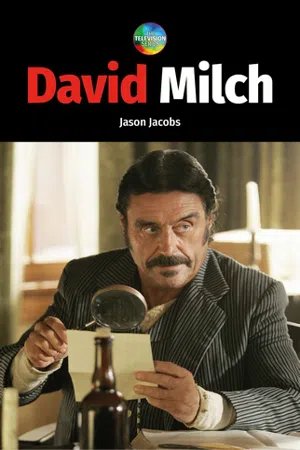
This book is about the life and work of David Milch, the writer who created NYPD Blue, Deadwood and a number of other important US television dramas. It provides a detailed account of Milch's journey from academia to the heights of the television industry, locating him within the traditions of achievement in American literature over the past in order to evaluate his contribution to fiction writing. It also draws on behind-the-scenes materials to analyse the significance of NYPD Blue, Deadwood, John From Cincinatti and Luck. Contributing to academic debates in film, television and literary studies on authorship, the book will be of interest to fans of Milch's work, as well as those engaged with the intersection between literature and popular television.
Information
Topic
LiteraturSubtopic
Europäische Literaturkritik1
Words
Passion, and passion in its profoundest, is not a thing demanding a palatial stage whereon to play its part. Down among the groundlings, among the beggars and rakers of the garbage, profound passion is enacted. And the circumstances that provoke it, however, trivial or mean, are no measure of its power.
Herman Melville, Billy Budd, Sailor1
In 1970 David Sanford Milch submitted two chapters from a novel as part of his Master of Fine Arts at the prestigious Iowa Writers’ Workshop. The never-to-be-published novel was entitled The Groundlings, and the title was clearly inspired by this passage from Melville’s last prose work, itself unpublished during his lifetime.2 Here and since, Milch’s writing has consistently engaged with the lives and passions of ‘groundlings’, a word originally denoting those so poor that they were located unseated in the pit of the theatre below the stage, and which has acquired the meaning of unsophisticated or uncritical readers. These are the low, cheap and often dirty creatures close to the ground whose lives undergo scrutiny in some of Milch’s most compelling works such as NYPD Blue, Deadwood, John From Cincinnati and Luck. The latter show’s most compelling characters are described in the script as The Degenerates – Marcus (Kevin Dunn), an irascible, wheelchair-bound, oxy-mask huffing worrier; Jerry (Jason Gedrick), a younger, hopped-up gambling genius; the kindly but dim-witted Renzo (Richie Coster); and the endlessly concupiscent Lonnie (Ian Hart) – who together allow us to participate in the profound highs and lows of the racetrack, and who threaten to steal the show altogether from its big star heavy-hitters Dustin Hoffman (Ace Bernstein) and Nick Nolte (Walter Smith). The Degenerates are characters for whom Milch has personal affection, and his dissertation was a signpost on his journey from a literary wonder boy and teacher in the 1960s and 1970s to a Hollywood television screenwriter and showrunner in the 1980s, 1990s and 2000s. Both forms of communication and expression are powered by words as the building blocks of character and story, and tracking Milch’s engagement with both allows us to get a sense of his inheritance of and participation in the traditions of American literature.
When I first met Milch in 2010 he showed me a copy of one of the volumes of American Literature: The Makers and the Making that he kept in his office: flicking through its many double-columned pages he said, ‘This is the tradition in which I see myself.’ Perhaps one had to be there, because it was said with a characteristic sense of submission to something greater, rather than an egotistical carving out of artistic identity in the world. Milch’s conception of himself in interviews, commentaries and workshops is explicitly tied to literature, especially his tutelage under the Southern poet and novelist whom he met at Yale, Robert Penn Warren. ‘The people I write for are all dead’, he has remarked, ‘Twain, Melville, James.’ The claim that Milch belongs in the pantheon of those artists who have captured the metabolism of American life and history in depth – Philip Roth, Cormac McCarthy, Nicholas Ray, Sam Peckinpah, Frank Capra, Robert Stone (some of them also carried the burden of early promise and floundered in the grip of addiction) – is not an attempt to elevate the status of either him or television through association with culturally validated and admired traditions. (What would be the point?) His fame and success have come exclusively from that despised emblem of commercialised vulgarity in the minds of most academics, teachers, critics and connoisseurs of literature – a slack-jawed, dribbling purveyor of all that is bent, distorting and beguiling: television, the medium for groundlings.
That this is an entirely false image of television, of art and of Milch’s contribution to both can be demonstrated in the tracing of his gradual maturation during the 1960s and 1970s, so that we see the move to television not as the sacrificing of loftier ambitions – despite what others such as his teacher at Iowa, Richard Yates, told him – but rather a necessary honouring of his particular skills as a storyteller and writer that, through a peculiar set of circumstances, washed him up at the medium that seems perfectly adjusted in its mendacity and sociality to an artist of his talents. Any assessment of Milch is bound to be caught between the discipline of Literary Studies, which has little time for television (beyond the use of its literary adaptations to engage bored students, or gestures of dilettantism such as writing about Mad Men for the Wall Street Journal), and the younger discipline of Television Studies, which celebrates the medium as an emblem of folk culture and is suspicious of any claims to high art as defiling the medium’s specificity. In the former’s dim lights, the dramatic products of television are unworthy of attention because corrupted by collective, commercial and industrial imperatives that ineluctably distort the characteristic voice of the individual artist; whereas, for the lords and ladies of Television Studies, all claims of artistic integrity, intentionality and artistic achievement smack of the illegal border crossing of transcendent values from the pre-structuralist Stone Age of mystical, organic evaluative behaviour, and ‘values’ are not something we should associate with television at all.3 In between, some of the finest works of art of the past decade vanish or are taken up only for the ways in which they reflect aspects of their social, cultural, industrial and other historical circumstances. In any case, the hygienic splitting of medium-specific works makes more sense in critical and reflective contexts than it does in practice: there are other forces in US literary culture and its institutions which shared a great deal with the mass entertainment industry. The story of Milch’s early development as a writer outlined in what follows eschews both approaches, instead mixing biographical elements with a cultural history of American criticism and creative practice.
Elmer Milch
Milch was not born to a literary family, but he has a background that brims with events that resonate with his work. His relatives settled in the US after fleeing the European anti-Jewish pogroms at the turn of the twentieth century; his great grandmother on his mother’s side witnessed the beheading of her husband by a Cossack. In True Blue, his account of the development of NYPD Blue, Milch gives an extraordinary account of the accident that befell his father, Elmer Milch, shortly after his marriage to Molly. Trained as a doctor, Milch Sr was recruited to a military medical unit during the Second World War; the night before he was due to go overseas in 1944 the jeep he was driving collided with an army truck, and in the accident his lower body was crushed. He was to spend the next year undergoing reconstructive surgery. The event had a lasting effect on Elmer: every three months or so thereafter ‘he’d need to be catheterized to dilate his urinary passage, which was constricted by scar tissue’, and he remained addicted to the strong narcotic painkillers taken during his recovery for the rest of his life.4 This vivid image of recurrent scarring and the relief of narcotics all bound up with unspecified desire and the implication of deceit (on his father’s reason for being in the jeep, Milch writes: ‘the public version was that the base was sealed down because of the imminent troop embarkation and he’d taken the jeep to drive into town to call my mother and tell her goodbye’), like many of the autobiographical scenes in True Blue, has a script-like quality to it. The words are freighted with unstated implications that seem to require our further work as readers to fully activate or realise their deepest meaning, and they carry forward – as we shall see – to Milch’s learning at Iowa.
Milch’s mother was not allowed access to her badly injured husband for many months, but eventually she was permitted to spend time alone with him in his hospital room. In True Blue, when writing about himself, Milch often ‘says’ something powerful by simply not saying it, and hence opens a door for the reader: ‘When he was released from the hospital, they left together to get Bob [Robert, his elder brother]. By this time, my mother was pregnant with me.’5 This is a Milchean scene par excellence: a statement of his origins in which injury, pain, narcotics, institutional rules and law as much as desire and love are the prominent contextual components in the act of conception. The meaning stored in the sentence unpacks as something like: ‘I came from this; this is my beginning.’
A young, recently married couple forced apart by a horrific accident (‘his bladder could be visualised about four inches below his neck’, according to Milch) on the eve of what was Elmer Milch’s departure for an uncertain, potentially lethal wartime destination (one assumes it was the D-Day operation) are, finally, allowed to be in one another’s company as he recovers to a state where one might judge that he is fit to be seen by his loved ones. One might wonder at the pseudo-public setting of the hospital bed, however privately arranged, and the potential for shame and secrecy that it held. What about its proximity to procedures and implements of care, recovery, agencies of pain and resources to salve, and their intermixing in an imagination that has remained in intimate thrall to his father’s moods, persona and ultimate destiny? To what extent are we hostage to our parents’ intentions, hopes and aspirations for us in the moments before, during and after our conception? One might take up the doubleness of Milch’s conception from the kernel of a brutal trauma and painful recovery alongside the miracle of survival, the release and joy of reunion between young lovers forced to forgo sex (even if it were physically possible), where desire and love overcome pain and injury and damage. Or, in another mood, one’s imagination might become susceptible to atavistic determinism, a temptation to deploy destiny as following the pathway of one’s origins, cursed like Noah’s son, Ham, to know (something – but what? In the biblical version the curse and its reasons are hardly straightforward or known in themselves.) But then, if that is so, this is part of a literary, almost mythic story of origin, included in a book capitalising on the success of a network TV show in the 1990s. Up until the sessions Milch recorded during the 2007–08 Writers’ Guild of America strike, True Blue provides the most extensive autobiographical account of his background, offering a robustly candid and yet – seemingly impossibly – at the same time obstructed view. Sometimes we can hide anything and everything by putting it in plain sight.
As we shall see when we come to consider the role of New Criticism in American literary studies, the role of biography in accounting for artistic achievement has for a long time been under suspicion as a simplified version of cultural mediation; the art expresses the life, so understanding the life brings us closer to appreciating the nature of the work. However, Milch’s background, and his father’s, strike me as an important component in a larger picture in order to grasp some aspects of the significance of the lived experience of the young boy: of the deceit, despair, lies, doubleness and concealment of deeper motives and desires in the life of a father who so dominated but did not wholly define Milch’s later artistic life. It is hard to overstate the resonance and power of his father’s psychic authority.
Elmer Milch’s boyhood was itself fractured by the unsettling behaviour of his parents and grandparents. His mother was the eldest of ten children, and as a grown man Elmer was therefore more or less the same age as his uncles. Her father was a bootlegger involved in the Jewish organised crime milieu that would culminate in Meyer Lansky’s domination of clubs and casinos in Saratoga and then south across New York State. David Milch eventually met Lansky, thinking he might write his biography, but found him so unreliable that he ‘couldn’t even be honest about what time it was’. Of his great grandfather Milch said, ‘probably the nicest thing about him was that he was a bootlegger’. Once, when the police showed up looking for a murder suspect, he blamed his own son, who had to flee the state and change his name. He later went on to run the Latin Quarter club in New York with Lou Walters (Barbara’s father), where mob money would be laundered.
When the patriarch’s wife died, he took his daughter and her husband with the young Elmer into his house, and may well have taken up with Elmer’s mother – his daughter – in an incestuous relationship. Hence Elmer’s early childhood was forged within this powerful melodramatic and criminal setting, with rival father figures and mortal stakes. Whatever was going on in the house, his father eventually attempted suicide by throwing himself off Niagara Falls in a barrel. Quite apart from living in this strange Sirkean domestic situation,...
Table of contents
- Cover
- Half Title
- Title Page
- Copyright
- Dedication
- Contents
- General editors’ preface
- Acknowledgements
- Introduction
- 1 Words
- 2 Character
- 3 Vision
- 4 Luck
- David Milch Filmography
- Bibliography
- Index
Trusted by 375,005 students
Access to over 1.5 million titles for a fair monthly price.
Study more efficiently using our study tools.
Frequently asked questions
Yes, you can cancel anytime from the Subscription tab in your account settings on the Perlego website. Your subscription will stay active until the end of your current billing period. Learn how to cancel your subscription
No, books cannot be downloaded as external files, such as PDFs, for use outside of Perlego. However, you can download books within the Perlego app for offline reading on mobile or tablet. Learn how to download books offline
Perlego offers two plans: Essential and Complete
- Essential is ideal for learners and professionals who enjoy exploring a wide range of subjects. Access the Essential Library with 800,000+ trusted titles and best-sellers across business, personal growth, and the humanities. Includes unlimited reading time and Standard Read Aloud voice.
- Complete: Perfect for advanced learners and researchers needing full, unrestricted access. Unlock 1.5M+ books across hundreds of subjects, including academic and specialized titles. The Complete Plan also includes advanced features like Premium Read Aloud and Research Assistant.
We are an online textbook subscription service, where you can get access to an entire online library for less than the price of a single book per month. With over 1.5 million books across 990+ topics, we’ve got you covered! Learn about our mission
Look out for the read-aloud symbol on your next book to see if you can listen to it. The read-aloud tool reads text aloud for you, highlighting the text as it is being read. You can pause it, speed it up and slow it down. Learn more about Read Aloud
Yes! You can use the Perlego app on both iOS and Android devices to read anytime, anywhere — even offline. Perfect for commutes or when you’re on the go.
Please note we cannot support devices running on iOS 13 and Android 7 or earlier. Learn more about using the app
Please note we cannot support devices running on iOS 13 and Android 7 or earlier. Learn more about using the app
Yes, you can access David Milch by Jason Jacobs in PDF and/or ePUB format, as well as other popular books in Literatur & Europäische Literaturkritik. We have over 1.5 million books available in our catalogue for you to explore.