Did early modern people care about their health? And what did it mean to lead a healthy life in Italy and England? Through a range of textual evidence, images and material artefacts Conserving health in early modern culture documents the profound impact which ideas about healthy living had on daily practices as well as on intellectual life and the material world in this period. In both countries staying healthy was understood as depending on the careful management of the six 'Non-Naturals': the air one breathed, food and drink, excretions, sleep, exercise and repose, and the 'passions of the soul'. To a close scrutiny, however, models of prevention differed considerably in Italy and England, reflecting country-specific cultural, political and medical contexts and different confessional backgrounds.
The following two chapters are available open access on a CC-BY-NC-ND license here: http://www.oapen.org/search?identifier=633180
3 'Ordering the infant': caring for newborns in early modern England - Leah Astbury
4 'She sleeps well and eats an egg': convalescent care in early modern England - Hannah Newton
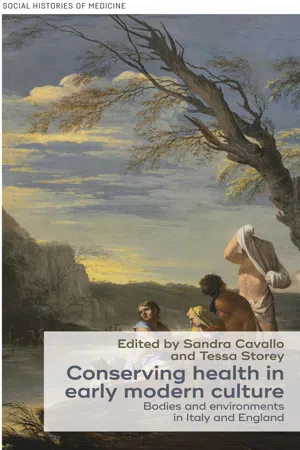
eBook - ePub
Conserving health in early modern culture
Bodies and environments in Italy and England
- 328 pages
- English
- ePUB (mobile friendly)
- Available on iOS & Android
eBook - ePub
Conserving health in early modern culture
Bodies and environments in Italy and England
About this book
Information
The Non-Naturals and the vulnerable body
2
‘What to expect when you're always expecting’: frequent childbirth and female health in early modern Italy
Pregnancy constituted a frequent physical state for many women of the early modern European aristocracy.1 In an age of high child mortality, the practice was considered laudable for the continuation of the aristocratic lineage. The rapidity of procreation required the sharing of knowledge among women regarding how to survive the physiological and psychological demands of frequent pregnancy and childbearing. Occasionally catastrophic events necessitated extreme interventions by medical practitioners or the ingestion of remedies prescribed by physicians. But success in frequent childbearing relied upon close attention to the Non-Naturals through the adoption of specific practices believed to be most conducive to successful pregnancy and good health in newborns. From proper rest and moderate exercise to limiting exposure to noxious fumes, purging the body and attending to the emotions of melancholy and anxiety, the pregnant woman was believed to have some control over her fertility and the positive outcome of her pregnancies.
Among Roman aristocratic women, attention to the ideal everyday regime was thought to be essential for the ‘trade’ (mestiere) of frequent childbearing in service to their marital dynasties.2 As was the case with all trades, it had traditions and knowledge shared among its practitioners. It did not evolve in an isolated periphery of medical hearsay, but rather among women with frequent access to the trained care of professionals, and to information passed from mothers to daughters, and among sisters, midwives and wet nurses. How did aristocratic women envision the daily health habits that they believed most conducive to the survival of the mother in this aristocratic female occupation? An extensive corpus of epistolary evidence by one Roman aristocratic woman, Eleonora Boncompagni Borghese (1642–95) provides precious insights into the thoughts of women on the place of the Non-Naturals in the healthy female body and in particular, the frequently pregnant and childbearing aristocratic mother.3
Eleonora's hundreds of letters sketch the panorama of seventeenth-century Roman life. She reflected openly on the religious controversies over quietism, the dilemmas of wayward aristocratic men and rebellious children, the challenges of aging and the ubiquity of illness. Above all she preferred issues related to health – there was little in that vast domain that escaped her scrutiny. Eleonora's medical perspective was clearly informed by the tenets of Galenic medicine, especially its emphasis on the centrality of balancing the body's humours and its attention to the Non-Naturals. The Non-Naturals emphasised that good health was linked to an individual's attention to movement, rest, bodily evacuations, air, diet and mental states that could enhance her or his health. Although recent scholarship has begun to recover the significance of the Non-naturals to early modern medical practice and to theories of human health, much less is known about how individuals without formal medical training factored them into their thinking on health and illness.4 Eleonora did not employ the term Non-Naturals, but the practices associated with them were critical to the way she thought about health in pregnancy. She placed the greatest emphasis on four of the Non-Naturals: adequate movement, rest, the moderate purging of the body, and the mental and spiritual state of the pregnant woman. She devoted less attention to the quality of the air, although she mentioned it occasionally and, as we shall see, in dire terms. Men (in her view) had much more trouble with proper diet than did women, so it received only occasional treatment in her letters regarding women's health.5
Eleonora's attention to the Non-Naturals echoes a similar focus in several popular and oft-reprinted early modern texts, including those by Scipione Mercurio and Giovanni Marinello. Eleonora never specifically referenced such works nor did she attend (as such manuals did) to the physiological elements of procreation and fertility. Vernacular texts offered readers explicit information on the sexual organs, the act of intercourse, and the techniques believed efficacious for impregnation and the production of boys in particular.6 From the perspective of twenty-first-century readers, Eleonora's perspective may seem less compelling, since she omitted such topics in her writing. Whether she did so for reasons of decorum (but might have discussed them in person) or whether she judged such information not the relevant issue for the recipient of her letters has not come to light in the extant letters of the noblewoman. Eleonora's imperative that good health derived from the practice of good habits is the recurring and consistent theme of her correspondence. She considered such attention the key variables for fertility, pregnancy and the successful delivery of offspring.
To grasp the relevance of the Non-Naturals for the health of mothers in particular, this article will attend first to the familial context that required a life of nearly continuous pregnancy for aristocratic women. Women's focus on good health habits has to be located in the challenging physical demands the aristocratic family regime made upon some women's bodies. Eleonora's emphasis on four Non-naturals as the foundation for the fecund female body illuminates the central place they held in her understanding of health and fertility. How each should be practised by women of childbearing age will thus be examined in detail.
The aristocratic ‘trade’ of frequent childbirth
A key reason why aristocratic women needed to be particularly attuned to the health demands of pregnancy was that they were pregnant so often. The aristocratic Boncompagni family illustrates this trend well. Beginning in the last years of the fifteenth century, through to the last years of the seventeenth century, each generation of the family had as many as eight to thirteen children. In each generation, the children were borne by a single woman who had married into the Boncompagni dynasty. Many other noble family trees testify to the fertility and the labour of their women, whose activity could occur over a long span of time, sometimes almost two decades of childbearing.
A close look at the implications for specific Roman aristocratic women illustrates the demands these practices made upon them. Boncompagni mothers, for instance, bore children at the rate of almost one per year, as did Leonor Zapata y Brancia (1593–1679) whose nine children came into the world in the space of just twelve years. This relentless efficiency was surpassed by her daughter-in-law Maria Ruffo (1620–1705), who added thirteen souls to the ranks of the dynasty during a sixteen-year span, by the end of which time she was 38 years old. Bearing two sets of twins added to the fecundity of her enterprise. It was Maria Ruffo's daughter, Eleonora Boncompagni Borghese, who left behind the voluminous ruminations on the necessity and the difficulties of frequent childbirth. Eleonora was Maria Ruffo's firstborn girl, so she observed both her mother's experiences and knew well and admired her long-lived grandmother.
While Eleonora herself had only four children who lived to adulthood, she accepted that her grandmother's and her mother's trajectory was t...
Table of contents
- Cover
- Series page
- Title page
- Copyright page
- Contents
- Plates
- Figures
- Contributors
- Acknowledgements
- Color Plates
- Introduction
- I A comparative perspective on preventive literature
- II The Non-Naturals and the vulnerable body
- III Airs and places
- IV Spiritual health and bodily health
- V Spaces, paintings and objects: performing and portraying health
- Bibliography
- Index
Trusted by 375,005 students
Access to over 1.5 million titles for a fair monthly price.
Study more efficiently using our study tools.
Frequently asked questions
Yes, you can cancel anytime from the Subscription tab in your account settings on the Perlego website. Your subscription will stay active until the end of your current billing period. Learn how to cancel your subscription
No, books cannot be downloaded as external files, such as PDFs, for use outside of Perlego. However, you can download books within the Perlego app for offline reading on mobile or tablet. Learn how to download books offline
Perlego offers two plans: Essential and Complete
- Essential is ideal for learners and professionals who enjoy exploring a wide range of subjects. Access the Essential Library with 800,000+ trusted titles and best-sellers across business, personal growth, and the humanities. Includes unlimited reading time and Standard Read Aloud voice.
- Complete: Perfect for advanced learners and researchers needing full, unrestricted access. Unlock 1.5M+ books across hundreds of subjects, including academic and specialized titles. The Complete Plan also includes advanced features like Premium Read Aloud and Research Assistant.
We are an online textbook subscription service, where you can get access to an entire online library for less than the price of a single book per month. With over 1.5 million books across 990+ topics, we’ve got you covered! Learn about our mission
Look out for the read-aloud symbol on your next book to see if you can listen to it. The read-aloud tool reads text aloud for you, highlighting the text as it is being read. You can pause it, speed it up and slow it down. Learn more about Read Aloud
Yes! You can use the Perlego app on both iOS and Android devices to read anytime, anywhere — even offline. Perfect for commutes or when you’re on the go.
Please note we cannot support devices running on iOS 13 and Android 7 or earlier. Learn more about using the app
Please note we cannot support devices running on iOS 13 and Android 7 or earlier. Learn more about using the app
Yes, you can access Conserving health in early modern culture by Sandra Cavallo,Tessa Storey, Sandra Cavallo, Tessa Storey in PDF and/or ePUB format, as well as other popular books in History & British History. We have over 1.5 million books available in our catalogue for you to explore.