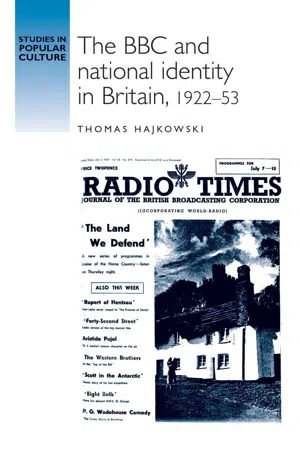
Examining the ways in which the BBC constructed and disseminated British national identity during the second quarter of the twentieth century, this book is the first study that focuses in a comprehensive way on how the BBC, through its radio programs, tried to represent what it meant to be British.
The BBC and national identity in Britain offers a revision of histories of regional broadcasting in Britain that interpret it as a form of cultural imperialism. The regional organization of the BBC, and the news and creative programming designed specifically for regional listeners, reinforced the cultural and historical distinctiveness of Scotland, Wales, and Northern Ireland. The BBC anticipated, and perhaps encouraged, the development of the hybrid "dual identities" characteristic of contemporary Britain.
This book will be of interest to scholars and students of nationalism and national identity, British imperialism, mass media and media history, and the "four nations" approach to British history.
- 252 pages
- English
- ePUB (mobile friendly)
- Available on iOS & Android
eBook - ePub
The BBC and national identity in Britain, 1922–53
About this book
Information
Publisher
Manchester University PressYear
2013Print ISBN
9781526118844
9780719079443
eBook ISBN
9781847797414
1
“Jolly proud you are a Britisher:” empire and identity, 1923–39
On the evening of December 13, 1939, Val Gielgud, Head of the BBC’s Features and Drama Department, listened to the final installment of the Drama Department’s serialized adaptation of A. E. W. Mason’s imperial adventure story The Four Feathers. The following day he wrote to the producer of the series, Peter Creswell, to congratulate him on its success. He noted to Creswell that the Director-General, F. W. Ogilvie, and the Home Service Board praised the program,1 concluding that “the romantic formula [was] considered acceptable even in wartime.”2 Creswell had earned the praise of Ogilvie and the rest of the Home Service Board, for his version of The Four Feathers proved to be a major undertaking. It starred accomplished radio actor Marius Goring as Harry Faversham and Clive Baxter, reprising his role from the Korda film version of The Four Feathers, as the young Harry. Serialized into eight installments, Creswell’s radio adaptation employed multiple studios and various effects including “recordings of special Arab noises and chatter and desert sounds” from the Korda production.3 The start of the Second World War and the evacuation of the Drama Department to Evesham disrupted the production of this ambitious series of programs.4 But, with the start of the war, the BBC hierarchy was less concerned with the move to Evesham than the tone and tenor of The Four Feathers. With Britain engaged in a major war for the second time in twenty-five years, the Home Service Board was concerned that the story of Harry Faversham’s redemption through imperial combat might strike listeners as inappropriate.
The broadcast of The Four Feathers reveals several aspects of the BBC’s relationship to empire and imperialism during the period from its inception in the early 1920s to the Second World War. It is but one example of how various BBC departments, especially Drama, Talks, and Features, extensively mined imperial history and literature for program material. The Four Feathers represented a fairly common type of BBC program, the dramatized life of the imperial hero. It was also one of a number of successful imperially themed films to be adapted to the radio. In addition to unashamedly representing Britain’s imperial past, the BBC became a consistent supporter of the empire during the interwar years. It presented the empire as an environment in which the best aspects of the British character and British institutions were at work; the empire, as reflected by the BBC, both constructed and reinforced British national identity. The BBC actively sought to explain and justify the empire to British listeners. And although the BBC did not suppress criticism of the empire, the dominant message was uncritical acceptance of imperialism as an integral part of British life.5
The BBC and the new imperial history
Chapters 1 and 2 together address contentious debates which have arisen from the “New Imperial History,” arguably the most important recent development in the field of British history. Proponents of the New Imperial History argue that the empire had a “constitutive” impact on domestic institutions and British culture. The origins of the New Imperial History can be traced back to two different sources. First there is the path-breaking work of John M. MacKenzie and the other contributors to his Studies in Imperialism Series.6 MacKenzie and his collaborators examine how a range of media, institutions, organizations, and cultural forms constructed and propagated an “imperial vision” in the late nineteenth and early twentieth centuries.7
In addition to MacKenzie, the genealogy of the New Imperial History goes back to Edward Said’s highly influential work Orientalism.8 According to Said, Europeans came to base their own sense of identity on hierarchical racial differences. Modern European identity was the product of the “othering” of colonized peoples and the establishment of binary oppositions between “West” and “East:” white/black, masculine/feminine, rational/irrational. Both Orientalism and Said’s later Culture and Imperialism9 have had a profound impact on one group of scholars associated with the New Imperial History. In addition to Said, these scholars take their influences from Marxism, feminism, and post-colonial theory. Much, but by no means all, of this scholarship focuses on the intersections of empire, gender, and sexuality.10 Although there are significant differences, in terms of theory and methodology, between what Catherine Hall calls the “Manchester School” (i.e. MacKenzie) and the more Saidean approaches, both represent a broad body of scholarship that acknowledges the deep and important impact of imperialism of British society, culture, and politics.11
Still, the New Imperial History hardly represents an historical orthodoxy or consensus. The extent to which Britain was “imbricated with the culture of empire”12 remains very much a contested issue. Bernard Porter, in his recent book The Absent-Minded Imperialists, argues that only when the scraps of empire are corralled and de-contextualized, or the definition of “imperial” stretched to include a broad range of phenomena, can one find much evidence of the empire in Britain’s domestic history.13 Porter and other scholars would argue that this is particularly true of working-class Britons.14 In his book, Jonathan Rose writes that “the majority of … youths were working-class, and they seem to have been strikingly unaware of their empire … even after a century of unrelenting indoctrination, most working people knew little of the empire and cared less.”15
This chapter, and the subsequent one, argue that the BBC committed itself to projecting the empire in a broad range of program types—talks, features, plays, outside broadcasts, variety, and music. Given the reach and potential influence of the BBC, this suggests that empire remained important to British national identity into the 1950s, even after the first wave of decolonization. Certainly, to borrow David Cannadine’s phrase, what the empire “looked like” changed significantly from 1922 to 1953, but it was almost always in the BBC’s schedules.16
The BBC produced and broadcast programs about empire for several different reasons. Some of the empire programming on the BBC was more propagandistic in purpose, produced specifically to try to change or reinforce public perceptions about the empire. Other programs were specifically educational because the professional elite that dominated the BBC despaired at the public’s lack of knowledge of the empire. This is suggestive; for while it confirms the commitment of the professional class to empire it also suggests that the majority of the country, the working classes, cared little for imperialism. But a considerable amount of empire material made it to the airwaves because it was popular and entertaining, and an integral part of Britain’s history and cultural heritage. Of course, the lines between an “organic” program produced largely to entertain or interest listeners, and propaganda or education, were not always so clear cut. Some audience research numbers seem to confirm the broad arguments of Porter and Rose; empire talks might entice only 3 to 5 per cent of the listening audience to tune in. But other imperially themed programs drew audiences of around 20 per cent of listeners. Rose makes a valid point when he notes that “too often, those who examine literature for evidence of imperialism, racism, or male supremacy assume that these values were unproblematically transmitted to its readers.”17 Yet Rose’s research is based on working-class autobiographies and memoirs—admittedly not a large or representative sample of working-class readers and listeners. BBC listener research allows us to consider the reaction of a much larger and more representative group to imperial culture. Presumably, if Britons knew little and cared little for their empire, broadcasts about empire would draw few listeners; but this was not always the case. While it may be true that by the middle of the twentieth century, few Britons knew the difference between a Dominion and a colony, millions still consumed empire as entertainment in the form of BBC programs. Of course, whether listeners tuned into the BBC’s empire broadcasts or not, empire was certainly “there,” on the air and in the pages of the Radio Times and any other newspaper that listed radio programs. Even the act of turning off a program on empire could serve as a subtle reminder of the imperial nature of British national identity.
Broadcasting the British empire(s)
How did the BBC validate empire to its domestic audience? How did it construct an empire suitable for a Britain recovering from the First World War and an unprecedented economic downturn? Despite several variables, such as program format, intent, audience, and the inclinations of the individual program producer, speaker, or performer, several important themes emerge. The empire was, above all, united and robust. The BBC asserted this despite, or rather because of, a number of developments in the 1920s and 1930s that suggested that the empire was drifting apart: nationalist agitation in India, Britain’s economic weakness, and the push by the white Dominions to assert their own political agendas and sense of national identity, culminating in the Statute of Westminster in 1931.
The BBC at times treated empire as a monolith—“The British Empire”—that included everything from the settler colonies to the recently acquired mandates in Africa and the Middle East. This was a powerful and comforting image of empire, because of the sheer size of the empire, and also because it suggested that only Britain could unite these disparate and dispersed territories. More often, however, the BBC represented the settler colonies quite differently from the rest of empire. It was the Dominions, and their aspirations for self-government, that caused considerable disquiet in imperial circles during the early decades of the twentieth century. But, the Dominions were “British,” enabling the BBC to produce reassuring narratives about kinship and brotherhood and the extension of British values and institutions, such as parliamentary democracy, around the world.
In contrast, the dominant discourse of the BBC’s programs about India and Africa remained, in various forms, the “civilizing mission.” The mission, as presented by the BBC, was more secular and less ...
Table of contents
- Cover Page
- Title Page
- Copyright Page
- Contents
- General editor’s foreword
- Acknowledgements
- Introduction
- 1 “Jolly proud you are a Britisher:” empire and identity, 1923–39
- 2 From the war to Westminster Abbey: the BBC and the empire, 1939–53
- 3 The BBC and the making of a multi-national monarchy
- 4 Rethinking regional broadcasting in Britain, 1922–53
- 5 Broadcasting a nation: the BBC and national identity in Scotland
- 6 BBC broadcasting in Wales, 1922–53
- 7 This Is Northern Ireland: regional broadcasting and identity in “Ulster”
- Conclusion
- Select bibliography
- Index
Trusted by 375,005 students
Access to over 1.5 million titles for a fair monthly price.
Study more efficiently using our study tools.
Frequently asked questions
Yes, you can cancel anytime from the Subscription tab in your account settings on the Perlego website. Your subscription will stay active until the end of your current billing period. Learn how to cancel your subscription
No, books cannot be downloaded as external files, such as PDFs, for use outside of Perlego. However, you can download books within the Perlego app for offline reading on mobile or tablet. Learn how to download books offline
We are an online textbook subscription service, where you can get access to an entire online library for less than the price of a single book per month. With over 1.5 million books across 990+ topics, we’ve got you covered! Learn about our mission
Look out for the read-aloud symbol on your next book to see if you can listen to it. The read-aloud tool reads text aloud for you, highlighting the text as it is being read. You can pause it, speed it up and slow it down. Learn more about Read Aloud
Yes! You can use the Perlego app on both iOS and Android devices to read anytime, anywhere — even offline. Perfect for commutes or when you’re on the go.
Please note we cannot support devices running on iOS 13 and Android 7 or earlier. Learn more about using the app
Please note we cannot support devices running on iOS 13 and Android 7 or earlier. Learn more about using the app
Yes, you can access The BBC and national identity in Britain, 1922–53 by Thomas Hajkowski in PDF and/or ePUB format, as well as other popular books in History & British History. We have over 1.5 million books available in our catalogue for you to explore.