- 292 pages
- English
- ePUB (mobile friendly)
- Available on iOS & Android
eBook - ePub
About this book
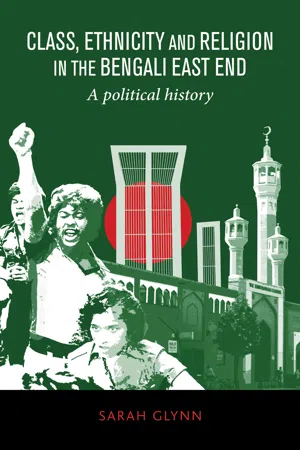
This exploration of one of the most concentrated immigrant communities in Britain combines a fascinating narrative history, an original theoretical analysis of the evolving relationship between progressive left politics and ethnic minorities, and an incisive critique of political multiculturalism. It recounts and analyses the experiences of many of those who took part in over six decades of political history that range over secular nationalism, trade unionism, black radicalism, mainstream local politics, Islamism and the rise and fall of the Respect Coalition. Through this Bengali case study and examples from wider immigrant politics, it traces the development and adoption of the concepts of popular frontism, revolutionary stages theory and identity politics. It demonstrates how these theories and tactics have cut across class-based organisation and acted as an impediment to addressing socio-economic inequality; and it argues for a left materialist alternative. It will appeal equally to sociologists, political activists and local historians.
Information
Publisher
Manchester University PressYear
2016Print ISBN
9781526107466
9780719095955
eBook ISBN
9781847799586
1 Sailors, students and settlers
This book tells a specifically political history, but this first chapter sets the scene with a very brief general history of the Bengali East End.
The East End of London
The East End of London is a place associated with strong but, in some ways, contradictory images; a place of cockney kinship and immigrant ghettos, at once English and ‘alien’. It is famous for battles with organised racism, but it is also portrayed as a ‘multicultural-receptor’ and symbol of English tolerance.1 And overriding all this has been the shared poverty of an area outwith the city walls. Before the recent period of surging land values and encroaching redevelopment, this was a place of almost unremittingly low wages and of making ends meet. It was a working-class area, with an admixture of small-scale, immigrant-run entrepreneurism, which was based around workshop trades (especially clothing) and, latterly, the ‘Indian’ restaurant industry. Poverty does not respect ethnic boundaries, but different groups tended to concentrate in different areas of work. In recent decades, beginning in the 1980s, the expansion of financial services and related businesses in the former dockland area of Canary Wharf and spilling out from the City of London has created pockets of great wealth. Parts of the old centres of immigration and working-class areas more generally are rapidly succumbing to the dual pressures of office expansion and gentrification. However, despite an influx of people on very high salaries, Tower Hamlets – the borough formed in 1965 through the amalgamation of the old boroughs of Stepney, Bethnal Green and Poplar – is still noted for having a high proportion of areas that are amongst the most deprived in England.2 Although it provides jobs to many people coming from outwith the borough, it still has exceptionally high levels of unemployment (13.4 per cent in the year to March 2013, when the British average was 7.8 per cent3). 43 per cent of all households rely on benefits, and this rises to 73 per cent for Bengali households, a figure matched only by the much smaller and more recently established Somali community.4The 2011 Census classed 35 per cent of homes as overcrowded, and overcrowding has always been especially severe among large Bengali households. Child poverty has reached 49 per cent, which is considerably worse than in any other UK local authority.5
The relative cheapness of the place, as well as the proximity of the City and of the old London Docks, made the East End a magnet for successive waves of immigrants – including internal migration from more rural parts of Britain. French Huguenots set up their silk looms in seventeenth-century Spitalfields; Irish Catholics worked in the docks loading and unloading the products of the British Empire; Jews escaping the poverty and pogroms of Eastern Europe arrived by boat from Hamburg and the Baltic ports to join an already established Jewish community; and Muslim Bengali seamen, or lascars, in the Empire’s merchant navy jumped ship and began chains of immigration that expanded with the new pressures and possibilities of the post-colonial world. There are groups of Chinese, Maltese, Cypriots and Africans, and more recent arrivals have included refugees from Somalia and migrant workers from the new EU member states of Eastern Europe, as well as the international business elite. Meanwhile, descendents of earlier immigrants have often moved on. By the time of the 2011 Census, only 31 per cent of respondents described themselves as White British6 – down from 43 per cent in 2001 – and 32 per cent described themselves as Bangladeshi, much the largest minority group.7 Many households are long-established, but there has also been a significant amount of movement in and out of the borough. The total population of Tower Hamlets in 2011 was measured as 254,000, up 26 per cent on the 2001 figure – a higher increase than in any other local authority.
Sylhet
The majority of the East End’s Bengali families emigrated from the Sylhet region, in the northeast of what is now Bangladesh. It is a distinctive area that speaks its own version of Bengali, which many claim as a separate language.8 Despite producing so many lascars, Sylhet is not on the coast; however there is a long tradition of Sylheti men working on merchant boats on the inland waterways, and once links had been made with British shipping companies in Calcutta (Kolkata), many of these men were prepared to put up with long waits and bribes to middlemen in order to secure a place on a British ship. In addition, the vagaries of the British land settlement system, whereby the Sylhet region contained a large number of small farmers owning their own land, meant that many Sylheti families had that little extra money needed to finance one of their sons to try his fortune at sea.9 The homes that the Bengalis left behind followed the traditional village pattern of the extended-family bari, with household units belonging to different brothers ranged around a street-like courtyard to create a private domestic world that was closed to male visitors.10 Patriarchal family ties were of overriding importance and continued to exert their influence in Britain. This is still the standard form of Sylheti village homestead, though village life has become less isolated and traditional with the spread of roads and electricity and modern forms of communication.
Many Londoni families – those with members living in Britain – have used their new wealth to build more modern houses, though these may be as much for show as for practical use. Most British Bengali families still have close relations in Bangladesh, and often also land and houses or other investments. The regional capital, despite its important shrine to a fourteenth-century Muslim saint, was, until recently, a place with few urban pretensions. It has now grown to around half a million inhabitants, and expatriate money has helped to generate a boom in development, with a mushrooming of shopping malls and western-style apartment buildings.11 In the streets of Sylhet town, the local Sylheti language is intermingled with the voices of visiting Londonis speaking English in a variety of British regional accents.
Bengali immigration
The East End Bengali community traces its origins to the first lascars. Lascars from the Indian subcontinent have played an important part in the British merchant navy since the seventeenth century. By 1938 they made up more than a quarter of British maritime labour, often working in the uncomfortable heat of ships’ boiler rooms, and an estimated 6,600 lost their lives on British ships in the Second World War.12 It was always a hard and disadvantaged life. Accounts from the eighteenth and nineteenth centuries record death and disease at sea and destitution in British ports. An Act of Parliament in 1823 laid down different rules for lascars and British sailors. Indian sailors on lascar articles (or contracts) were paid less, fed less and given less space, and they had to be discharged back in an Indian port. These rules were not completely repealed until 1983.13 Many lascars jumped ship to try their luck in other work in Britain, often planning to sign on to another ship on the much more generous British articles. The British government and shipping companies worked together setting up regulations and controls to discourage this, especially during periods of economic depression. Lascar numbers grew during the First World War – and some were deliberately enticed from their ships by British industries – but the post-war recession and severe jobs crisis resulted in ‘race riots’ in British ports, demands from the seamen’s union for priority to be given to white British sailors, and attempts at repatriation. People of Britian’s Indian Empire were legally British citizens, entitled to live and work in Britain, but a 1925 Act of Parliament, ostensibly directed at ‘coloured alien seamen’, was used to force repatriation of some Indian seamen who did not possess officially accepted proof of British citizenship. The proportion of the lascars who jumped ship was never large, but a continuous flow did manage to get away, and this was the only method that those without much money could come to Britain and seek their fortune. Once they had got away from the ship, they had to lie low until their articles expired and the shipping company could no longer claim them as a ‘deserter’, for which they risked punishment by imprisonment. When, in 1947, the Partition of India and Pakistan cut Sylhetis off from access to Calcutta, the leader of the Indian Seamen’s Union, Aftab Ali, actually advised Bengali seamen to leave their ships at British ports.14 Caroline Adams collected oral histories from several of the Bengali immigrant pioneers, many of which read like adventure stories, and the spirit of adventure must have been an important spur to their actions.15 But they were also leaving tough peasant life in a poorly developed country for a land of opportunity, to try and achieve financial security, status and greater material comfort for themselves and, most importantly, for their families.
Those first Bengali sailors spearheaded a major immigration, but they themselves were relatively few. At the outbreak of the Second World War, it has been estimated that those in the East End numbered between a hundred and fifty and two hundred,16 and by the time of the 1951 Census ‘Pakistanis’ in the East End boroughs were still measured in hundreds. In 1948, the year after Pakistani Independence, the British Nationality Act confirmed that all subjects of the British Crown – that is everyone in the colonies and the Commonwealth – had the right to come and live in Britain. However, there were soon restrictions from the Pakistan Government, which refused to allow emigration from the Eastern, Bengali, half of the country. More significant immigration from what was then East Pakistan can be dated from 1956, when the Pakistan government was finally persuaded to grant one thousand passports to ex-seamen and their survivors or dependants. Further negotiations removed the remaining restrictions, and by 1962 some five thousand men had come to live in East London, close to the first Sylheti links in the docks.17 Many more went to the North and the Midlands, where they took jobs in factories making textiles, steel, heavy engineering and cars. Often the search for work took them from town to town and job histories were interspersed with periods of unemployment. In each place the men went they would make contact with other Bengali immigrants.18
The Bengalis in the East End also interacted with a small group of better-educated fellow countrymen who had come to London to continue their education or take up professional employment. This small Bengali elite were able to help the Bengali workers and played a disproportionate role in the early years of this political history. Some of the students lived or worked alongside East-End Bengalis, as the growing number of Bengali-run restaurants provided them with a source of cheap accommodation and supplementary income.19
Most of the first generation of post-war immigrants – and this is especially true of the Sylhetis – were younger men who did not intend to stay on in Britain, but planned to return to their families, and to their native land, once they had earned a reasonable sum of money. While many may have found white girlfriends, and on occasion married them, most Bengalis chose to find a wife through an arranged marriage in Sylhet. Their, generally teenage, brides hardly got a chance to get to know their husbands before being left to live alone with their new in-laws, waiting for an occasional visit. The men worked hard and saved hard, and almost everything they saved they sent back to their extended families in Sylhet, where it was used to buy land and improve houses. But they had not earned the fortunes they had dreamed of, and their families had come to rely on their continued work in Britain. Meanwhile, immigration laws were noticeably constricting, pushing many immigrants to decide to bring their wives and children over to Britain before it was too late. Even after they had been joined by their immediate family, many men continued to remit money to the joint family bari in Sylhet.20
Immigration legislation and the growth of the community
Just as Britain confirmed that its doors were open to the subjects of its former Empire, their closure was already the subject of debate, both inside and outside government. In an echo of debates over Jewish immigration half a century earlier, the 1950s saw a return to the twin concerns of immigration control and immigrant integration; and the long-standing problems of poor areas such as the East End became associated, in the minds of those who opposed immigration, with those new immigrants who were forced to live in them. In 1962, Britain’s growing anti-immigration movement was rewarded ...
Table of contents
- Cover
- Half Title Page
- Title Page
- Copyright Page
- Contents
- List of figures
- Preface and acknowledgements
- Introduction
- 1 Sailors, students and settlers
- 2 Desher Dak – ‘The Call of the Homeland’
- 3 Joi Bangla! – 1971
- 4 British Bangladeshis
- 5 Socialism on stony ground
- 6 Black radicalism and separate organisation
- 7 Bengalis in the council chamber
- 8 Mobilisation through Islam
- 9 The Respect experiment
- 10 Diverging paths
- Bibliography
- Index
Trusted by 375,005 students
Access to over 1.5 million titles for a fair monthly price.
Study more efficiently using our study tools.
Frequently asked questions
Yes, you can cancel anytime from the Subscription tab in your account settings on the Perlego website. Your subscription will stay active until the end of your current billing period. Learn how to cancel your subscription
No, books cannot be downloaded as external files, such as PDFs, for use outside of Perlego. However, you can download books within the Perlego app for offline reading on mobile or tablet. Learn how to download books offline
Perlego offers two plans: Essential and Complete
- Essential is ideal for learners and professionals who enjoy exploring a wide range of subjects. Access the Essential Library with 800,000+ trusted titles and best-sellers across business, personal growth, and the humanities. Includes unlimited reading time and Standard Read Aloud voice.
- Complete: Perfect for advanced learners and researchers needing full, unrestricted access. Unlock 1.5M+ books across hundreds of subjects, including academic and specialized titles. The Complete Plan also includes advanced features like Premium Read Aloud and Research Assistant.
We are an online textbook subscription service, where you can get access to an entire online library for less than the price of a single book per month. With over 1.5 million books across 990+ topics, we’ve got you covered! Learn about our mission
Look out for the read-aloud symbol on your next book to see if you can listen to it. The read-aloud tool reads text aloud for you, highlighting the text as it is being read. You can pause it, speed it up and slow it down. Learn more about Read Aloud
Yes! You can use the Perlego app on both iOS and Android devices to read anytime, anywhere — even offline. Perfect for commutes or when you’re on the go.
Please note we cannot support devices running on iOS 13 and Android 7 or earlier. Learn more about using the app
Please note we cannot support devices running on iOS 13 and Android 7 or earlier. Learn more about using the app
Yes, you can access Class, ethnicity and religion in the Bengali East End by Sarah Glynn in PDF and/or ePUB format, as well as other popular books in Social Sciences & Globalisation. We have over 1.5 million books available in our catalogue for you to explore.