Supernatural elements are of central significance in many of Shakespeare's plays, contributing to their dramatic power and intrigue. Ghosts haunt political spaces and internal psyches, witches foresee the future and disturb the present, fairies meddle with love and a magus conjures a tempest from the elements. Although written and performed for early modern audiences, for whom the supernatural, whether sacred, demonic or folkloric, was part of the fabric of everyday life, the supernatural in Shakespeare continues to enthrall audiences and readers, and maintains its power to raise a range of questions in contemporary contexts.
This edited collection of twelve essays from an international range of contemporary Shakespeare scholars explores the supernatural in Shakespeare from a variety of perspectives and approaches, generating new knowledge and presenting hitherto unexplored avenues of enquiry across the Shakespearean canon.
eBook - ePub
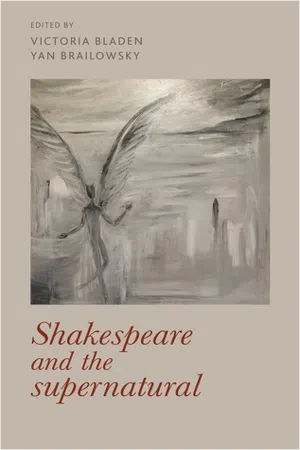
Shakespeare and the supernatural
- 284 pages
- English
- ePUB (mobile friendly)
- Available on iOS & Android
eBook - ePub
Shakespeare and the supernatural
About this book
Information
Publisher
Manchester University PressYear
2020Print ISBN
9781526109088
9781526109064
eBook ISBN
9781526109132
Magic, music and gender
9
Music and magic in The Tempest: Ariel's alchemical songs
It has often been stressed that The Tempest is Shakespeare's most musical play:1 the island's soundscape is uniquely rich and varied, its ‘noises,/Sounds, and sweet airs’ (3.2.127–8) enhance its supernatural atmosphere and Prospero's magic power is wielded largely through the music of Ariel and his fellow spirits. Unsurprisingly, music is one of the aspects of the play that has received the most critical attention, the perfect integration of this ‘dangerously refractory material’2 in the drama being regularly praised.3
Critics have long recognised that the play contains alchemical patterns and symbols. In the late eighteenth century, Thomas Warton recorded the affinity between Prospero and a ‘chemical necromancer’ from an Italian romance.4 And yet it was only in the late twentieth century that the groundbreaking work of Michael Srigley5 and Peggy N. Simonds6 revealed the extent to which the play is steeped in alchemical lore.7 To the best of my knowledge, however, the analysis of Ariel's songs from an alchemical perspective has never been undertaken. This is what I propose to develop in this chapter.
Ariel–Mercurius
As well as his mythological, folkloric, biblical and occult – and particularly cabalistic – associations, Ariel, the agent of Prospero's musical magic, has been correctly identified as the alchemical Mercurius.8 Shakespeare's ‘airy spirit’ perfectly matches the description of Mercurius as ‘an aerial spirit or soul… present everywhere and at all times during the alchemical opus’.9 This ‘protean, elusive’ spirit is ‘ambivalent, both destructive and creative’; he is ‘the ultimate solvent’, ‘the grand master of the reiterated cycle of solve et coagula (dissolve and coagulate) which constitutes the alchemical work of purification’.10 This is an apt delineation of Prospero's ethereal, dainty and at times mischievous attendant spirit, the swift shapeshifter he calls upon to control the actions of most of the characters on the island in order to enlighten them. Moreover, the representation of Mercurius as the rebis or hermaphrodite, ‘the perfect integration of male and female energies’,11 parallels Ariel's androgynous role in the play.12
The alchemical quest for gold effected through the agency of Mercurius can be construed as a purely material one (chrysopoeia) and it is the alchemists so inclined, often nicknamed ‘puffers’, who are the butt of Ben Jonson's satire in the play The Alchemist (1610) and the masque Mercury Vindicated from the Alchemists at Court (1616).13 However, for Renaissance practitioners of iatrochemistry such as Paracelsus, the philosopher's stone designated the panacea or all-healing elixir of life, and was another name for physical and spiritual purification.14 As will become clearer in the course of this chapter, it is spiritual alchemy that Shakespeare is chiefly concerned with in The Tempest.
The alchemist's great work or magnum opus, the chemical wedding of sulphur and mercury, fixed and volatile, male and female, red king and white queen, sun and moon, Sol and Luna, creative will and wisdom,15 could not take place without the intervention of Mercurius. He was present at the three main stages of the opus: the nigredo or black stage – putrefaction, the albedo or white stage – purification, connected with ‘the dawning of consciousness’,16 and the rubedo or red stage – reunification, associated with Sol, the sun.17 The rubedo marked the attainment of the philosopher's stone, a red powder or tincture that transmutes base metals into gold.
In the play, the black stage is exemplified among other episodes by ‘the psychological death’ of the Three Men of Sin18 whom Ariel apostrophises in his role as harpy or ‘minister of Fate’ (3.3.53–82).19 The white stage occurs when Prospero, having called for ‘[a] solemn air’, describes the gradual effect of the musical cure he has devised for the sinners:
The charm dissolves apace,
And as the morning steals upon the night,
Melting the darkness, so their rising senses
Begin to chase the ignorant fumes that mantle
Their clearer reason. (5.1.64–8)20
After having charmed or led the castaways astray to the sound of his voice and his instruments, Ariel contrives to assemble all the characters before Prospero's cell, a metaphor for the alchemical vessel: everything is ready for the red stage or final reconciliation to take place. Nevertheless, since Antonio and Sebastian remain unregenerate, the great work is only partly achieved at the end of the play. It is no accident that these two figures should prove immune to the allurements of music: ‘[t]he man that hath no music in himself,/Nor is not mov'd with concord of sweet sounds,/Is fit for treasons, stratagems and spoils’.21
That music accompanies each stage of Prospero's magnum opus is especially relevant considering the importance of this discipline in the alchemical tradition. Alchemy was often called ‘the musical art’ because,22 like music, it is governed by number.23 Alchemists found in music the harmonious universe they sought to recreate by means of the philosopher's stone.24
Ariel–Mercurius as chemical mediator is ‘the ‘spirit’ which joins ‘soul’ and ‘body’, ‘form and matter’.25 This aspect of his role calls to mind Marsilio Ficino's spiritus, the spirit or thin, clear vapour that mediates between corpus and anima and whose nature is akin to that of musical sound.26 For Ficino, ‘music has a stronger effect than anything transmitted through the other senses, because its medium, air, is of the same kind as the spirit’.27 Ariel's name, which suggests both air, the element, and musical melody – specifically the ayre28 – could not have been more apt from a Ficinian perspective.
Ficino used music to ‘attract the spiritual influence of a particular planet’ on the performers and listeners.29 He was accustomed to singing Orphic hymns ‘most often addressed to the sun’ while accompanying himself on what was probably a lira da braccio.30 Ariel–Orpheus and his cohort of spirits perform both instrumental and vocal music intended to control the castaways’ behaviour. It can send them to sleep or wa...
Table of contents
- Cover
- Half-title page
- Title page
- Copyright page
- Dedication
- Contents
- Figures
- Notes on contributors
- Acknowledgements
- Introduction: Shakespeare and the supernatural
- I Embodying the supernatural
- II Haunted spaces
- III Supernatural utterance and haunted texts
- IV Magic, music and gender
- V Contemporary transformations
- Index
Trusted by 375,005 students
Access to over 1.5 million titles for a fair monthly price.
Study more efficiently using our study tools.
Frequently asked questions
Yes, you can cancel anytime from the Subscription tab in your account settings on the Perlego website. Your subscription will stay active until the end of your current billing period. Learn how to cancel your subscription
No, books cannot be downloaded as external files, such as PDFs, for use outside of Perlego. However, you can download books within the Perlego app for offline reading on mobile or tablet. Learn how to download books offline
Perlego offers two plans: Essential and Complete
- Essential is ideal for learners and professionals who enjoy exploring a wide range of subjects. Access the Essential Library with 800,000+ trusted titles and best-sellers across business, personal growth, and the humanities. Includes unlimited reading time and Standard Read Aloud voice.
- Complete: Perfect for advanced learners and researchers needing full, unrestricted access. Unlock 1.5M+ books across hundreds of subjects, including academic and specialized titles. The Complete Plan also includes advanced features like Premium Read Aloud and Research Assistant.
We are an online textbook subscription service, where you can get access to an entire online library for less than the price of a single book per month. With over 1.5 million books across 990+ topics, we’ve got you covered! Learn about our mission
Look out for the read-aloud symbol on your next book to see if you can listen to it. The read-aloud tool reads text aloud for you, highlighting the text as it is being read. You can pause it, speed it up and slow it down. Learn more about Read Aloud
Yes! You can use the Perlego app on both iOS and Android devices to read anytime, anywhere — even offline. Perfect for commutes or when you’re on the go.
Please note we cannot support devices running on iOS 13 and Android 7 or earlier. Learn more about using the app
Please note we cannot support devices running on iOS 13 and Android 7 or earlier. Learn more about using the app
Yes, you can access Shakespeare and the supernatural by Victoria Bladen,Yan Brailowsky, Victoria Bladen, Yan Brailowsky in PDF and/or ePUB format, as well as other popular books in Literature & Literary Criticism in Drama. We have over 1.5 million books available in our catalogue for you to explore.