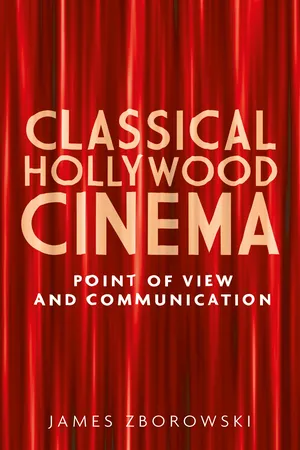
This book offers a new approach to filmic point of view by combining close analyses informed by the tools of narratology and philosophy with concepts derived from communication studies.
Each chapter stages a conversation between two masterpieces of classical Hollywood cinema and one critical concept that can enrich our understanding of them: Vertigo (Alfred Hitchcock, 1958) and Mr. Deeds Goes to Town (Frank Capra, 1936) are interpreted in relation to point of view; Anatomy of a Murder (Otto Preminger, 1959) and The Man Who Shot Liberty Valance (John Ford, 1962) are considered with reference to the concept of distance; and Letter from an Unknown Woman (Max Ophuls, 1948) and Only Angels Have Wings (Howard Hawks, 1939) are explored through the lens of communication. Each encounter reveals new, exciting and mutually illuminating ways of appreciating not only these case studies, but also the critical concepts at stake.
- 137 pages
- English
- ePUB (mobile friendly)
- Available on iOS & Android
eBook - ePub
About this book
Information
Subtopic
English Literary Criticism1
Point of view, consciousness and interaction
The study of point of view in fiction is the study of the endless possibilities of the relationship between a fiction’s story-world, including the entities within that world, and the way that story-world is presented to (in fact, and at the same time, created for) the reader or viewer. This broad definition allows us to see that accounts of point of view concern themselves with issues beyond those to do with fictional characters but also helps to explain why characters, as among the most important elements of a fictional story-world, are almost always afforded a very important place within such accounts. There is no sustained discussion of literary or filmic point of view that does not refer extensively to characters.
Unfortunately, as this chapter seeks to demonstrate, prevailing models of filmic point of view do not place us in the best position to describe and explain the representation of characters’ experiences in narrative fiction films. In what follows, I explore first the representation of character consciousness, and then the representation of character interaction, in an attempt to highlight what I take to be the key problems within existing theoretical accounts of filmic point of view with respect to these areas of concern, and in order to propose an alternative way of seeing and proceeding. My principal method is to interrogate the terms and (therefore) the underlying assumptions that are available in our attempts to account, in our acts of theory and criticism, for the representation of these dimensions of character experience, and to test these terms and assumptions against the experiences offered by narrative fiction films (and my case study films in particular).
Representing character consciousness in novels and films
The ability of prose narration to represent human consciousness is one important topic within studies of literary point of view. So successful and subtle are novelistic representations of human consciousness that critics and theorists who compare novels and films often find the latter markedly inferior in this regard. George Bluestone, in his book Novels into Film (1966), suggests that ‘The rendition of mental states – memory, dream, imagination – cannot be as adequately represented by film as by language. If the film has difficulty presenting streams of consciousness, it has even more difficulty presenting states of mind which are defined precisely by the absence of them in the visible world.’1 In his book Coming to Terms: The Rhetoric of Narrative in Fiction and Film (1990) Seymour Chatman cites (and does not fundamentally challenge) the above passage, after having claimed in his introduction that ‘the greater facility of literary narrative [than filmic] for rendering the mental life of characters’ is one example of ‘issues that seems reasonably settled’ and can therefore be ‘skip[ped] over’.2 In a chapter from his book Consciousness and the Novel (2002) entitled ‘Henry James and the movies’, David Lodge (who, it is worth noting, has adapted literary texts, including one of his own novels for television) echoes Bluestone:
Consciousness was [Henry James’s] subject … how the minds of sensitive, intelligent individuals are forever analysing, interpreting, anticipating, suspecting, and questioning their own motives and those of others. And consciousness of this kind, which is self-consciousness, is precisely what film as a medium finds most difficult to represent, because it is not visible. If you make the characters put their thoughts into speech, you destroy the essential feature of consciousness in James’s world-picture – its private, secret nature; if you have the characters articulate their thoughts in voice-over monologue, you go against the grain of the medium and produce an artificial, intrusive effect. Facial expression, body language, visual imagery, and music can all be powerfully expressive, but they lack precision and discrimination. They deal in broad basic emotions: fear, desire, joy. James’s fiction, by contrast, is full of the finest, subtlest psychological discriminations.3
In this chapter I seek an enlarged understanding of how films represent characters as thinking and feeling beings-in-the-world, which I hope will make the medium seem less impoverished in this respect than Bluestone, Chatman, Lodge and many others claim. Before proceeding further, I think it is worth stating that I will not attempt to address the question of how far a character can become a filmic narrator. Humans are prodigious producers of words and tellers of stories, so it is not difficult for us to imagine a fictional character to be the (fictional) source of prose narration; conversely, to entertain the notion that a character is responsible for producing filmic images is much more difficult. I believe therefore that to propose or seek out a homodiegetic filmic narrator (to use Gérard Genette’s term)4 is an uphill struggle that will end in failure. I will not attempt to argue the case any further here;5 I will simply declare that my attention and efforts lie elsewhere.
Henry James (to continue a moment longer with Lodge’s example) used characters not as narrators but as ‘filters’ (to use Chatman’s term)6 or as loci of ‘focalisation’ (to use Genette’s).7 To employ Genette’s distinctions: we ‘see’ through the ‘eyes’ of a particular character, but that character is not the one who ‘speaks’.8 When the method of ‘the Master’ (as Henry James has been labelled) is described this way, one’s mind may already be turning to another medium, film and another ‘master’, Alfred Hitchcock – perhaps especially his Vertigo, a film whose protagonist John ‘Scottie’ Ferguson/James Stewart spends a lot of screen time silently watching another person – seeing without speaking, we might say. In James’s novels and in Hitchcock’s films, we are not given access to the story-world by any narrating activity by the protagonist, yet the presentation of the story-world exhibits elements that we understand to relate to that character’s consciousness and experience.
Take, for example, the famous restaurant scene near the beginning of Vertigo. Scottie, a retired police detective, has been persuaded to shadow the wife of an old college acquaintance (Gavin Elster/Tom Helmore) to get to the root of the strange behaviour he claims she has been exhibiting. Scottie agrees to go to Ernie’s restaurant so that he can see Madeleine there (dining with her husband) without himself being seen. The scene begins with a shot of Scottie in medium close-up at the bar, looking over his shoulder. ‘The obvious way to develop this would be to satisfy our curiosity by cutting at once to [Scottie’s] point of view, and an image of Madeleine’, suggests Charles Barr.9 What in fact follows, as Robin Wood notes, ‘is not (cannot possibly be) a point-of-view shot, yet it has the effect of linking us intimately to the movement of Scottie’s consciousness’.10 The camera does not cut, but pans left, allowing the viewer to take in the opulent dining area, then slowly tracks forward. In the background of the frame we see Elster sitting at a table with a woman (Kim Novak) whose back is to the camera, and who must be Madeleine. Neil Potts elaborates upon Wood’s assertion that this first shot of the scene connects the viewer to the movement of Scottie’s consciousness, and suggests that the camera ‘strikes a fine balance between declaring fascination and practising caution’.11 Barr’s hypothetical option of cutting immediately to an optical POV shot would, in comparison to this, feel brash, and would not achieve the effects Potts describes: ‘The shot’s perceptible “jostling”, its slow pacing and its resting at some distance from Madeleine all express the nervously attentive, surreptitious vigil maintained by Scottie.’12
Even this brief sketch of a single shot from a single film begins to suggest that the medium’s ability to represent consciousness might not be quite so dire as Lodge suggests. And the descriptions above focus on only one element of the scene, albeit a vital element of film art (and one which, significantly, does not appear in Lodge’s brief list of film’s ‘powerfully expressive’ features): camera movement. The other element of this particular scene that probably commands, and has indeed received, most attention is Herrmann’s score. In the restaurant scene, as in much of the rest of the film, the music communicates desire, but it does so in such a way that it communicates more than just a ‘broad basic emotion’. The pull between fascination and caution that Potts sees expressed in the scene’s camera movements is also suggested by David Cooper in his analysis of the film’s score, which he notes ‘avoid[s] the resolution of [dissonant melodic notes] on strong beats and [shuns] obvious and predictable harmonic progressions’.13 Describing Herrmann’s ‘convoluted route’ to resolution, Cooper adds that ‘the expected fulfilment is initially frustrated, but the gratification engendered at the point of final resolution is greater than it would have been had the dissonance been resolved immediately’.14
One could continue indefinitely in this vein: letting novels and their critics and theorists set the standards and terms of debate, and seeing how far film might measure up. However, I will now turn to the larger task of arguing that if we are going to do justice to the possibilities and the achievements of film, then the terms of debate need to be broadened significantly.
What is called thinking?15
In fact, the problem is larger still. Although literary criticism is an important site for the discussion of consciousness, inner lives, introspection, mental states, and so on, such language hardly belongs to literary criticism exclusively. The phenomena these terms point towards are key ingredients of modern identity. ‘Our modern notion of the self is related to, one might say constituted by, a certain sense … of inwardness.’16 So begins the long section on ‘Inwardness’ in Charles Taylor’s Sources of the Self: The Making of Modern Identity (1989). Taylor outlines the historical formation (via figures including Plato, Augustine, René Descartes and John Locke) of the widely held contemporary sense of identity as a thing possessing a crucial ‘inner’ and private dimension. This model of identity and subjectivity, which distinguishes between an inner realm of thought and feeling and an outer realm of things, and which in philosophy tends to go by the name of ‘dualism’ – or ‘Cartesian dualism’, when it is traced back to Descartes – is so pervasive that it seems redundant to offer general examples of it (though I will in the next section offer examples of the model at work within film studies). It is, Taylor correctly observes, ‘a mode of thought we easily fall into. The onus of argument, the effort, falls to those who want to overcome dualism.’17
An even remotely thorough account of the key figures who have sought to overcome dualism is not on the cards here. Even if I were in a position to provide it (which I am not), the main business of this chapter is to suggest how approaches to filmic characters and point of view that harbour dualistic assumptions have led us astray or not put us in the best position to articulate some of film’s properties, possibilities and achievements, and how an alternative approach might do better. That said, it does seem appropriate to introduce, or rehearse, a few key tenets and proponents of anti-dualist thinking, and in so doing disclose some of the key sources that have informed my own thinking.
Lee Braver observes that ‘digging up Descartes in order to kill him off yet again has been a rather popular pastime among philosophers for some time now’,18 but from the ranks of such philosophers he presents Martin Heidegger and Ludwig Wittgenstein for special attention.19
Heidegger’s existential phenomenology wants to draw attention to the fundamentality of humans’ ‘being-in-the-world’20 with others. That is to say, according to Heidegger, the place we begin, and the place philosophy should likewise begin, is not with an individual perceiving subject, which through coming to know and understand itself can then un...
Table of contents
- Cover
- Half Title
- Title Page
- Copyright
- Contents
- Preface
- Acknowledgements
- Introduction: point of view and communication
- 1 Point of view, consciousness and interaction
- 2 Distance, representation and criticism
- 3 Communication, love and death
- Conclusion: categories and conversations
- Postscript: education, communication and film studies
- Select bibliography
- Index
Trusted by 375,005 students
Access to over 1.5 million titles for a fair monthly price.
Study more efficiently using our study tools.
Frequently asked questions
Yes, you can cancel anytime from the Subscription tab in your account settings on the Perlego website. Your subscription will stay active until the end of your current billing period. Learn how to cancel your subscription
No, books cannot be downloaded as external files, such as PDFs, for use outside of Perlego. However, you can download books within the Perlego app for offline reading on mobile or tablet. Learn how to download books offline
We are an online textbook subscription service, where you can get access to an entire online library for less than the price of a single book per month. With over 1.5 million books across 990+ topics, we’ve got you covered! Learn about our mission
Look out for the read-aloud symbol on your next book to see if you can listen to it. The read-aloud tool reads text aloud for you, highlighting the text as it is being read. You can pause it, speed it up and slow it down. Learn more about Read Aloud
Yes! You can use the Perlego app on both iOS and Android devices to read anytime, anywhere — even offline. Perfect for commutes or when you’re on the go.
Please note we cannot support devices running on iOS 13 and Android 7 or earlier. Learn more about using the app
Please note we cannot support devices running on iOS 13 and Android 7 or earlier. Learn more about using the app
Yes, you can access Classical Hollywood cinema by James Zborowski in PDF and/or ePUB format, as well as other popular books in Media & Performing Arts & English Literary Criticism. We have over 1.5 million books available in our catalogue for you to explore.